

What are adult motor skills and why do they matter?
Adult motor skills are the physical abilities that allow you to move, interact with objects, and carry out daily tasks. They divide into two main categories: gross motor skills, which use large muscle groups for activities like walking and balance, and fine motor skills, which rely on smaller muscles in the hands and fingers for precision tasks like writing or fastening buttons.
These skills matter for several practical reasons:
- They support daily independence, from getting dressed to preparing meals.
- Good balance and coordination reduce the risk of falls, particularly as you age.
- Maintaining dexterity protects your ability to carry out care tasks for children or older relatives.
- Motor competence is linked to better cognitive function and psychological well-being, not just physical fitness.
- Decline in these skills can affect confidence and willingness to stay active.
For parents and caregivers, understanding your own motor abilities is just as useful as understanding those of the children in your care.
Table of Contents
- Gross and fine motor skills: what sets them apart?
- Why improving your motor skills benefits both body and mind
- Proven methods for improving adult motor skills
- Nature-inspired activities that support motor skill development for caregivers
- How do you assess adult motor skill proficiency?
- How motor skill decline affects daily life and independence
- Nutrition and lifestyle factors that support motor skills
- Strategies to prevent motor skill deterioration
- Key takeaways
Gross and fine motor skills: what sets them apart?
Both types of motor skill are present throughout adult life, but they age differently and require different kinds of maintenance.
Gross motor skills involve large muscle groups and whole-body movements:
- Walking, running, and climbing stairs
- Maintaining balance while standing or moving on uneven ground
- Jumping, lifting, and carrying
Research tracking neuromotor functions from age 6 to 80 found that balance and gross motor functions begin declining from the early twenties, with the steepest drops in older adulthood. High body mass index compounds this, negatively affecting balance in particular.
Fine motor skills involve the hands, fingers, and wrists:
- Writing, typing, and drawing
- Handling small objects, tools, or fastenings
- Precision tasks in caregiving, such as administering medication or adjusting equipment
Fine motor performance peaks between 25 and 35 years of age, then declines more slowly than gross motor ability. Daily hand use appears to preserve these skills longer. The principle is straightforward: fine motor skills deteriorate without regular practice, while gross motor habits tend to remain more stable until later in life.
Why improving your motor skills benefits both body and mind
Motor skill development is not only about physical performance. The benefits extend into cognitive and psychological health in ways that are directly relevant to caregivers.
Research finding: Higher motor competence in adults is strongly linked to better cognitive function and reduced anxiety and depression, contributing positively to perceived health and daily functioning.
Specific benefits include:
- Fall prevention. Stronger balance and coordination reduce injury risk at home and outdoors.
- Mental health. Regular motor training is associated with lower levels of anxiety and depression.
- Independence. Adults who maintain motor competence are better able to manage daily tasks without assistance.
- Cognitive sharpness. Motor learning involves neural adaptation, which supports brain health alongside physical fitness.
- Caregiver capacity. Good dexterity and coordination make physical caregiving tasks safer and less tiring.
Treating motor skill maintenance as part of your overall health routine, rather than something separate from it, gives you a practical framework that covers both body and mind.
Proven methods for improving adult motor skills
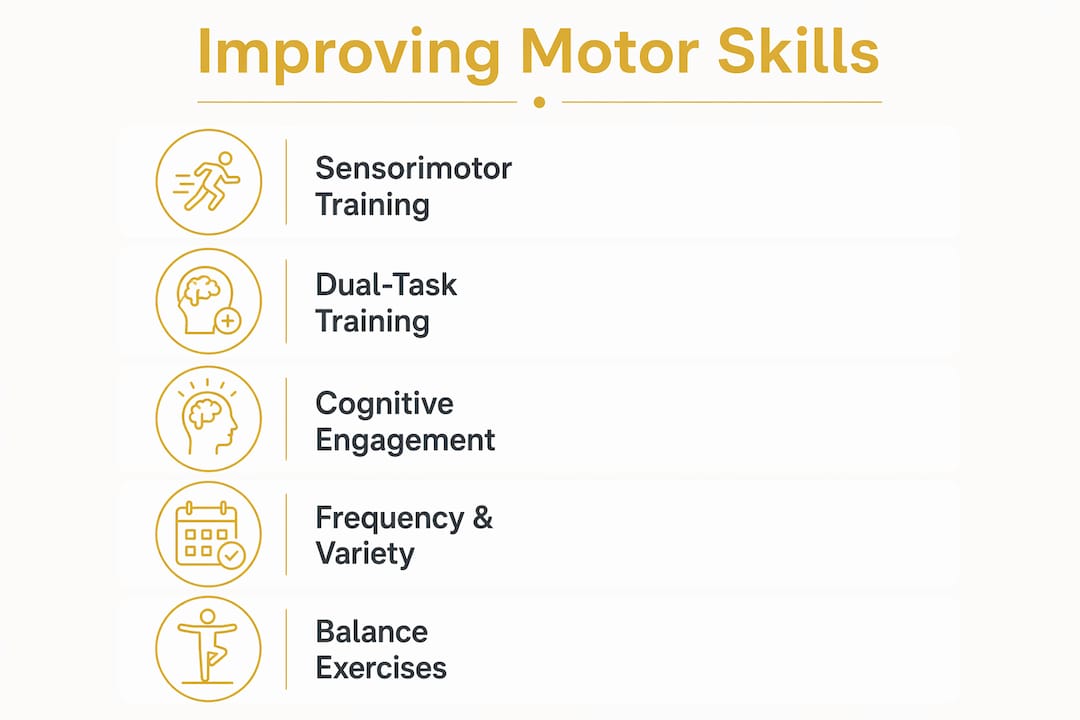
Effective motor skill training combines frequency, variety, and cognitive engagement. Here is what the evidence supports.
Sensorimotor training (SMT) targets the neural and sensory pathways that control balance and coordination. Unlike standard strength training, SMT directly engages proprioceptive and neuromuscular systems, making it particularly useful for adults experiencing age-related sensory decline or conditions such as peripheral neuropathy. A structured SMT programme typically includes balance challenges, proprioception drills, and coordination exercises progressed over several weeks.

Complex motor patterns outperform simple repetitive exercises. Activities like martial arts drills, kettlebell flows, or dance sequences require variable, coordinated movements that build dynamic control and adaptability. These are more transferable to real-life demands than isolated gym exercises.
Training frequency and measurement:
- Aim to practice regularly, with several sessions each week including multiple repetitions of each exercise.
- Measure progress by task completion speed, not just whether you can perform a movement. Faster shoelace tying or quicker object manipulation indicates genuine functional gain.
- Structured balance programmes recommend practising each exercise multiple times per session to build joint stability and reduce fall risk.
Dual-task training combines a physical movement with a cognitive challenge, such as walking while counting backwards or sorting objects while standing on one leg. This mirrors real-life demands and accelerates motor learning more effectively than physical practice alone.
Pro Tip: Add a simple cognitive task to your balance exercises. Try standing on one foot while reciting the alphabet or naming items in a category. This dual-task approach strengthens the brain-muscle connection that everyday movement actually requires.
Nature-inspired activities that support motor skill development for caregivers
Outdoor and nature-based activities offer a practical way to work on your own motor skills while engaging children at the same time. Thezoofamily’s approach to educational play is built around exactly this kind of shared, purposeful activity.
Useful options for caregivers include:
- Birdwatching with binoculars. Tracking moving birds trains hand-eye coordination and fine motor control as you adjust focus and aim. Thezoofamily’s nature-inspired binoculars are designed for this kind of active outdoor use.
- Nature photography. Handling a camera, framing a shot, and pressing the shutter at the right moment all require fine motor precision and visual coordination.
- Outdoor obstacle courses. Walking across uneven ground, stepping over logs, or balancing on rocks directly trains gross motor skills and proprioception.
- Gardening and foraging. Picking, sorting, and planting engage fine motor dexterity in a purposeful, low-pressure context.
- Walkie-talkie coordination games. Using two-way radios during outdoor play requires listening, responding, and moving simultaneously, a natural form of dual-task training.
For more structured guidance, Thezoofamily’s motor skills development guide covers practical approaches for both children and adults in caregiving settings. You can also explore specific activities for motor development that work well for families spending time outdoors together.
How do you assess adult motor skill proficiency?
Knowing where you stand helps you track progress and identify areas that need attention. Several practical tools are used in clinical and community settings.
The Timed Up and Go (TUG) test measures agility and dynamic balance. You stand from a chair, walk three metres, turn, and return to sitting. Faster completion times indicate better functional mobility.
The 30-second sit-to-stand test counts how many times you can rise from a chair in half a minute, giving a reliable measure of lower limb strength.
The Zurich Neuromotor Assessment (ZNA-2) is a standardised clinical tool covering fine motor, gross motor, balance, and movement quality across a broad age range. It is used in research and specialist settings rather than at home, but its five components offer a useful framework for thinking about which areas to prioritise.
For everyday self-assessment, track how quickly and accurately you complete familiar tasks: buttoning a shirt, writing a sentence, or standing on one leg with eyes closed. Decline in speed or accuracy is a practical early signal worth acting on.
How motor skill decline affects daily life and independence
When motor skills deteriorate, the effects show up in ordinary tasks before they become obvious in clinical tests. Difficulty opening jars, slower reaction times when navigating stairs, or increased effort when writing are early signs.
More significant decline affects independence directly. Adults who lose balance confidence tend to reduce their activity levels, which accelerates further decline. This cycle, reduced movement leading to weaker motor function leading to less movement, is well documented in older adults. Maintaining motor competence is therefore a priority, not an optional extra.
Nutrition and lifestyle factors that support motor skills
Physical training alone is not sufficient. Several lifestyle factors directly affect how well your motor system functions.
- Protein intake supports muscle maintenance, which underpins both gross and fine motor performance.
- Vitamin D and calcium are important for bone density and muscle function, particularly relevant for fall prevention.
- Hydration affects neuromuscular efficiency. Even mild dehydration slows reaction times.
- Sleep is when motor memory consolidates. Practising a new skill before sleep tends to improve retention.
- Reducing sedentary time matters as much as structured exercise. Long periods of inactivity accelerate the loss of fine motor precision.
Strategies to prevent motor skill deterioration
Prevention is more effective than recovery. A few practical measures make a significant difference.
- Ergonomic adjustments. Set up your workspace so that repetitive tasks do not strain the wrists, shoulders, or lower back. Poor posture during fine motor tasks accelerates fatigue and increases injury risk.
- Injury prevention. Warm up before balance or coordination exercises. Ankle and wrist stability work reduces the likelihood of sprains that interrupt training.
- Consistent practice over intensity. Short, frequent sessions maintain motor pathways more effectively than occasional intense efforts.
- Variety in movement. Rotating between different types of activity prevents the overuse of specific muscle groups and keeps the motor system adaptable.
- Early intervention. Address any noticeable decline in grip strength, balance, or coordination promptly rather than waiting for it to affect daily function.
Understanding fine motor skill development across the lifespan helps caregivers recognise what to watch for in themselves as well as in the children they support.
Key takeaways
Adult motor skills require consistent, varied practice to remain functional across the lifespan, with sensorimotor training and complex movement patterns offering the strongest evidence-based results.
| Point | Details |
|---|---|
| Two skill types to maintain | Gross motor skills decline faster with age; fine motor skills are preserved longer through daily hand use. |
| Train several times each week | Frequency matters more than session length for building and maintaining motor function. |
| SMT targets neural pathways | Sensorimotor training addresses proprioception and balance in ways standard strength work does not. |
| Dual-task training accelerates learning | Combining cognitive challenges with physical movement mirrors real-life demands and improves motor retention. |
| Lifestyle supports training | Sleep, protein intake, hydration, and reduced sedentary time all directly affect motor skill maintenance. |