

Unplugging the family for the afternoon sounds simple until someone announces they’re bored within minutes. But here’s the thing: screen-free time doesn’t have to mean a battle of wills. Nature-based activities are proven to boost creativity and family wellbeing in ways that no app can replicate. With the right toolkit of ideas, going screen-free becomes something your children actually look forward to, and something you’ll treasure too.
Table of Contents
- Why screen-free family time matters
- Forest School principles for everyday families
- Five screen-free activities to spark creativity
- Modelling and sustaining healthy screen-free habits
- Safety, inclusion, and all-weather play
- Resources to extend your family’s screen-free journey
- Discover more at The Zoofamily
- Frequently asked questions
Key Takeaways
| Point | Details |
|---|---|
| Nature creates connection | Regular outdoor play strengthens family bonds and reduces dependence on screens. |
| Small steps work | Even short, weekly nature activities measurably lower children’s screen time. |
| Child-led exploration | Letting children guide play boosts creativity and keeps them engaged. |
| Balance is key | Mixing quality screens with outdoor activities avoids extremes and supports development. |
| Year-round possibilities | All-weather play and adaptability ensure lasting, enjoyable screen-free routines. |
Why screen-free family time matters
Children today are growing up in a world saturated with screens, and the effects are measurable. Excessive passive screen time can lower curiosity and resilience in children, while purposeful outdoor play directly addresses those developmental needs. The difference between passive scrolling and active exploration is enormous, and your children’s brains know it.
Across Scandinavia, the concept of friluftsliv (outdoor life) shapes how families spend their time together regardless of the weather. Children play outside in rain, snow, and mud, and they are healthier and more emotionally regulated for it. This isn’t a cultural quirk; it’s a philosophy backed by decades of observation. European families are increasingly rediscovering this approach, and it’s easier to adopt than you might think.
“The evidence is clear: children who spend more time outdoors are more curious, more resilient, and more connected to the world around them.”
Here’s what regular screen-free outdoor time genuinely delivers for your family:
- Stronger emotional bonds through shared experiences and unstructured play
- Better physical health from movement, fresh air, and sensory stimulation
- Greater creativity as children invent games and solve problems without prompts
- Reduced anxiety linked to time in green spaces and natural environments
- Improved sleep thanks to physical activity and reduced blue light exposure
A Finnish study on preschoolers found a direct empirical link between increased outdoor time and reduced screen use. More time outside naturally crowds out screen time, without any arguments. Explore more nature play ideas to get started with your own family.
Forest School principles for everyday families
Forest School is a Scandinavian-inspired educational approach that has spread rapidly across Europe and the UK. It uses small groups, open-ended play, and child-led exploration in natural settings, and families can adopt its principles at their own pace. You don’t need a forest or a qualification. You need curiosity and a willingness to follow your child’s lead.
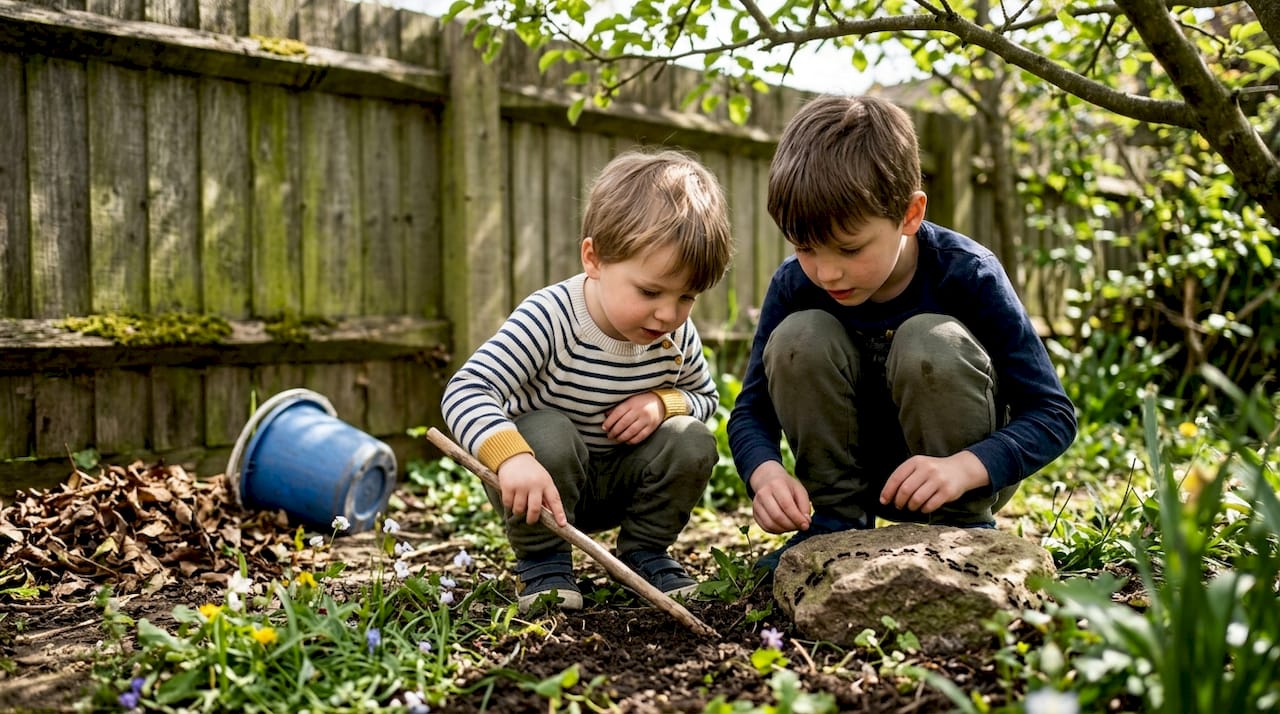
The core idea is simple: let children direct their own discovery. An adult’s role shifts from instructor to curious companion. When your child wants to investigate a beetle or build a dam in a puddle, your job is to ask questions, not provide answers.
| Feature | Classic Forest School | Home-led nature play |
|---|---|---|
| Setting | Woodland or wild space | Garden, park, or local green space |
| Group size | Small (6 to 12 children) | Family unit |
| Frequency | Weekly, term-long | As often as suits your routine |
| Adult role | Trained practitioner | Curious parent or carer |
| Activities | Child-led, open-ended | Child-led with gentle prompts |
| Equipment | Specialist tools | Everyday items and natural materials |
| Weather | All conditions | All conditions |
The beauty of adapting Forest School at home is that you set the pace. You can start small and build confidence gradually. Find inspiration for natural playground ideas that translate these principles into your own outdoor space.
Pro Tip: Start with a single 30-minute family walk each week. Pick one thing to observe closely, a tree, a bird, a patch of moss. Returning to the same spot across seasons builds a powerful sense of connection and continuity for children.
Five screen-free activities to spark creativity
The best screen-free activities share one quality: they invite children to do something, not just watch. These five ideas work across European climates and require minimal equipment. Activities like nature journals, barefoot trails, mud kitchens, and den building encourage all-weather play and genuine connection with the natural world.
- Nature trail journals Bring a small notebook and pencil on every walk. Children sketch leaves, record bird calls, and note the weather. Over time, these journals become treasured records of seasonal change and personal discovery.
- Barefoot sensory paths Create a simple path in your garden using trays of sand, smooth pebbles, damp grass, bark chippings, and mud. Walking barefoot activates sensory pathways and grounds children in a very literal sense.
- Mud kitchens and loose-part play A washing-up bowl, some soil, water, and a collection of sticks, stones, and seed pods is all you need. Children cook, mix, build, and experiment for hours. Mess is the point.
- Mini beast hunts Lift logs, check under stones, and peer into long grass with a magnifying glass. Recording findings in a simple tally chart introduces early science skills and genuine wonder at the small world.
- Den building Using fallen branches, old sheets, and natural materials, children construct shelters and claim their own space outdoors. It builds problem-solving, negotiation, and a powerful sense of ownership.
| Activity | Materials needed | Best age range |
|---|---|---|
| Nature trail journal | Notebook, pencil, magnifying glass | 5 and above |
| Barefoot sensory path | Trays, sand, pebbles, bark, mud | 2 and above |
| Mud kitchen | Bowl, soil, water, loose parts | 2 to 8 years |
| Mini beast hunt | Magnifying glass, tally chart | 4 and above |
| Den building | Branches, sheets, rope | 4 and above |
Frequent nature visits result in measurable reductions in children’s screen time, making these activities doubly valuable. Browse outdoor play area ideas and natural play inspiration to extend these ideas further.
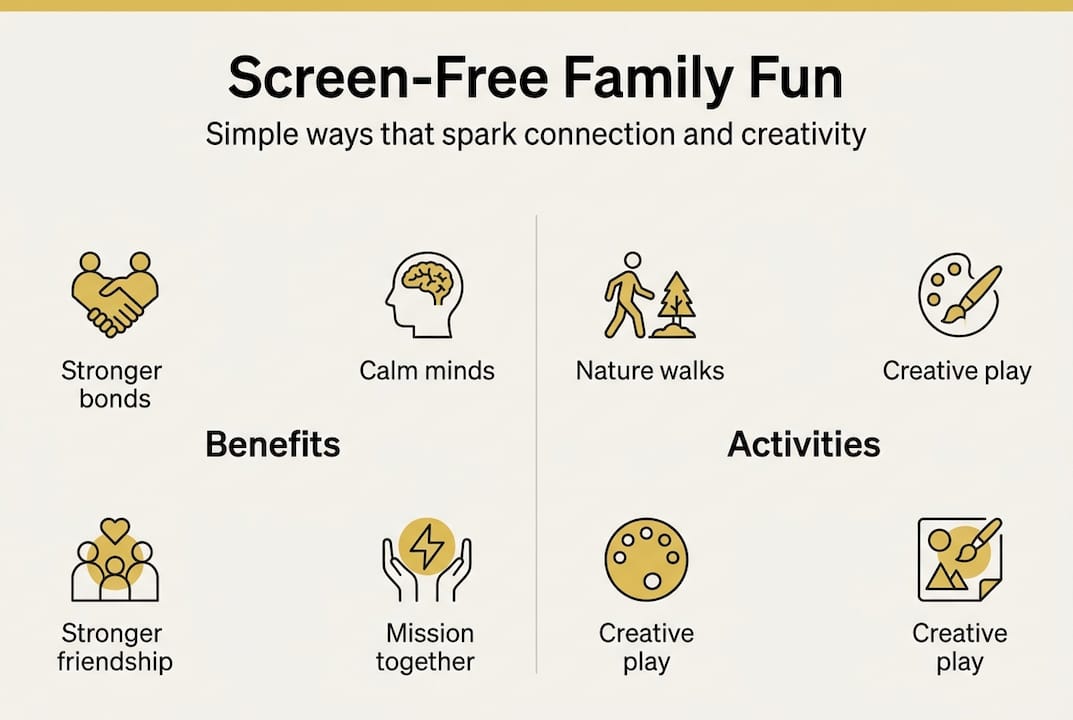
Pro Tip: Keep a small bag of loose parts (pine cones, feathers, smooth stones, conkers) by the door. On days when motivation is low, pulling out the bag often sparks immediate play without any prompting.
Modelling and sustaining healthy screen-free habits
Children watch everything you do. Parental behaviour powerfully influences children’s screen habits, and modelling outdoor curiosity matters far more than any rule you set. If you put your phone down and pick up a stick, your child will follow.
The most effective strategy is replacement, not restriction. Banning screens creates power struggles. Offering something genuinely exciting in their place creates enthusiasm. Frame outdoor time as a privilege, not a punishment, and watch the resistance dissolve.
It’s also worth noting that quality educational screen use can be beneficial when balanced with nature and play. The goal isn’t zero screens; it’s a healthy rhythm where outdoor time is the default and screens are a considered choice.
Here are five practical tips for building lasting screen-free routines:
- Anchor outdoor time to existing habits, such as after school or before dinner, so it becomes automatic
- Involve children in planning activities so they feel ownership and excitement
- Join in fully rather than supervising from a distance; your presence doubles the value
- Celebrate small wins, like a new bird spotted or a den completed, to build positive associations
- Be consistent but flexible, aiming for regular outdoor time without rigidity about how it looks
Research shows that each additional outdoor visit reduces a child’s daily screen time by 2 to 3 minutes on average. Small, consistent steps genuinely add up. Discover more nature curiosity activities to keep your routine fresh and engaging.
Safety, inclusion, and all-weather play
One of the most common concerns parents raise is safety. How much freedom is too much? The answer lies in calibrated risk: allowing children to experience manageable challenges while staying aware of genuine hazards. Outdoor play should balance freedom and supervision, operate in small groups, and follow leave-no-trace ethics so that natural spaces remain beautiful for everyone.
Inclusion matters too. Screen-free outdoor activities can be adapted for children of all abilities and ages. A child in a wheelchair can participate in a nature journal, a sensory tray, or a bird-watching session just as meaningfully as any other child. The key is designing activities around what children can do, not what they can’t.
“There is no such thing as bad weather, only unsuitable clothing.” This Scandinavian saying captures the all-weather mindset that transforms outdoor play from a fair-weather treat into a year-round family tradition.
Essential practices for safe and inclusive outdoor play:
- Dress for the weather with layers, waterproofs, and sturdy footwear regardless of season
- Supervise without hovering, staying close enough to help but far enough to allow independence
- Adapt activities for different ages and physical abilities so everyone can participate
- Leave no trace, teaching children to respect and restore natural spaces as they play
- Check the environment briefly before play, noting any hazards like broken glass or unstable ground
Explore curiosity-focused nature ideas that work beautifully across different ages and abilities.
Resources to extend your family’s screen-free journey
Once your family catches the outdoor play habit, you’ll want more ideas and community support to keep the momentum going. Forest School directories and nature play blogs provide ongoing guidance and a steady stream of activity inspiration across every season.
Here are some of the best resources to explore:
- Forest School Parents’ Guide for a clear overview of how Forest School works and how to find one near you
- The Zoofamily blog for outdoor play inspiration tailored to nature-loving families across Europe
- Local wildlife trusts and nature reserves often run free family events and guided walks throughout the year
- Community gardens and allotments where children can grow food, observe insects, and connect with seasonal rhythms
- Parent networks and Forest School communities on social platforms where families share ideas, photos, and encouragement
The most powerful resource, though, is simply stepping outside together. Everything else follows from that first step.
Discover more at The Zoofamily
At The Zoofamily, we believe that every child deserves a childhood filled with wonder, mud, and the sound of birdsong. Our family nature play hub brings together activity ideas, product inspiration, and a community of parents who share your values. Whether you’re looking for your next outdoor adventure or the perfect tool to spark your child’s curiosity, we’re here to help.
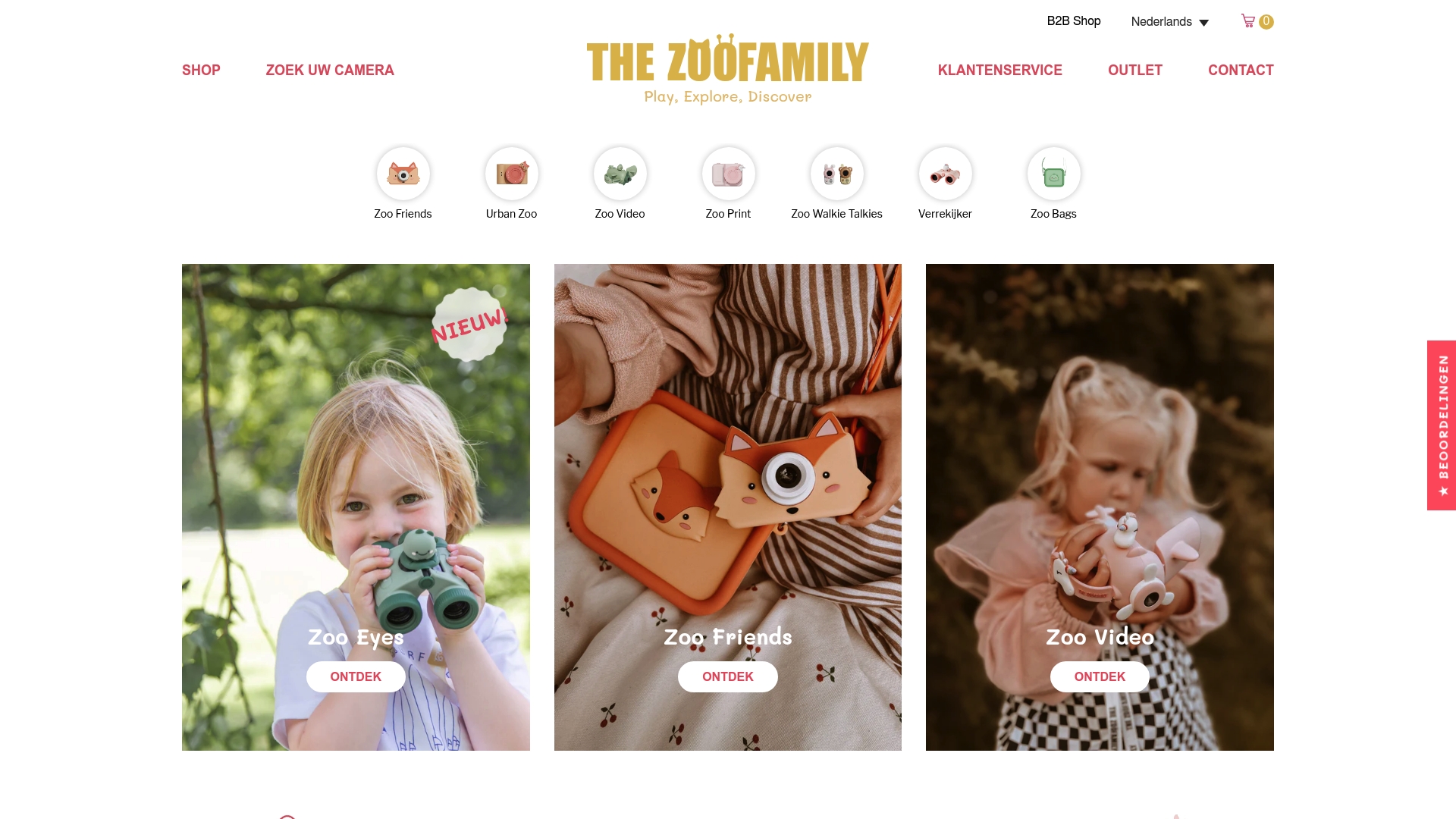
From animal-themed kids’ cameras that turn nature walks into photographic adventures, to binoculars that bring distant birds into sharp focus, every product we create is designed to deepen your child’s connection with the natural world. And for every camera sold, we plant one tree. Explore our full range and join thousands of European families who are choosing curiosity over screens, one outdoor adventure at a time.
Frequently asked questions
How can I reduce my child’s screen time without causing arguments?
Replacing, not banning screens avoids power struggles by making outdoor activities feel like an exciting swap rather than a restriction. Involve your child in choosing the activity to build enthusiasm from the start.
Does more outdoor time really reduce children’s screen habits?
Yes. More nature visits are empirically linked to lower screen time in children, even when the outdoor sessions are short and close to home.
Is all screen time harmful for children?
No. Balanced educational screen use may support development when it’s co-viewed and paired with plenty of nature play and creative activity.
What if my family doesn’t have easy access to nature?
Small parks, window boxes, or sensory trays brought indoors can spark the same curiosity and creativity. Home-based adapted play still fosters the connection and imagination that outdoor time builds.
How do I keep children motivated for outdoor play year-round?
Vary the activities with the seasons, dress properly for the weather, and always join in yourself. All-weather, routine-based play builds lasting family habits far more effectively than occasional big outings.