

TL;DR:
- Children can develop strong bonds with nature regardless of their urban or rural environment.
- Outdoor play and exploration support cognitive, emotional, and social development, fostering curiosity and resilience.
- A mindful parent mindset, emphasizing patience and allowing natural messiness, is key to nurturing lifelong environmental connection.
Many parents assume that a deep connection with nature is a luxury reserved for families with sprawling gardens or rural addresses. The research tells a very different story. Studies from across Europe consistently show that children in cities can form just as strong a bond with the natural world, provided adults give them the right nudges. Whether you have a balcony, a nearby park, or simply a windowsill, this guide translates powerful findings into practical, joyful actions. Nature connection is not a postcode lottery. It is something every family can cultivate, and it matters more for your child’s development than you might expect.
Table of Contents
- Why nature matters for children’s development
- Creating nature-rich environments at home and beyond
- Outdoor education and adventurous play: European models
- Navigating barriers: Urban access, adult attitudes and technology
- A new mindset: Letting go and embracing the messy
- Discover more nature-inspired ideas with The Zoofamily
- Frequently asked questions
Key Takeaways
| Point | Details |
|---|---|
| Nature shapes learning | Natural environments and materials spark deeper curiosity, confidence and STEM skills in children. |
| Simple steps matter | Small actions—like using loose parts or naming wildlife—lay the foundation for lifelong eco-values. |
| Mindset is crucial | Letting go of overly controlled play helps children gain independence, joy and connection with nature. |
| Barriers can be navigated | Urban families can adapt outdoor education strategies using creative local solutions and balanced attitudes. |
Why nature matters for children’s development
Nature is not simply a pleasant backdrop for childhood. It is an active ingredient in how children think, feel, and grow. When a child crouches to inspect a beetle or arranges sticks into a dam, they are doing something far more sophisticated than playing. They are building the cognitive scaffolding for curiosity, persistence, and scientific thinking.
Research confirms this is not anecdotal. Loose parts play with natural materials measurably increases STEM behaviours and intrinsic motivation in young children. Loose parts play refers to any open-ended activity using materials that can be moved, combined, and rearranged freely, such as pebbles, pinecones, and leaves. Unlike a toy with a single function, a handful of acorns can become currency, a counting exercise, or the foundation of an imaginary village. The possibilities are endless, and that openness is precisely what drives deep thinking.
Beyond cognition, the emotional and social benefits are striking. Children who spend regular time outdoors show improved behaviour, stronger cooperation with peers, and greater overall wellbeing. Even brief nature experiences, a ten-minute walk through a tree-lined street, can shift a child’s mood and focus. As a nature-based play guide for families explains, these are not one-off effects. They compound over time.
Perhaps the most compelling finding is the long-term one. Biophilia in young children, the innate human tendency to connect with living systems, directly correlates with a later sense of connectedness to nature and pro-environmental actions in adulthood. Put simply, the child who explores a garden today is more likely to recycle, conserve, and advocate for green spaces as an adult.
“Children are not vessels to fill with nature facts. They are natural scientists who need room to investigate on their own terms.”
Here is a summary of what consistent nature exposure delivers:
- Stronger STEM skills through open-ended, hands-on exploration
- Improved emotional regulation and reduced anxiety
- Better cooperation and conflict resolution with peers
- Increased curiosity and intrinsic motivation to learn
- Lifelong pro-environmental attitudes and behaviours
With the need for nature now clear, how exactly does play outdoors impact development?
Creating nature-rich environments at home and beyond
Understanding nature’s developmental value shapes how we design children’s daily spaces. The good news is that you do not need a forest on your doorstep. You need intention.
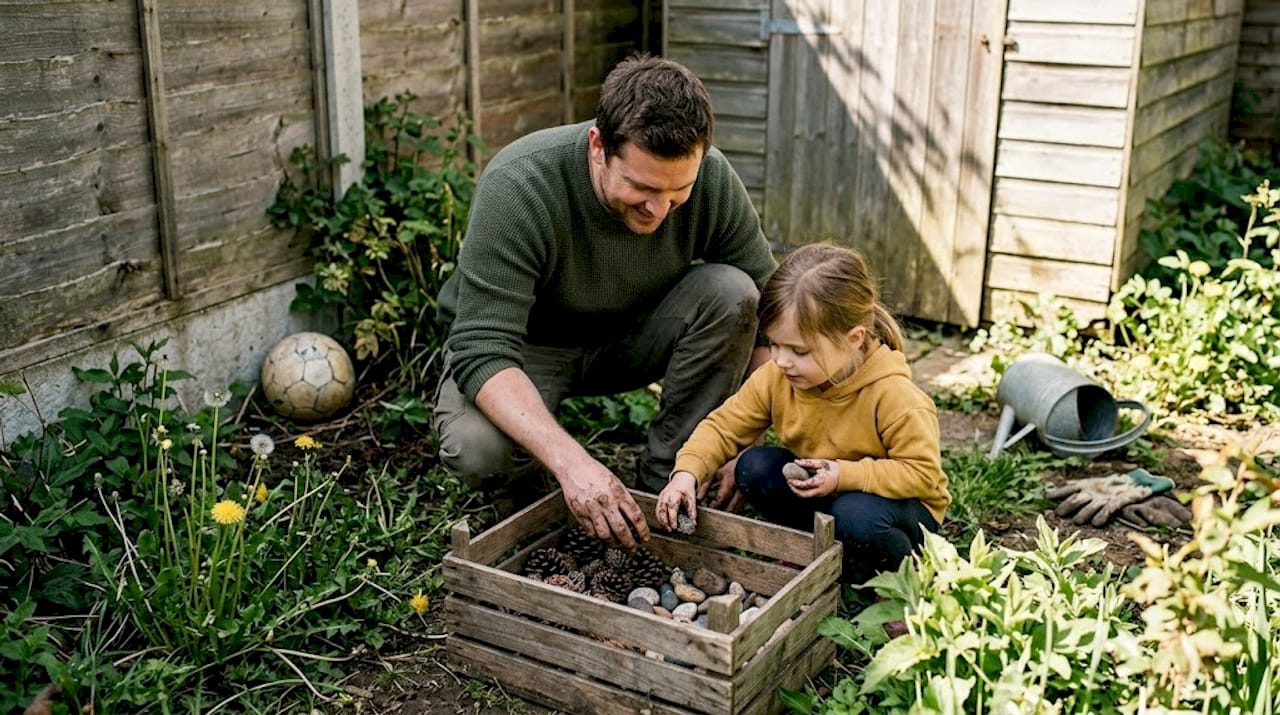
The first step is rethinking what counts as a nature toy. A bag of plastic figurines has one story to tell. A collection of smooth river stones, dried seed pods, and twisted bark pieces has thousands. Loose parts play outperforms limited-function toys in supporting creativity and problem-solving, which means the most powerful additions to your home often cost nothing at all.
Here is a quick comparison to help you make informed choices:
| Material | Type | Creative potential | Problem-solving | Nature connection |
|---|---|---|---|---|
| Plastic action figure | Digital or manufactured | Low | Low | None |
| Sticks, leaves, and stones | Natural loose parts | Very high | Very high | Strong |
| Educational nature kit | Structured natural | Medium | Medium | Moderate |
| Digital nature app | Screen-based | Medium | Low | Weak |
Beyond materials, naming and noticing matters. When you point out a blackbird versus a sparrow, or show your child how to identify an oak leaf, you are giving them a language for the living world. That language builds a relationship. Check out these wildlife-friendly garden ideas to turn even a small outdoor space into a habitat worth exploring.
Pro Tip: Keep a small tray of natural materials near your front door. After every walk, invite your child to add one find. Over a season, this simple habit builds a stunning collection and sparks ongoing scientific curiosity.
If you are looking to build excitement around outdoor movement too, practical active play event tips can help you structure sessions that combine physical energy with nature discovery. Structured or spontaneous, the key is regularity.
Simple ways to create nature-rich environments:
- Fill a balcony planter with herbs and let your child water and harvest them
- Set up a bird feeder visible from a window and keep a spotting notebook nearby
- Collect seasonal materials on walks and use them for art, sorting, and storytelling
- Turn bath time into a sensory exploration with water, pebbles, and floating leaves
Outdoor education and adventurous play: European models
Having set up inviting environments, how do structured outdoor approaches enhance children’s growth?
Across Europe, educators have long recognised what many parents are only now discovering: the outdoors is not just a venue for play, it is a classroom without walls. Frameworks like Forest Kindergartens in Germany and Scandinavia, and Bush Schools in the UK, are built on the belief that risk, collaboration, and nature as teacher produce outcomes that indoor settings simply cannot replicate.
Outdoor education boosts behaviour, motivation, and intercultural awareness while also teaching children to assess and manage risk confidently. That last point is important. Risk is not the enemy of childhood safety. It is the training ground for judgement.
The evidence from specific programmes is hard to ignore:
| Approach | Duration | Key outcomes |
|---|---|---|
| Bush School (UK primary) | 10 weeks | Improved wellbeing, self-regulation, maths success |
| Forest Kindergarten (Germany) | Year-round | Higher resilience, creativity, and cooperation |
| European outdoor education pilot | Varies | Better behaviour and intercultural empathy |
Bush School over 10 weeks significantly increased wellbeing, self-regulation, and even maths success in primary-aged children. That is a remarkable result from simply moving learning outside.
You do not need to enrol your child in a specialist programme to borrow these principles. Here is how to adapt them at home:
- Allow climbing. A tree, a low wall, or a climbing frame all build proprioception (the body’s sense of its own position) and confidence.
- Let your child lead. On walks, follow their curiosity rather than your route. Destination is secondary to discovery.
- Introduce collaborative challenges. Build a shelter from branches together, or navigate a trail using a simple drawn map.
- Explore outdoor science activities that mirror what Forest Schools do, turning everyday nature into structured inquiry.
- Accept that learning outdoors is messier and slower. That is the point.
Pro Tip: When children face a small physical challenge outdoors, resist the urge to intervene immediately. A pause of just 30 seconds often gives them enough space to solve it themselves, and that self-solved moment builds far more confidence than your help would.
For families who want more active play for development, combining physical challenges with natural settings is one of the most effective combinations available.
Navigating barriers: Urban access, adult attitudes and technology
While structured education helps, modern lifestyles create specific obstacles for families.
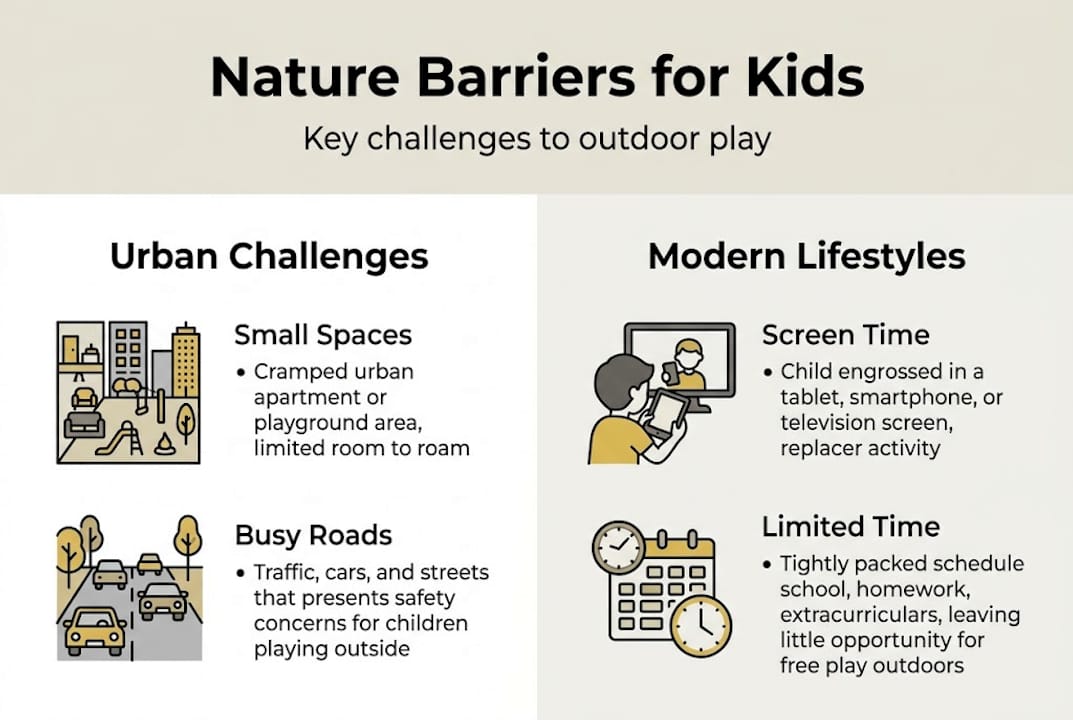
One of the most persistent myths is that urban children are simply too removed from nature to benefit meaningfully. In reality, research paints a more nuanced picture. Urban children often display greater environmental sensitivity but lower environmental awareness, meaning they care about nature yet lack direct experience with it. Digital play reduces the imaginative and exploratory uses of natural materials, narrowing a child’s understanding of what the natural world is and does.
This is not a reason for despair. It is a call for small, consistent action. City parks, community gardens, and even a single potted plant on a windowsill can function as a child’s nature window. The important thing is that the experience is real, sensory, and child-led.
“The issue is not that children do not love nature. The issue is that adults have become afraid to let them explore it.”
That fear is worth examining. Adult over-supervision and training gaps in outdoor facilitation significantly reduce the benefits of child-led nature play. When we hover, redirect, and sanitise every outdoor experience, we rob children of the unpredictable moments that build genuine resilience.
Here are practical strategies for navigating common barriers:
- No garden? Use community allotments, rooftop gardens, or school green spaces as weekend destinations.
- Screen time conflict? Introduce a nature photography challenge using a child’s camera to make the outdoors more engaging than a tablet.
- Safety concerns? Start small and local. A familiar park where your child can roam within sight builds independence gradually.
- Child resistance? Follow their interests. A child obsessed with dinosaurs will happily study real fossils or visit a geology trail.
Building on activities that connect children to eco values for kids at home reinforces what they discover outdoors and creates a coherent, values-led approach to raising environmentally aware children.
A new mindset: Letting go and embracing the messy
After reviewing all the strategies, research, and frameworks, one truth rises above the rest: the most important variable is not the tool, the location, or the programme. It is the parent’s mindset.
We have seen what the science says about loose parts, Forest Schools, and biophilia. But none of it works if a parent cannot tolerate mud on a school jumper, a failed den, or a child who wants to sit and watch an anthill for twenty minutes instead of completing a nature worksheet. The breakthrough moment for most families is not finding the perfect activity. It is deciding that the imperfect, unscripted moment is enough.
At The Zoofamily, we believe the richest nature memories are rarely the planned ones. They are the accidental rainstorms, the worm discovered in a plant pot, the bird call that stops a child mid-sentence. Fostering those moments requires you to slow down and resist the urge to improve or direct. Explore what playful eco education can look like when adults step back and trust children to lead.
Let go of the itinerary. The mess is the method.
Discover more nature-inspired ideas with The Zoofamily
If this article has sparked ideas, we have a whole world of resources waiting for you. At The Zoofamily, we design tools and content that help children fall in love with the natural world, from animal-inspired cameras that plant a tree with every purchase to activity guides built around real outdoor exploration.
Our blog is packed with nature-based play ideas that work in every setting, from city flats to country walks. Whether you are just starting out or looking to deepen an already curious child’s relationship with nature, you will find practical, joyful inspiration tailored to real family life. Come explore with us.
Frequently asked questions
How can I connect my child to nature in a city flat?
Use household materials for loose parts play, visit local parks regularly, or start a small balcony garden together. Even minimal natural materials measurably boost creativity and STEM behaviours in young children.
Are educational toys or natural objects better for learning?
Natural objects like sticks and stones consistently support richer, more imaginative play. Loose parts play outperforms limited-function toys in developing creativity and scientific thinking.
Is it risky to let children play freely outdoors?
Managed risk builds confidence and real-world problem-solving skills. Risk management in outdoor education is shown to improve behaviour and overall child outcomes significantly.
Can digital nature play replace real outdoor experiences?
Digital play supports some learning but cannot replicate the sensory depth of real nature. Digital play in nature tends to be more rule-based and less imaginative than hands-on exploration.
How do nature activities help children care for the environment?
Early nature connection is one of the strongest predictors of later environmental action. Pro-environmental behaviours increase meaningfully with regular early nature exposure and child-led exploration.