

TL;DR:
- Family activities rooted in nature boost confidence, self-esteem, and environmental awareness.
- Eco-friendly crafts use natural, found materials to foster creativity and respect for nature.
- Regular outdoor rituals strengthen family bonds and nurture lifelong ecological habits.
Finding meaningful activities that genuinely connect your family, spark real imagination, and sit comfortably alongside eco-conscious values is harder than it sounds. Busy schedules, screens, and the pressure to make every outing “worth it” leave many parents feeling stuck. The good news is that some of the most powerful bonding experiences cost nothing and require only a patch of green space, a handful of curiosity, and a willingness to get a little muddy. This article walks you through creative, evidence-backed ideas rooted in nature, crafted for families who want moments that matter long after the weekend is over.
Table of Contents
- Forest School adventures: Unleashing creativity outdoors
- Eco-friendly crafts to do as a family
- Seasonal nature crafts inspired by the National Trust
- Family nature rituals and outdoor adventure hunts
- Why creative bonding in nature is more than just fun
- Want more eco-friendly family inspiration?
- Frequently asked questions
Key Takeaways
| Point | Details |
|---|---|
| Child-led nature play | Letting children direct outdoor activities boosts creativity, confidence, and eco-awareness. |
| Eco-friendly crafts | Using safe, local materials makes family crafts sustainable and supports nature learning. |
| Seasonal inspiration | Adapting crafts to the seasons keeps family traditions fresh and connects children to nature’s cycles. |
| Rituals create connection | Weekly or monthly outdoor rituals help families bond and foster lifelong environmental values. |
Forest School adventures: Unleashing creativity outdoors
Forest School is not a trendy buzzword. It is a child-led outdoor methodology built around regular sessions in natural settings, guided by minimal-impact principles that put the child’s curiosity firmly in the driver’s seat. Unlike structured school trips with clipboards and tick-boxes, Forest School sessions invite children to build dens, stir mud kitchens, create seed bombs, and craft land art from whatever nature offers that day.
Research consistently confirms that Forest School improves confidence, self-esteem, emotional wellbeing, physical skills, cognitive performance, and environmental awareness across all age groups. Those are seven measurable areas of benefit from simply spending unstructured time outside.
“The most lasting changes in children’s relationship with nature come not from lectures but from repeated, sensory-rich experiences in which they are free to explore, fail, and discover on their own terms.”
The magic is in process over product. When a child spends forty minutes choosing the right sticks for a den roof, they are building spatial reasoning, resilience, and patience. The den might collapse. That is the point.
How to get started
- Search for a local Forest School group or qualified leader in your area.
- Plan a monthly “DIY Forest School” morning in a nearby woodland or park.
- Pack only what you need: waterproofs, snacks, and an open mind.
- Set one rule: follow the child’s lead for at least the first hour.
- Finish with a short reflection, asking what they noticed, built, or discovered.
| Feature | Forest School approach | Traditional structured outdoor play |
|---|---|---|
| Direction | Child-led | Adult-directed |
| Materials | Natural, found objects | Brought equipment |
| Outcome focus | Process and exploration | Specific activity goal |
| Risk tolerance | Managed, embraced | Minimised |
| Environmental impact | Minimal trace | Variable |
Pro Tip: You do not need a forest. A backyard corner with soil, sticks, and old pots becomes a perfectly valid Forest School classroom. Start small and build from there.
For more ways to nurture eco-conscious kids through outdoor play, or to gather fresh nature scavenger hunt ideas for your next session, both are excellent starting points.
Eco-friendly crafts to do as a family
Once you have tasted the freedom of Forest School play, eco-crafting feels like a natural extension of that creative energy. The key difference from standard craft afternoons is simple: every material comes from nature and goes back to it.
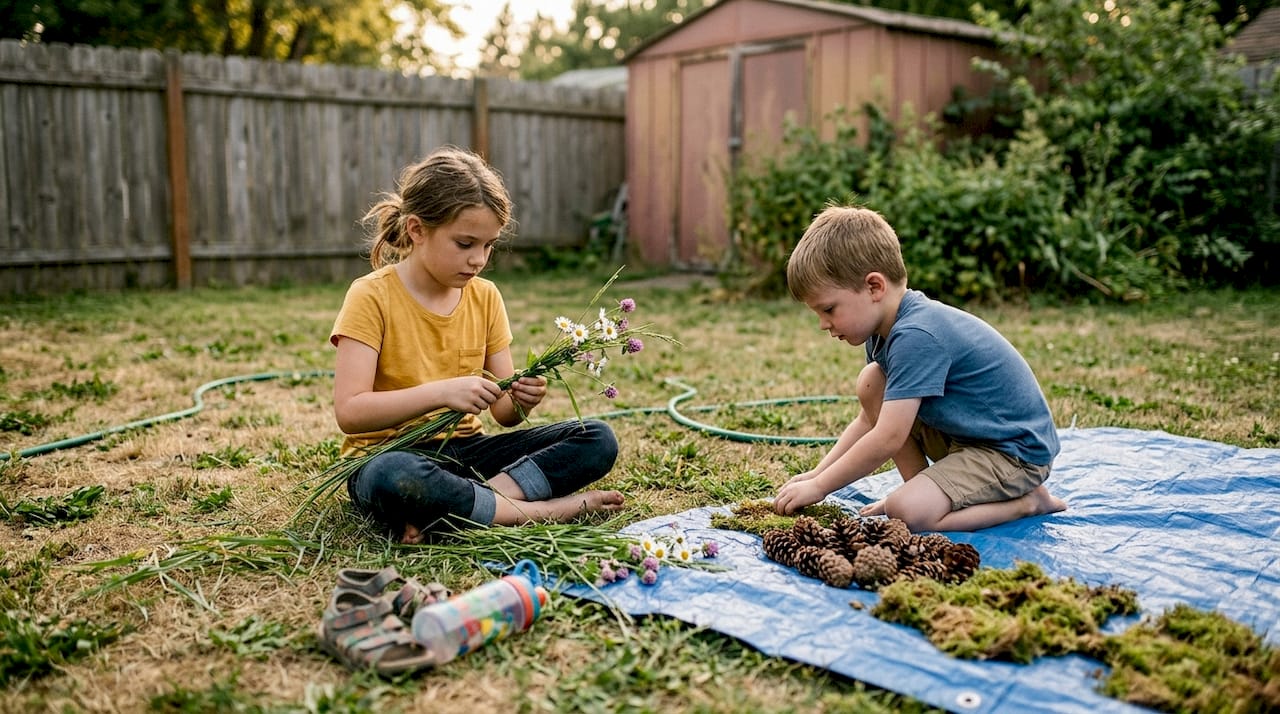
Building a barefoot sensory trail using forest textures, or braiding grass hearts with wildflowers for a Mother’s Day gift, teaches children that beauty and meaning can be found in the ordinary world around them. No plastic required.
Safe and sustainable materials for European families
| Material | Best season | Age suitability | Notes |
|---|---|---|---|
| Fallen leaves | Autumn | 2+ | Avoid mouldy specimens |
| Moss clumps | Spring/Autumn | 4+ | Only collect from abundance |
| Bark pieces | Year-round | 5+ | Use fallen bark only |
| Seed heads | Late summer | 3+ | Check for allergens |
| Smooth pebbles | Year-round | 3+ | Rivers and beaches |
The benefits run deeper than a pretty finished product. Eco-crafting builds fine motor skills, encourages quiet collaboration between siblings, and stretches the imagination in ways that a pre-cut craft kit simply cannot. When your five-year-old decides a pine cone is actually a hedgehog, that is genuine creative thinking in action.
Seasonal eco-craft project ideas
- Spring: Pressed flower bookmarks and seed-paper greeting cards
- Summer: Pebble painting and natural dye fabric printing
- Autumn: Leaf skeleton art and conker threading
- Winter: Pine cone bird feeders and twig star decorations
- Year-round: Nature mandalas, stick weaving, and mud painting
For city families, adaptations are simple. A windowsill herb garden provides leaves and stems. A local park offers enough fallen material for an afternoon of creative work. The craft does not need to be elaborate to be meaningful.
Pro Tip: Contact your nearest nature reserve or woodland trust. Many run seasonal “tidy-up” days where families collect fallen materials responsibly, giving you a ready supply and supporting conservation at the same time.
To find even more ways to boost family outdoor adventures beyond the craft table, there are plenty of practical ideas waiting for you.
Seasonal nature crafts inspired by the National Trust
Some of the most charming and accessible nature craft ideas come from heritage organisations that have spent decades helping families connect with the natural world. The National Trust’s approach is reassuringly simple: use what you find, damage nothing, and let curiosity guide the making.
One standout project is sycamore seed dragonflies, created using paired sycamore seeds as wings and a twig body. The process naturally teaches children to identify sycamore trees, notice how seeds travel on the wind, and spot similar species on future walks. Leaf printing and autumn wreaths follow the same principle, turning a walk into a living art class.
Top five tips for memorable, low-impact seasonal crafts
- Collect only what is fallen or genuinely abundant; never pull from living plants.
- Bring a small field guide to help children identify what they gather.
- Use natural adhesives where possible: mud, clay, or pine resin.
- Photograph the finished piece outdoors before returning materials to the ground.
- Make identification part of the craft: label each element with its real name.
These projects do more than produce something pretty. Children who regularly handle natural materials begin to notice nature rituals in the seasons around them, becoming sharper observers and more confident wildlife spotters over time.
For leaf printing, the method could not be simpler. Press a fresh leaf vein-side down onto watercolour paper, roll over it with a brayer or firm sponge, and lift to reveal the full skeleton of the leaf. Every species produces a different print. Children quickly become competitive about who can find the most unusual leaf, which is exactly the kind of engaged curiosity you want to encourage.
Pro Tip: Let children gift their seasonal crafts to grandparents or neighbours. The act of giving something handmade and natural builds pride, generosity, and a sense that their creativity has real value in the world.
Family nature rituals and outdoor adventure hunts
Crafts are wonderful for a Sunday afternoon, but rituals are what build a lasting family culture around nature. A ritual is simply a repeated, intentional experience that everyone anticipates and recognises as theirs.
Families who build regular outdoor traditions report stronger nature connectedness in their children, alongside measurable improvements in confidence and pro-environmental behaviour. The frequency matters more than the scale.
“Parental modelling of nature engagement is one of the strongest predictors of children’s own lifelong relationship with the natural world. Children do not need to be taught to love nature; they need to see the adults they trust loving it first.”
Four family nature rituals worth starting this month
- Monthly scavenger hunt: Use seasonal scavenger hunt ideas tailored to your local environment. Swap lists with another family to keep it fresh.
- Annual tree planting: Choose a meaningful date, pick a native species, and plant together. Revisit the tree each year to measure its growth.
- Sustainable family picnic: Pack entirely plastic-free, forage one ingredient (responsibly), and eat outside regardless of the weather.
- Weekly story walk: One family member chooses a route; another narrates a story inspired by what you all encounter along the way.
These creative family rituals improve ecological awareness and wellbeing in ways that a single big trip to a national park simply cannot replicate. Consistency beats spectacle every time.
Tips for keeping rituals stress-free
- Keep the kit minimal: one bag, one rule, one hour minimum.
- Rotate who chooses the activity to build ownership across all ages.
- Embrace bad weather; some of the best discoveries happen in the rain.
- Try photography scavenger hunt tips to add a creative layer for older children.
- For urban families, a local cemetery, allotment, or canal path works beautifully.
Single-parent families and multi-generational groups adapt these rituals easily. Grandparents bring identification knowledge; teenagers bring energy and humour. Everyone has a role.
Why creative bonding in nature is more than just fun
Most articles on family nature activities focus on the “what to do” list. What often goes unsaid is the deeper truth: these experiences are not extras. They are the foundation.
When you sit in the mud with your child building a tiny dam, you are not just passing time. You are demonstrating, through your own presence, that the natural world is worth slowing down for. Research confirms that sensory-rich nature experiences triggered by parental choices are precisely what build genuine, lifelong ecological habits. Nature acts as a co-actor in those moments, not a backdrop.
The uncomfortable truth is that perfectly curated outdoor experiences can actually get in the way. When every activity is photographed and optimised, children sense that the outing is really for the content, not for them. The messiest, most unplanned afternoons tend to produce the strongest memories and the deepest sense of connection.
Our challenge to you is this: once a week, go outside with your family with no agenda beyond being present. No perfect picnic, no matching wellies, no planned outcome. Let the afternoon go sideways. Let someone get muddy. Let someone be bored long enough to invent something. That is where building lifelong eco-consciousness actually begins.
Want more eco-friendly family inspiration?
At The Zoofamily, we believe that creative connection between children and nature is one of the most powerful gifts a family can cultivate together. Every camera we sell plants a tree, because we know that the children who grow up exploring the natural world are the ones who will fight to protect it.
Whether you are just starting out or looking to deepen your family’s outdoor practice, explore The Zoofamily for hands-on guides, activity ideas, and community stories that bring eco-conscious family life to life. For your next weekend, dive straight into our nature ritual inspiration and discover how simple, repeated moments in nature become the stories your children carry into adulthood.
Frequently asked questions
What ages are eco-friendly family bonding activities suitable for?
Most nature-based activities are suitable for ages 3+, with simple modifications for safety and engagement at different developmental stages. Younger toddlers thrive with sensory-focused tasks, while older children enjoy more complex construction or identification challenges.
How do I make nature crafts safe and sustainable?
Always use only fallen or abundant materials, avoid any protected plant species, and ensure every supply you use is fully biodegradable. Checking local conservation guidelines before foraging takes only a few minutes and protects both your family and the ecosystem.
What if our family lives in a city with limited green space?
Start with backyard hunts and crafts using whatever your immediate environment offers, then progress to local parks and nature reserves at weekends. Even a balcony with a few pots of herbs and a bird feeder creates genuine nature connection.
How do family nature rituals benefit children’s development?
Regular outdoor rituals improve confidence and self-esteem alongside emotional wellbeing and focus, according to empirical Forest School research. Consistency across weeks and months is what produces lasting developmental benefits rather than single big outings.