

Over 60 percent of european parents underestimate how powerful play is for childhood development, often seeing it as just a break rather than essential learning. For eco-conscious moms in Germany and France, understanding play’s true role means choosing gifts that inspire more outdoor exploration and environmental awareness. This article highlights valuable insights, including british research, to help you find educational gifts that blend the joy of discovery with responsible, nature-rich childhood experiences.
Table of Contents
- Defining Play And Common Misconceptions
- Types Of Play And Their Unique Roles
- How Play Boosts Child Development
- Outdoor Play And Connection To Nature
- Adult Involvement And Play Environments
Key Takeaways
| Point | Details |
|---|---|
| The Importance of Play | Play is a vital mechanism for children’s development, integrating physical, cognitive, and social growth into their learning experiences. |
| Types of Play | Different forms of play, such as physical, symbolic, and social play, each contribute uniquely to specific developmental skills and emotional intelligence. |
| Outdoor Play Benefits | Engaging with nature fosters sensory learning and builds environmental awareness, providing crucial opportunities for holistic development. |
| Role of Adults in Play | Adults should enhance children’s play through supportive environments that allow for autonomy, balancing guidance and creative freedom. |
Defining Play and Common Misconceptions
Play represents far more than simple entertainment or idle time for children. It is a complex, dynamic process fundamental to human development, encompassing physical, cognitive, and social growth. Theoretical perspectives on play emphasise that play exists on a rich spectrum ranging from completely unstructured exploration to carefully guided learning experiences.
Contrary to popular belief, play is not a frivolous activity but a serious mechanism through which children understand their world. Many parents and educators mistakenly view play as separate from learning, when in reality, it is an integral pathway for skill acquisition. Research from international early childhood panels systematically debunks myths suggesting play is non-academic or unimportant for older children. These misconceptions can limit children’s developmental opportunities by underestimating play’s profound cognitive and emotional benefits.
Play manifests in multiple forms: imaginative role-playing, physical games, constructive building activities, and structured educational interactions. Each type contributes uniquely to children’s growth, helping them develop problem-solving skills, emotional regulation, creativity, and social understanding. The complexity of play means it cannot be reduced to a single definition but must be appreciated as a nuanced, adaptive process that changes with a child’s developmental stage.
Pro tip: Observe your child’s play without interrupting, noting the intricate ways they explore, experiment, and learn through seemingly simple activities.
Types of Play and Their Unique Roles
Play is a multifaceted experience that manifests in numerous distinct forms, each contributing uniquely to children’s developmental journey. Comprehensive research reviews have identified several critical categories of play that serve different psychological and developmental functions, ranging from physical interactions to complex symbolic representations.
These play types include physical play, which develops gross motor skills and body awareness; object play, where children explore and manipulate their environment; symbolic play, involving imagination and representation; and rule-based games that introduce social negotiation and strategic thinking. Research from educational experts highlights how each play category provides specific learning opportunities, from constructive play that enhances spatial reasoning to social play that builds interpersonal communication skills.
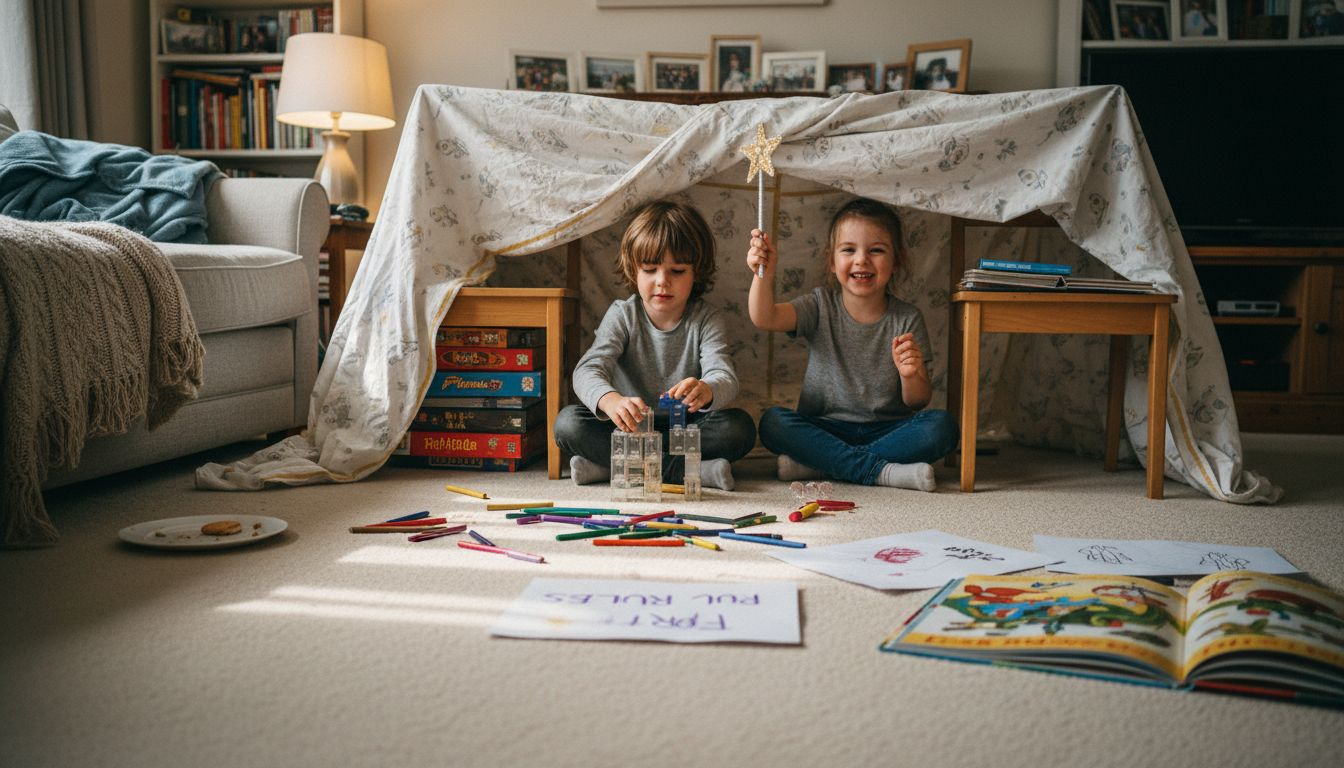
Particularly fascinating are the nuanced roles of imaginative and pretend play, where children create alternative scenarios, try on different identities, and process complex emotional experiences. These play forms are not merely entertainment but critical mechanisms for cognitive flexibility, emotional intelligence, and understanding social dynamics. Through these varied play experiences, children gradually develop problem-solving abilities, learn emotional regulation, and construct their understanding of the world around them.
Pro tip: Create a diverse play environment with materials that encourage multiple play types, allowing your child to naturally explore and learn through different interactive experiences.
Here is a summary comparing the main types of play and their contributions to development:
| Type of Play | Key Developmental Focus | Typical Activities |
|---|---|---|
| Physical Play | Strength, coordination | Running, climbing, jumping |
| Object Play | Manipulation, exploration | Building, stacking, sorting |
| Symbolic Play | Imagination, representation | Pretend, drawing, storytelling |
| Rule-Based Games | Social rules, strategy | Board games, sports, card games |
| Social Play | Communication, empathy | Group activities, role-play |
How Play Boosts Child Development
Play serves as a powerful developmental catalyst, transforming seemingly simple interactions into profound learning experiences for children. Systematic research examining the global evidence of play’s impact reveals its extraordinary capacity to support holistic child development across multiple critical domains: physical, cognitive, emotional, and social.
In the physical domain, play encourages movement, coordination, and motor skill development. Children naturally develop strength, balance, and spatial awareness through activities like climbing, running, and manipulating objects. Cognitively, play stimulates problem-solving skills, creativity, and intellectual curiosity. Through exploratory and imaginative play, children learn to think flexibly, develop strategic reasoning, and build foundational academic skills that extend far beyond traditional classroom learning.
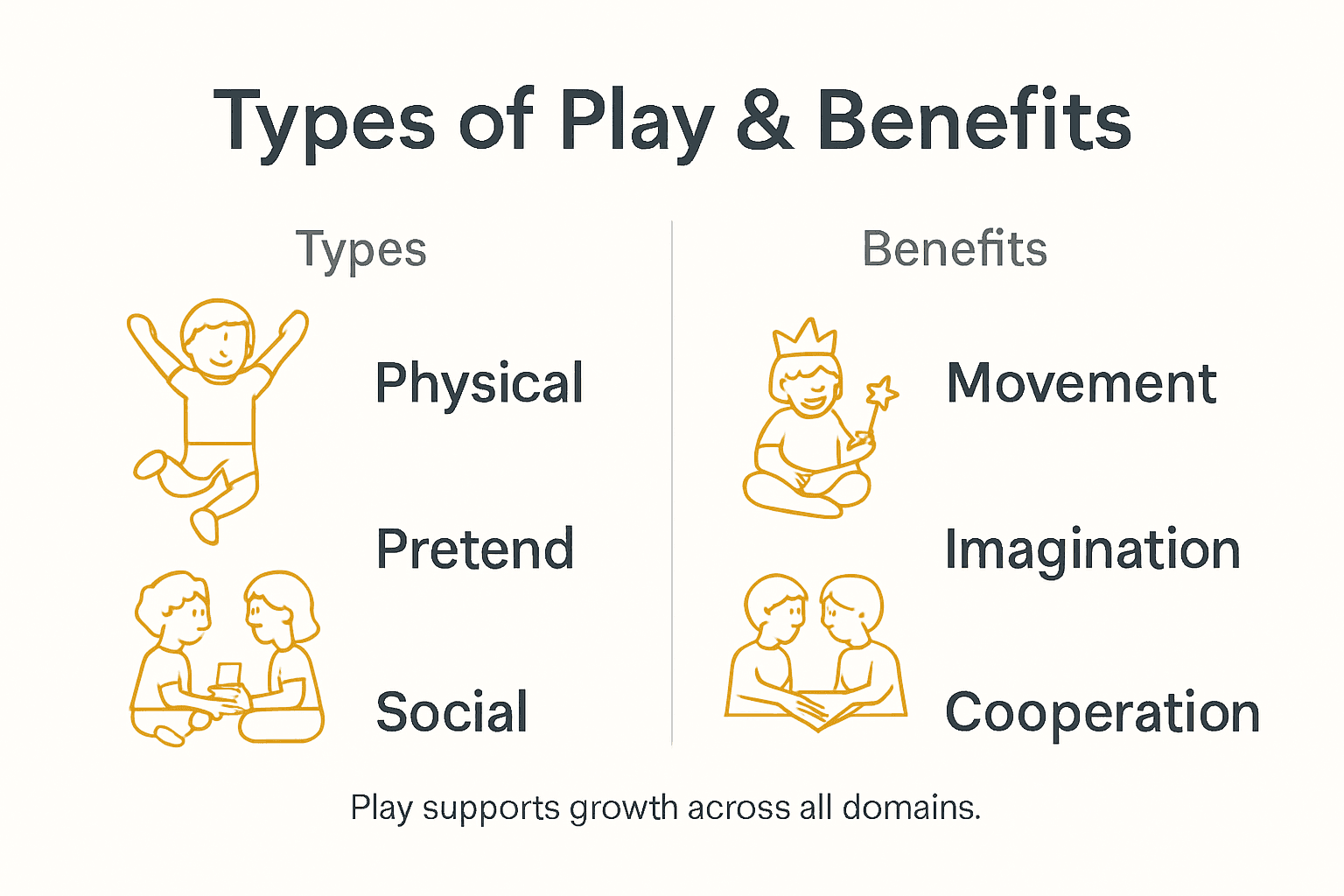
Emotionally and socially, play provides a crucial arena for children to understand complex human interactions, emotional regulation, and interpersonal dynamics. By engaging in cooperative games, role-playing scenarios, and collaborative activities, children learn empathy, negotiation, conflict resolution, and social communication. These experiences help them develop emotional intelligence, build resilience, and create meaningful connections with peers and adults.
Pro tip: Intentionally create diverse play opportunities that challenge your child across different developmental domains, rotating between physical, creative, social, and cognitive play experiences.
To clarify how play affects core developmental domains, consider this breakdown:
| Developmental Domain | Main Benefits Provided by Play | Example Outcome |
|---|---|---|
| Physical | Motor skills, balance, fitness | Confident movement |
| Cognitive | Problem-solving, creativity, reasoning | Flexible thinking |
| Emotional | Self-regulation, resilience, awareness | Managing frustration |
| Social | Cooperation, conflict resolution, empathy | Effective peer interaction |
Outdoor Play and Connection to Nature
Nature offers an extraordinary classroom where children learn through direct, immersive experiences that textbooks cannot replicate. International research on outdoor learning and play reveals profound benefits of connecting children with natural environments, demonstrating that outdoor play is far more than simple recreation—it is a critical pathway for holistic development.
Outdoor environments provide sensory-rich landscapes that stimulate multiple developmental domains simultaneously. Children climbing trees develop physical coordination, problem-solving skills, and spatial awareness. Exploring woodland paths introduces complex ecological concepts, encourages curiosity, and builds scientific understanding. Collecting leaves, observing insects, and listening to birdsong activate sensory learning mechanisms that engage children’s natural wonder and create deep, lasting memories of environmental interaction.
Beyond individual growth, outdoor play cultivates essential environmental consciousness. By experiencing nature directly, children develop emotional connections with the natural world, fostering empathy, respect, and a sense of ecological responsibility. These early experiences lay the groundwork for future environmental stewardship, helping children understand their interconnectedness with broader ecosystems and the importance of conservation.
Pro tip: Create regular, unstructured outdoor exploration opportunities that allow your child to interact with nature without excessive adult direction, enabling genuine discovery and personal connection.
Adult Involvement and Play Environments
Adult participation in children’s play represents a nuanced, complex interaction that profoundly influences developmental outcomes. International research exploring adult roles in play reveals a sophisticated spectrum of engagement, ranging from passive observation to active, intentional co-participation that can significantly enhance children’s learning experiences.
Effective adult involvement requires a delicate balance between guidance and autonomy. Rather than directing play entirely, adults serve best as facilitators who create enabling environments, provide strategic support, and respond sensitively to children’s emerging interests. This approach allows children to maintain creative control while benefiting from subtle adult scaffolding that introduces complexity, challenges assumptions, and gently expands play’s potential learning dimensions.
The physical play environment itself becomes a critical factor in adult-supported play experiences. Thoughtfully designed spaces that offer age-appropriate challenges, diverse sensory stimuli, and opportunities for open-ended exploration can dramatically enhance play’s developmental impact. Contemporary research frameworks emphasise that responsive environments should adapt to individual children’s developmental needs, encouraging both independence and supportive interaction.
Pro tip: Create play spaces with multiple interaction zones that allow children to choose between independent exploration and occasional adult engagement, supporting their emerging sense of autonomy.
Unlock the Power of Play with The Zoofamily
The article highlights how vital play is to children’s physical, cognitive and emotional growth, and how connecting with nature deepens this developmental journey. Many parents seek ways to enrich playtime with purposeful tools that spark curiosity and inspire exploration without interrupting the child’s creative flow. At The Zoofamily, we understand these challenges and aspirations deeply. Our range of children’s cameras, walkie-talkies, and binoculars are thoughtfully designed with animal references that invite kids to engage with the natural world meaningfully. This helps foster the very imaginative and outdoor play experiences that research shows are critical for wellbeing and learning.
Give your child the opportunity to learn through play while nurturing a lifelong bond with nature. Explore our unique products that align perfectly with the developmental benefits featured in the article. Every camera you purchase contributes to restoring the planet with tree planting—creating a brighter future for your child and generations to come. Discover these playful pathways for growth today at The Zoofamily. Your next adventure in learning and nature starts here.
Frequently Asked Questions
What are the different types of play that support children’s development?
Play can be categorised into types such as physical play, object play, symbolic play, rule-based games, and social play. Each type contributes uniquely to a child’s growth, enhancing skills like motor coordination, problem-solving, imagination, and social interaction.
How does play contribute to cognitive development in children?
Play fosters cognitive development by stimulating problem-solving skills, creativity, and intellectual curiosity. Through imaginative and exploratory play, children learn to think flexibly and develop foundational academic skills crucial for their learning journey.
Why is outdoor play important for children’s wellbeing?
Outdoor play connects children with nature, providing sensory-rich experiences that support physical, cognitive, and emotional development. It promotes curiosity, nurture environmental awareness, and fosters a sense of responsibility towards the ecosystem.
What role do adults play in enhancing children’s play experiences?
Adults can significantly enhance children’s play by acting as facilitators. They should create supportive environments, provide guidance without directing play, and respond sensitively to children’s interests, allowing for both independence and learning opportunities.
Recommended
- Understanding the Benefits of Imaginative Play – The Zoofamily
- Childhood Brain Development: A Guide for Modern European Mums – The Zoofamily
- Making Learning Fun: Engaging Activities for Your Kids – The Zoofamily
- Making Learning Fun: Engaging Activities for Your Kids – The Zoofamily
- Kids Need Role Models - Interactive Counselling