

Most children, when asked to name a cloud, will point upward and say “fluffy.” That’s it. One word, one type, one missed opportunity. The truth is, the sky above your local park is a living science lesson, and you don’t need a textbook to teach it. Outdoor activities like cloud watching have been shown to boost children’s science motivation and sharpen their observation skills in ways that classroom lessons simply can’t replicate. This guide will walk you through the key cloud types, how they form, and the most enjoyable outdoor activities to help your child aged 5 to 10 fall genuinely in love with the sky.
Table of Contents
- Why learn about clouds? Educational and outdoor benefits
- The main types of clouds for children to recognise
- How do clouds form? Simple explanations for curious kids
- Fun outdoor activities for learning cloud types
- Why simplifying cloud types launches a lifelong love of nature
- Take your family’s learning further with The Zoofamily
- Frequently asked questions
Key Takeaways
| Point | Details |
|---|---|
| Start with basics | Teach Cirrus, Cumulus, and Stratus for easy, memorable learning outdoors. |
| Learn through play | Games, DIY projects, and sky hunts make cloud science fun and accessible. |
| Boost nature connection | Cloud spotting develops curiosity, observation, and a stronger bond with nature. |
| Simple science works | Break down cloud formation into four easy steps: evaporation, rising, cooling, condensation. |
Why learn about clouds? Educational and outdoor benefits
Cloud spotting might sound like a quiet, passive activity, but for children aged 5 to 10, it’s anything but. When a child learns to look up and ask “what kind of cloud is that?”, they’re practising observation, forming predictions, and connecting with the natural world in a way that feels completely effortless. These are skills that carry forward into science, geography, and beyond.
Spending time outdoors looking at clouds also has a measurable impact on curiosity. Nature observation builds a child’s sense of wonder and encourages them to ask questions about how the world works. That kind of intrinsic motivation is far more powerful than any worksheet. And the best part? It costs nothing. All you need is a patch of sky and a bit of time.
Cloud activities are also wonderfully calm. In a world full of screens and noise, lying on a blanket and watching clouds drift overhead is genuinely restorative for both children and parents. It creates space for conversation, storytelling, and shared discovery. These are the moments children remember.
Here’s a quick look at what cloud spotting offers your child:
- Observation skills: Children learn to notice detail, shape, and change over time.
- Weather prediction: Spotting dark nimbus clouds before rain teaches cause and effect.
- Science vocabulary: Learning words like “cumulus” or “stratus” builds confidence with scientific language.
- Focus and patience: Watching clouds change shape encourages sustained attention.
- Emotional wellbeing: Time outdoors in nature reduces stress and improves mood.
“The sky is the most democratic classroom there is. Every child, everywhere, has access to it.”
Empirical studies confirm that outdoor activities like cloud watching have positive effects on science motivation and academic achievement in primary-aged children. So next time the weather looks interesting, resist the urge to stay indoors. That overcast sky is an invitation.
Having set the scene for why cloud learning matters, now let’s discover the types your children can spot.
The main types of clouds for children to recognise
The sky holds ten official cloud genera according to meteorologists, but for children aged 5 to 10, four families are all you need. Keeping it simple is the whole point. Once your child can confidently name four types, the sky transforms from background scenery into something personal and exciting.
Here are the four essential types, explained in child-friendly terms:
- Cirrus: These are the high, wispy clouds that look like someone dragged a paintbrush across a blue canvas. They sit very high in the sky and are made of ice crystals. Tell your child they look like horse tails or strands of hair blowing in the wind.
- Cumulus: The classic “cotton ball” cloud. Puffy, white, and cheerful looking. These are the clouds children draw when they pick up a crayon. They usually mean fair weather.
- Stratus: Flat, grey, and layered, these clouds spread across the whole sky like a blanket. They often bring drizzle and that flat, overcast light on a dull morning.
- Nimbus (Nimbostratus/Cumulonimbus): Dark, heavy, and full of rain. When you see these rolling in, it’s time to find a jacket. “Nimbus” is actually a prefix meaning rain, which is a fun fact children love.
The four types most suitable for children aged 5 to 10 are Cirrus, Cumulus, Stratus, and Nimbus, and each one has a distinct enough appearance that even a five-year-old can learn to tell them apart with a little practice.
| Cloud type | Appearance | Weather clue | Memory trick |
|---|---|---|---|
| Cirrus | Wispy, thin, high | Usually fair | “Curly hair in the sky” |
| Cumulus | Puffy, white, rounded | Fair to changeable | “Cotton ball clouds” |
| Stratus | Flat, grey, layered | Drizzle or overcast | “Stretchy blanket clouds” |
| Nimbus | Dark, heavy, thick | Rain coming | “Nimbus means rain” |
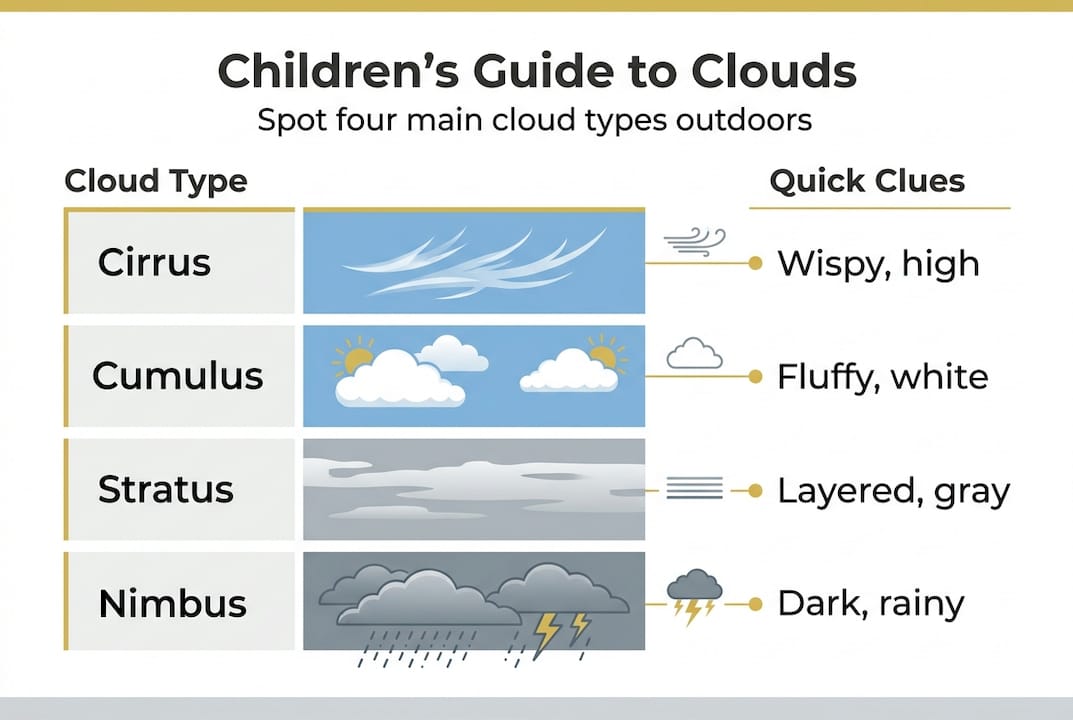
The Met Office cloud spotting guide is a brilliant resource if you want to go deeper, but for most family outings, this table is more than enough to get started.
Pro Tip: Turn cloud naming into a points game. Give your child a point for each type they correctly identify on a walk. First to five points earns a treat. It makes the learning stick without feeling like a lesson.
For more ideas on turning the outdoors into a classroom, browse our outdoor science activities or explore educational outdoor play ideas that work for this age group.
How do clouds form? Simple explanations for curious kids
Once your child can name the clouds, the next question is almost always: “But where do they come from?” It’s one of the best questions a child can ask, and the answer is genuinely fascinating once you strip away the jargon.
Clouds form through evaporation, rising air, cooling, and condensation onto tiny particles in the atmosphere. That’s the science in one sentence. But for a curious seven-year-old, a four-step story works much better.
The four steps of cloud formation:
- Evaporation: The sun heats water in puddles, rivers, and the sea. That water turns into invisible water vapour and rises into the air. Ask your child: “Have you ever seen a puddle disappear after rain? That’s where the water went!”
- Rising air: Warm air is lighter than cool air, so it floats upward, carrying the water vapour with it. Blow warm breath onto a cold window and watch the mist appear. Same idea.
- Cooling: As the air rises higher, it gets colder. Cold air can’t hold as much water vapour as warm air, so the vapour starts to change.
- Condensation: The vapour clings to tiny dust or pollen particles in the air and turns into microscopic water droplets or ice crystals. Billions of these droplets together form a cloud.
| Step | What happens | Everyday analogy |
|---|---|---|
| Evaporation | Water turns to vapour | Puddle drying after rain |
| Rising | Warm air carries vapour up | Steam rising from a hot drink |
| Cooling | Air gets colder at height | Breath fogging in winter |
| Condensation | Droplets form on particles | Mirror steaming after a shower |
For a brilliant hands-on experiment, hold a warm cup of tea near a cold window on a chilly morning and watch the steam condense. It’s a miniature cloud forming right in your kitchen. Children find this genuinely magical, and it makes the outdoor experience richer when they understand what they’re looking at.
For more ways to bring science outside, our outdoor science experiments page has plenty of ideas to keep curious minds engaged. You can also explore more cloud facts to answer those follow-up questions that always come.
Fun outdoor activities for learning cloud types
With the basics and science at hand, you’re ready to turn cloud learning into real outdoor adventures. These activities are low-cost, easy to organise, and genuinely enjoyable for children aged 5 to 10.
Four outdoor activities to try this week:
- DIY cloud spotter: Cut a square window into a piece of cardboard and glue printed images of the four cloud types around the frame. Your child holds it up to the sky and matches what they see to the pictures. Making a cloud spotter and going on sky hunts is one of the most effective ways to make cloud identification stick for young learners.
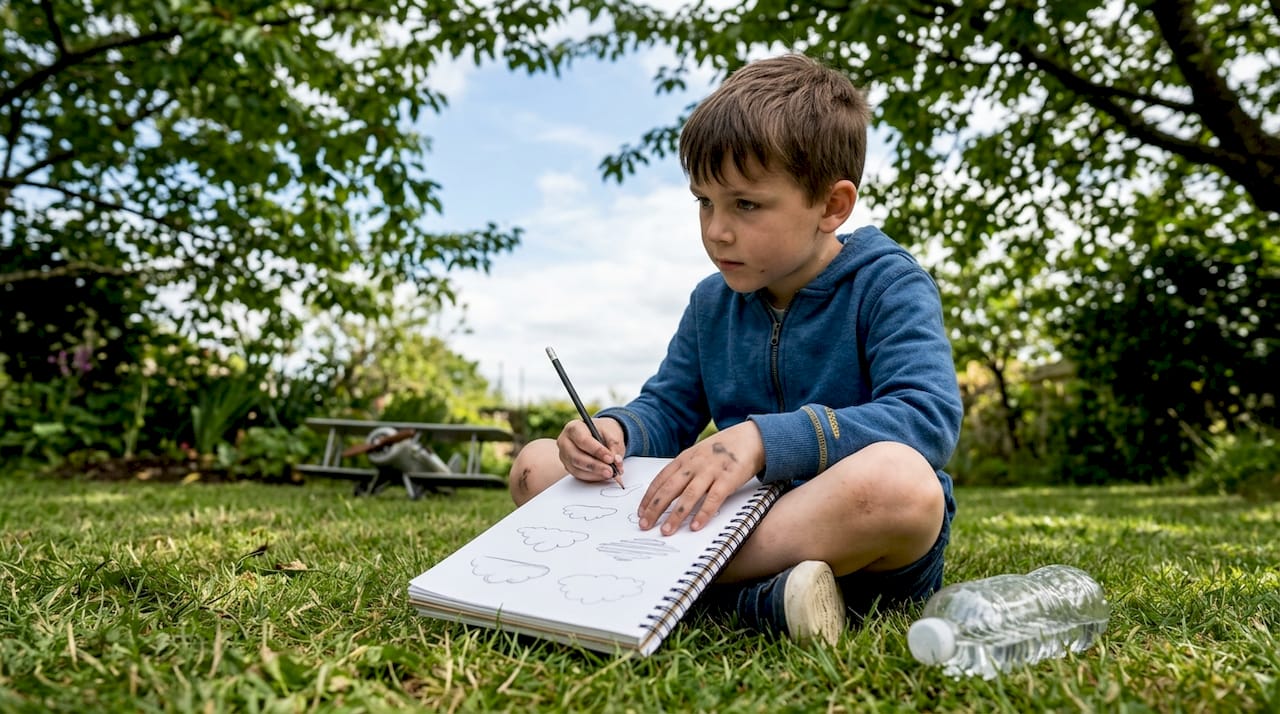
- Cloud drawing journal: Bring a sketchbook and pencils on your next walk. Ask your child to draw the clouds they see and label them. Over several weeks, they’ll start to notice patterns, like which clouds appear before rain.
- Cotton ball cloud models: Back at home, use cotton wool balls and blue card to recreate the clouds your child spotted outside. This craft reinforces what they saw and gives them something to display proudly. Our recycled art projects page has similar ideas that use simple materials.
- Weather prediction challenge: Before heading out, ask your child to look at the clouds and predict the weather for the afternoon. Keep a simple tally of correct predictions over a month. Children love being right, and it builds genuine meteorological thinking.
For each activity, you’ll need very little. A notebook, some pencils, a piece of cardboard, and cotton wool are enough to cover all four. The real ingredient is time outdoors together.
Pro Tip: Combine your cloud walk with a nature scavenger hunt. Ask your child to find one thing on the ground that matches each cloud type, something wispy like a feather for cirrus, something round and fluffy for cumulus. It doubles the engagement and keeps younger children moving.
For more outdoor play inspiration and creative ideas, we’ve gathered plenty of resources to help you plan your next adventure. You can also find additional cloud learning tips to extend the activities further.
Why simplifying cloud types launches a lifelong love of nature
Here’s something most cloud guides won’t tell you: introducing all ten official cloud genera to a six-year-old is one of the fastest ways to kill their interest in the sky. We’ve seen it happen. A parent, enthusiastic and well-prepared, arrives with a laminated chart of every cloud classification. Within ten minutes, the child is looking at their shoes.
The Met Office recommends starting with three basic cloud families and adding detail gradually, using mnemonics and songs to make names memorable. That approach works because it prioritises wonder over taxonomy.
At The Zoofamily, we believe the goal of any outdoor learning activity isn’t to produce a junior meteorologist. It’s to create a child who looks up. A child who notices. A child who asks “why?” and feels confident enough to guess an answer. That habit, formed early through simple, joyful experiences outdoors, is what grows into a genuine love of nature.
The most powerful moments don’t come from lists. They come from a child grabbing your sleeve on a Tuesday afternoon and whispering, “Mum, those are cumulonimbus. We should probably go inside.” Explore more outdoor learning ideas to keep building that instinct.
Take your family’s learning further with The Zoofamily
Cloud spotting is just the beginning. At The Zoofamily, we believe every outdoor moment is a chance to spark curiosity, build confidence, and deepen your child’s connection to the natural world.
Our resources are designed with exactly this in mind: helping mums like you turn ordinary walks into extraordinary learning experiences. Whether you’re looking for more exciting science activities to try together or exploring our range of nature-inspired tools for curious kids, you’ll find everything you need to keep the adventure going. For every camera we sell, we plant one tree, because we believe in a world where natural beauty is there for your children’s children to discover too.
Frequently asked questions
Which cloud types should I introduce to children first?
Start with Cirrus, Cumulus, and Stratus for children aged 5 to 10, as these three are visually distinct and easy to explain without overwhelming young learners.
How can I make cloud spotting interesting for children?
Use a DIY cardboard cloud spotter, drawing journals, and cotton ball crafts to make cloud identification hands-on and genuinely fun rather than a passive exercise.
Is outdoor cloud watching actually educational?
Empirical studies show that outdoor activities like cloud watching have measurable positive effects on children’s science motivation, curiosity, and academic achievement in primary school years.
What age is best to start teaching about clouds?
Ages 5 to 10 are ideal for introducing the four basic cloud types, with more detailed classifications added naturally as children grow older and more confident.