

The best water play ideas you can set up right now are: ice excavation, water painting, a DIY water wall, a sensory water bin, sink-or-float experiments, sponge transfer relay, water bottle spray painting, and a kiddie pool treasure hunt. Each one takes under ten minutes to prepare and uses items you likely already have at home or in your setting.
Here is a quick summary of why each works:
- Ice excavation — builds fine motor skills and introduces temperature science
- Water painting — low-mess, calming, and supports mark-making
- Water wall — teaches gravity and problem-solving (STEM activity)
- Sensory water bin — multi-sensory, language-rich, and endlessly adaptable
- Sink-or-float — introduces early science prediction and vocabulary
- Sponge transfer relay — develops hand-eye coordination and gross motor control
- Spray bottle target painting — fine motor and creative expression combined
- Kiddie pool treasure hunt — supports counting, sorting, and social play
Safety first: Constant, arm’s-reach adult supervision is required whenever children are near water. Empty every container immediately after play. Apply sunscreen and hats for outdoor sessions, and schedule play outside peak UV hours.
To get started now, pick ice excavation. You need: a freezer-safe container, small plastic animals or coins, and a bowl of warm water.
Key takeaways
Water play activities for toddlers and preschoolers deliver broad EYFS coverage, require minimal materials, and are safe when containers are emptied immediately after every session.
| Point | Details |
|---|---|
| Start with one activity | Ice excavation or a sensory bin needs only three items and takes under ten minutes to set up. |
| Use everyday materials | Funnels, sponges, spray bottles, and food colouring cover most activities and cost very little. |
| Supervise at arm’s reach | Constant adult supervision is required; children can drown in one to two inches of water. |
| Empty containers immediately | Drain every tub, pool, and tray the moment the session ends, without exception. |
| Link play to one EYFS goal | Choose one area per session — science, language, or motor — and use one open question to extend it. |
Table of Contents
- What are the best water play ideas to try today?
- How do you set up water play indoors and outdoors?
- What safety rules apply to water play?
- How does water play support EYFS learning goals?
- How do you manage mess and keep set-up quick?
- A practical note on running a session
- Sources
What are the best water play ideas to try today?
These eight activities cover the full range of water play activities — sensory, motor, literacy, and science — and each one is repeatable with minimal cost.
Ice excavation
Fill a container with water, drop in small plastic animals, coins, or pebbles, and freeze overnight. Set it out with warm water, pipettes, and small brushes. Children chip, pour, and squeeze to free the objects.
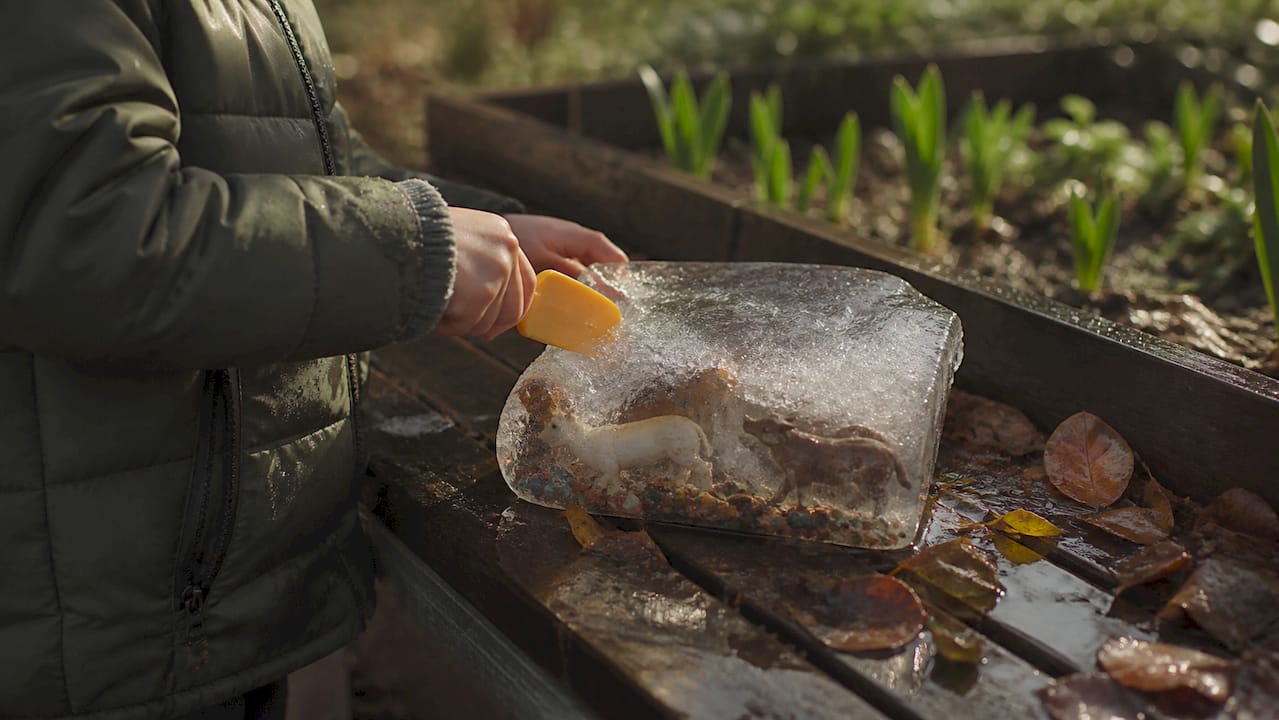
Materials: Freezer-safe tub, small objects, warm water, pipettes, brushes UK sourcing tip: Pound shops stock pipettes and small brushes cheaply; charity shops are good for plastic animals. Age adaptation: Toddlers enjoy pouring warm water freely. Preschoolers can predict which tool melts ice fastest. EYFS link: Understanding the World — temperature, change of state, prediction.
Freeze-and-excavate activities reliably capture attention and create easy science lessons about temperature and melting that extend naturally into measurement and prediction prompts.
Water painting
Give children large paintbrushes and a bucket of plain water. They paint fences, paving slabs, or large sheets of paper. The “painting” disappears as it dries, so the activity resets itself.
Materials: Large paintbrushes, buckets, water, optional food colouring UK sourcing tip: Wilko and most garden centres sell decorating brushes for under £1 each. Age adaptation: Toddlers paint freely. Preschoolers can try copying shapes or letters. EYFS link: Expressive Arts and Design; Communication and Language (naming colours, shapes).
DIY water wall
Fix rain gutters, PVC pipe sections, or cut plastic bottles to a fence or wooden board at different angles. Pour water in at the top and watch it travel down. Children rearrange the sections to change the flow.
Materials: Gutters or PVC offcuts, cable ties, a wooden board or fence, jugs UK sourcing tip: Screwfix and B&Q sell short gutter sections cheaply; recycled bottles cost nothing. Age adaptation: Toddlers pour and observe. Preschoolers adjust angles and predict where water will go. EYFS link: Understanding the World (gravity, flow, cause and effect).
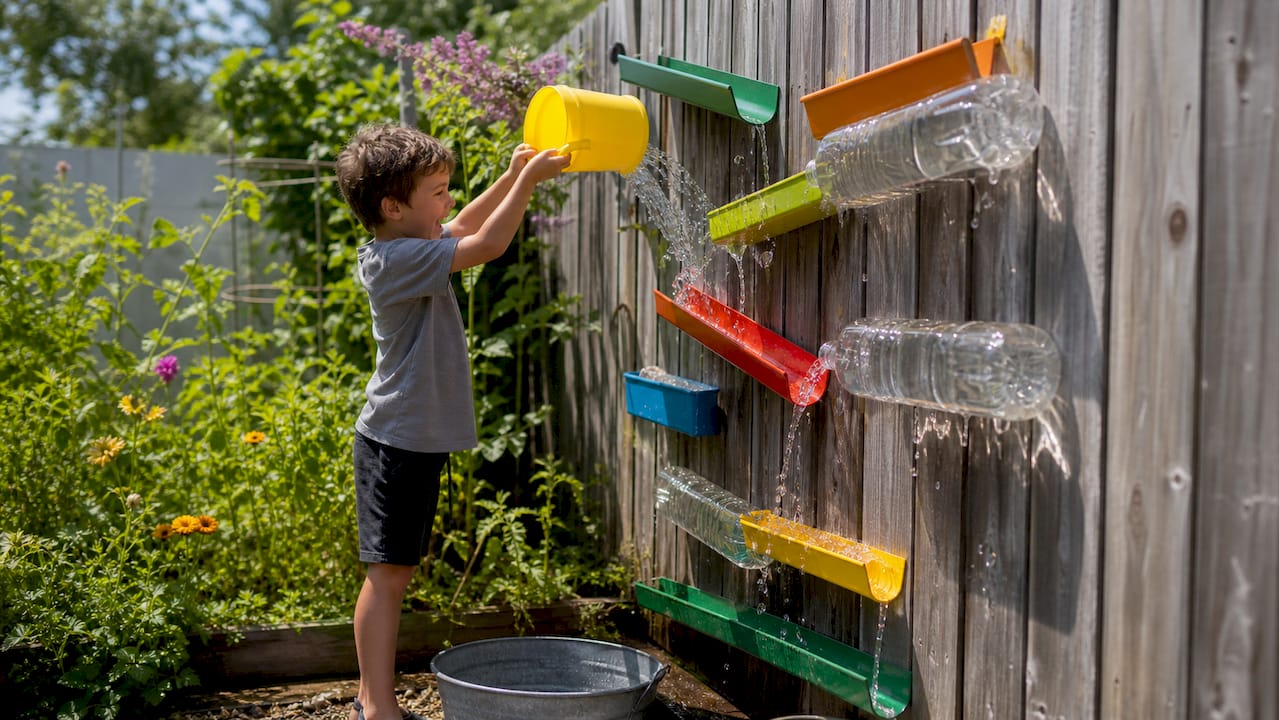
Water walls built from gutters and recycled bottles are low-cost STEM activities that teach gravity and problem-solving and are easy to reconfigure as children’s skills grow.
Sensory water bin
Fill a large tray or storage box with water. Add natural items: pebbles, leaves, herbs, lemon slices. Include scoops, funnels, and small containers. Children explore freely.
Materials: Large storage tray, natural objects, scoops, funnels, small cups UK sourcing tip: IKEA TROFAST boxes and supermarket storage tubs work well and stack flat. Age adaptation: Toddlers scoop and pour. Preschoolers sort objects by size, weight, or texture. EYFS link: Communication and Language (describing textures, smells); Physical Development (fine motor pouring).
Turning a water tray into a themed “potion station” or “car wash” using everyday items sustains focus and deepens language use, according to PBS KIDS for Parents.
Learning prompt: Ask “What does the lemon smell like?” or “Which one feels rough?” to build descriptive vocabulary during play.
Sink-or-float experiments
Collect a mix of objects: a cork, a stone, a sponge, a coin, a leaf, a plastic lid. Children predict, then test, then sort into “sinks” and “floats” groups.
Materials: Large bowl or tray of water, mixed household objects, two sorting trays or labels UK sourcing tip: No purchase needed — raid the kitchen drawer and garden. Age adaptation: Toddlers drop and watch. Preschoolers predict before testing and record results with drawings. EYFS link: Understanding the World (buoyancy, scientific method); Mathematics (sorting, classifying).
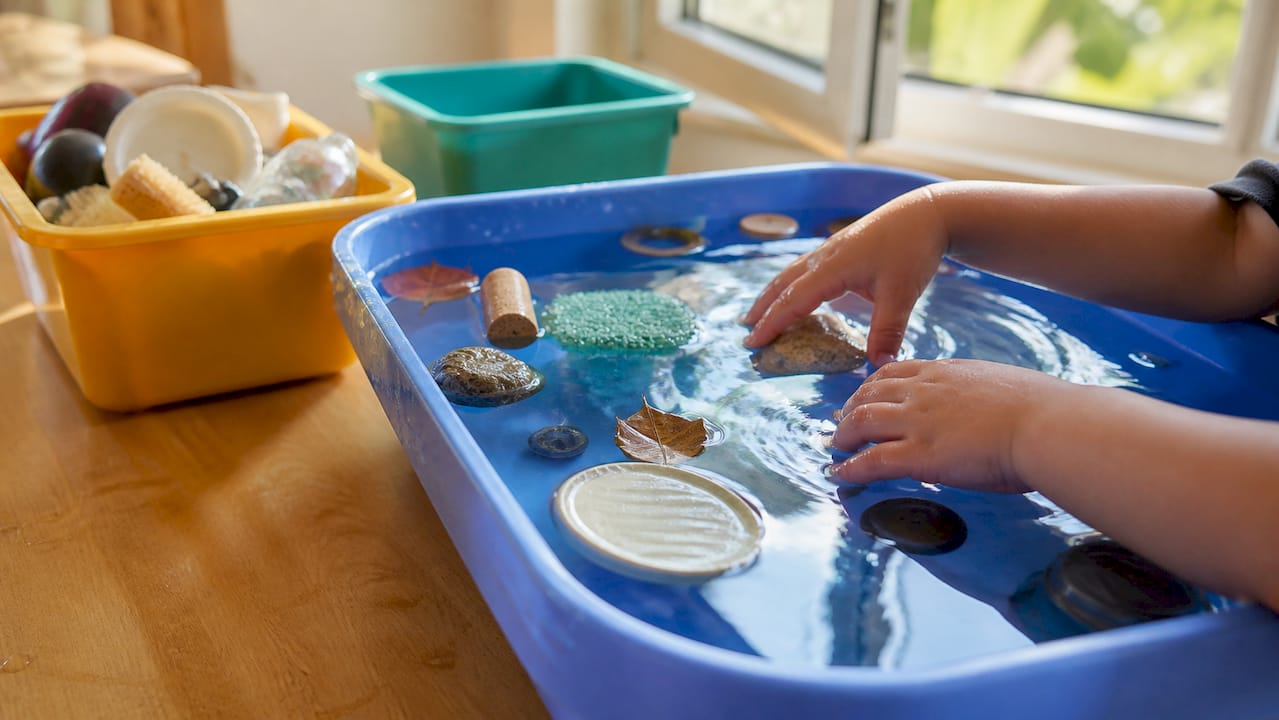
Water play supports early maths and science concepts including volume and buoyancy, and sink-or-float is one of the clearest ways to make those concepts visible to young children.
Sponge transfer relay
Place two buckets a short distance apart. Children squeeze a soaked sponge to transfer water from one bucket to the other. Time it, race a partner, or set a fill-line target.
Materials: Two buckets, large sponges, water UK sourcing tip: Supermarket car-wash sponges are large, cheap, and durable. Age adaptation: Toddlers squeeze freely without the relay structure. Preschoolers enjoy the timed challenge. EYFS link: Physical Development (gross and fine motor, bilateral coordination); Personal, Social and Emotional Development (turn-taking, persistence).
Spray bottle target painting
Tape large sheets of paper to a fence or wall. Fill spray bottles with water mixed with a few drops of food colouring. Children spray at targets, mix colours, or try to write their initial.
Materials: Spray bottles, food colouring, paper, tape UK sourcing tip: Pound shops and supermarkets sell trigger spray bottles for around £1. Age adaptation: Toddlers spray freely. Preschoolers aim at drawn targets or try colour mixing. EYFS link: Expressive Arts and Design; Physical Development (hand strength, trigger control).
Spray and squeeze activities reliably support sensory development, fine motor skills, and sustained engagement for toddlers and preschoolers.
Kiddie pool treasure hunt and boat races
Drop numbered or coloured objects into a paddling pool. Children fish them out with nets or spoons, count them, and sort by colour. For boat races, fold paper boats and blow or fan them across the pool.
Materials: Paddling pool, small objects, nets or slotted spoons, paper for boats UK sourcing tip: Supermarkets stock paddling pools from around £5 in summer; pound shops carry fishing nets. Age adaptation: Toddlers retrieve and sort. Preschoolers count, order by number, and race boats. EYFS link: Mathematics (counting, sorting); Communication and Language (following instructions, describing).
A wide range of outdoor water activities — including pool treasure hunts and water gun races — can be scaled by age and work well for family or group play.
Materials overview
| Item | Used in |
|---|---|
| Scoops and funnels | Sensory bin, water wall, sink-or-float |
| Spray bottles | Target painting, water wall |
| Food colouring | Water painting, spray painting, sensory bin |
| Sponges | Sponge relay, sensory bin |
| Pipettes | Ice excavation, sensory bin |
| Buckets | Sponge relay, water painting, treasure hunt |
| Nets and slotted spoons | Treasure hunt, sink-or-float |
| Freezer-safe tubs | Ice excavation |
Water tables fitted with funnels and measuring cups support fine motor development, hand-eye coordination, and sensory awareness during both indoor and outdoor play.
Pro Tip: Set a closing ritual: five minutes before the session ends, tell children it is time to “empty the ocean.” Give each child a small jug to pour water into a drain or plant bed. It turns clean-up into part of the play.
How do you set up water play indoors and outdoors?
Shopping checklist
You do not need specialist equipment. These items cover most activities and last for years:
- Water tray or large storage box (IKEA, supermarkets, or pound shops)
- Funnels, scoops, and measuring cups (kitchen sections of supermarkets or pound shops)
- Spray bottles (pound shops, around £1 each)
- Buckets in two sizes (garden centres, supermarkets)
- Nets and slotted spoons (pound shops, kitchen aisles)
- Food colouring (supermarket baking aisle, under £1 per bottle)
- Large sponges (supermarket car-care section)
For a nature-inspired water play table, add pebbles, shells, leaves, and small animal figures to any of the activities above.
Indoor set-up
Lay a large tarpaulin or old shower curtain under the tray. Use a tray with raised sides to contain splashes. Warm the water slightly for toddlers under 18 months. Keep towels within reach and dress children in waterproof aprons or old clothes.
Tray height matters: for toddlers, a low tray on the floor is safer and more comfortable than a table-height setup.
Outdoor set-up
Choose a flat, shaded area. Avoid setting up on slippery decking without a non-slip mat. Use a groundsheet under the activity zone. For creative outdoor water play, a garden hose or water butt can refill containers without repeated trips indoors.
Hygiene and storage
Change water between sessions and after any child has been unwell. Rinse trays and toys with clean water after each use and allow them to dry fully before storing. Avoid shared mouth-contact items such as straws. Store equipment in stackable, labelled crates so set-up takes under two minutes next time.
Pro Tip: Pre-sort materials into labelled tubs — one for “pouring tools,” one for “science objects,” one for “art supplies.” Each tub becomes a self-contained activity kit.
What safety rules apply to water play?
Constant, arm’s-reach adult supervision is required for toddlers around water. This is not optional.
Key safety fact: Children can drown in as little as one to two inches of water. Empty every container immediately after play ends, without exception.
Drowning prevention
- Stay within arm’s reach of toddlers at all times during water play.
- Empty all containers the moment the session ends — do not leave filled trays unattended.
- Never leave children unsupervised near paddling pools, even briefly.
- Drain paddling pools after each use and store them upside down.
Hygiene
- Change water at the start of each session and whenever it becomes visibly dirty.
- Avoid shared mouth-contact items (straws, drinking cups used as play tools).
- Wash children’s hands before and after water play.
- Clean water trays and toys weekly with a mild disinfectant, then rinse thoroughly.
Sun safety for outdoor play
- Schedule outdoor sessions before 10:00 or after 16:00 to avoid peak UV hours.
- Apply SPF 30 or higher sunscreen 20 minutes before going outside.
- Use sun hats with a wide brim.
- Offer water to drink regularly — children playing in the sun dehydrate quickly.
For early years settings
- Follow your setting’s adult-to-child ratios at all times during water play.
- Assign one named adult as the water-play supervisor for each session.
- Store equipment behind a locked gate or in a closed cupboard when not in use.
- Record any incidents involving water in your setting’s accident log.
How does water play support EYFS learning goals?
Water play maps directly to five areas of the EYFS framework, and the connections are concrete rather than incidental.
Water play supports key EYFS learning outcomes by enabling children to explore scientific concepts like buoyancy and flow, build fine motor skills through pouring and squeezing, and develop language through themed, narrative play.
EYFS area by activity
- Communication and Language: Sensory bin (describing textures, smells), treasure hunt (following instructions), water painting (naming colours and shapes). Prompt: “Can you tell me what the water feels like today?”
- Physical Development: Sponge relay (gross motor, bilateral coordination), spray bottle painting (hand strength, trigger control), ice excavation (fine motor, pincer grip). Prompt: “Can you squeeze all the water out?”
- Understanding the World: Sink-or-float (prediction, buoyancy), water wall (gravity, cause and effect), ice excavation (temperature, change of state). Prompt: “What do you think will happen if we pour warm water on the ice?”
- Expressive Arts and Design: Water painting, spray bottle target painting, colour mixing. Prompt: “What colour did you make when you mixed those two?”
- Personal, Social and Emotional Development: Sponge relay (turn-taking), treasure hunt (sharing, cooperation), any group activity (negotiating roles). Prompt: “Whose turn is it to pour next?”
Pairing water play with literacy tasks — such as squirting letters with a spray bottle or searching for alphabet objects in a pool — supports vocabulary and phonics practice in age-appropriate ways.
Age differentiation: Toddlers benefit most from open-ended sensory exploration with no set outcome. Preschoolers are ready for prediction tasks, simple rules, and recording results through drawing or mark-making.
Sensory play supports child development across multiple domains simultaneously, which is why water activities deliver such broad EYFS coverage from a single session.
How do you manage mess and keep set-up quick?
Ground protection
Old towels, a tarpaulin, or a cheap shower curtain under the activity zone catch most splashes. For indoor sessions, a plastic-backed picnic blanket works well and wipes clean in seconds.
Timing and rotation
Run 15–20 minute stations rather than one long session. Children stay more focused, and you can rotate between activities without a full reset. A five-minute wind-down at the end — where children help empty containers — keeps the session structured.
Clothing
Dress children in old clothes or waterproof aprons before the session starts. Rash vests are useful for outdoor play in summer. Keep a bag of spare clothes nearby; wet children get cold faster than you expect, particularly in the UK.
Storage for small spaces
- Stackable plastic crates hold all equipment for one activity kit.
- Hanging buckets on a garden fence free up floor space.
- Flat storage trays slide under a bed or behind a sofa when not in use.
Pro Tip: Label each crate with a picture of the activity it contains. Children can help select and return kits independently, which builds responsibility and saves you time.
A practical note on running a session
Setting up a 20-minute water play session does not require much preparation. A low tray on the floor, warm water, three scoops, two funnels, and a handful of pebbles is enough for two toddlers to stay engaged for the full time. One adult can supervise comfortably at arm’s reach while sitting on a low chair beside the tray.
The learning outcome you observe most often is language: children narrate what they are doing, ask questions, and describe what they feel. That happens without any prompting when the materials are interesting and the adult is present and attentive.
For busy caregivers, the key is accepting that a simple set-up works. You do not need a specialist water table or expensive kit. A plastic storage box from a supermarket and a few kitchen utensils deliver the same developmental value. Thezoofamily’s early years water play ideas show how nature-connected materials — shells, pebbles, animal figures — add depth without adding cost.
Sources
These sources were used to compile this article. Each one is worth bookmarking for safety guidance, EYFS references, or activity ideas.
- Playing With Water | PBS KIDS for Parents
- Water play — NAPA Center
- 15 backyard water play ideas for hot summer days | Cresthill Academy
- DIY water wall for kids: How to build an easy water play wall | Little Bins for Little Hands
- 22 easy water activities for kids you can set up at home this summer | Parents
- Preschool water play activities | Pre-K Printable Fun
- 10 water activities for preschoolers that merge learning with play | Moving Little Minds