

Every parent faces the challenge of choosing toys that genuinely nurture their child’s curiosity and sense of wonder. For eco-conscious families in Western Europe, the decision is about more than just fun—it’s about supporting growth in a way that aligns with your values. Imaginative play offers young children the chance to explore, create, and build environmental awareness naturally, while providing meaningful alternatives to screen-based entertainment. This guide illuminates how thoughtful choices can spark creativity and connect your child to the world around them.
Table of Contents
- Defining Imaginative Play In Early Childhood
- Types And Examples Of Imaginative Play Activities
- Why Unstructured Outdoor Play Matters
- Cognitive, Social, And Emotional Benefits Unpacked
- Nurturing Nature Connection Through Play
- Common Pitfalls And Supporting Healthy Play
Key Takeaways
| Point | Details |
|---|---|
| Imaginative Play Drives Development | Imaginative play is crucial for cognitive, social, and emotional growth, allowing children to explore concepts in a safe environment. |
| Child-Led Creativity is Essential | The best imaginative play is self-directed, encouraging children to set their own scenarios and rules without adult interference. |
| Natural Materials Foster Imagination | Providing open-ended materials and opportunities for unstructured play supports creativity much more than structured toys or activities. |
| Nurturing Outdoor Exploration | Unstructured outdoor play enhances imaginative thinking and encourages a lasting connection to nature, fostering environmental awareness. |
Defining Imaginative Play in Early Childhood
Imaginary play is far more than pretend games or dressing up in costumes. It’s a fundamental developmental process that begins early in infancy and shapes how your child understands the world around them.
At its core, imaginative play involves your child perceiving ordinary objects as something entirely different. A wooden spoon becomes a microphone, a cardboard box transforms into a spaceship, and a pile of blankets creates an enchanted forest. This ability to mentally shift what objects represent is a critical developmental milestone.
Research shows that infants and toddlers are capable of engaging in imaginary play, challenging older assumptions that only older children could do this. Your toddler is already exercising imagination, even if it looks subtle or unstructured.
What Makes It Imaginative Play?
Imaginary play differs from other types of play because it requires your child to take control. They decide the rules, set the story, and determine what happens next. This self-direction is essential—your child drives the experience, not an adult or a structured game.
Key characteristics include:
- Child-led direction and control over the play scenario
- Use of symbolic thinking (objects representing something else)
- Intrinsic motivation—your child plays because they want to, not for reward
- Flexibility and creativity in problem-solving within the play context
- Engagement with abstract ideas and possibilities
Unlike structured activities with predetermined outcomes, imaginative play thrives on open-endedness. There’s no “right way” to play.
How It Develops From Birth
Play is widely recognised as a vehicle for learning in early childhood, characterised by intrinsic motivation and self-direction. This development happens gradually across the first few years.
Your newborn engages in sensory exploration. By 18 months, they might pretend to drink from an empty cup. By age three, they orchestrate complex scenarios with multiple characters and plotlines. This progression reflects growing cognitive capacity and creative confidence.
The beauty? Your child doesn’t need fancy toys or structured lessons to develop this skill. Natural materials, open-ended objects, and unstructured time outdoors create ideal conditions for imaginative play to flourish.
Imaginative play isn’t something you teach your child—it’s something you create space for them to discover naturally.
Pro tip: Observe your child’s imaginative play without directing it. Resist the urge to “improve” their stories or suggest what should happen next. Your quiet presence and genuine interest in what they’re creating builds confidence far more than your participation would.
Types and Examples of Imaginative Play Activities
Imaginary play comes in many forms, each supporting different developmental areas. Understanding the various types helps you recognise what your child is doing and how to support their creativity.
Dramatic play is when your child acts out everyday scenarios. They might pretend to cook dinner, run a shop, or care for a baby doll. This mirrors real-world experiences and helps them process what they observe.
Role play takes this further by having your child adopt a specific character or profession. They become a veterinarian, firefighter, teacher, or parent. Role play builds confidence and helps children explore different perspectives and responsibilities.
Socio-dramatic play involves multiple children creating shared imaginary worlds together. Two children might collaborate on a restaurant scenario, negotiating roles and storylines. This develops crucial social and communication skills as they navigate shared narratives.
Below is a summary of the main types of imaginative play and their unique advantages:
| Type of Play | Typical Scenario | Main Developmental Benefit | Social Impact |
|---|---|---|---|
| Dramatic Play | Acting out daily life situations | Builds real-world understanding | Encourages role negotiation |
| Role Play | Adopting specific professions/characters | Boosts self-confidence and empathy | Fosters perspective taking |
| Socio-dramatic Play | Collaborative story creation | Strengthens communication and planning | Develops teamwork skills |
Real-World Examples for Your Family
Dramatic play, role play, and socio-dramatic play all involve symbols, role-taking, and narrative expression. Your child might transform your living room into a camping adventure one afternoon and a hospital the next.
Here’s what imaginative play looks like in practice:
- Building a “shop” from cushions and selling imaginary groceries
- Playing house with siblings or friends using blankets as walls
- Creating characters and acting out stories with toy animals
- Pretending everyday objects have magical properties
- Staging performances with stuffed animals as audience members
- Playing restaurant, hotel, or school with family members
These activities aren’t just entertainment. Symbolic use of objects and imaginative storytelling help develop cognitive and social skills as children experiment with new meanings.
Why Unstructured Outdoor Play Matters
Nature provides endless possibilities for imaginative play. Sticks become wands, leaves transform into currency, and a patch of grass becomes an entire kingdom. Outdoor play activities inspire creative thinking more effectively than structured indoor games.
Your child’s imagination flourishes when given natural materials and open space. No script, no instructions, no predetermined outcomes.
The richest imaginative play happens when children have time, freedom, and natural materials—not adult direction or educational objectives.
Pro tip: Provide open-ended materials like cardboard boxes, blankets, natural objects, and recycled items rather than toys with preset functions. Your child will create far more imaginative scenarios with a stick and some stones than with a boxed game.
Here is a comparison of indoor versus outdoor imaginative play environments:
| Setting | Materials Used | Creative Opportunities | Environmental Connection |
|---|---|---|---|
| Indoor | Blankets, boxes, soft toys | Limited by space and items | Minimal nature contact |
| Outdoor | Sticks, leaves, stones | Boundless possibilities | Builds nature appreciation |
Cognitive, Social, and Emotional Benefits Unpacked
Imaginary play isn’t just entertainment—it’s your child’s brain building itself from the inside out. When your child engages in pretend scenarios, they’re developing skills that shape their entire future.
The Cognitive Payoff
Play-based learning fosters cognitive development through exploration and problem-solving. Your child learns to think flexibly, adapting their ideas when scenarios shift or obstacles appear.
When your child pretends to run a shop, they’re practising mental maths, decision-making, and planning. They imagine a customer, decide what the “customer” wants, and negotiate prices. This executive function development happens naturally through play.
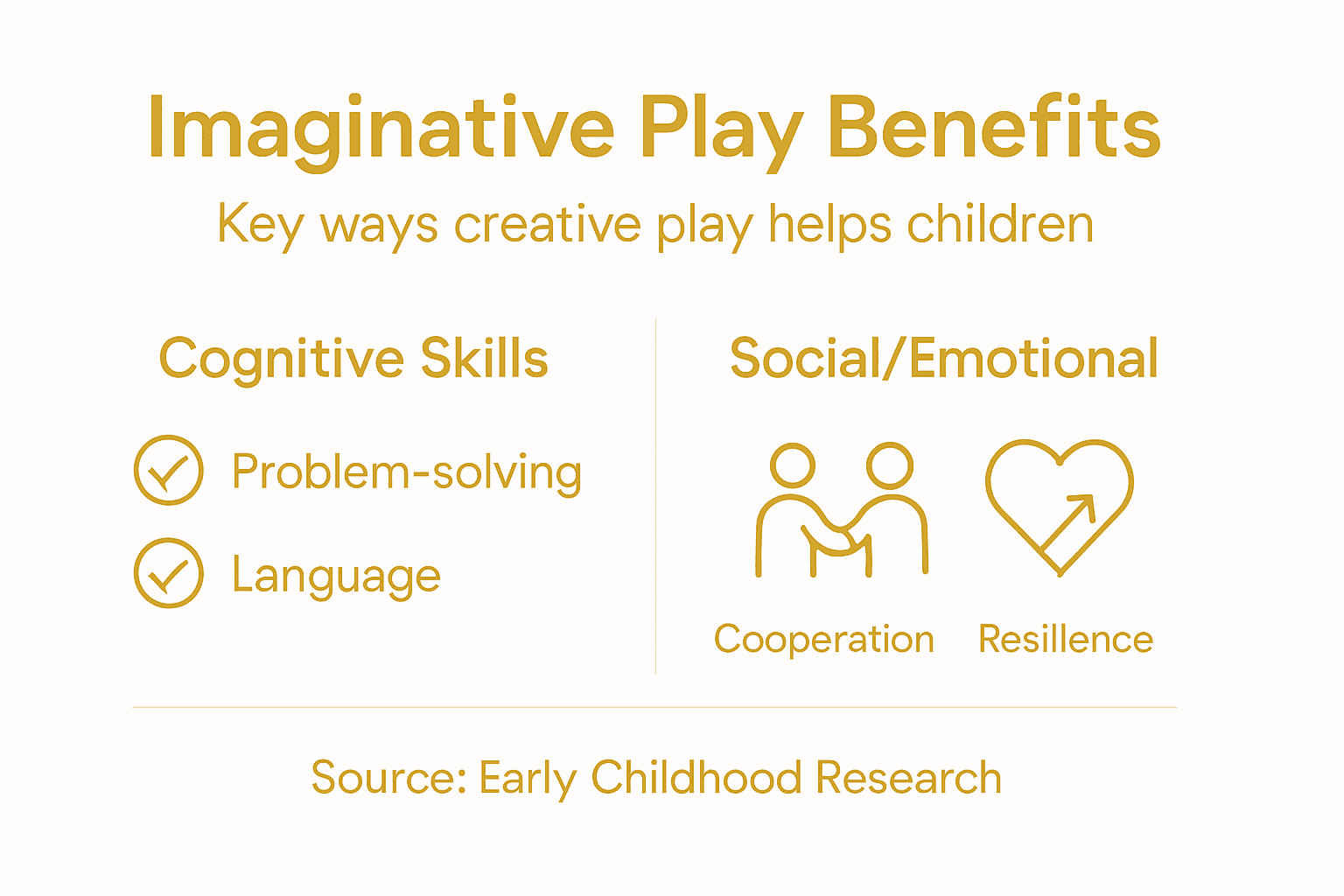
Language skills flourish too. Your child invents dialogue, narrates stories, and experiments with new vocabulary in context. They use words they’ve heard adults use, testing them out safely within their imaginary worlds.
Key cognitive gains include:
- Problem-solving and creative thinking
- Attention and memory strengthening
- Abstract thinking and symbolic reasoning
- Planning and sequencing abilities
- Language expansion and communication
Social Benefits That Last
When your child plays with others, they’re learning negotiation without realising it. Two children creating a shared story must compromise, listen, and adapt their ideas. This builds perspective-taking and genuine empathy.
Your child discovers that others have different thoughts and feelings. They learn cooperation naturally—not because an adult insisted, but because collaboration makes the play better.
These early social skills become the foundation for friendships, teamwork, and later academic success.
Emotional Resilience Through Play
Imaginary play gives your child a safe space to process emotions. They might replay a scary doctor’s visit through play, gradually building confidence. They experience small challenges, solve them, and build emotional regulation skills.
Your child learns that feelings are manageable. Scared? Play it out as a brave character. Sad? Work through it in a story. This isn’t suppressing emotions—it’s developing healthy ways to understand and express them.
Play is how children make sense of their world and build confidence to handle real challenges.
Benefits in emotional development:
- Building resilience and coping strategies
- Expressing emotions safely
- Developing self-confidence
- Processing experiences and fears
- Understanding cause and effect in relationships
Pro tip: _Don’t interrupt your child’s imaginative play to teach lessons or correct their “facts.” Let them explore, fail, and problem-solve independently. Your quiet observation and genuine interest matter far more than your guidance.
Nurturing Nature Connection Through Play
Nature isn’t just a backdrop for play—it’s essential to developing your child’s relationship with the environment. When your child imagines adventures in forests, gardens, or wild spaces, they’re building lifelong environmental awareness.
This matters deeply for eco-conscious families. Your child’s early connection to nature shapes whether they’ll become someone who values and protects our planet.
How Nature Play Transforms Children
Nature-based play environments support well-being through engagement and growth. Unstructured time outdoors allows your child to experience genuine challenge, discovery, and calm simultaneously.
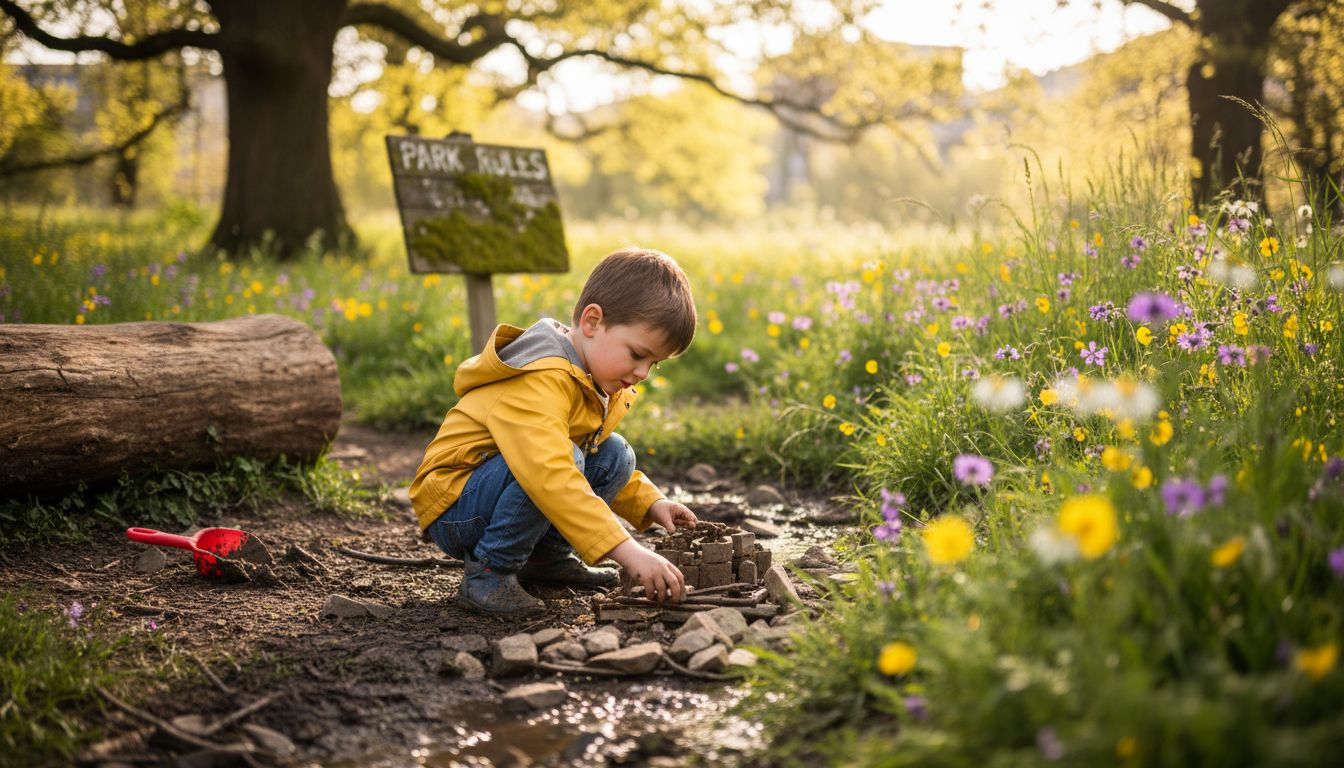
When your child plays in natural spaces, they’re not just having fun. They’re developing environmental stewardship—the sense that nature matters and deserves care.
Benefits your child gains:
- Genuine curiosity about plants, insects, and ecosystems
- Sense of belonging and connection to place
- Emotional calm and reduced stress
- Physical fitness and sensory development
- Understanding of seasons and natural cycles
- Motivation to protect wild spaces
Biodiversity and Psychological Well-being
Children’s interaction with biodiversity during nature play enhances environmental connection. When your child encounters diverse plants, animals, and habitats, they develop richer understanding of ecology.
A child who plays among wildflowers, observes insects, and explores different outdoor spaces develops stronger environmental identity than one who plays only in manicured parks.
Access to natural play environments also improves psychological well-being. Your child experiences genuine exploration, not predetermined activities with outcomes adults control.
Imaginative Play in Nature Spaces
Nature provides endless materials for imagination. Sticks become walking sticks for forest expeditions. Stones become treasure. A hillside becomes a dragon’s lair. Your child’s creativity flourishes without manufactured toys limiting possibilities.
Raising eco-conscious kids through nature play teaches values through experience, not lecture. Your child learns environmental care by playing in spaces worth protecting.
This natural learning sticks. Your child who builds fairy houses with fallen branches, creates stories about pond creatures, and explores woodlands develops authentic environmental values.
The strongest environmental stewards are children who fell in love with nature through play, not instruction.
Pro tip: Take your child to wild or semi-wild spaces regularly, even if they’re overgrown or “untidy.” Manicured gardens are beautiful, but natural playgrounds teach children how real ecosystems work and spark genuine curiosity about biodiversity.
Common Pitfalls and Supporting Healthy Play
The line between supporting play and controlling it is thin. Many well-meaning parents accidentally undermine imaginative play by trying to improve it. Understanding what harms play helps you protect it.
The Adult-Led Trap
Adult-led play without child control undermines the benefits of imaginative play. When you direct the scenario, set the rules, or correct your child’s “facts,” you’ve shifted ownership from them to you.
Your child stops playing their story and starts performing yours. This kills intrinsic motivation—the very engine that makes play powerful.
Common ways adults accidentally take over:
- Suggesting what should happen next in the story
- Correcting pretend facts (“That’s not how a real shop works”)
- Imposing your ideas about how the play should develop
- Setting time limits or stopping play abruptly
- Interrupting to teach lessons or educational content
- Judging the play as “not creative enough”
The Screen and Structure Problem
Too much structured activity leaves no space for imaginative play. Your child moves from school to piano to sports to screen time. When does genuine play happen?
Screens present a different problem. They provide passive entertainment masquerading as play. Your child watches instead of imagining, consumes instead of creates.
Healthy play requires unscheduled time. Boring moments are when imagination sparks.
Supporting Play Without Controlling It
Your role is facilitation, not direction. You create conditions for play, then step back. This means:
- Providing open-ended materials (boxes, blankets, sticks, stones)
- Offering uninterrupted time outdoors and indoors
- Being physically present without directing
- Showing genuine interest by observing and listening
- Answering questions without “improving” the play
- Resisting the urge to teach during play
When your child asks you to join, follow their lead completely. Play their character, accept their rules, ask questions about their world. Your participation matters only if they control the narrative.
The best thing you can do for imaginative play is nothing at all—just protect the time and space where it happens naturally.
Your presence matters differently than your participation. A parent reading nearby, available if needed, gives security without control.
Pro tip: When your child’s play seems “boring” or repetitive, resist the urge to suggest improvements. They’re working through something important. Repetition builds confidence and mastery. Your job is protecting uninterrupted time, not enriching it.
Ignite Your Child’s Imagination and Connection to Nature Today
The article highlights how imaginative play is essential for your child’s cognitive growth, emotional resilience, and social skills. Yet, one challenge parents face is providing the right open-ended tools that encourage intrinsic motivation and self-direction without adult control. You want to nurture your child’s creativity while fostering a genuine connection with nature—something that traditional toys or screen time cannot offer.
At The Zoofamily, we understand your goal to inspire open-ended, nature-inspired play. Our kids’ cameras, walkie-talkies, and binoculars serve as perfect imaginative play companions that encourage discovery and storytelling outdoors. Each product includes animal references designed to spark curiosity about wildlife and promote environmental stewardship from a young age. Plus, for every camera sold, we plant a tree, helping build a greener world for future generations.
Explore how you can support your child’s natural creativity and love for the planet by visiting The Zoofamily now. Discover tools created to enrich imaginative play without adult interference and give your child the freedom to explore, invent, and grow.
Frequently Asked Questions
What are the cognitive benefits of imaginative play for children?
Imaginative play fosters cognitive development by enhancing problem-solving skills, abstract thinking, and language expansion. When children engage in pretend scenarios, they exercise their ability to think flexibly and creatively.
How does imaginative play support social skills in young children?
Imaginative play encourages children to negotiate roles, cooperate with peers, and develop empathy through shared storytelling. These interactions lay the groundwork for strong social skills and future friendships.
Why is unstructured outdoor play important for imaginative play?
Unstructured outdoor play provides natural materials that stimulate creativity and imagination. Children use their surroundings to create scenarios, which helps them develop a deeper connection to nature and promotes environmental stewardship.
How can parents facilitate imaginative play without controlling it?
Parents can facilitate imaginative play by providing open-ended materials, uninterrupted time, and physical presence without directing the play. It’s essential to allow children to lead their imaginative scenarios to maintain their intrinsic motivation.
Recommended
- Understanding the Benefits of Imaginative Play – The Zoofamily
- Understanding the Benefits of Imaginative Play – The Zoofamily
- Understanding the Benefits of Imaginative Play – The Zoofamily
- Understanding the Benefits of Creative Play for Children – The Zoofamily
- Benefits of Nature Walks: Complete Guide - Lushy Gardens