

TL;DR:
- PMR446 license-free radios are the legal and safest choice for families in Europe.
- Establish simple routines like battery checks and regular check-ins to ensure safe usage.
- Teaching children about privacy and responsible communication builds trust and confidence.
Picture this: your child darts ahead on a forest trail, disappearing behind a cluster of trees. Your heart skips. Then their voice crackles through a small radio in your hand, cheerful and clear. That moment captures exactly why walkie talkies have become a firm favourite for families across Europe. They give children a genuine sense of freedom whilst keeping parents connected. But choosing the wrong model, skipping safety checks, or ignoring privacy risks can turn a brilliant tool into a headache. This guide covers everything you need, from legal requirements to daily routines, so your family can explore with confidence.
Table of Contents
- Choosing the right walkie talkies for children
- Essential pre-use checks and safe setup
- Safe communication habits and privacy tips
- Understanding radio safety and managing RF exposure
- Why trusting everyday routines beats chasing perfection
- Explore more family safety and outdoor tools
- Frequently asked questions
Key Takeaways
| Point | Details |
|---|---|
| Use PMR446 models | European families should choose only PMR446-compliant walkie talkies for legal and safe use. |
| Set clear safety routines | Always conduct pre-use checks and establish regular check-in times with your children. |
| Prioritise privacy | Remind children not to share personal information and use privacy codes where possible. |
| Trust everyday habits | Consistent routines create safer, more confident outdoor play than technology alone. |
Choosing the right walkie talkies for children
With the importance of safe communication established, let’s examine how to choose reliable equipment for your family. The single most important rule for European families is straightforward: always buy PMR446 licence-free radios, which operate on the 446 MHz band, use a fixed antenna, and are limited to 0.5W of power across 16 channels. These radios require no licence, work legally in every EU country, and are designed to be safe for everyday family use.
Pro Tip: Never buy US FRS or GMRS walkie talkies for use in Europe. These models operate on different frequencies and are illegal under EU radio regulations, even if they look identical to PMR446 sets.
Once you know the legal standard, the next step is matching features to your child’s age and typical outdoor environment. The table below shows what is required versus what is simply helpful.
| Feature | Required | Strongly recommended |
|---|---|---|
| PMR446 compliance | Yes | |
| Fixed antenna | Yes | |
| Max 0.5W power | Yes | |
| Drop-proof casing | Yes | |
| Water-resistant (IP-rated) | Yes | |
| Volume limiter | Yes | |
| Key-lock function | Yes | |
| VOX hands-free mode | Yes |
For younger children especially, a few features make a real difference in daily use. Kid-safe models are durable, drop-proof, water-resistant, and typically achieve a tested range of around 0.5 to 1 mile in suburban or park settings, which is more than enough for most family outings.
Here are the features worth prioritising when shopping:
- Volume limiter: Protects small ears from sudden loud bursts of static or sound
- Key-lock: Stops little fingers from accidentally changing the channel mid-adventure
- VOX hands-free mode: Lets children transmit without pressing a button, useful when they are climbing or carrying things
- IP-rated water resistance: Essential for muddy parks, rainy days, and forest trails
- Simple channel display: Large, clear numbers reduce frustration for younger users
Understanding how walkie talkies work helps you explain the basics to your child before heading out. You can also explore walkie talkie basics to build your own confidence as the supervising adult.
Essential pre-use checks and safe setup
Once you’ve chosen your walkie talkies, the next step is setting up safely before each use. A quick five-minute routine before leaving the house can prevent most common problems, from dead batteries to children wandering out of range without realising it.
Follow these steps every time you head outdoors with walkie talkies:
- Check battery levels on both units. Low batteries reduce range significantly and can cut out without warning.
- Confirm matching channels so both radios are tuned to the same frequency before you leave home.
- Set the same privacy code on each unit to reduce interference from other users nearby.
- Test volume and range with a short walk before play begins.
- Define the safe play zone clearly with your child, including boundaries they must not cross without checking in first.
- Agree on a check-in routine so children call in every 10 to 15 minutes, even if nothing is wrong.
Pro Tip: Run a quick range test with your child before starting play. Walk to the furthest point of the planned play area and confirm the signal is clear. This also doubles as a fun warm-up activity.
The table below compares sensible setup routines across three common outdoor settings.
| Setting | Suggested boundary | Check-in interval | Key concern |
|---|---|---|---|
| Park | Visible benches or paths | Every 10 minutes | Crowding and channel interference |
| Forest | Marked trail section | Every 10 to 15 minutes | Signal drop behind dense trees |
| Large garden | Garden perimeter | Every 15 minutes | Battery drain during long sessions |
For inspiration on making outdoor time genuinely exciting, outdoor play ideas are worth bookmarking before your next family adventure.
Safe communication habits and privacy tips
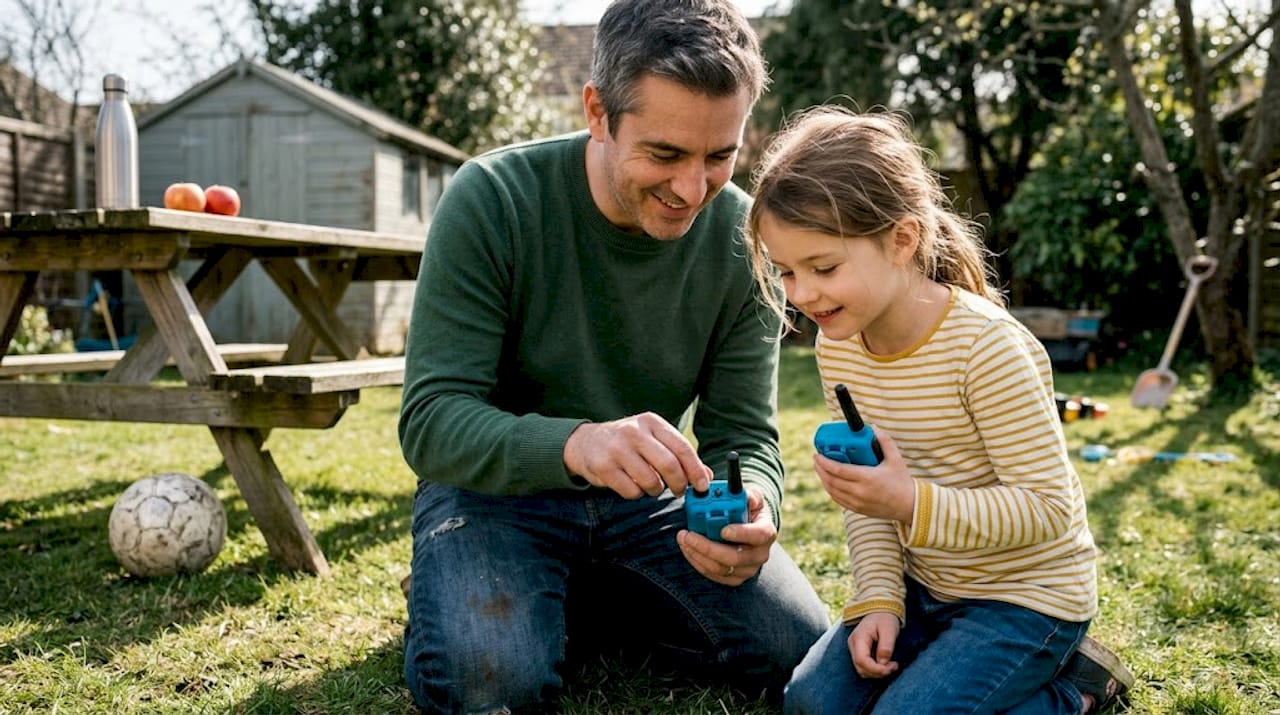
After initial setup, focus shifts to how children should communicate safely and protect their privacy whilst using walkie talkies. Open radio channels are exactly that: open. Anyone with a compatible radio on the same channel and privacy code can hear what is being said. That is not a reason to avoid walkie talkies, but it is a reason to be thoughtful.
Teach your child these clear rules before they pick up a radio:
- Never share full names, home addresses, or school names over the air
- Use a family codeword for emergencies so your child can signal distress discreetly
- Ignore strangers on the channel and switch to an alternative channel immediately if someone unfamiliar responds
- Keep conversations brief and practical: location updates and activity check-ins, not personal chats
- Always identify themselves to you using a simple agreed phrase rather than their real name
Important: Privacy codes on walkie talkies (known as CTCSS or DCS tones) filter out unwanted transmissions on your radio but do not encrypt your signal. Anyone scanning the channel can still hear you. Brief your children on this clearly and supervise usage accordingly.
If interference or an unfamiliar voice appears on your channel, the best response is simple: switch channels immediately, confirm the new channel with your child, and carry on. There is no need to engage. For families who want to read further on this topic, extra privacy guidance covers practical steps for managing open-channel communication safely.
For a broader look at why these tools matter for children’s development and confidence, walkie talkies for children is a helpful starting point.
Understanding radio safety and managing RF exposure
Having set communication routines, it’s equally important to understand how safe walkie talkies are from a radiation standpoint. This is one of the most common concerns we hear from parents, and the reassurance is genuine and evidence-based.
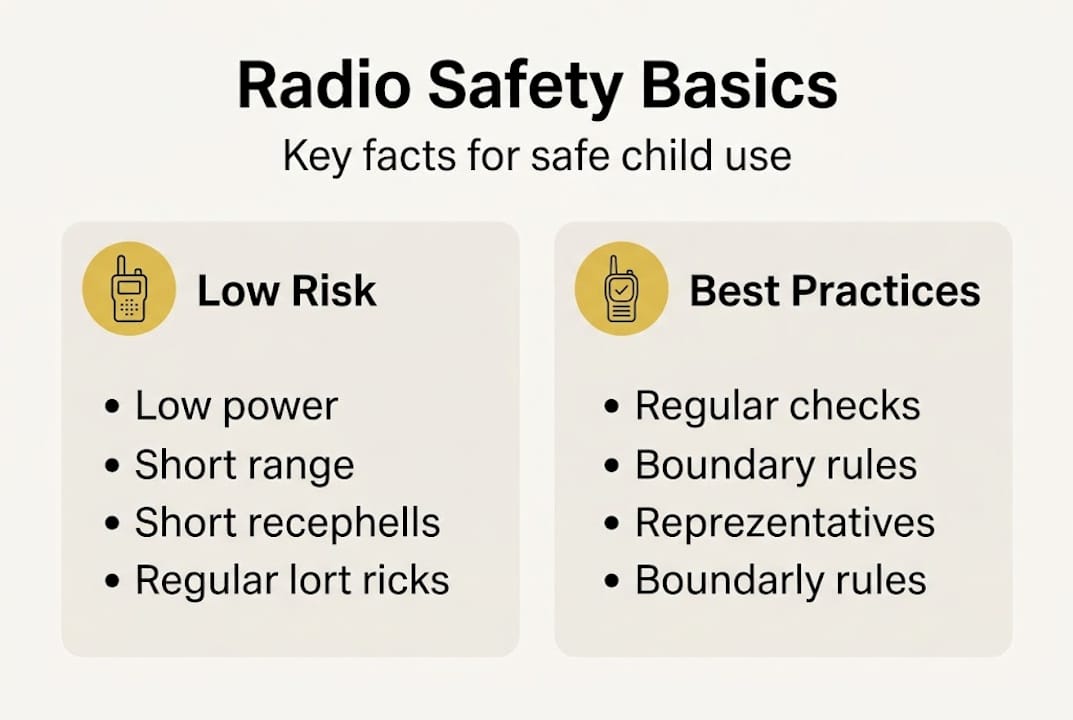
PMR446 walkie talkies operate at a maximum of 0.5W, which is considerably lower than a standard mobile phone. They comply fully with the EU Radio Equipment Directive (RED 2014/53/EU), which sets SAR (Specific Absorption Rate) limits at 2 W/kg for the head and 4 W/kg for the limbs. In practice, brief push-to-talk transmissions keep actual exposure well below these limits.
Here are straightforward habits that reduce RF exposure further, without any sacrifice to the fun:
- Use short transmissions: Press the button, speak briefly, and release. There is no need to hold the button down whilst thinking.
- Hold the unit slightly away from the head during transmission rather than pressing it directly against the ear
- Encourage listening more than transmitting: Children naturally spend more time listening, which involves no RF output at all
- Use VOX or speaker mode when possible, keeping the radio at arm’s length
For health-conscious families, the combination of low power output, strict EU compliance, and sensible usage habits means PMR446 walkie talkies are among the safest personal communication tools available. The science supports their everyday use for children without reservation.
Why trusting everyday routines beats chasing perfection
Here is something worth saying plainly: no piece of equipment, however well-designed, replaces consistent family habits. We see this clearly in families who use walkie talkies regularly. The ones who feel most at ease outdoors are not the ones with the most advanced radios. They are the ones who have built simple, reliable routines and stuck to them.
The check-in every 15 minutes. The agreed codeword. The boundary conversation before play begins. These small, repeated actions do something that technology alone cannot: they build trust between parent and child, and they build genuine independence in children over time.
There is a temptation to believe that more features or stronger encryption will solve the underlying anxiety of letting children roam. It rarely does. What actually works is consistent outdoor communication paired with honest conversations about boundaries and what to do if something feels wrong. That combination, practised regularly, is what turns a nervous parent into a confident one.
Explore more family safety and outdoor tools
If these tips have sparked ideas for your next family outing, you are in the right place. At The Zoofamily, we design tools that help children connect with each other and with the natural world around them. Every product we make is built with safety, durability, and genuine outdoor fun in mind.
Visit our outdoor solutions for families to browse walkie talkies, binoculars, and cameras designed specifically for young explorers. If you want to go deeper on the technical side, our detailed walkie talkie guide covers everything from frequency basics to choosing the right model for your child’s age. Safe adventures start with the right knowledge and the right kit.
Frequently asked questions
Are walkie talkies safe for young children to use regularly?
Yes. PMR446 walkie talkies comply with the EU Radio Equipment Directive and its strict SAR limits, making them safe for everyday use when handled sensibly.
Can someone listen in on our children’s walkie talkie conversations?
Technically yes, because walkie talkie channels are open. Privacy codes reduce interference but do not encrypt the signal, so supervise usage and ensure children never share personal details over the air.
What is the legal walkie talkie frequency for families in Europe?
Families must use PMR446 licence-free radios, which operate on the 446 MHz band and are legal across all EU countries without any licence requirement.
How can I teach my child to use walkie talkies responsibly?
Start with a simple pre-use routine: check batteries, match channels, set privacy codes, and remind them never to share personal details. Consistent check-in habits reinforce responsible use far more effectively than rules alone.