

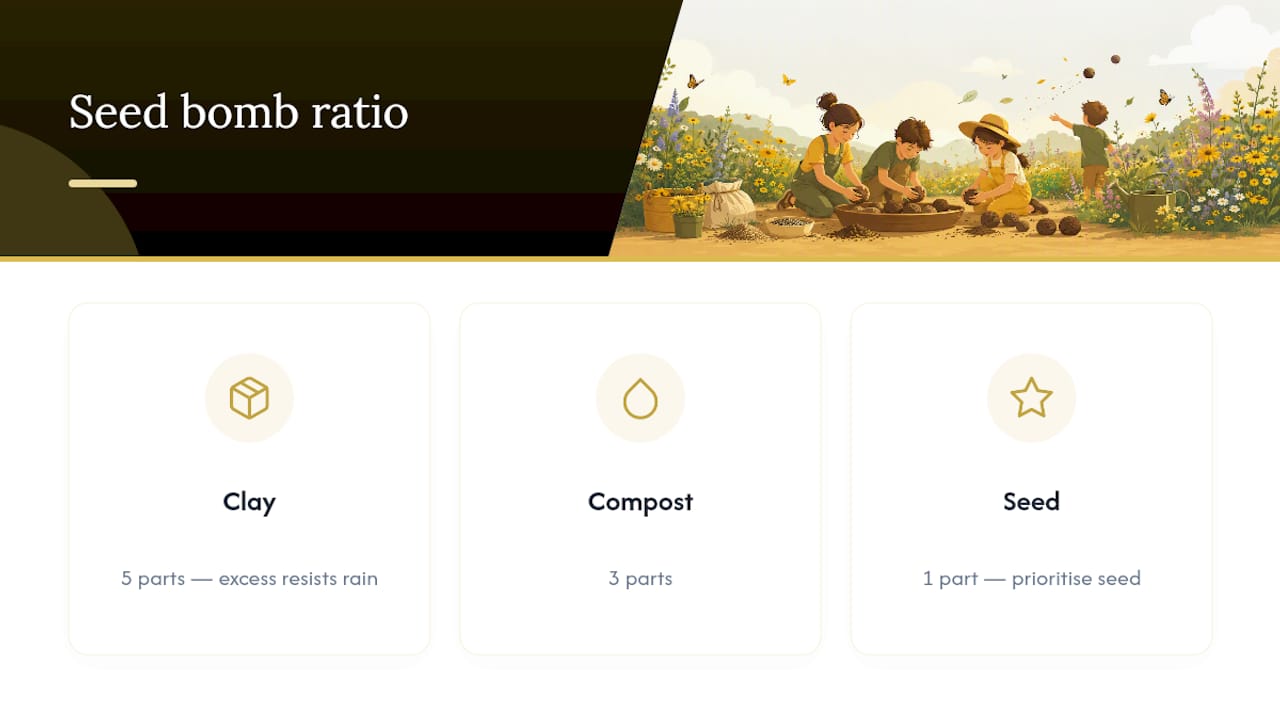
A seed bomb is a small ball of native wildflower seed, compost and clay, built to protect seed until rain breaks it down. The most reliable beginner recipe is 5 parts compost to 3 parts powdered clay to 1 part seed by volume, mixed with a splash of water and rolled to about 20mm. Gather your seeds and materials, choose native wildflowers, and you can be shaping bombs within the hour.
TL;DR:
- Using a ratio of five parts compost, three parts clay, and one part seed by volume yields the highest seed emergence, with about 44 percent success.
- Drying bombs indoors at 18 to 20°C on cardboard for 24 to 48 hours prevents cracking and ensures the shell holds long enough for seeds to establish.
- Sowing seed bombs in early spring or just before autumn rains provides the best chance for successful germination and growth.
- Native wildflower seeds are essential, with four to six seeds per bomb, and should be placed on bare, disturbed soil away from paved or protected areas.
- Excessively large bombs or overuse of clay make the shells too hard to break down, reducing germination success, and should be corrected for optimal results.
Table of Contents
- What do you need to make seed bombs?
- What is the best seed bomb recipe and ratio?
- How do you make seed bombs step by step?
- How long does it take seed bombs to dry, and when should you sow them?
- Which seeds work best in a seed bomb?
- Why do seed bombs fail, and how do you fix it?
- Can children help make seed bombs?
- What matters most when making seed bombs
- Sources
What do you need to make seed bombs?
The recipe uses four core ingredients, all easy to find at a garden centre or online.
- Peat-free compost – supplies nutrients as seeds establish, and avoids the environmental damage peat extraction causes.
- Powdered clay – bentonite clay or pottery clay both work; this is what binds the ball and holds it together until rain softens it.
- Native wildflower seeds – choose a mix suited to your region rather than generic “wildflower” blends of unknown origin.
- Water – added gradually, never poured in all at once.
For tools, you need little more than a fine sieve, a mixing bowl, a tray or flattened cardboard box for drying, and a small cookie scoop if you want consistent sizes. Gloves are worth having for children or anyone with sensitive skin, since clay dust can be drying. If you’re making bombs as gifts or party favours, a small paper bag or twist of tissue finishes the job nicely. Skip treated seed packets and anything labelled invasive for your area. Both cause more harm than good once scattered.
What is the best seed bomb recipe and ratio?
Trials testing seed bomb formulas consistently point to one working ratio: 5 parts compost, 3 parts clay, 1 part seed, measured by volume rather than weight. Clay should never climb much past a third of the total mix. Push it higher and the bomb sets so hard that rain struggles to break it down, trapping the seed inside indefinitely, according to Garden UK’s tested guidance.
In one Garden UK trial, bombs made to this ratio and dried correctly achieved 44% seed emergence, compared with just 12% for seed scattered loose on bare ground.
Flour can stand in for clay in a pinch. It’s cheaper and often already in the kitchen cupboard. The trade-off is a weaker, more crumbly bomb with a much shorter shelf life, so flour versions suit an activity you’re doing and sowing the same week, not a batch for gifting later.
Two quick examples to scale from:
- Kids’ batch: 5 cups compost, 3 cups clay, 1 cup seed makes roughly 15 to 20 bombs at 20mm.
- Classroom or bulk batch: double or triple the same ratio; 10 cups compost, 6 cups clay, 2 cups seed yields around 35 to 40 bombs.
How do you make seed bombs step by step?
Once your ratio is measured out, the process itself takes under an hour from mix to rolled bomb.
- Sieve the compost first to remove twigs and lumps. This produces a smoother dough and reduces the air pockets that cause bombs to burst when they land.
- Mix the dry base of compost and clay thoroughly before adding anything else.
- Add seeds last. Stirring them in early risks crushing delicate seed coats during mixing, so fold them through once the base is combined.
- Add water a splash at a time, working it through with your hands until the mix reaches a consistency close to biscuit dough. It should hold together without being sticky or sloppy.
- Roll into balls around 20mm across. Press three to six seeds into each one as you shape it, then roll firmly to close any gaps.
- Dry indoors on cardboard for 24 to 48 hours. A bomb is ready when it feels firm and dry to the touch all the way through, not just on the surface.
- Store in a paper bag somewhere cool and dry until you’re ready to sow.
A batch of 20 bombs takes roughly 20 minutes to mix and roll, then the drying time works in the background.
Pro Tip: Keep a small bowl of plain water beside you while rolling. Dipping fingertips before shaping each bomb stops the mix sticking to your hands and speeds up a group session no end.
How long does it take seed bombs to dry, and when should you sow them?
Drying is where most homemade batches go wrong, and it has nothing to do with impatience. It’s about temperature.
- Dry indoors at 18 to 20°C, laid out on cardboard rather than a plate or tray.
- Allow 24 to 48 hours, checking that the centre feels firm before storing.
- Keep bombs out of direct sun and off warm windowsills. Fast drying dries the surface before the inside catches up, and that mismatch is what cracks the shell.
Cardboard wicks moisture from underneath as bombs dry, which trials suggest reduces cracking compared with drying on a plate or in strong sun, per Garden UK’s testing.
Once dry, store bombs in a paper bag somewhere cool and dark. Clay-based bombs hold for weeks; flour versions degrade faster and are best used within days.
For sowing, aim for early spring or just before the autumn rains begin, timing that gives seed the best chance to establish before dry weather sets in. In drier climates, hand watering during the first couple of weeks after rain breaks the clay down helps seedlings past their most vulnerable stage. Expect the first shoots within two to four weeks, depending on species and weather.
Which seeds work best in a seed bomb?
Native wildflower seed is the only sensible choice here, not a generic “meadow mix” of unclear origin. Sourcing region-appropriate seed avoids introducing species that outcompete or crowd out the plants local pollinators already depend on, a point Farmers’ Almanac makes clearly for anyone tempted by cheap imported blends.
Aim for four to six seeds per bomb. Nectar-rich annuals and cornfield species such as poppy, cornflower and corn marigold tend to establish reliably and give pollinators an early source of food.
Where you throw or plant them matters as much as what’s inside them:
- Bare, disturbed soil gives seed the best contact and highest emergence.
- Avoid established grass or paved ground, where roots can’t reach soil at all.
- Never deploy on protected land, nature reserves, or private property without permission. Guerrilla gardening enthusiasm doesn’t override land rights, and rules on where you can legally scatter seed vary by area, so check locally first.
Your own garden, a neglected verge with the landowner’s blessing, or a school planting bed are all safer, more productive targets than a scattergun approach.
Why do seed bombs fail, and how do you fix it?
Most failed batches trace back to one of four mistakes, all easy to spot once you know what to look for.
- Too much clay sets the bomb like a brick. If yours feels rock hard once dry, next time cut clay back towards the 3 parts mark and rework the wet mix looser before rolling.
- Drying too fast in sun or on a hot windowsill cracks the shell before it’s cured. Move batches somewhere shaded and cooler, and be patient with the 24 to 48 hour window.
- Bombs rolled too large struggle to break down evenly. Stick close to 20mm, the size trials link to better emergence rates.
- Wrong placement, especially on grass or pavement, starves seed of soil contact. Choose bare earth and sow just ahead of expected rain for the best result.
Pro Tip: If a whole batch turns out too dry and crumbly to roll, don’t bin it. Mist lightly with water, knead for a minute, and it usually comes back to workable dough.
Can children help make seed bombs?
Yes, and it’s one of the easiest craft activities to scale up or down for age. Younger children do best on rolling duty, since squeezing damp compost into balls is satisfying and mess-forgiving. Older children can help measure and mix the dry ingredients under supervision, while an adult handles adding water and checking the final consistency.
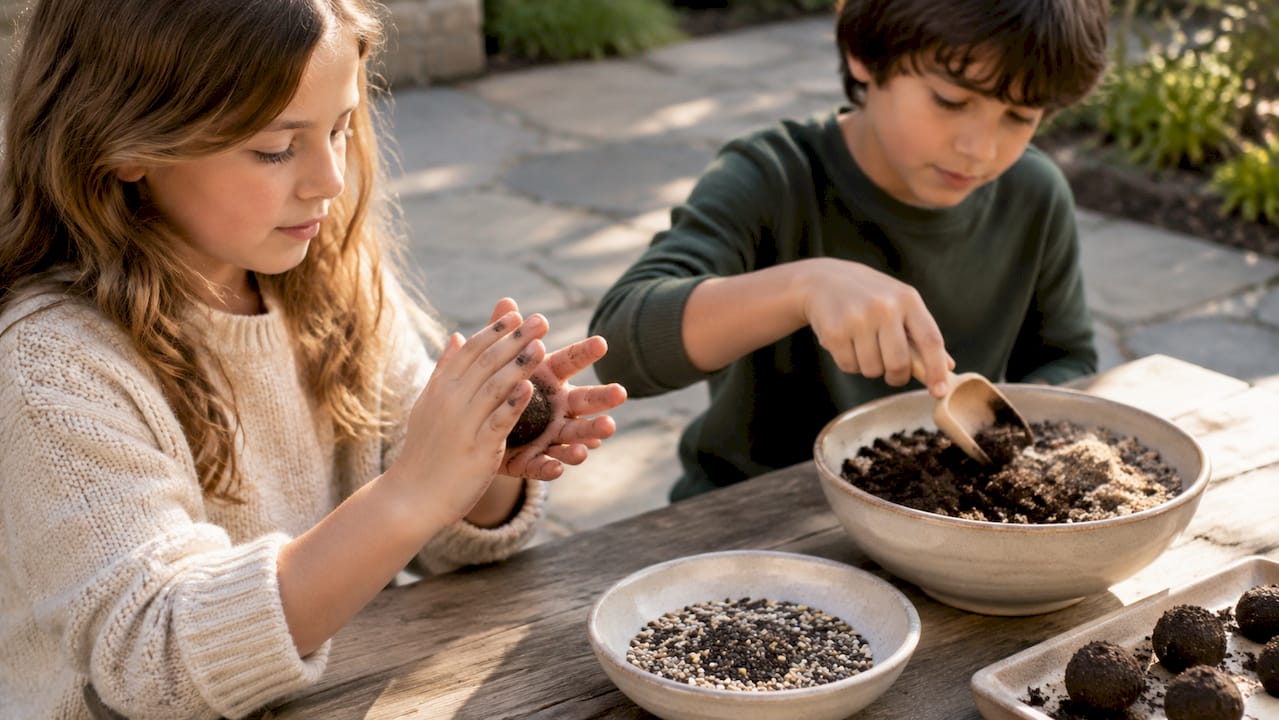
For classroom kits or party favours, pack finished bombs individually in small paper bags or twists of tissue, and label them with the seed mix inside. It’s a tidy way to send a batch home without crumbling in someone’s pocket. If you’re planning a wider outdoor session afterwards, Thezoofamily’s guide on creating wildlife friendly gardens for children to explore has further ideas for turning a seed bomb afternoon into an ongoing nature project.
What matters most when making seed bombs
The advice that gets repeated most often online, more clay for a sturdier bomb, is exactly backwards. A bomb that survives being thrown is worthless if it also survives every rainstorm that follows. The 5:3:1 ratio isn’t a suggestion to tinker with; it’s the point at which the shell protects seed just long enough and then lets go.
Where most guides fall short is sowing timing. Plenty of tutorials treat seed bombs as a summer craft project and stop there, when the difference between early spring or pre-autumn rain sowing and a random midsummer toss is the difference between a wildflower patch and a handful of dried clay pebbles months later.
If you take one thing from this away, prioritise the seed itself over the craft. Native, region-appropriate mixes matter more than a perfectly smooth ball or decorative packaging. Get that right, respect where you scatter them, and the rest is genuinely hard to get wrong.
— ALAIN
Sources
- Wildflower seed bombs, The Perfect DIY Summer Project - Farmers’ Almanac
- How to make seed bombs that actually germinate — Garden UK