

TL;DR:
- A well-chosen kid’s camera encourages outdoor exploration and creativity, fostering a lifelong passion.
- Durability, simplicity, and age-appropriate features are more important than technical specs.
- Engaging activities and parental involvement enhance a child’s interest and experience in nature photography.
Finding a truly inspiring gift for your child is harder than it sounds. Most toys end up competing with screens, and the result is another gadget that gathers dust after a fortnight. A well-chosen camera is different. It pulls children outdoors, sharpens their observation skills, and gives them a creative outlet that no app can replicate. Whether your child is fascinated by beetles in the garden or birds in the park, the right camera can turn that curiosity into a lifelong passion. This guide walks you through everything you need to know, from matching camera types to your child’s age, to practical activities that spark a genuine love for nature.
Table of Contents
- Understanding your child’s needs and camera basics
- Top kids camera types and expert recommendations
- How to choose: Key features and criteria to prioritise
- Setting up and encouraging creative nature photography
- Why traditional specs matter less than creativity and experience
- Help your child explore creativity with the right camera
- Frequently asked questions
Key Takeaways
| Point | Details |
|---|---|
| Prioritise simplicity and durability | Choose cameras designed for children’s hands, with minimal menus and robust builds to survive outdoor play. |
| Focus on creativity over specs | A camera that sparks nature exploration and tangible memories is more important than high megapixel counts. |
| Match camera type to age and interests | Screen-free and instant print models are ideal for younger children, while rugged or action cameras suit adventurous older kids. |
| Support engagement with creative activities | Encourage outdoor use with fun challenges like scavenger hunts and ethical nature photography. |
Understanding your child’s needs and camera basics
Before browsing models and price tags, it helps to think about who this camera is actually for. A three-year-old and a ten-year-old have completely different needs, and buying the wrong type is the most common mistake parents make.
Here is a simple age-based framework to guide your thinking:
- Ages 3 to 6: Look for toy-like, screen-free cameras with large, simple buttons. At this age, the act of pressing the shutter is the joy. Fewer menus mean less frustration and more outdoor time.
- Ages 7 to 12: Instant print cameras and more robust digital models work brilliantly here. Children this age love seeing a tangible result, and they can handle slightly more complex controls.
- Ages 10 and above: Rugged, feature-rich cameras become worthwhile. These children can learn about framing, light, and composition, especially if they are already interested in nature or wildlife.
Durability is non-negotiable for outdoor use. A shockproof build protects against the inevitable drops, and a waterproof rating is genuinely useful for muddy woodland walks or beach holidays. Do not let a high megapixel count distract you. As durability and sensor quality matter far more for children than raw megapixels, focusing on build and simplicity will serve you better than chasing specs.
The screen question is worth considering carefully. A rear screen can help children frame their shots, but it also becomes a distraction. Many children spend more time reviewing photos than actually taking them. For younger children especially, a screen-free model keeps the focus on the world around them rather than the device in their hands.
Pro Tip: Let your child hold the camera in the shop or at home before committing. If the buttons are too small or the body too heavy, they will stop using it within a week. Comfort drives consistency.
For cameras for young explorers, the priority is always simplicity and robustness over impressive-sounding technical features.
Top kids camera types and expert recommendations
With a clearer picture of your child’s needs, it is time to look at the main camera categories and what experts actually recommend.
| Camera type | Best age | Key strengths | Key weaknesses |
|---|---|---|---|
| Digital (Camp Snap) | 5 to 12 | Screen-free, simple, durable | No instant print |
| Digital (VTech KidiZoom Duo FX) | 4 to 10 | Feature-rich, robust | Built-in games distract |
| Instant print (Fujifilm Instax Mini) | 7 and above | Tangible photos, creative | Ongoing film cost |
| Action/rugged (DJI Osmo Action 4) | 10 and above | Waterproof, high quality | Expensive, complex |
| Toy cameras | 3 to 6 | Safe, colourful, affordable | Poor photo quality |
The Fujifilm Instax Mini and Camp Snap are consistently recommended for distraction-free and tangible photography experiences, and it is easy to see why. The Camp Snap has no screen, no games, and no way to delete photos, which sounds limiting but is actually liberating. Children stop second-guessing every shot and start exploring more freely.
The VTech KidiZoom Duo FX is durable and packed with features, but experts warn that its built-in games can pull children away from photography altogether. If your goal is to nurture a love for nature and creativity, a camera that doubles as a gaming device works against you.
For older children who are genuinely passionate about wildlife or outdoor adventure, the DJI Osmo Action 4 and the Olympus Tough TG-7 are worth the investment. Both handle rough conditions with ease, and the image quality is good enough to genuinely reward a child’s effort and patience.
Key things to look for across all categories:
- Simple shutter button that works with small hands
- Wrist or neck strap included or compatible
- Adequate battery life for a full afternoon outdoors
- Minimal pre-loaded games to keep focus on photography
For a detailed kids cameras comparison across models suited to nature lovers, it is worth exploring options tailored specifically to outdoor use.
How to choose: Key features and criteria to prioritise
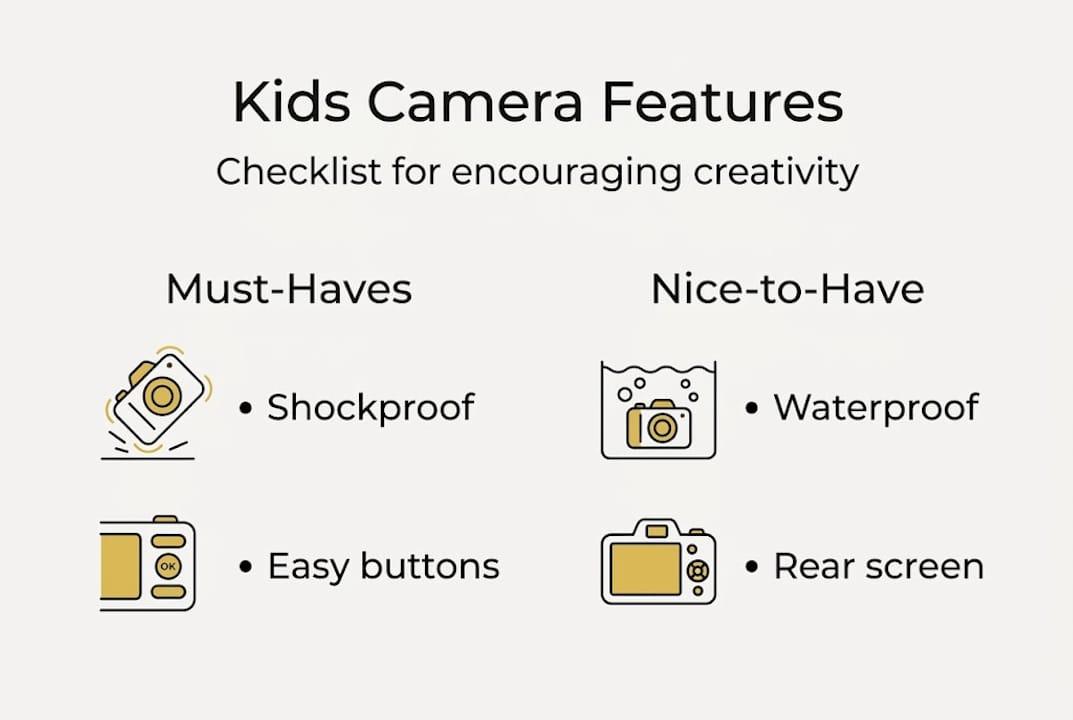
Knowing the types is one thing. Knowing how to judge them for your specific situation is another. Here is a practical checklist to work through before you buy.
| Feature | Why it matters | What to look for |
|---|---|---|
| Shockproof rating | Children drop things | 1.5 metre drop protection minimum |
| Waterproof rating | Outdoor and beach use | IPX4 or higher |
| Button size and layout | Ease of use | Large, clearly labelled buttons |
| Battery life | Full-day outings | At least 150 shots per charge |
| Storage | Ongoing use | SD card slot or generous internal memory |
| Screen presence | Focus vs distraction | Screen-free for under 7s |
Expert reviewers consistently rank durability, simplicity, and ergonomic design above technical specs for children, and real-world use confirms this. A camera that survives a muddy forest floor is worth far more than one with a higher resolution that cracks on the first drop.
Here is a step-by-step approach to narrowing your choice:
- Set your budget including ongoing costs (film, batteries, memory cards).
- Identify the primary setting where it will be used: garden, park, forest, beach, or travel.
- Match the age bracket to the camera type using the framework above.
- Prioritise durability over megapixels or screen size.
- Check for distraction features such as games or social sharing, and avoid them for younger children.
- Read recent reviews from parents, not just tech journalists.
Instant print cameras carry an ongoing cost of roughly 75 pence per shot, which adds up quickly. Digital cameras with an SD card have a one-off storage cost and then unlimited use. For a child who loves to experiment freely, digital is often the more practical choice long term.
Pro Tip: If you are buying for a nature-focused child, pair the camera with a simple field guide to local birds or insects. It transforms photography into a genuine discovery tool rather than just a toy.
For ideas on ecological photography for kids, there are wonderful resources that connect camera use directly to environmental curiosity.
Setting up and encouraging creative nature photography
Choosing the right camera is only half the work. How you introduce it shapes whether your child uses it for a week or for years.
Start with a proper setup before handing it over:
- Charge the battery fully before the first use to avoid early disappointment.
- Adjust the strap to fit your child’s wrist or neck comfortably.
- Insert and format the memory card so it is ready to go from the first shot.
- Set the date and time if the camera supports it, which helps with organising photos later.
- Do a quick test together indoors before heading outside.
For outdoor safety, keep it simple. Teach your child to stay on paths when photographing wildlife, to move slowly and quietly near animals, and never to disturb nests or habitats for a better shot. These habits build respect for nature from the very start.
“The best nature photographers are patient observers first and camera operators second. Teaching children to watch before they shoot is the most valuable lesson you can give them.”
Structured activities like scavenger hunts paired with cameras genuinely foster hands-on learning and outdoor curiosity. Try these to get started:
- Bug or plant scavenger hunt: Give your child a list of ten things to photograph, from a red leaf to a spider’s web.
- Capture the changing seasons: Photograph the same tree or corner of the garden once a month throughout the year.
- Make a photo book: Print favourites and create a simple nature journal together.
For troubleshooting, blurry photos usually mean the child is moving too quickly. Teach them to hold their breath for a second before pressing the shutter. Battery drain is often caused by leaving the camera on between shots, so a simple habit of switching off makes a real difference.
For inspiring nature photography ideas and teaching photography ethics around wildlife, there are resources designed specifically for young photographers.
Pro Tip: Join your child on their first few outdoor photography sessions. Your enthusiasm is contagious, and modelling curiosity about the natural world is the single most powerful thing you can do.
Why traditional specs matter less than creativity and experience
There is a pattern we see repeatedly: parents spend weeks comparing megapixels and screen resolutions, then hand over a technically impressive camera that their child uses twice before losing interest. The specs were never the problem. The experience was.
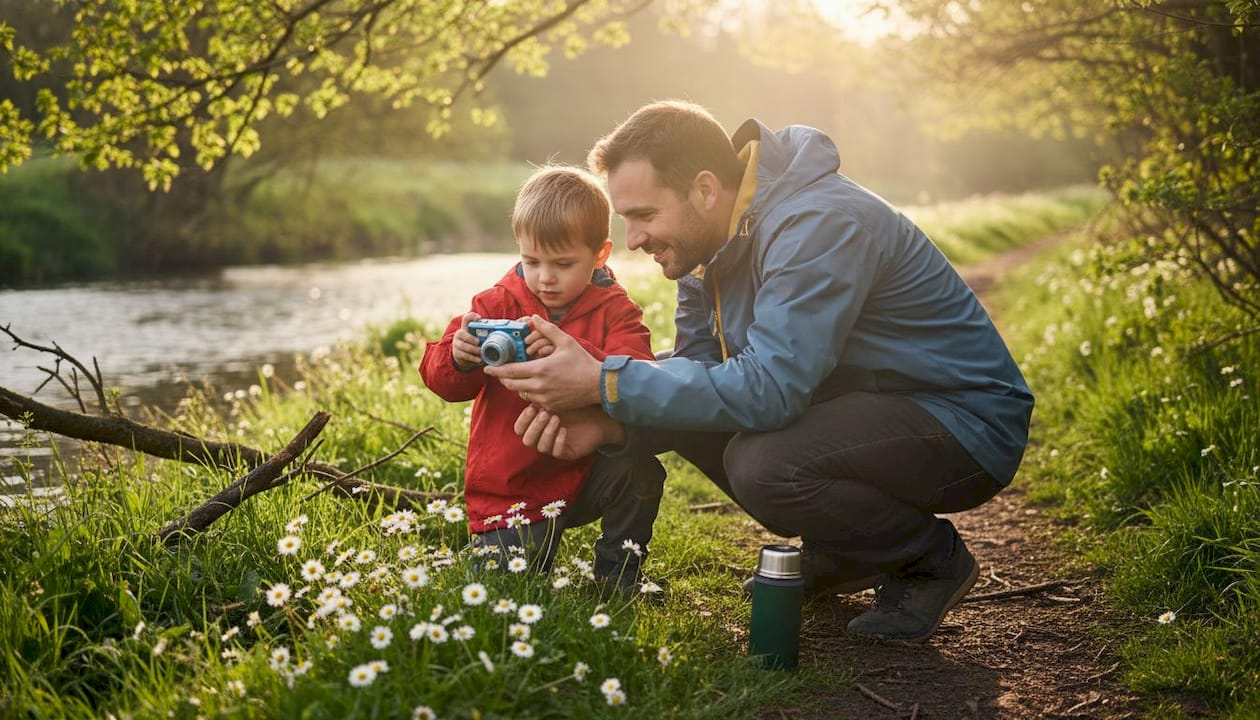
Children do not engage with cameras because of sensor quality. They engage because photography feels like an adventure. A screen-free camera that forces them to look at the world rather than a display, a model that survives a tumble down a riverbank, a device simple enough that a six-year-old can use it independently without asking for help: these are the features that create lasting engagement.
Screen-free cameras are recommended not just for avoiding distraction but for inspiring genuine creative perspective-taking, and this aligns with what we observe in children who develop a real love for nature photography. The tangible, the simple, and the adventurous win every time.
Long-term engagement is built through outdoor adventure and real memories, not through impressive technical features. When a child photographs a fox at dusk or a frost-covered leaf on a winter morning, no megapixel count captures the pride they feel. The right camera is the one that gets used, not the one that looks best on a spec sheet. For tips for children’s animal photos, the focus is always on curiosity first and technique second.
Help your child explore creativity with the right camera
At The Zoofamily, we believe the right camera does more than take pictures. It opens a child’s eyes to the natural world around them, builds patience, and creates memories that last far longer than any screen-based toy.
We have built The Zoofamily around exactly this idea: connecting children to nature through thoughtfully designed cameras, binoculars, and walkie-talkies that feel like an invitation to explore rather than another gadget to stare at. For every camera sold, we plant one tree. Explore our nature photography inspiration for activity ideas, buying guides, and creative challenges that turn any outdoor space into a photography adventure. The right camera is just the beginning of a lifelong love for creativity and the natural world.
Frequently asked questions
Which camera is best for children who love exploring outdoors?
For young explorers, the Camp Snap or Fujifilm Instax Mini are excellent starting points, as both Camp Snap and Instax Mini are recommended for outdoor, screen-limited experiences. For older children aged ten and above, rugged models like the DJI Osmo Action 4 offer the durability and quality to match their ambitions.
Are toy cameras worth buying for under-6s?
Toy cameras are durable and manageable for preschoolers, but toy cameras often deliver poor photo quality that limits real nature photography. An entry-level digital camera with simple controls offers better long-term value.
Is it better to choose instant film or digital cameras?
Instant cameras create tangible keepsakes and teach patience, but instant film costs average around 75 pence per shot. Digital cameras allow unlimited practice and are more practical for children who love to experiment freely.
How can I encourage my child to use the camera outdoors?
Organise nature scavenger hunts and let your child choose their own subjects freely. Joining them on early outings and showing genuine interest in what they photograph builds confidence and sustains curiosity far more effectively than any instruction.
Recommended
- Benefits of Kids’ Cameras – Fostering Creativity and Nature Connection – The Zoofamily
- Camera Features for Kids: Sparking Eco-Friendly Creativity – The Zoofamily
- Animated photo transformation: bring family memories to life — WonderLens | WonderLens