

Outdoor storytelling games are structured play activities that blend narrative with nature to build children’s creativity, language skills, and social confidence. Unlike screen-based entertainment, these games use the natural world as a stage, turning a park, garden, or woodland walk into a living story setting. Research confirms that outdoor settings lower social anxiety while inspiring richer descriptive language through sensory stimuli like birdsong and rustling leaves. Thezoofamily designs its products and guides around exactly this principle: that children connect most deeply with each other and with nature when they are actively playing outside.
What are outdoor storytelling games and why do they work?
Outdoor storytelling games are any group activity where children build, share, or perform a narrative in an outdoor setting. The term covers everything from simple story circles to dice-based games and nature-inspired narrative quests. The recognised educational term for this practice is “outdoor story circles,” though parents and activity leaders often use the broader phrase “storytelling games” to describe the full range of formats.
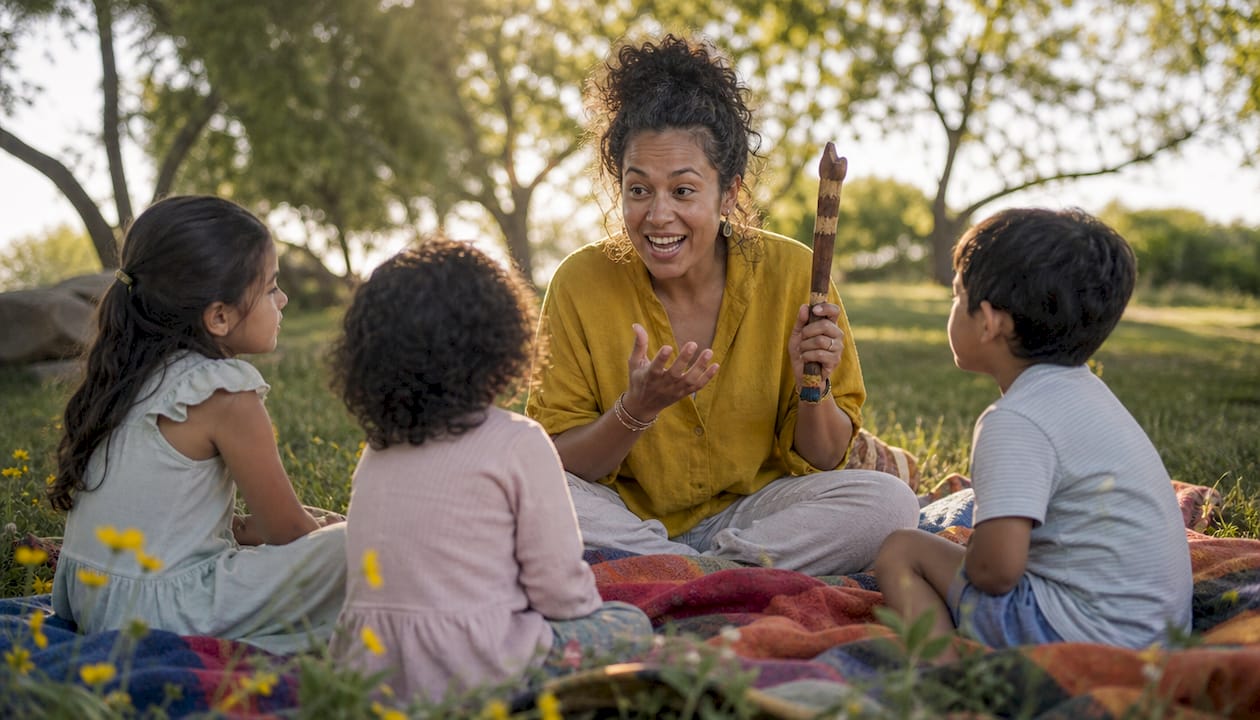
These games work because the outdoor environment does half the job for you. Storytelling circles in natural settings deepen vocabulary by inviting children to describe sensory details drawn directly from their surroundings. A child who might struggle to describe a character indoors will readily say “she had hair like the silver bark on that birch tree” when sitting beneath one. That connection between observation and language is the core mechanism behind every effective outdoor storytelling activity.
Parents who integrate storytelling outdoors report stronger family bonds and children who look forward to the activity as a shared tradition. That outcome is not accidental. When the pressure to perform is removed and replaced with collaborative play, children open up. The result is genuine conversation, shared laughter, and stories that families remember long after the session ends.
What tools and materials do you need?
The best outdoor storytelling sessions require very little equipment. A handful of well-chosen props makes the difference between a session that flows and one that stalls.
| Tool | What it does | DIY or ready-made |
|---|---|---|
| Story dice | Generates random characters, settings, and plots | DIY with stickers on wooden cubes |
| Story card deck | Provides visual prompts to spark narrative | Ready-made (e.g. Campfire Stories Deck) |
| Talking stick or stone | Manages turn-taking and respectful listening | DIY with a pinecone or smooth pebble |
| Seating mat or blanket | Creates a defined story circle | Any picnic blanket |
| Weather layer | Keeps children comfortable and focused | Lightweight waterproof jacket |
The Campfire Stories Deck contains 50 cards split into 25 character cards and 25 action cards, designed for children aged 5 and older. It is one of the most accessible ready-made options because it requires no reading ability for younger children. The images do the prompting.
For a free alternative, the Roll-a-Story format uses three dice rolls to generate a character, a setting, and a plot element. Children roll once for each component and then build their story from those three ingredients. The prep time is under five minutes, and the results are reliably surprising and funny.
Pro Tip: Use a natural object, such as a pinecone or smooth stone, as your talking stick. Natural objects as talking sticks structure turn-taking and reduce interruptions without any adult enforcement.
How to organise your first outdoor storytelling session
A well-run first session sets the tone for every session that follows. Structure matters more than creativity at the start.
-
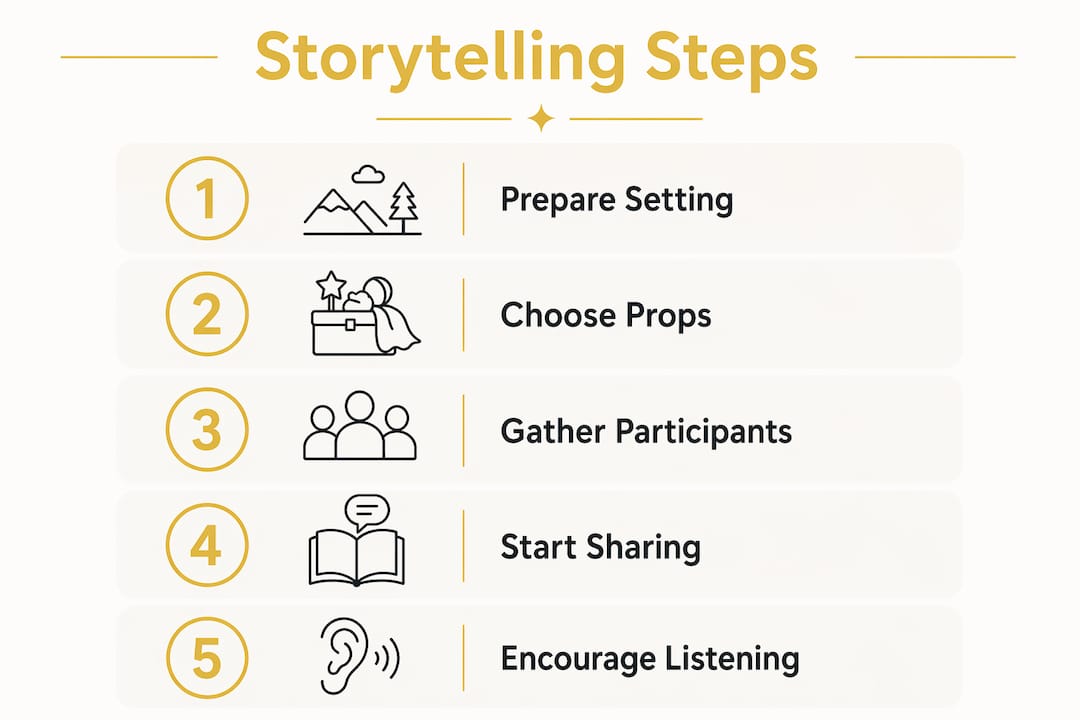
Choose your location. Pick a spot with natural shelter, soft ground for sitting, and enough space for a circle. A woodland clearing, a park corner, or a garden work equally well. Avoid locations with heavy foot traffic, which breaks concentration.
-
Arrange a story circle. Seat children in a circle on blankets or mats. The circle signals equality: no one is at the front, and every voice carries the same weight. This physical arrangement reduces the performance anxiety that kills participation.
-
Set group norms. Before the first story begins, agree on two rules: one person speaks at a time, and every contribution is accepted without criticism. Keep the rules simple and state them positively.
-
Start with a grounding exercise. Beginning with a brief silence eases children into focused presence after active play. Ask everyone to close their eyes for thirty seconds and name one thing they can hear. This sensory check-in shifts attention from running around to listening, which is the core skill storytelling requires.
-
Introduce the game format. Roll the story dice or draw the first card. Read out the prompt and give children ten seconds to think before anyone speaks. Silence at this stage is productive, not awkward.
-
Manage the group. Pass the talking stick around the circle. If a child passes, accept it without comment and return to them at the next round. Shy children often join in once they see that passing carries no penalty.
-
Close the session deliberately. End with a round where each child says one word that describes how the story made them feel. This closing ritual signals that the session is complete and gives every voice a final moment.
“A relaxed outdoor environment transforms storytelling from a traditional performance into a shared, immersive experience that builds empathy and imagination.”
Pro Tip: Keep your first session to twenty minutes. Children leave wanting more, which makes the next session easier to start.
Creative variations to keep children engaged
Once children know the basic format, variety keeps the energy high. These formats suit different ages, group sizes, and outdoor settings.
-
Collaborative sentence circles. Each child adds one sentence to a shared story. The rule is that every sentence must include something the child can currently see, hear, or smell. This grounds the narrative in the real environment and produces wonderfully strange stories.
-
Found-object prompts. Before the session, ask children to collect three natural objects: a leaf, a stone, and something they find interesting. Each object becomes a story element. The leaf might be a magic map, the stone a sleeping giant, and the interesting object a mysterious artefact.
-
Narrative quests. Framing a walk as a quest with a narrative mission increases children’s willingness to participate and reduces complaints on longer outings. Assign roles before you set off: one child is the navigator, one is the chronicler who remembers story details, and one is the lookout who spots story-worthy objects along the route.
-
Sensory vocabulary rounds. Ask children to describe the setting using only words they have never used before. This game builds descriptive language and works particularly well with children aged 7 and older.
| Format | Best age group | Group size | Prep needed |
|---|---|---|---|
| Collaborative sentence circle | 5+ | 3–8 children | None |
| Found-object prompts | 6+ | 2–6 children | 5 minutes |
| Roll-a-Story dice game | 5+ | 2–10 children | Under 5 minutes |
| Narrative quest walk | 7+ | 4–12 children | 10 minutes |
| Campfire Stories Deck | 5+ | 2–8 children | None |
Pro Tip: Frame every walk as a quest with a specific mission, such as finding the oldest tree or crossing the “enchanted bridge” (any bridge will do). Children who know they are on a quest stay engaged far longer than children who are simply going for a walk.
How to build connection and confidence through storytelling
The deepest value of outdoor storytelling games is not the stories themselves. It is what happens between the children and between children and parents while the stories are being made.
Outdoor storytelling games focus on connection rather than performance, which removes the anxiety that shuts children down in more formal settings. When a child knows their contribution will be accepted and built upon rather than judged, they take risks with language. Those risks are where real creativity lives.
-
Share family stories. Weave in real family memories as story prompts. “Once there was a child who got lost in a supermarket” lands differently when the child knows it happened to their parent. Shared stories build family identity and give children a sense of belonging to a longer narrative.
-
Celebrate every contribution. Respond to each story addition with a specific, genuine reaction. “I love that the dragon was afraid of butterflies” is more useful than “well done.” Specific feedback tells children that you were actually listening.
-
Use the talking stick consistently. Natural objects as conversational controls improve group dynamics without adult enforcement. Children self-regulate more effectively when a physical object defines whose turn it is.
-
Create a storytelling tradition. Return to the same location for storytelling sessions. Children develop a relationship with the place, and the familiarity lowers the activation energy needed to start. A favourite tree or a particular bench becomes the “story spot,” and arriving there signals that something good is about to happen.
“Designing storytelling games to be low-pressure and collaborative lowers resistance and encourages children to experiment with language comfortably.”
The long-term outcome of consistent outdoor storytelling is a child who is comfortable speaking in groups, skilled at listening, and genuinely curious about the world around them. Those are not small gains.
Key takeaways
Outdoor storytelling games work best when they combine a natural setting, a simple structure, and a low-pressure atmosphere that puts connection ahead of performance.
| Point | Details |
|---|---|
| Start with structure | Use dice, cards, or a talking stick to give every session a clear shape from the first minute. |
| Ground children first | A thirty-second sensory pause before storytelling begins shifts attention from play to listening. |
| Vary the format | Rotate between sentence circles, found-object prompts, and narrative quests to maintain engagement across sessions. |
| Prioritise connection | Focus on shared experience rather than polished stories to reduce anxiety and build confidence. |
| Build a tradition | Return to the same location regularly so children associate the place with a positive shared activity. |
Why outdoor storytelling changed how I see family time
I started running outdoor story circles with a small group of children on weekend walks, mostly because I was tired of hearing “I’m bored” ten minutes into every outing. What I did not expect was how quickly the dynamic shifted. Within two sessions, children who rarely spoke in group settings were adding sentences with genuine confidence. One child, who had been reluctant to join in at all, invented a character so detailed and funny that the whole group asked for her story to continue the following week.
The challenge I encountered most often was the transition from active play to sitting still. Children do not switch modes easily. The grounding exercise, that thirty-second silence where everyone names something they can hear, solved this almost immediately. It is a small thing, but it works every time.
My advice to parents starting out: resist the urge to direct the story. The moment you correct a child’s narrative logic (“but dragons can’t live underwater”), you close a door. Let the story go wherever the children take it. The stranger the story, the more invested they become. Your job is to hold the circle, pass the talking stick, and laugh at the right moments.
Thezoofamily’s approach to outdoor play, connecting children with nature through curiosity and creativity, aligns exactly with what I have seen work in practice. The best stories come from children who are genuinely looking at the world around them.
— ALAIN
Thezoofamily’s resources for outdoor storytelling and nature play
Thezoofamily has built a collection of guides and activity ideas specifically for parents who want to make outdoor time more creative and connected. If you are ready to take storytelling further, the parent’s guide to outdoor group story making covers how to incorporate family pets and natural settings into your sessions.
For more ideas on combining nature and imagination, the nature play week activities guide offers formats suited to curious children of all ages. Thezoofamily’s cameras, binoculars, and walkie-talkies are designed to deepen children’s engagement with the natural world, making every outdoor session richer and more memorable. For every camera sold, Thezoofamily plants one tree, so your family’s outdoor adventures contribute directly to restoring the natural world your children are learning to love.
FAQ
What are outdoor storytelling games?
Outdoor storytelling games are structured play activities where children build shared narratives in a natural setting, using prompts such as dice, cards, or found objects. They develop language skills, creativity, and social confidence simultaneously.
What age are outdoor storytelling games suitable for?
Most formats work well from age 5 upwards. The Campfire Stories Deck is designed for ages 5 and older, while narrative quest formats suit children aged 7 and above who can sustain a longer narrative thread.
How long should an outdoor storytelling session last?
Twenty minutes is the right length for a first session with younger children. As children become familiar with the format, sessions can extend to forty-five minutes without losing engagement.
How do I include shy children in storytelling games?
Pass the talking stick without pressure and accept a pass without comment. Low-pressure collaborative formats reduce speaking anxiety, and shy children typically join in once they see that every contribution is welcomed rather than judged.
Do I need to buy special equipment for outdoor storytelling?
No special equipment is required. A pinecone as a talking stick, three standard dice, and a blanket to sit on are enough to run a full session. Ready-made options like the Campfire Stories Deck add variety but are not necessary to start.