

Some of the best rainy day preschool activities to start with right now are:
- Indoor obstacle course (15–30 mins) — builds gross motor skills and coordination using cushions, tape, and plastic cups; no specialist kit needed.
- Window suncatchers with crayon shavings (20–30 mins) — a process art project that introduces states of matter and light filtration while practising fine motor control.
- Dry sensory bin (15–20 mins) — fill a tub with dry rice or pasta for tactile exploration and early vocabulary building.
- Alphabet or number scavenger hunt (10–15 mins) — supports phonics and number recognition through movement; post-it notes and masking tape are all you need.
- Reading den or blanket fort (5–10 mins to set up; open-ended) — supports self-regulation and independent play, both key Early Years Foundation Stage (EYFS) goals.
- Sink-or-float experiment (10–15 mins) — introduces basic scientific thinking with a washing-up basin and household objects.
Each activity uses household items, fits a small flat, and links directly to EYFS learning goals. Activity roundups consistently group ideas by energy level and available materials, which is exactly how this guide is structured. Thezoofamily’s nature-themed toys can extend several of these ideas once you have the basics underway.
Table of Contents
- 1. High-energy games that burn off wiggles indoors
- 2. Rain-themed craft projects for fine motor skills
- 3. Sensory bins and tactile play with easy cleanup
- 4. Short literacy and numeracy games for preschoolers
- 5. Calm and cosy activities for wind-down time
- 6. Simple science and STEAM experiments at home
- 7. Practical setup, mess management, and safety
- 8. How to adapt activities for ages 3–5 and group play
- 9. Why rainy-day play matters for child development
- 10. Tips for engaging reluctant or shy children
- Key takeaways
- A practical note on rainy-day routines
- Nature-themed toys that extend indoor play
- Useful sources and further reading
1. High-energy games that burn off wiggles indoors
Active play is the first thing to reach for on a wet morning. Educators recommend active indoor games for preschoolers because they develop gross motor skills and concentration at the same time.
Six games to try:
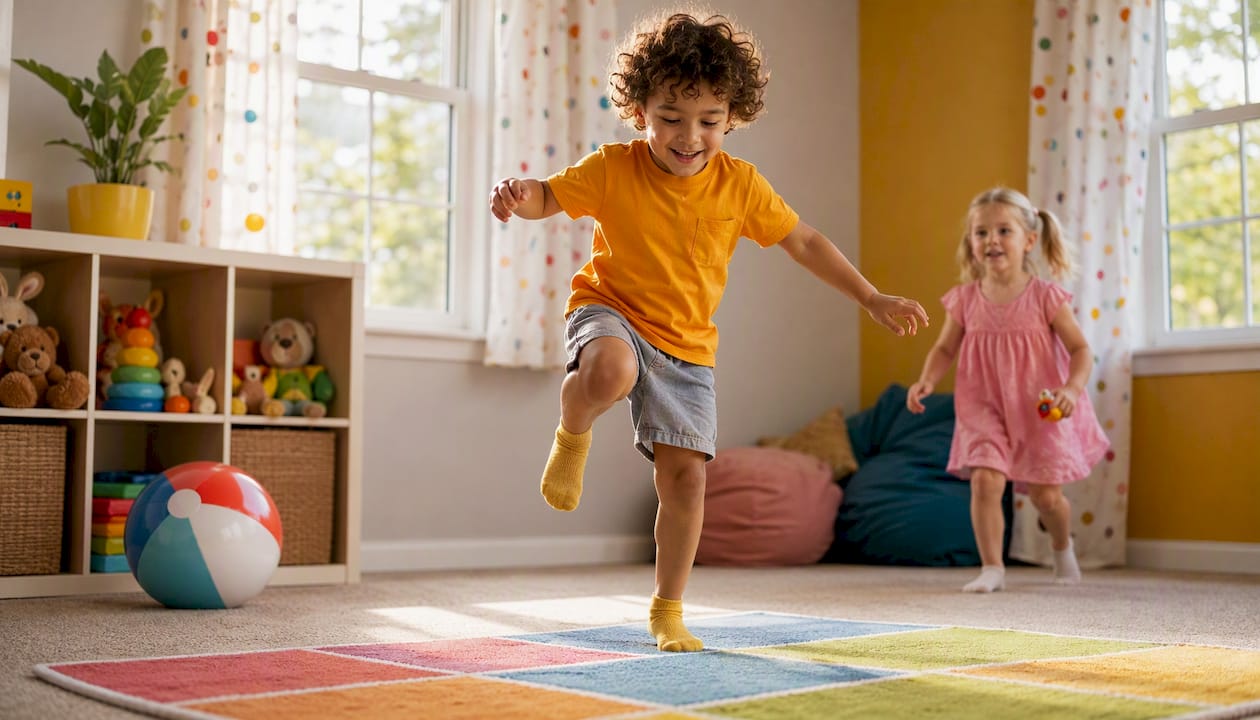
- Indoor hopscotch — use masking tape on a hard floor; works in a hallway.
- Balloon volleyball — tie a length of string between two chairs; tap a balloon over the net.
- Floor is lava — scatter cushions and ask children to move without touching the floor.
- Taped balance beam — two parallel strips of tape, 15 cm apart; walk heel-to-toe.
- Blowing-ball straw races — scrunch a small piece of tissue paper and blow it across the floor through a straw; this also exercises oral-facial muscles.
- Cushion stepping stones — arrange sofa cushions in a path; add a rule (hop on one foot, arms out) to increase the challenge.
Materials: masking tape, balloons, sofa cushions, drinking straws, tissue paper.
Time: 10–20 minutes per game; rotate every 15 minutes to keep energy levels steady.
Safety notes:
- Clear the floor of small objects before you start.
- Use non-slip socks or bare feet on hard floors.
- Keep balloons away from children under three due to choking risk if they burst.
- Supervise closely during stepping-stone and balance-beam games.
SEND-friendly adaptations: For children with limited mobility, replace hopping with rolling a ball along the tape beam. Balloon tap works well seated.
Pro Tip: Construct a simple obstacle course from cushions, painter’s tape, and plastic cups. Rotate one element each time to keep the challenge fresh and encourage problem-solving.
2. Rain-themed craft projects for fine motor skills
Process art — where the making matters more than the result — is the most developmentally useful approach for preschool crafts. These projects range from low-mess to moderately messy.
Six craft ideas:
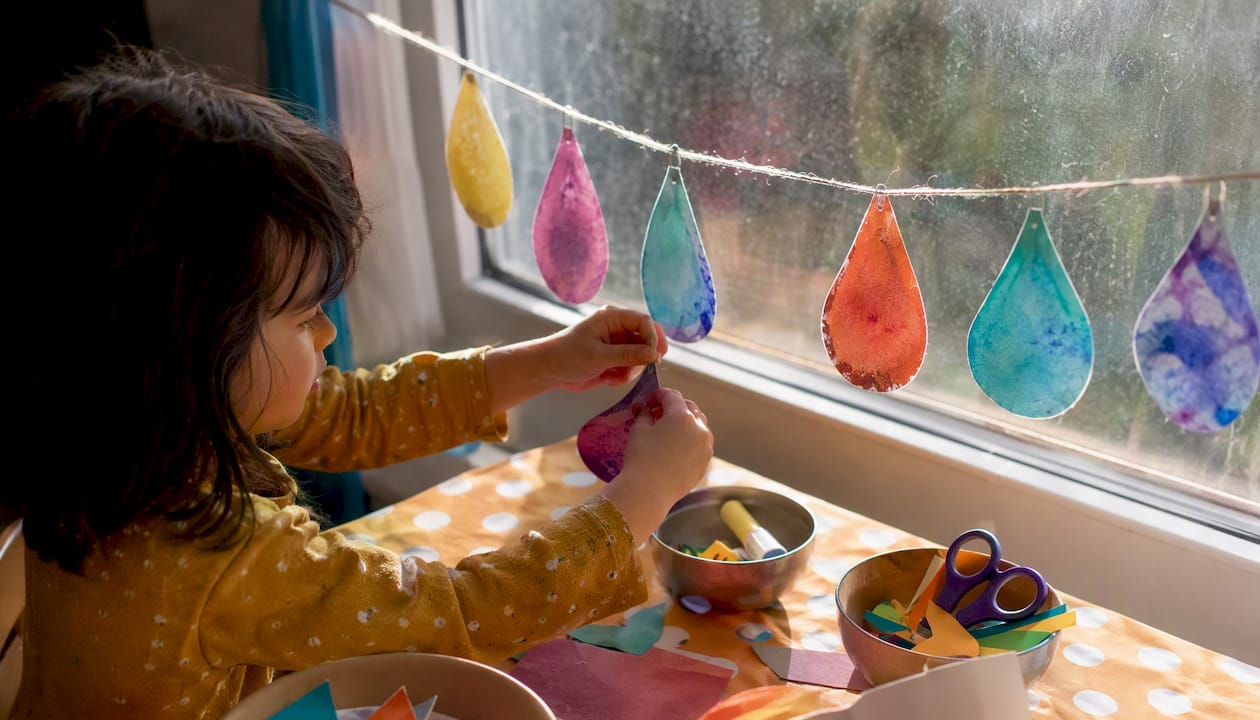
- Window suncatchers (crayon shavings) — grate old crayons, sandwich shavings between two sheets of wax paper, and press briefly with a warm iron (adult only). Hang in the window. Demonstrates solids melting to liquids.
- Raindrop tissue art on contact paper — stick squares of coloured tissue paper onto a sheet of clear contact paper; hang in the window for a stained-glass effect. No heat required; suitable for three-year-olds.
- Toilet-roll raindrop stamps — pinch one end of a toilet roll into a teardrop shape, dip in blue paint, and stamp onto paper.
- Salt-dough puddles — mix 1 cup flour, ½ cup salt, ½ cup water; shape into puddle forms; air-dry or bake at 120°C for two hours (adult supervision).
- Raindrop collage — cut raindrop shapes from old magazines and glue onto card.
- Leaf-print rain scene — press leaves gathered before the rain into paint and stamp onto paper.
Age adjustments:
- Three-year-olds: pre-cut shapes, offer chunky glue sticks, limit colour choices to two or three.
- Five-year-olds: introduce scissors, ask them to plan a colour pattern, or add letter labels to their artwork.
Display tip: Peg finished work on a length of string across a window using small wooden pegs. A fridge magnet gallery works equally well for card-based pieces.
Mess levels: Tissue art and collage are low-mess. Salt dough and paint stamps are moderate; cover the table with a wipe-clean cloth first.
Pro Tip: Lay a large plastic tablecloth under the work area before you start. Fold it inward after the session to contain crumbs and paint drips, then shake it outside when the rain stops.
3. Sensory bins and tactile play with easy cleanup
Messy activities support tactile development; the key is matching the material to your tolerance for mess and using containment from the start.
Five sensory ideas:
- Dry rice or pasta bin — pour into a deep storage tub; add scoops, cups, and small toy animals. Sweep stray grains with a dustpan; no mopping needed.
- Cloud dough — mix 8 parts plain flour with 1 part baby oil; it holds its shape but crumbles. Keep it in a large tray on the kitchen floor.
- Water-sink play in a basin — one washing-up basin on a towel; add cups, spoons, and small waterproof toys. Contain the splash zone with a bath mat.
- Sensory bottles — fill empty plastic bottles with water, glitter glue, and small beads; seal the lids with strong tape. Shake and watch; no mess at all.
- Rain-sensory tray — fill a baking tray with a thin layer of blue-dyed water; add pebbles, shells, and small figures. Children scoop, pour, and describe what they feel.
Safety notes:
- Dry fillers (rice, pasta, small beads) are a choking hazard for children under three. Supervise closely or switch to larger pasta shapes.
- Check sensory bottle lids are fully sealed before handing them over.
- Keep water play contained to one room with easy-clean flooring.
SEND-friendly options: Sensory bottles are ideal for children who find direct tactile contact difficult. Cloud dough is softer and less gritty than sand, which suits children with sensory sensitivities.
Extension prompts: Ask children to describe what they feel (“Is it rough or smooth?”), sort objects by colour or size, or count how many scoops fill a cup. These prompts build vocabulary and early numeracy without turning play into a lesson.
Pro Tip: For sensory play, match the material to your mess tolerance: water in a single basin for wet exploration, or dry rice that sweeps up in seconds. Both deliver the same tactile benefits.
4. Short literacy and numeracy games for preschoolers
These activities work in 5–15 minute bursts, which suits the attention span of most three-to-five-year-olds. Using numbered markers in active games supports early maths through movement and counting.
Four game templates:
- Alphabet scavenger hunt — write one letter on each post-it note and stick them around the room. Call out a letter; the child finds it and brings back an object that starts with that sound.
- Number-puddle hop — cut 12 paper “puddles” and number them 1–12. Lay them on the floor; call a number and the child hops to it. Extend by asking them to hop the correct number of times.
- Letter-sound matching with toys — line up small toys; ask the child to sort them by their starting sound. A car, a cat, and a cup all start with /k/.
- Counting with everyday objects — gather spoons, buttons, or building blocks; count them into groups, then add or take one away.
Materials: post-it notes, a marker pen, paper cut into puddle shapes, small household objects or toys.
Printable alternative: Free weather-themed printables include alphabet cards and number mats you can print and laminate for repeated use. Educational stamps are another practical tool for letter and number recognition activities.
Increasing the challenge for older preschoolers: Add a timer, introduce two-digit numbers, or ask children to write the letter rather than just find it.
5. Calm and cosy activities for wind-down time
Quiet time is not a gap in the day. It gives children space to practise concentration and self-regulation, both of which are EYFS priorities. Educators recommend creating a reading corner or cosy den to support these skills on wet days.
Six calm options:
- Reading corner — stack five or six books on a cushion pile; let the child choose. Rain-themed titles (such as Elmer and the Rainbow or The Snail and the Whale) extend the day’s theme.
- Blanket fort — drape a sheet over a table; add a torch and two or three books. Setup takes five minutes.
- Calm sensory jars — the sealed glitter bottles from the sensory section double as a breathing tool; ask the child to breathe slowly until the glitter settles.
- Simple jigsaws — keep a rotation of two or three puzzles at different difficulty levels; swap them out every few weeks to maintain interest.
- Matching games — pairs of picture cards face-down on the floor; flip two at a time to find matches. Supports memory and concentration.
- Story-creation cards — draw or print simple pictures (a character, a place, a problem, a solution) on separate cards; the child arranges them and tells a story.
Duration estimates: Reading corner: open-ended. Blanket fort: 20–40 minutes. Jigsaws: 10–20 minutes. Story cards: 10–15 minutes.
Encouraging independent play: Set up the activity and step back. Say “I wonder what will happen if…” rather than directing. Soft background music (classical or nature sounds) helps some children settle.
SEND-friendly suggestions: Weighted lap pads or a small tent can support children who need proprioceptive input to feel calm. Matching games with large, clear images work well for children with visual processing differences.
Pro Tip: Rotate quiet activities every few weeks so they feel fresh. A jigsaw that has been out of sight for a month is as engaging as a new one.
6. Simple science and STEAM experiments at home
Short experiments introduce scientific thinking without specialist equipment. The key is asking questions before and after: “What do you think will happen?” and “Why do you think that happened?”
Four experiments:
- Sink or float — fill a washing-up basin with water; gather 10–15 household objects (a coin, a cork, a spoon, a leaf). Predict, then test. Introduces buoyancy.
- Sponge cloud water cycle — hold a soaked sponge above a clear bowl; squeeze slowly. The water “raining” from the sponge models how clouds release rain. Connects to the water cycle.
- Making oobleck — mix 2 parts cornflour with 1 part water; add blue food colouring. It behaves as a solid under pressure and a liquid when still. Introduces states of matter.
- Mini-boat races — fold small boats from aluminium foil; float them in a basin and blow them across with a straw. Add small coins one at a time to explore load and sinking.
Materials: washing-up basin, household objects, sponge, clear bowl, cornflour, food colouring, aluminium foil, straws.
Safety notes:
- Oobleck is non-toxic but keep it away from drains; dispose of it in the bin.
- Any activity involving a warm iron (crayon suncatchers) requires adult-only handling; children observe only.
- Small objects used in sink-or-float need supervision for children under three.
Process art projects like crayon suncatchers demonstrate basic states of matter and light filtration, making them a natural bridge between craft and science for preschool-age children.
7. Practical setup, mess management, and safety
Good preparation cuts cleanup time significantly. Activity collections for preschoolers consistently recommend household items and simple containment strategies to keep prep quick.
Room setup checklist:
- Clear a defined play zone; move fragile items out of reach.
- Lay a wipe-clean tablecloth or shower curtain on the floor for messy activities.
- Put a bin bag within arm’s reach.
- Have a damp cloth and a roll of kitchen paper ready.
- For paint or dough activities, dress children in an old T-shirt or a painting apron.
- On hard floors, use non-slip mats or bare feet.
Cleanup shortcuts:
| Activity type | Containment method | Cleanup time |
|---|---|---|
| Dry sensory bin | Deep storage tub with lid | 2–3 minutes |
| Paint stamping | Wipe-clean tablecloth | 5 minutes |
| Water play | Single basin on a bath mat | 3–4 minutes |
| Cloud dough / oobleck | Large tray on kitchen floor | 5–10 minutes |
| Craft scraps | Bin bag open beside the table | 2 minutes |
Storage and reuse: Store leftover cloud dough in a zip-lock bag in the fridge for up to a week. Laminated number and letter cards last for months. Sensory bottles can be resealed and reused indefinitely.
Small-flat adaptations: Use the kitchen floor for all wet or messy activities. A hallway is ideal for balance beams and hopscotch. Balloon volleyball works in any room with a 2-metre ceiling.
8. How to adapt activities for ages 3–5 and group play
A single activity can work across the preschool age range with small adjustments. Experts advise matching complexity to the child’s age: simpler tasks with fewer materials for younger children, more open-ended choices for older ones.
Age adjustments:
- Three-year-olds: one-step instructions, pre-cut materials, larger objects, shorter sessions (10–15 minutes).
- Four-year-olds: two-step instructions, introduce simple rules (take turns, count to five), 15–20 minute sessions.
- Five-year-olds: multi-step tasks, introduce writing or drawing to record results, 20–30 minute sessions with a clear goal.
Group and sibling play tips:
- Assign roles: one child is the “leader” who picks the next stepping stone; another is the “timer” who counts to ten.
- For crafts, give each child a defined space (a placemat) to reduce conflict over materials.
- In science experiments, one child predicts, another places the object in the water, a third records (draws) the result.
- For shy or reluctant children, set up an activity and let them watch before joining. Parallel play (working side by side without direct interaction) is a valid starting point.
Increasing complexity: Add counting rules to active games, introduce an extra colour to sensory bins, or ask older children to sort objects into two groups before play begins.
9. Why rainy-day play matters for child development
Play is not a break from learning. For preschool-age children, it is the primary mechanism through which learning happens.
Active indoor games develop gross motor skills, balance, and the ability to follow multi-step instructions. Sensory play builds tactile discrimination and expands vocabulary as children describe textures, temperatures, and quantities. Process art supports fine motor control and, when it involves heat or water, introduces early STEAM concepts such as states of matter and light filtration.
Literacy and numeracy games connect physical movement to abstract concepts. Hopping to a number, finding a letter on a post-it note, and sorting toys by sound all reinforce phonics and number sense through the body, not just the page. Quiet activities practise concentration and self-regulation, skills that underpin later academic learning.
Teachers also encourage imaginative transformations of indoor spaces — a pretend bakery, a jungle adventure — to activate problem-solving and social play even in small rooms. The activity type matters less than the quality of engagement.
10. Tips for engaging reluctant or shy children
Some children need more time before they join in. That is normal and does not require fixing.
Set up an activity and leave it accessible without requiring participation. A sensory bin on the kitchen floor, a puzzle on the coffee table, or a set of story cards on a cushion all work as open invitations. Children who feel no pressure to perform are more likely to engage on their own terms.
Parallel play is a useful bridge. Sit beside the child and do the activity yourself, narrating quietly (“I’m putting the coin in the water — I wonder if it will sink”). Curiosity tends to follow.
For children who find transitions difficult, give a two-minute warning before switching activities. A visual timer (a sand timer works well) makes the transition concrete and predictable.
Keep the first attempt short. A five-minute sensory bin is a success. Build duration gradually over several sessions rather than pushing for a longer engagement on the first try.
Key takeaways
The most effective rainy day preschool activities combine a short active session, one creative or sensory activity, and a calm wind-down — all using household materials and taking under 30 minutes each.
| Point | Details |
|---|---|
| Start active | Begin the day with a gross motor game to release energy before quieter activities. |
| Use household items | Masking tape, cushions, rice, and post-it notes cover most activities; no specialist kit needed. |
| Match activity to age | Three-year-olds need one-step tasks and pre-cut materials; five-year-olds can handle multi-step challenges. |
| Contain mess from the start | A wipe-clean tablecloth and a bin bag cut cleanup to under five minutes for most activities. |
| Thezoofamily extends play | Nature-themed toys from Thezoofamily (binoculars, cameras, walkie-talkies) extend imaginative indoor play and connect it to the natural world. |
A practical note on rainy-day routines
The biggest shift on a rainy day is not finding the right activity. It is letting go of the idea that you need to entertain continuously.
Set up one or two invitations to play before the day starts: a sensory bin by the kitchen, a set of numbered puddle cards on the floor, a blanket and a stack of books in the corner. Then step back. Children who find their own way into an activity tend to stay with it longer and get more from it than children who are directed into one.
One specific example that works reliably: tape a simple road layout on the floor with masking tape, add a handful of toy animals or vehicles, and leave it. Most preschoolers will spend 20–30 minutes there without any adult input. The Zoofamily’s animal-themed toys fit naturally into this kind of setup, and their rainy day ideas blog has further process-art and imaginative-play suggestions worth bookmarking.
The goal is not a perfectly structured day. It is a manageable one.
Nature-themed toys that extend indoor play
When the activities in this guide have run their course, Thezoofamily’s range of nature-themed children’s toys gives preschoolers a new way to engage with the same ideas indoors.
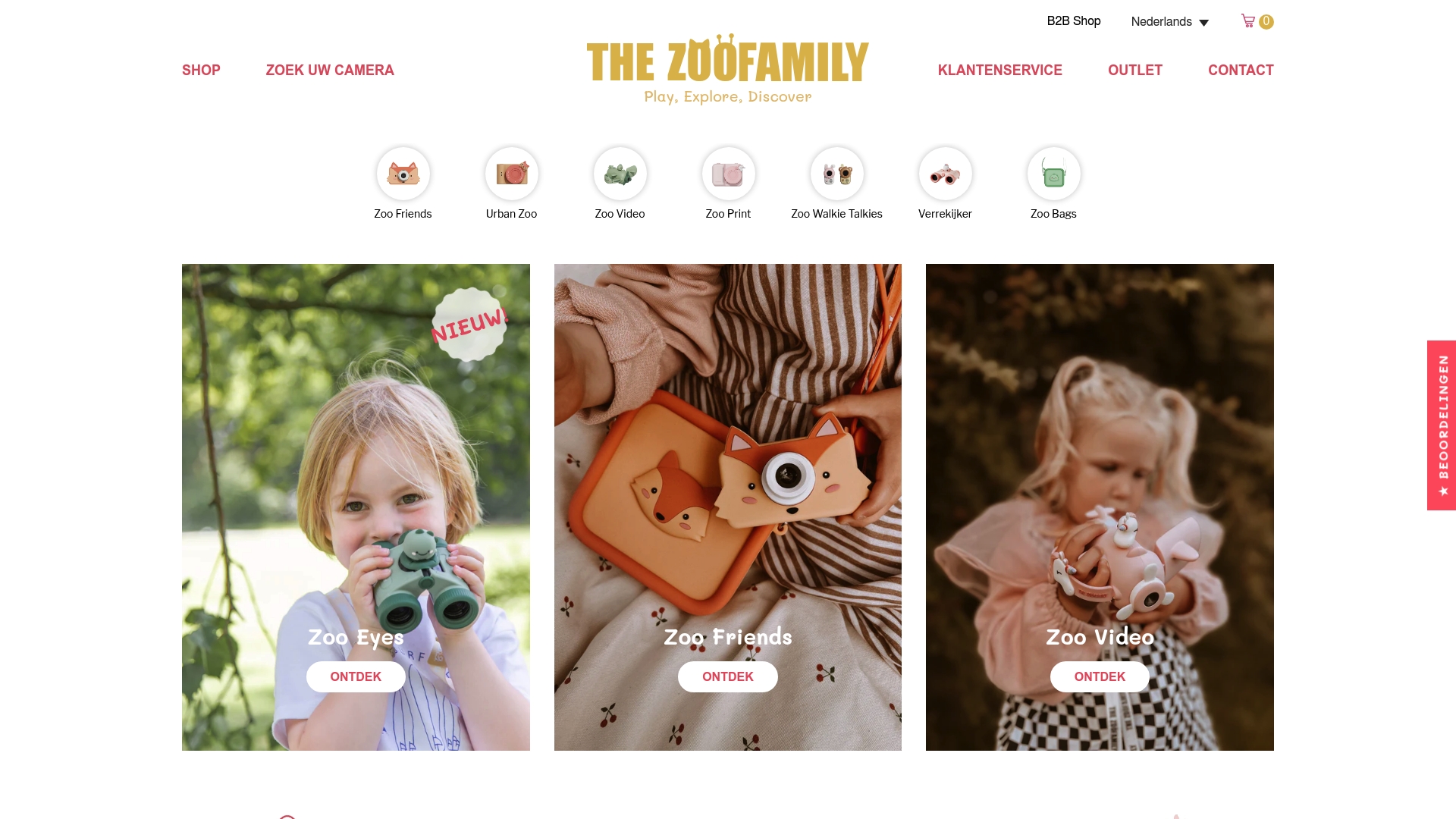
A pair of Thezoofamily binoculars turns a blanket fort into a safari observation post. Walkie-talkies add a communication layer to obstacle courses and imaginative role play. The kids’ camera encourages children to document their craft projects, sensory bins, and science experiments, building a visual record of what they made and discovered. For every camera sold, Thezoofamily plants one tree, connecting the play directly to the natural world the activities are designed to spark curiosity about.
Browse the full range at thezoofamily.com and find the toy that fits your child’s current favourite activity.
Useful sources and further reading
A short list of trustworthy resources for more activities, printables, and early-years guidance:
- PBS KIDS for Parents — Rainy Day Activities — a broad, family-friendly roundup with age-filtered ideas; good starting point for parents new to structured play.
- Teaching Expertise — 30 Rainy Day Preschool Activities — practitioner-written list grouped by category (art, science, games, sensory); useful for teachers and home educators.
- Pre-K Pages — Raindrop Suncatchers Fine Motor Art — detailed craft tutorial with STEAM learning notes; recommended for the suncatcher project.
- ParentMap — Indoor Play Activities from a Preschool Teacher — teacher-perspective tips on obstacle courses and imaginative space transformations; strong on practical setup advice.
- Thezoofamily — 7 Fun Ideas for Rainy Days with Your Kids — animal-themed process art and interactive games from Thezoofamily; best for extending nature-themed imaginative play indoors.