

Every british mom knows the excitement of sharing Earth’s wonders with her children, yet finding creative ways to spark curiosity can be challenging. Over 60 percent of European families say they crave more hands-on nature experiences that deepen family connections. Exploring the night sky through lunar photography combines science, art, and sustainability while encouraging meaningful outdoor adventures your children will treasure for years.
Table of Contents
- Step 1: Choose The Right Night For Moon Photos
- Step 2: Set Up Your Kids’ Camera And Tripod
- Step 3: Adjust Camera Settings For Night Photography
- Step 4: Frame And Focus On The Moon With Kids
- Step 5: Review And Share Your Magical Moon Photos
Quick Summary
| Key Point | Explanation |
|---|---|
| 1. Optimal Moon Phases Enhance Photos | Choose first or last quarter phases for balanced illumination and clear details in lunar photography. |
| 2. Stable Setup is Essential | Use a sturdy tripod or stable surfaces to reduce blur and ensure your camera remains steady during shooting. |
| 3. Adjust Camera Settings Carefully | Set aperture to f/4 or f/8, use ISO 400 to 800, and shoot in RAW for the best results in night photography. |
| 4. Focus on Creative Composition | Make the Moon the centrepiece and experiment with different framing techniques to enhance your lunar images. |
| 5. Review and Share Your Work | Enhance images with editing software, select the best shots, and share them with the community to inspire learning. |
Step 1: Choose the Right Night for Moon Photos
Capturing stunning lunar photographs requires selecting the perfect evening when astronomical conditions align perfectly. Your mission is understanding how moon phases and atmospheric conditions dramatically influence image quality.
NASA recommends experimenting with lunar photography conditions by tracking moon phases carefully. The ideal nights typically occur during first or last quarter phases when moonlight offers balanced illumination without overwhelming brightness. Full moon evenings create harsh glare that washes out intricate surface details, while new moon periods provide insufficient lunar visibility.
Planning becomes crucial. Check local moonrise and moonset times to determine optimal shooting windows. Weather matters immensely too watching for clear skies with minimal atmospheric turbulence. Cloud cover or high humidity can dramatically reduce photographic clarity. Consider using smartphone apps or astronomy websites that provide precise lunar phase calendars and astronomical forecasts.
Expert Suggestion: Maintain a lunar photography journal tracking successful shooting conditions to develop personalised insights about your local night sky environment.
Here is a quick reference comparing lunar phases and their suitability for moon photography:
| Moon Phase | Illumination Level | Visibility of Details | Suitability for Photography |
|---|---|---|---|
| New Moon | Very low | Surface not visible | Unsuitable—moon cannot be seen |
| First Quarter | Moderate | Craters and shadows clear | Excellent—best balance |
| Full Moon | Very high | Details washed out | Difficult—excessive brightness |
| Last Quarter | Moderate | Surface features defined | Excellent—good visibility |
Step 2: Set Up Your Kids’ Camera and Tripod
Preparing the right equipment is crucial for capturing breathtaking lunar photographs with your young adventurers. Your goal is to create a stable setup that allows children to safely manage their camera while minimising image blur.

NASA recommends stabilising cameras for night photography by using a sturdy tripod or finding alternative steady surfaces. For younger photographers, consider child-friendly tripods with adjustable heights and lightweight designs. When selecting a tripod, ensure it can support your camera’s weight and provides smooth pan and tilt movements. Some compact models come with additional features like quick release plates and built-in spirit levels to help kids achieve perfect alignment.
Teach your children how to properly mount photographic equipment) by demonstrating gentle handling and secure attachment techniques. Show them how to extend tripod legs evenly and lock them into place. If a traditional tripod feels challenging, explore alternative stabilisation methods like bean bags, stable rock surfaces, or specialised smartphone mounts that can help young photographers maintain image sharpness.
Expert Suggestion: Practice setting up the camera and tripod together during daylight hours to build confidence and muscle memory before your exciting nighttime lunar photography adventure.
Step 3: Adjust Camera Settings for Night Photography
Night photography demands precise camera configurations to capture the Moon’s mesmerising details. Your challenge is mastering technical settings that transform ordinary snapshots into extraordinary lunar images.
The National Wildlife Federation recommends optimal night photography techniques by focusing on three critical camera settings. Start with aperture selection use f/4 or f/8 to allow maximum light entry. Increase your ISO to around 400 or 800 to enhance light sensitivity while maintaining image quality. Crucially shoot in RAW format to preserve maximum image information and allow more flexibility during post processing.
NASA’s lunar photography guidelines emphasise experimenting with manual settings to achieve perfect exposure. Practice adjusting shutter speed to prevent Moon overexposure particularly during different lunar phases. Remember that each camera responds differently to night conditions so take multiple shots with varying configurations. Encourage your children to view each attempt as a learning opportunity documenting their settings and results to understand how slight adjustments dramatically impact image quality.
Expert Suggestion: Create a simple photography settings logbook where kids can record their camera configurations and corresponding image results to track their learning progress.
Here is a summary table of key camera settings for lunar photography with children:
| Setting | Recommended Range | Reason for Choice |
|---|---|---|
| Aperture (f-stop) | f/4 to f/8 | Allows sufficient light and sharpness |
| ISO | 400 to 800 | Enhances sensitivity, keeps low noise |
| Format | RAW | Retains maximum editing flexibility |
| Shutter Speed | Varies (experiment) | Prevents overexposure, captures details |
Step 4: Frame and Focus on the Moon with Kids
Photographing the Moon becomes a magical learning experience when you transform technical skills into an exciting exploration with your children. Your mission is to help young photographers discover the art of capturing lunar landscapes through creative composition and patient observation.
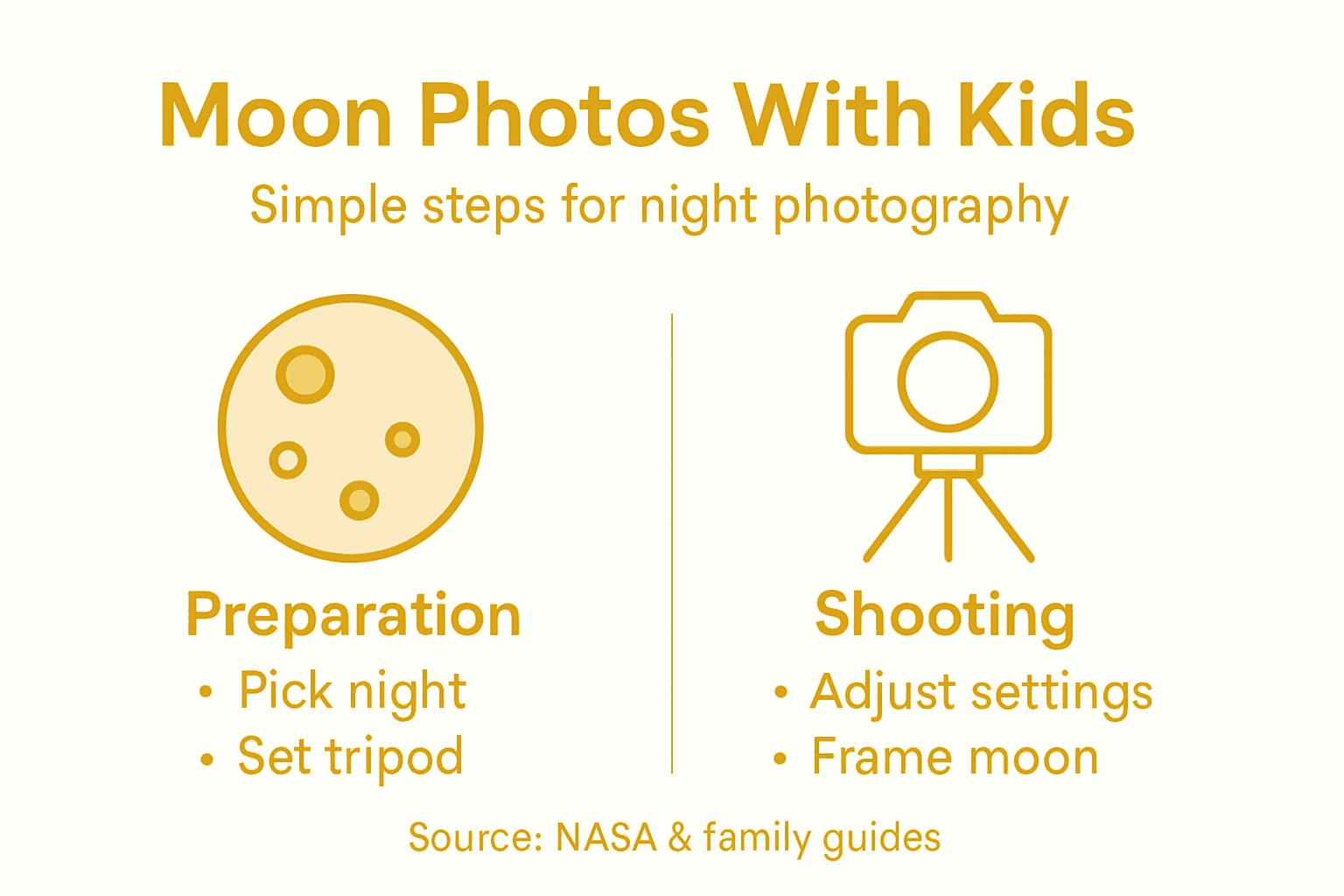
NASA’s lunar photography guide recommends teaching children to make the Moon the centrepiece of their image. Encourage them to experiment with different framing techniques positioning the lunar surface either centrally or using creative off centre compositions. Zoom lenses or telescope attachments can help magnify lunar details transforming an ordinary snapshot into an extraordinary celestial portrait. Teach kids to reduce camera brightness settings to reveal subtle lunar textures craters and distinctive surface characteristics.
Moon observation resources for families suggest involving children by turning photography into an interactive learning adventure. Encourage them to identify visible lunar features like prominent craters mountain ranges and dark maria regions. Experiment with framing the Moon against terrestrial elements like trees silhouettes or distant landscapes to add visual interest and context. Remind your young photographers that patience and repeated attempts are essential skills in capturing the perfect lunar image.
Expert Suggestion: Create a fun lunar feature spotting game where children earn points for identifying and photographing different Moon surface characteristics.
Step 5: Review and Share Your Magical Moon Photos
The final stage of lunar photography is a delightful opportunity to celebrate your children’s astronomical achievements and inspire their curiosity about the night sky. Your mission is to transform raw images into cherished memories and potentially connect with a wider community of young astronomers.
NASA’s lunar photography guidelines recommend using editing software to enhance your Moon photographs subtly. Work with your children to adjust brightness contrast and sharpness while maintaining the image’s natural integrity. Select the most compelling shots that showcase interesting lunar features like crater formations or intriguing surface textures. Discuss what makes certain images special helping your young photographers develop a critical and appreciative eye.
International Observe the Moon Night offers an exciting platform for sharing your photographic discoveries. Encourage your children to upload their favourite images to community galleries engaging with other young astronomers worldwide. This shared experience not only validates their creative efforts but also connects them to a global network of lunar enthusiasts. Create a family album or digital slideshow to document your lunar photography journey celebrating each unique perspective and learning moment.
Expert Suggestion: Create a playful lunar photo rating system where family members vote on their favourite images using fun astronomy themed stickers or points.
Capture Magical Moon Moments with Your Kids Using The Zoofamily
Taking stunning moon photos at night with children involves overcoming challenges like selecting the perfect lunar phase, stabilising the camera setup, and mastering night photography settings. These steps require patience, the right tools, and creative guidance to ignite your children’s curiosity while ensuring clear, beautiful images of the Moon’s surface. If you want to enhance this shared adventure, using specialised equipment designed for young explorers can make all the difference.
At The Zoofamily, we offer the best kids’ cameras engineered for ease of use and durability during nighttime shoots. Our products come with playful animal designs that stimulate kids’ connection with nature and encourage them to explore the world beyond the backyard. Plus, with every camera sold, we plant a tree to nurture the very planet your children are learning to appreciate. Start your lunar photography journey today and create unforgettable memories that inspire a lifelong love of the night sky. Discover more on our website and let the cosmic adventure begin at https://thezoofamily.com.
Frequently Asked Questions
What is the best night to take moon photos with kids?
The best nights for taking moon photos with kids are during the first or last quarter phases. Plan ahead by checking local moonrise and moonset times to ensure optimal shooting windows.
How do I set up a camera for lunar photography with children?
To set up a camera for lunar photography with children, use a sturdy tripod to stabilise the camera. Teach your kids how to properly mount the camera and ensure the tripod is steady before starting to shoot.
What camera settings should I adjust for night photography?
For night photography, adjust the aperture to between f/4 and f/8, increase the ISO to around 400 or 800, and shoot in RAW format. Practise these settings during different lunar phases to see what works best.
How can I make moon photography a fun experience for my kids?
Make moon photography a fun experience by involving your kids in the creative process, such as framing the moon in interesting ways. Create a spotting game where they earn points for identifying and photographing different lunar features.
What should I do after taking photos of the moon with my children?
After taking photos of the moon, review the images together and select the most compelling ones to edit. Consider creating a family album or participating in community galleries to share your lunar photography journey.
Recommended
- 7 Tips for Exciting Photography Scavenger Hunts – The Zoofamily
- Meilleurs gadgets plein air enfants – Comparatif 2025 – The Zoofamily
- Éduquer Enfants à la Patience : Clés et Bienfaits Naturels – The Zoofamily
- DIY Playground Ideas to Inspire Outdoor Creativity at Home – The Zoofamily
- Imaginative Art Prints Every Kid’s Room Deserves - ArtMandre