

Most children’s walkie-talkies labelled “long range” will cover a short range in a typical UK park or suburban street, and an even shorter range indoors or in dense woodland. The box may say 5 km, 10 km, or even more. That figure comes from a test in open, flat terrain with no obstacles. In everyday family use, you will rarely see it.
Quick answer for parents:
- Park or open field: expect a few kilometres on a clear day
- Wooded trails or housing estate: a short distance is more realistic
- Indoors (house to garden): often a very short distance
The single most important factor is line-of-sight: if two people can see each other across a field or beach, the radios will usually work well. Add trees, walls, or hills, and range drops quickly.
Table of Contents
- How far do long range walkie talkies really work?
- What range can you expect in different environments?
- What actually affects how far a walkie-talkie reaches?
- What should parents prioritise when buying children’s walkie-talkies?
- Simple steps to improve range and clarity
- UK safety rules and PMR446: what parents need to know
- When should you consider an alternative to walkie-talkies?
- Thezoofamily walkie-talkies: designed for children’s outdoor play
- Key takeaways
- A note on what actually matters
- Useful sources
How far do long range walkie talkies really work?
Manufacturers measure “maximum range” under ideal lab conditions: one radio on high ground, the other in a valley, nothing in between, fresh batteries, and a clear radio spectrum. Retailers commonly advertise ranges of many miles based on these tests. In a normal neighbourhood, actual range is much shorter, typically within walking distance.
Consumer radios typically achieve a few kilometres in open terrain. Urban performance is lower. The gap between the box claim and family reality is not a defect. It is simply how radio physics works in real environments.
Doubling transmit power does not double range. Increasing power raises reach somewhat, but not linearly. Antenna quality and placement often matter more than wattage.
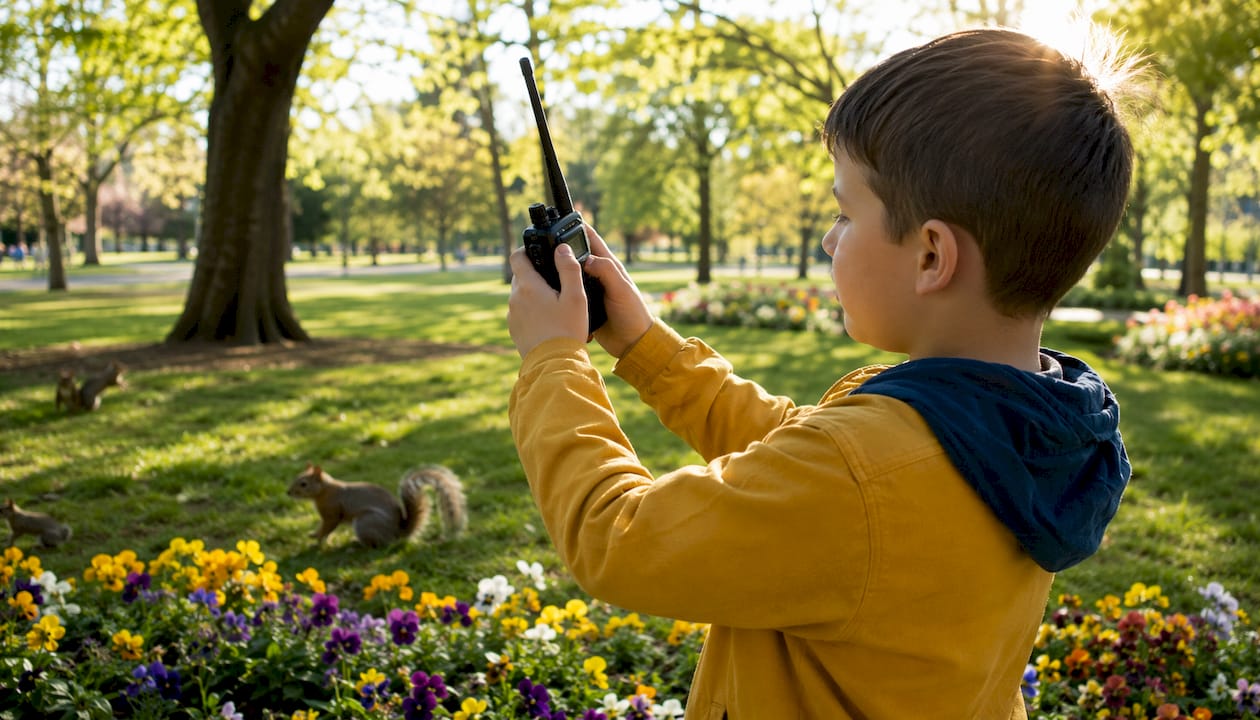
Pro Tip: When reading packaging, look for the frequency band (UHF is better around buildings), PMR446 compliance for licence-free UK use, and battery type. Ignore the headline kilometre figure.
What range can you expect in different environments?
| Environment | Realistic range |
|---|---|
| Indoors (house to garden) | a short distance |
| Suburban street or housing estate | within a local neighborhood |
| Park or open field | several kilometres |
| Woodland or forest trail | somewhat less than open areas |
| Hilltop to hilltop (clear view) | a few kilometres |
| Across open water or flat farmland | a few kilometres |
A few things explain the differences:
- Open fields and water remove most obstacles, so the signal travels further.
- Woodland absorbs signal through dense foliage; summer canopy reduces range more than bare winter trees.
- Urban areas are the hardest. Concrete and metal structures block and reflect signals more aggressively than trees do.
- Weather plays a smaller role than obstacles, but heavy rain or dense fog can cut range by roughly 20–30% in severe conditions.
What actually affects how far a walkie-talkie reaches?
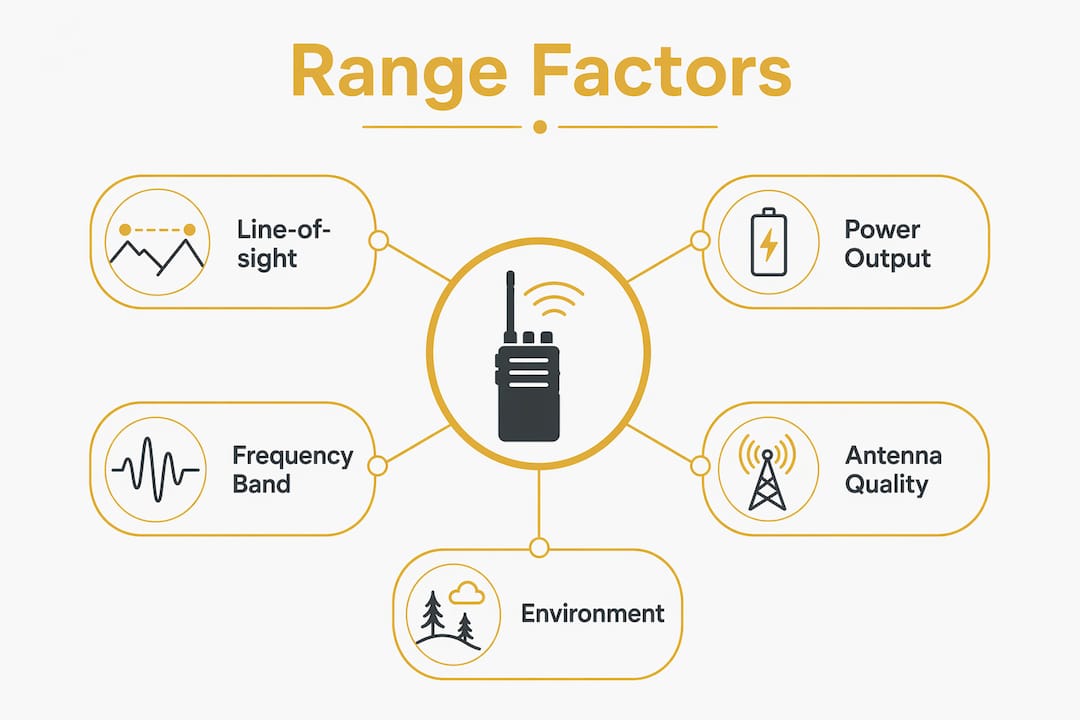
Obstacles are usually the primary limit, not the radio’s wattage. Concrete, metal, and dense topography deaden signals quickly, and urban canyon effects can trap or scatter transmissions.
Key factors:
- Line-of-sight: hills, buildings, and ridgelines block the signal path directly.
- Frequency band: UHF (used by most consumer and PMR446 radios) penetrates buildings better than VHF, though it still dislikes large obstacles.
- Transmit power: higher wattage helps in open areas, but not proportionally.
- Antenna quality and orientation: a damaged or poorly angled antenna can cut range by tens of per cent. Keeping the radio vertical and the antenna upright makes a real difference.
- Battery level: low batteries reduce output power and produce scratchy, unreliable audio.
- Interference: nearby Wi-Fi routers, other radios, and metal structures all chip away at clarity.
Pro Tip: If range suddenly drops, check three things first: swap in fresh batteries, raise the radio above your head or move to higher ground, and check the antenna is straight and undamaged.
What should parents prioritise when buying children’s walkie-talkies?
For family use, simplicity and reliability matter far more than headline range. A child who can operate the radio confidently and hear clearly is better served than one holding a high-power device they cannot use.
Checklist for parents:
- PMR446 compliance: confirms the device is licence-free in the UK and meets Ofcom power limits. This is the standard to look for on the box.
- Simple controls: large push-to-talk button, easy volume adjustment, and clear channel display.
- Audio clarity: a loud, clear speaker matters more than extra kilometres on the box.
- Battery life: rechargeable packs or standard AA/AAA batteries are both fine; check how long a full charge lasts under normal play.
- Durability: rubberised casing, wrist straps, and belt clips help with outdoor play.
- CE or UKCA marking: confirms the device meets UK safety standards.
Avoid higher-power radios that fall outside PMR446 rules. They require licences, are unsuitable for children, and offer no practical benefit for family outings. You can read more about walkie-talkie safety for children before you buy.
Simple steps to improve range and clarity
Getting the most from a set of walkie-talkies does not require new gear. A few habits make a consistent difference.
- Hold the radio upright with the antenna vertical. Tilting it sideways can reduce range noticeably.
- Move to higher ground. Gaining even a few metres of elevation extends reach because the signal travels in a straighter line.
- Charge batteries fully before an outing. Low power is one of the most common causes of poor performance.
- Avoid metal structures and enclosed spaces when transmitting. Step away from a car or building before pressing the button.
- Keep messages short and clear. Long transmissions in poor conditions are harder to receive than brief ones.
Pro Tip: If you are in a park with poor range, try moving to the highest point you can reach, such as a gentle hill or a footbridge. Even 6 metres of extra height can produce a noticeable improvement without changing the radio at all.
Pairing walkie-talkie use with structured outdoor activities also helps children learn good radio habits. Thezoofamily has a useful list of walkie-talkie games for kids that make practice feel like play.
UK safety rules and PMR446: what parents need to know
Most children’s walkie-talkies sold in the UK operate on PMR446, the licence-free radio service regulated by Ofcom. PMR446 devices are limited to 0.5 W of output power and must use a fixed, non-detachable antenna. These restrictions are what make them legal to use without a licence anywhere in the UK.
Key points for parents:
- No licence needed for PMR446 devices. Any compliant set is ready to use out of the box.
- Higher-power radios (above PMR446 limits) require a licence from Ofcom and are not appropriate for children’s use.
- Antenna handling: teach children not to bend or pull the antenna. A damaged antenna reduces range and can expose sharp edges.
- Volume levels: keep volume at a comfortable level to protect hearing, especially with headphones or earpieces.
- Battery safety: use the charger supplied with the device and keep batteries away from young children.
- Outdoor supervision: walkie-talkies support communication during play but do not replace adult supervision, particularly in unfamiliar terrain.
For broader guidance on safe outdoor play and staying connected, Tendaro’s outdoor activity blog offers practical family checklists worth bookmarking.
This article is general information, not legal or regulatory advice. Check current Ofcom guidance for the rules that apply to your specific device.
When should you consider an alternative to walkie-talkies?
A standard PMR446 set covers most family outings. There are situations, though, where a different solution makes more sense.
- Mobile phones with family-sharing features: nationwide coverage, location sharing, and voice calls. The downsides are cost, distraction risk for children, and dependence on mobile signal and battery.
- Licensed two-way radios with repeaters: much greater range, but they require an Ofcom licence, are complex to set up, and are not suitable for young children.
- Hybrid smart radios using cellular or Wi-Fi backhaul: these extend range almost indefinitely but depend on data coverage and a subscription. They are better suited to adults than children.
If you need reliable communication across more than 3–5 km, or in an area with no mobile signal at all, a licensed radio or a satellite communicator is a more honest solution than a higher-power handheld.
Thezoofamily walkie-talkies: designed for children’s outdoor play
Thezoofamily builds walkie-talkies specifically for children, not scaled-down adult devices. The controls are simple, the casing is durable, and the designs use animal references to connect children with the natural world. Every set is PMR446 compliant, so there is no licence to arrange and no complicated setup.
The brand’s mission goes beyond the product. For every camera sold, Thezoofamily plants one tree, reflecting a commitment to the outdoor environments where children use these radios. If you are looking for a set that balances practical range, child-friendly design, and a clear safety profile, view the full range on the Thezoofamily website.
Key takeaways
Most children’s walkie-talkies will cover 2–5 km in a park or open field and commonly less than 1–2 km in woodland or on a housing estate, regardless of what the box claims.
| Point | Details |
|---|---|
| Realistic range for families | Expect 2–5 km in open parks; under 1–2 km in woods or urban streets. |
| Box claims are best-case figures | Manufacturers test at line-of-sight with no obstacles; real use is always lower. |
| PMR446 is the UK standard | Look for PMR446 compliance to confirm licence-free, child-safe power limits. |
| Prioritise usability over range | Clear audio, simple controls, and good battery life matter more than headline kilometres. |
| Thezoofamily option | PMR446-compliant, child-focused design with durable casing and nature-themed play appeal. |
A note on what actually matters
There is a tendency to judge walkie-talkies by the largest number on the box. For children, that instinct leads to the wrong purchase. A radio that reaches 10 km in a mountain valley is not more useful to a seven-year-old in a Surrey woodland than one that reaches 1 km clearly and reliably.
The real question is not maximum distance. It is whether a child can press one button, hear a parent’s voice clearly, and respond without confusion. Simplicity, durability, and compliance with UK rules are the criteria worth checking. Range will take care of itself within the realistic limits of the environment.
Useful sources
- Ofcom / PMR446: the UK regulator’s guidance on licence-free radio use. The primary reference for confirming whether a device is legal to operate without a licence.
- Hytera: how far can walkie-talkies reach: a detailed technical guide covering environment types, obstacle effects, and realistic range data for consumer radios.
- TwoWayRadioWholesale: real distance vs advertised: practical breakdown of why box figures differ from real-world performance, with notes on antenna, power, and weather.
- Relaypro: how far do walkie-talkies reach: consumer-focused range guide with open-terrain and urban comparisons.
- Radio Warehouse: walkie-talkie range factors: Australian retailer with a clear explanation of why advertised ranges are theoretical; figures are from the Australian market but the physics applies universally.
- Thezoofamily: brand guidance on PMR446 compliance and child-focused walkie-talkie design for UK families.