

This guide gives you twelve ready-to-run cooperative outdoor challenges for primary-age children (Years 1–6), each with an age band, timings, kit list and safety notes. For a low-prep session that works straight away, start with the wildlife photo scavenger hunt (Years 2–5, 45 minutes) or the map-and-clue treasure trail (Years 3–6, 50 minutes). Both need minimal kit, run with an appropriate adult-to-child ratio, and produce clear teamwork gains.
Sustained outdoor learning produces stronger outcomes than one-off events. A sector review confirms that good preparation and follow-up are what make the difference. Before you run any session, confirm your adult:child ratios, check that a DBS-checked safeguarding lead is present, and have a weather contingency plan in place.
Quick picks at a glance:
- Wildlife photo scavenger hunt: Years 2–5, 45 min, low kit
- Map-and-clue treasure trail: Years 3–6, 50 min, laminated cards only
Key takeaways
Cooperative outdoor team-building challenges produce the strongest learning gains when they are repeated, well prepared, and followed by a structured debrief linked to classroom outcomes.
| Point | Details |
|---|---|
| Start with two activities | Choose complementary challenges that build the same skill at increasing difficulty. |
| Debrief every session | Ask one focused question after each activity to lock in the learning. |
| Confirm safeguarding first | Nominate a DBS-checked lead, set ratios by age band, and carry a written welfare plan. |
| Repeat over time | Sustained programmes outperform single events; run the same activity twice with a harder version. |
| Adapt roles, not tasks | Give every child a meaningful role rather than simplifying the activity for mixed-ability groups. |
Table of Contents
- What group team building challenges work best outdoors?
- How do you plan and sequence a session effectively?
- UK safeguarding and risk assessment: what do you need to check?
- What kit do you actually need?
- How do you adapt activities for mixed abilities?
- Sample 1-hour session plan and longer-session checklist
- What experienced youth leaders notice about outdoor challenges
- Sources
What group team building challenges work best outdoors?
The twelve activities below are fully cooperative. No child wins alone.
1. Wildlife photo scavenger hunt
Age: Years 2–5 | Group: 4–6 | Time: 45 min Kit: Kid-friendly camera or phone, printed checklist
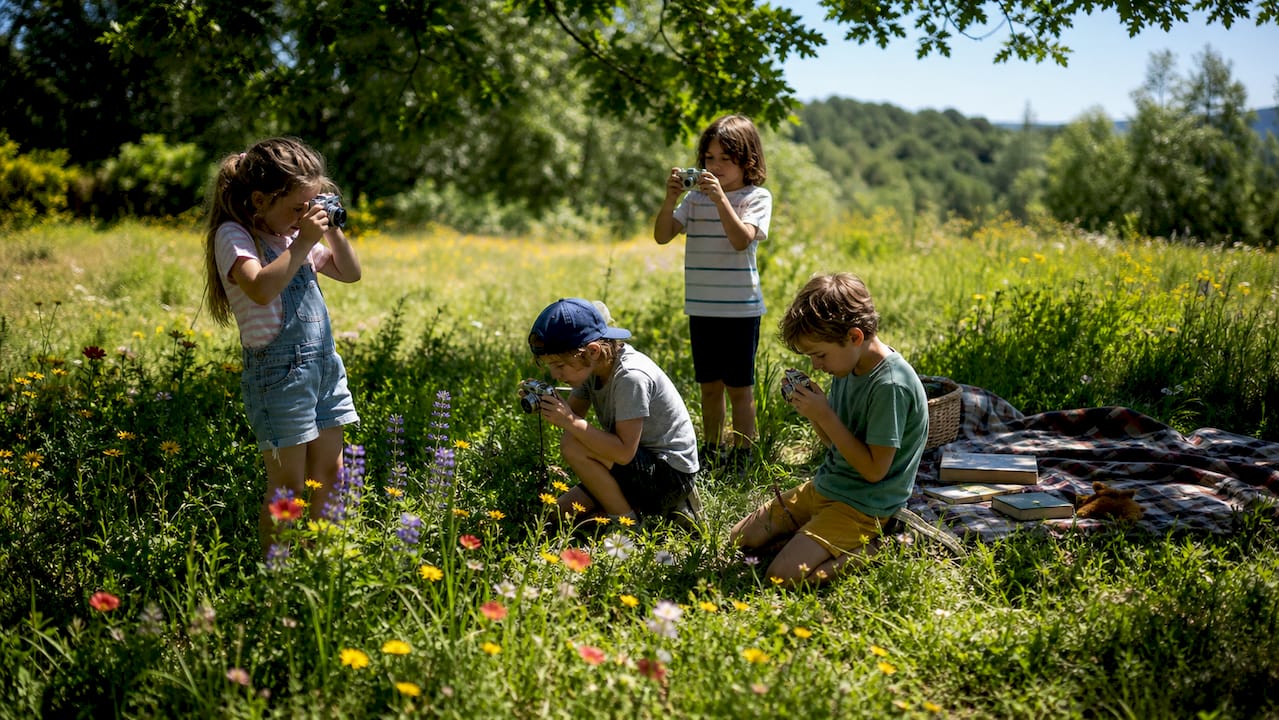
- Give each team a checklist of ten nature items (leaf shapes, insects, bark textures).
- Teams photograph every item rather than collect it, keeping the environment intact.
- Compare photos at the end and discuss what each team spotted differently.
Learning outcomes: Communication, observation, cooperation Debrief prompt: “Which item was hardest to find, and how did you decide where to look?” Safety note: Stay within a defined boundary; adult checks photos at halfway point.
Thezoofamily cameras are well suited here. They are built for small hands and drop-resistant, so children focus on the hunt rather than the kit. A printed paper checklist works just as well if cameras are unavailable.
2. Map-and-clue treasure trail
Age: Years 3–6 | Group: 4–8 | Time: 50 min Kit: Laminated clue cards, simple site map
- Place six clue cards around a defined outdoor area before the session.
- Teams read each clue together and agree on the next location before moving.
- The final clue leads to a shared reward (stickers, a nature certificate).
Learning outcomes: Leadership, problem-solving, communication Debrief prompt: “Who took the lead at each clue, and did that change as you went?” Safety note: Laminate clues to survive wet weather; responsible adults stationed at start and finish.
3. Den building
Age: Years 2–6 | Group: 5–8 | Time: 40 min Kit: Rope, tarpaulins or large sticks, no sharp tools
- Set a brief: the den must shelter the whole team from imaginary rain.
- Teams plan, build and test their structure (adult pours a cup of water on the roof).
- Groups present their design choices to the wider group.
Learning outcomes: Resilience, planning, teamwork Debrief prompt: “What would you change if you had ten more minutes?” Safety note: No cutting tools; check overhead branches before building.
4. Blindfolded sensory trail
Age: Years 1–4 | Group: 4–6 | Time: 30 min Kit: Blindfolds (one per pair), rope guide line
- Pairs take turns: one child is blindfolded, the other guides using only words.
- The sighted child describes textures, sounds and smells along a short route.
- Swap roles halfway.
Learning outcomes: Communication, trust, empathy Debrief prompt: “What was harder: giving instructions or following them?” Safety note: Clear the route of trip hazards before the session; adult walks alongside each pair.
5. Nature relay with walkie-talkies
Age: Years 3–6 | Group: 6–12 | Time: 35 min Kit: Walkie-talkies (one per team), nature ID cards
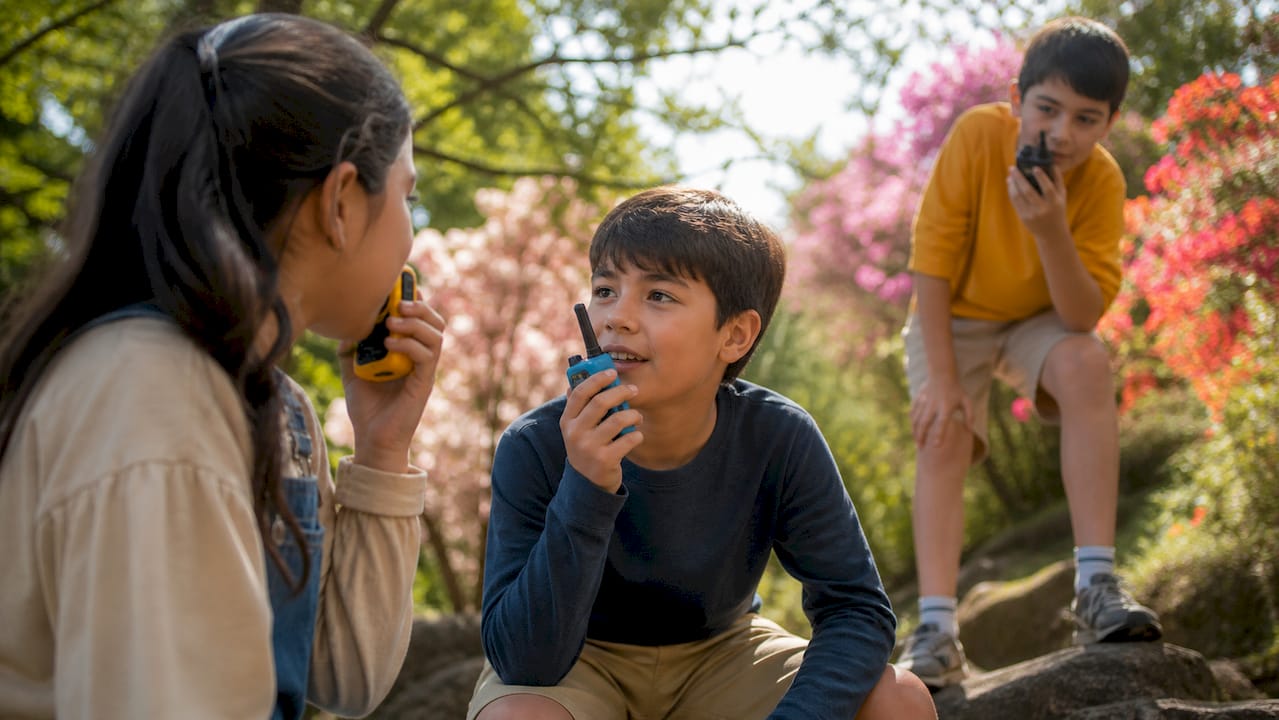
- Split into two sub-groups: spotters in the field, recorders at base.
- Spotters describe a nature item over the walkie-talkie; recorders identify it from ID cards.
- Teams score a point for each correct identification.
Learning outcomes: Communication, listening, teamwork Debrief prompt: “What made a description easy or hard to understand?” Safety note: Set a clear boundary for spotters; adults carry a spare walkie-talkie.
Thezoofamily walkie-talkies extend the range of this activity across larger sites such as school fields or woodland edges.
6. Team shelter test
Age: Years 4–6 | Group: 5–8 | Time: 40 min Kit: Tarpaulin, pegs, rope
- Teams have 20 minutes to build a shelter that fits everyone inside.
- Test it: all team members sit inside for two minutes.
- Discuss what worked and what collapsed.
Learning outcomes: Resilience, leadership, planning Debrief prompt: “How did you decide who did what?” Safety note: No climbing above shoulder height; adult checks anchor points.
7. Water-transfer cooperation game
Age: Years 2–5 | Group: 4–8 | Time: 25 min Kit: Buckets, cups with small holes, target container
- Teams transfer water from a full bucket to a target container using only the holed cups.
- The goal is a collective target volume, not a race against another team.
- Works on grass; expect wet feet.
Learning outcomes: Cooperation, problem-solving Debrief prompt: “How did you work out the best way to carry the water?” Safety note: Use plain water; dry hands before handling any electrical kit.
8. Group orienteering puzzle
Age: Years 4–6 | Group: 4–8 | Time: 50 min Kit: Simple orienteering map, control cards, pencils
- Each control point has a letter; teams collect all letters to spell a nature word.
- Every team member must visit at least two controls.
- Outdoor science activities can be added at each control to link to curriculum.
Learning outcomes: Leadership, navigation, teamwork Debrief prompt: “How did you split up the controls fairly?” Safety note: Buddy system at all times; adults at start, finish and one mid-point.
9. Collective story-building with natural props
Age: Years 1–4 | Group: 4–8 | Time: 20 min Kit: Natural objects collected by children (sticks, leaves, stones)
- Each child adds one object to a central display and one sentence to a shared story.
- No object or sentence can repeat what has already been said.
- Record the story on a clipboard for a classroom follow-up.
Learning outcomes: Creativity, communication, listening Debrief prompt: “Whose sentence surprised you most, and why?” Safety note: Check objects for sharp edges; wash hands after handling soil.
10. Wildlife binocular watch
Age: Years 2–6 | Group: 4–6 | Time: 30 min Kit: Binoculars, tally sheet, pencils
- Teams observe a fixed area for 15 minutes and tally every bird or insect spotted.
- Compare tallies across teams and discuss why counts differ.
- Link to science curriculum: habitats and living things.
Learning outcomes: Observation, patience, cooperation Debrief prompt: “What conditions helped you spot more wildlife?” Safety note: Stay seated or stationary; avoid disturbing nesting areas.
Thezoofamily binoculars are sized for children aged 5 and above and include a focus wheel children can operate independently.
11. Human knot alternative (circle untangle)
Age: Years 1–3 | Group: 6–10 | Time: 15 min Kit: None
- Children stand in a circle and each holds a short rope loop connecting them to two neighbours.
- The group must untangle the circle without letting go, moving under and over each other.
- Use rope loops instead of hand-holding for hygiene and accessibility.
Learning outcomes: Communication, problem-solving, resilience Debrief prompt: “What did you try first, and did it work?” Safety note: Keep movements slow; adult monitors for children who feel uncomfortable.
12. Adult-led fire-lighting demonstration
Age: Years 5–6 | Group: 6–12 | Time: 40 min Kit: Fire steel, tinder, designated fire pit, bucket of water
- Adult demonstrates fire-lighting; children observe and assist with tinder preparation only.
- Teams collect and sort tinder by type (dry grass, bark, thin twigs) as a cooperative task.
- Discussion: how fire was used historically and its role in nature.
Learning outcomes: Resilience, observation, respect for nature Debrief prompt: “What did each type of tinder do differently?” Safety note: Adult controls fire at all times; children stay 1 metre back; water bucket present.
How do you plan and sequence a session effectively?
Start with your learning aim, then choose two or three activities that build on each other. A session focused on communication works well as: sensory trail (trust and listening) → nature relay with walkie-talkies (verbal precision) → collective story-building (creative listening). Each activity uses the same skill at increasing complexity.
Timed 1-hour session template:
| Phase | Activity | Duration |
|---|---|---|
| Warm-up | Circle untangle or sensory trail | 10 min |
| Main challenge | Wildlife photo hunt or treasure trail | 30 min |
| Short follow-up | Collective story or binocular watch | 10 min |
| Debrief | Reflection questions, clipboard notes | 10 min |
For a half-day, run two main challenges with a snack break between them and a longer debrief at the end. Outdoor lessons planned and assessed with the same rigour as classroom lessons produce consistently better outcomes.
Curriculum links:
- PSHE: cooperation, empathy, managing feelings (debrief prompts map directly to PSHE outcomes)
- PE: physical coordination, spatial awareness
- Science: habitats, living things, materials (den building, binocular watch, fire-lighting)
Simple assessment: ask children to write one sentence on a sticky note after the debrief. Collect these for evidence of learning.
UK safeguarding and risk assessment: what do you need to check?
NSPCC guidance requires a nominated safeguarding lead, safer recruitment checks for all adults working with children, and a written welfare plan for every event. Complete these checks before the session date.
Pre-session checklist:
- Nominate a leader in charge and a home contact (an adult not on the trip who can coordinate with parents and emergency services)
- Confirm safer recruitment compliance for all adults, including visiting helpers
- Carry a written first-aid plan; for adventurous activities, Scout Association rules require appropriate first-aid cover and a continuous risk assessment
- Complete a pre-activity site recce, especially after heavy rain when ground conditions change quickly
- Check weather forecast; NYA weather guidance recommends hydration planning (an appropriate amount in hot weather), sun protection, clothing layers and a contingency plan for adverse conditions
- Carry emergency contacts for every child
Supervision ratios by age band:
| Age band | Minimum adult:child ratio | Notes |
|---|---|---|
| Years 1–2 (ages 5–7) | 1:6 | Higher ratio for adventurous activities |
| Years 3–4 (ages 7–9) | 1:8 | Follow stricter guidance if multiple rule-sets apply |
| Years 5–6 (ages 9–11) | 1:10 | Reduce for off-site or high-risk activities |
Girlguiding’s risk assessment guidance covers headcounts, contingency planning and grouping steps in practical detail. When an activity falls under more than one rule-set, always follow the strictest applicable guidance.
Pro Tip: Print one emergency card per adult before the session. Include the site address, nearest A&E, the home contact’s number and the safeguarding lead’s name.
What kit do you actually need?
Must-haves (free or already owned):
- Basic first-aid kit and whistle
- Water bottles for every child
- Spare clothing layer per child
- Clipboards and pencils
- Laminated activity cards (print and laminate once, reuse many times)
Nice-to-haves that boost learning:
- Kid-friendly cameras for photo hunts and evidence capture
- Walkie-talkies for larger sites or relay activities
- Binoculars for wildlife observation
- Simple nature ID guides (RSPB free downloads work well)
Budget tiers:
- Free: rope offcuts, natural materials, printed checklists, borrowed school stopwatches
- Low cost (under £2 per child): laminated clue cards, tally sheets, rope loops for circle untangle
- Modest spend: durable kid-safe cameras, binoculars and walkie-talkies for repeated use across multiple sessions
Thezoofamily cameras, binoculars and walkie-talkies are designed for children aged 5 and above and built to handle outdoor conditions. For outdoor play ideas that use similar low-cost kit, the Thezoofamily blog has practical suggestions.
How do you adapt activities for mixed abilities?
Every activity above can run with a mixed-ability group. The key is role flexibility, not task simplification.
Practical adaptations:
- Assign roles by strength: a child with limited mobility photographs while others collect; a child with communication needs operates the walkie-talkie at base
- Use visual task cards with pictures alongside written instructions for children who need them
- Add a quiet regrouping point away from the main activity for children who need a sensory break
- Provide differentiated success criteria: “your team found five items” vs. “your team found ten and described each one”
- Use buddy pairs for the sensory trail so no child navigates alone
Scaffolded leadership: rotate the “team reporter” role during the debrief so every child speaks once. This gives quieter children a structured moment to contribute without pressure.
For younger or SEN children, the educational outdoor play activities on the Thezoofamily blog offer shorter, sensory-led formats that pair well with the activities above.
Sample 1-hour session plan and longer-session checklist
Minute-by-minute 1-hour plan:
- 0–5 min: Arrival, register, safety briefing and boundary walk
- 5–15 min: Warm-up activity (circle untangle)
- 15–45 min: Main challenge (wildlife photo scavenger hunt)
- 45–55 min: Short follow-up (collective story with found objects)
- 55–60 min: Debrief, sticky-note reflection, headcount and return
Half-day / full-day checklist:
- Parental consent forms collected and checked
- Home contact confirmed and briefed
- Snack and water break scheduled every 60–90 minutes
- Medication protocols confirmed with school/group lead
- Contingency activity planned for wet weather (move den building under a shelter)
- Final headcount before departure and on return
Troubleshooting prompts:
- Wet ground: swap water-transfer game for den building; move sensory trail to a hard path
- Adult shortage: reduce group size per activity; pause one station rather than lower ratios
- Lost child: activate pre-agreed procedure immediately; home contact calls parents; do not move the group until the child is located
What experienced youth leaders notice about outdoor challenges
Most leaders expect the main challenge to produce the teamwork gains. The debrief is where the learning actually locks in.
A simple wildlife photo hunt produces visible cooperation within minutes. Children who rarely lead in class take charge of the camera or the checklist. The debrief question “who decided where to look next?” consistently surfaces leadership that adults did not notice during the activity itself.
The evidence supports starting small and repeating. Sustained outdoor programmes produce stronger outcomes than single events. Running the same activity twice, three weeks apart, with a harder version the second time, produces more measurable progress than running twelve different activities once each. Link the second session back to what children said in the first debrief. That connection is what makes outdoor learning stick in the classroom.
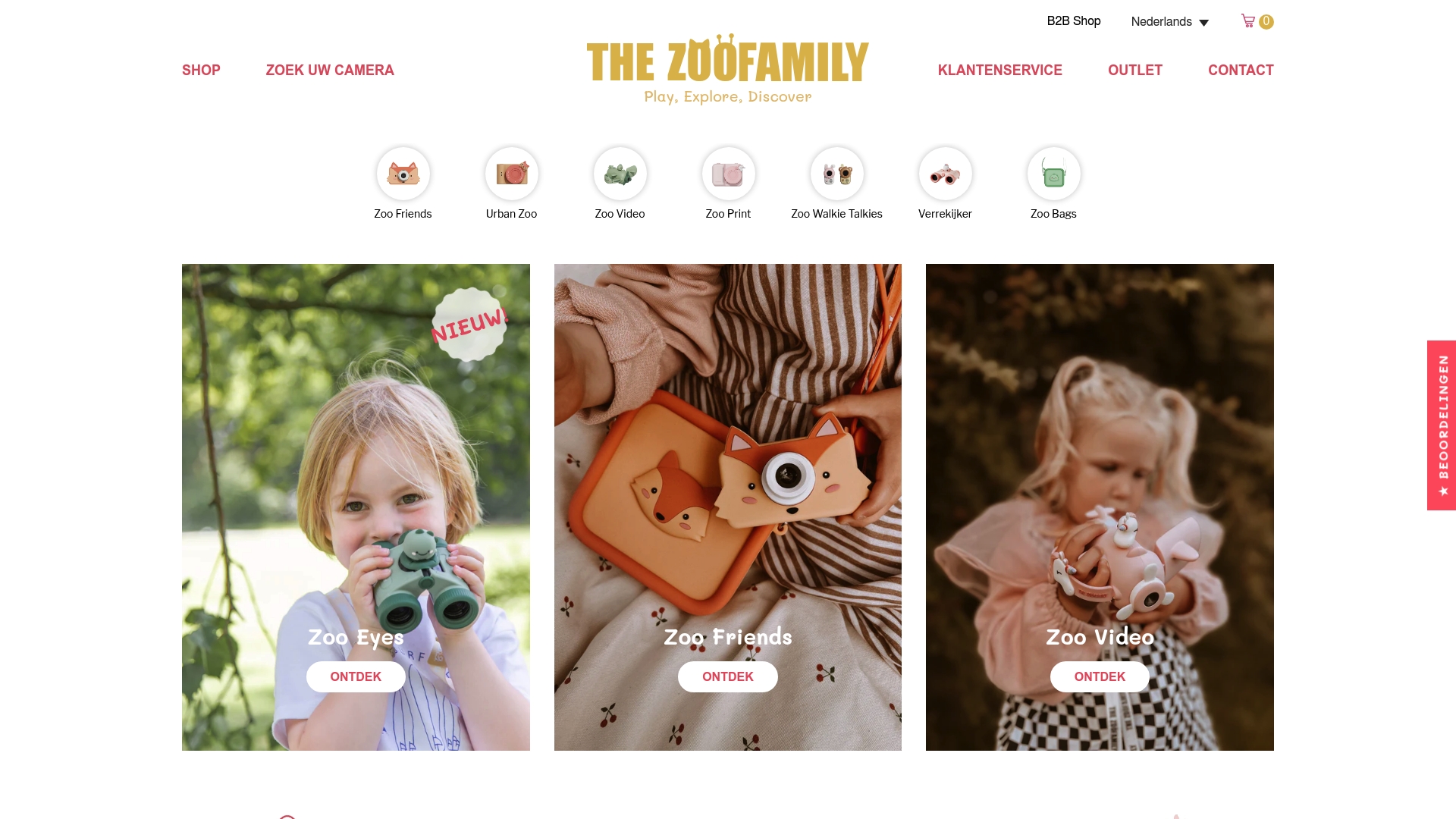
Thezoofamily makes kid-sized cameras, walkie-talkies and binoculars built for outdoor use. Each camera sold plants one tree. Visit Thezoofamily to find durable, nature-themed kit that supports repeated outdoor sessions.
Sources
- Outdoor learning: Exploring the evidence-base – Chartered College research hub
- NSPCC – Safer activities and events
- Scout Association – POR 9a: Preparation, generic rules and definitions for all activities
- Girlguiding – Risk assessment: activity outside normal meeting place (PDF)
- NYA – Weather guidance (PDF)