

Team building challenges for young children are short, cooperative nature tasks that use simple props, such as cameras or walkie-talkies, to build social skills and curiosity. This article gives you eight ready-to-run activities for children aged 3 and up, a prep checklist, safety notes and age adaptations, plus links to further activity resources.
TL;DR:
- Most activities take 10 to 40 minutes; scavenger hunts work best within 40 minutes, while rotating tasks can hold attention better than one long round.
- Set clear boundaries and a regroup signal before starting, then intervene only for genuine hazards or serious distress rather than ordinary mess or frustration.
- Pair children in twos or threes, assign jobs such as photographer and guide, and rotate roles so each child gets a turn leading and following.
- Younger children can use shorter clue lists with an older partner, while tactile clues or audio recording can replace visual or written tasks.
Table of Contents
- Why nature challenges build cooperation and curiosity
- Eight nature team challenges you can run this week
- Prep checklist and facilitation guide for parents
- Adapting challenges for different ages and abilities
- How The Zoofamily kit fits into these challenges
- What to watch for in the field
- Which Zoofamily kit matches which challenge
- FAQ
- Sources
Why nature challenges build cooperation and curiosity
Pretend and outdoor play becomes more social and complex from around age three, and this stage supports cooperation and early theory of mind, according to the Child Mind Institute. Shared outdoor tasks give children a reason to coordinate rather than play side by side.
Outdoor play supports physical activity and is linked to lower risks such as obesity and myopia, compared with indoor-only settings, according to Purdue Global. That matters for team challenges because movement and shared exploration tend to go together outdoors in a way that is harder to recreate indoors.
Observation rather than constant correction helps too. The NAEYC recommends that adults watch during manageable, risky outdoor play and step in only for hazards or real distress, because age-appropriate risk builds resilience and decision-making. Giving children a shared purpose, such as a map, a camera or a set of clues, and a simple role each tends to increase cooperative play.

Eight nature team challenges you can run this week
Each activity below works with items you likely already own, or with a kids’ camera, walkie-talkie or binoculars if you want to add a shared tool.
- Paired photo scavenger hunt. Two children share one camera: one navigates to a list of simple targets (something round, something soft), the other takes the photograph. Takes 15 to 30 minutes for pairs of two.
- Nature detective partner walk. Small groups of two or three follow a clipboard of picture clues, spotting items such as a feather, a pinecone or a snail shell, in the style of the Scouts’ nature detective template. Takes 20 to 40 minutes.
- Blindfolded sensory map with a partner. One child gently guides a blindfolded partner by voice to touch bark, leaves or grass, then the guided child draws or describes the “map” afterwards. Takes 10 to 15 minutes and needs a flat, hazard-checked path.
- Leaf-match relay. Partners collect leaves and race to sort them into matching pairs or shapes, helping each other rather than competing. Takes 10 to 20 minutes.
- Habitat-building teamwork. A small group gathers twigs, moss and leaves to build a mini shelter for a toy insect or figure, dividing jobs like collecting and arranging. Takes 20 to 40 minutes.
- Buddy binocular birdwatch. One child holds and steadies binoculars while the other calls out what they see or ticks a simple picture sheet, then they swap. Takes 15 to 30 minutes.
- Collaborative nature collage. The group arranges found leaves, petals and twigs onto card or paper to build one shared picture. Takes 20 to 30 minutes.
- Team photo-story. The group chooses three or four photo moments from the walk and tells a short story together using the pictures as a sequence. Takes 20 to 30 minutes.
Nature scavenger hunts and detective-style challenges work well for small groups and can be run in sessions of roughly 40 minutes or less, with a simple spotting sheet, according to Kids Club ELC. For the photo and communication-based tasks, pairing a camera, walkie-talkie or binoculars with clear roles (one holds the tool, one directs) keeps the activity cooperative rather than a solo job.
Pro Tip: Give each pair a job title out loud, such as “photographer” and “guide”, so roles stay clear without you repeating instructions.

Prep checklist and facilitation guide for parents
A short checklist before you start keeps the session calm and lets children focus on each other rather than on logistics.
- Check clothing and footwear for the terrain, and pack water, hats and any permissions needed for the location.
- Pack the kit: camera, walkie-talkie or binoculars, spotting sheets, a basic first-aid pouch and a simple headcount plan.
- Set physical boundaries clearly before starting (a fence line, a path, a marked tree) so children know how far they can roam.
- Pair children in twos or threes with named roles, such as photographer, navigator or recorder, and rotate roles partway through.
- Agree a call-and-response regroup signal (a whistle, a phrase, a hand clap pattern) before you begin.
Practitioners recommend observing children during manageable outdoor risk and stepping in only for genuine hazards or serious distress, because this builds resilience and self-regulation, according to the NAEYC. In practice, that means watching from a short distance, prompting with a question rather than an instruction, and only intervening directly when a hazard appears, such as a steep edge or a busy path, rather than every time a task gets messy.
Pro Tip: Keep each round to 15 to 20 minutes and switch activities before interest fades, rather than pushing one task longer to “finish” it.
Adapting challenges for different ages and abilities
Every activity above can flex up or down without changing its purpose.
- For younger or newer children, shorten the target list, use fewer steps and pair them with an older child or adult for the first round.
- For more confident children, add a time element, a longer route or a second task layered on top, such as counting colours while photographing.
- For children who find visual tasks hard, swap a photo or written clue for a tactile one, such as feeling textures, or use audio recording instead of writing.
- Low-magnification binoculars, or a simple cardboard DIY pair made from two tubes, often work better than full-size optics for a first birdwatch.
- Keep pace child-led: success means the pair worked together, not that they finished fastest or found the most items.
How The Zoofamily kit fits into these challenges
We offer animal-themed kits designed to support shared outdoor play.
- A kids’ camera suits the paired photo scavenger hunt and the team photo-story, since one child frames the shot while the other spots the subject.
- A walkie-talkie set can add a communication channel for birdwatching or detective walks, supporting cooperative play.
- Binoculars can be used in birdwatching activities by pairs operating together.
- Beyond play, each camera we sell funds one planted tree, so a single afternoon of outdoor team challenges connects directly to a small environmental act.
What to watch for in the field
Watch which child naturally takes the lead and which hangs back, then swap roles next round so both get a turn at each job. The best sign of success is not a finished scavenger hunt, it is two children figuring out a problem together without asking you first.
Pro Tip: Celebrate the small cooperative moment, a shared laugh, a swapped turn, rather than only the completed task.
— ALAIN
Which Zoofamily kit matches which challenge
Matching the right tool to the right activity makes these sessions easier to run and more fun to repeat.
- Choose a kids’ camera for the photo scavenger hunt, the team photo-story and the nature collage.
- Choose a walkie-talkie for paired communication across the detective walk or the birdwatch.
- Choose binoculars for the buddy birdwatch, starting with lower magnification for younger children.
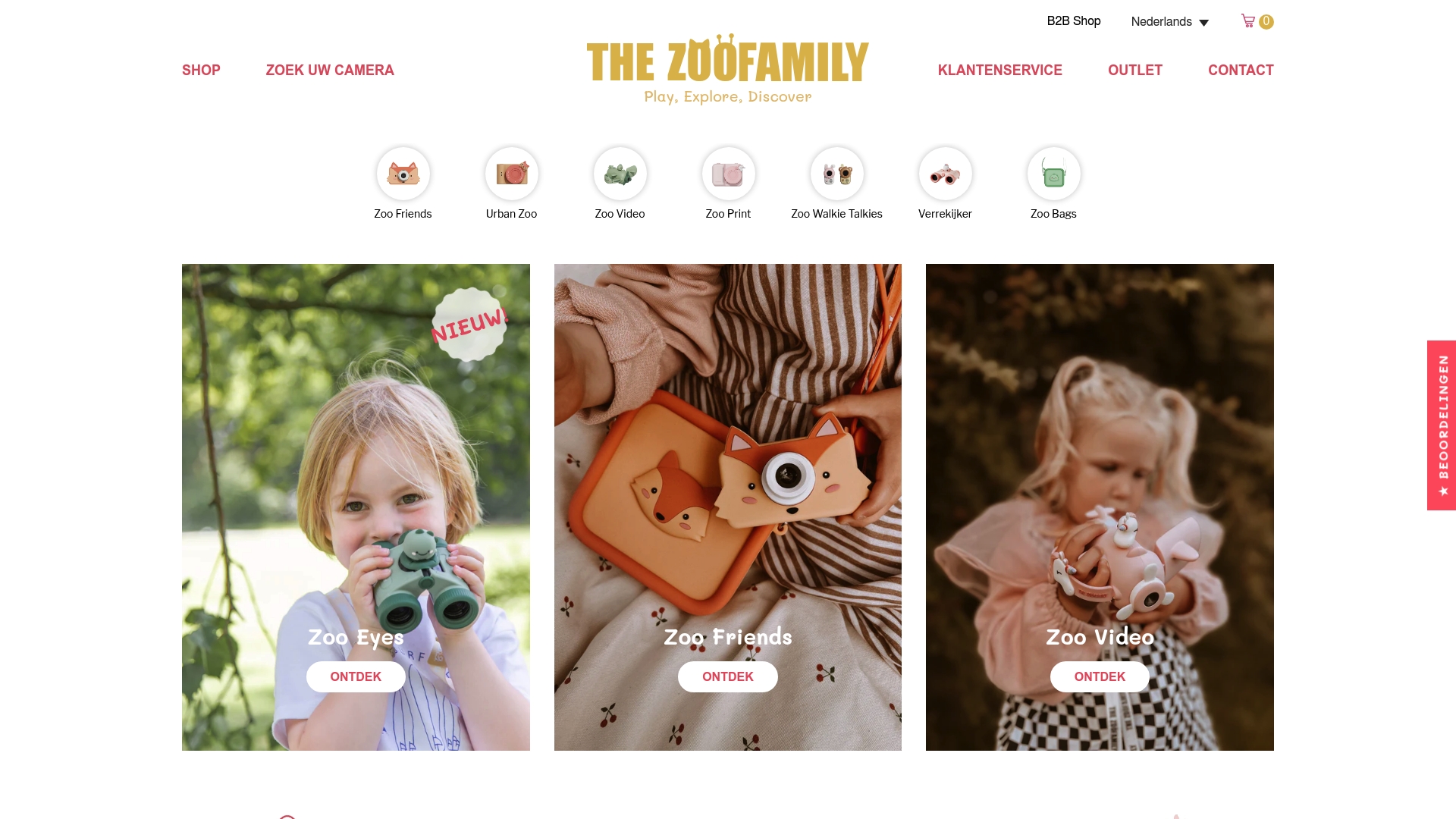
Browse the full Zoo Friends, Urban Zoo and Zoo video range to find the piece that fits your next outdoor session.
FAQ
What age group do these team challenges suit best?
These challenges are designed for children aged 3 and up, since pretend and cooperative play becomes noticeably more social from around that age, according to the Child Mind Institute. Younger children can join with a shortened task list and an adult or older sibling as a pairing partner.
How long should a team building session last?
Most of the activities above run for 10 to 40 minutes, and nature scavenger hunts specifically tend to work best in sessions of around 40 minutes or less, according to Kids Club ELC. Shorter rotations between two or three activities usually hold attention better than one long task.
When should I step in during outdoor play?
Step in only for genuine hazards, such as a steep drop or a road nearby, or if a child is seriously distressed, rather than every time a task gets messy or slow, following guidance from the NAEYC. Manageable risk and a bit of frustration are part of how children build resilience and problem-solving skills.
Do I need special equipment to start?
No, most of the eight activities only need items you likely already have, such as paper, a clipboard or a blindfold. A kids’ camera, walkie-talkie or pair of binoculars simply adds a shared tool that gives pairs a clearer reason to coordinate.