

Every mother wants her child to thrive, but understanding how young brains actually grow can feel confusing. Neurological development in early childhood is a dynamic process—your child’s brain constantly reshapes itself in response to both nature and nurture. These first years are a time of rapid maturation and heightened sensitivity, where every outdoor exploration or new experience helps build strong neural foundations. Discover how simple, nature-inspired choices can give your child lifelong cognitive, emotional, and creative advantages.
Table of Contents
- Defining Neurological Development In Early Childhood
- Stages And Pathways Of Brain Maturation
- Environmental Influences On Neural Growth
- Nature Connection And Cognitive Benefits
- Risks Of Neglect And Supportive Strategies
Key Takeaways
| Point | Details |
|---|---|
| Importance of Early Development | Neurological development in early childhood is crucial, as it sets the foundation for lifelong learning and functioning. Engage children with diverse sensory experiences to strengthen neural pathways. |
| Nature’s Role | Outdoor exploration significantly boosts cognitive development by activating multiple neurological systems simultaneously. Encourage child-led nature activities for optimal learning. |
| Detecting Developmental Neglect | Early signs of developmental neglect may include minimal interaction and limited sensory exploration. Recognising these warning signs can lead to timely interventions that positively impact development. |
| Environmental Influence | Supportive environments, including nutrition and emotional safety, enhance brain plasticity. Foster rich experiences through regular outdoor activities to promote healthy brain growth. |
Defining neurological development in early childhood
Neurological development in early childhood is far more than just your child reaching milestones on schedule. It’s the dynamic process of how your child’s brain builds connections, organises itself, and learns to control their body and mind.
At its core, neurological development encompasses motor, cognitive, hearing, and visual functions alongside the intricate brain-behaviour relationships that form during infancy and the first six years. Think of it as your child’s brain continuously remodelling itself, much like rewiring an entire house room by room.
This development includes several interconnected systems:
- Motor skills – from lifting their head to climbing trees with confidence
- Cognitive abilities – how they think, remember, and solve problems
- Sensory functions – processing what they see, hear, and touch
- Emotional regulation – managing feelings and responses to the world around them
What makes this period so critical is the sheer speed of growth. Your child’s brain experiences rapid maturation alongside neuroplasticity, meaning it’s remarkably adaptable and responsive to experience. Every interaction, every outdoor adventure, every time they touch bark or observe a bird – their neural pathways strengthen in response.
Early neural growth sets the foundation for lifelong learning and functioning, making these first six years genuinely irreplaceable.
Not all children develop at identical rates, and this variation is completely normal. Gestational age influences developmental timelines, and some infants – particularly those born moderately or late preterm – may progress at different speeds. Understanding this helps you avoid comparing your child to others.
The reason nature engagement matters so profoundly during this window is simple: outdoor exploration directly stimulates multiple neurological systems simultaneously. When your child investigates a garden with binoculars, they’re not just having fun – they’re strengthening visual processing, fine motor control, cognitive curiosity, and emotional resilience all at once.
Conseil pro: Observe what captures your child’s natural attention in nature – insects, water, textures – and follow their lead rather than directing activities. This child-led exploration creates stronger neural connections than adult-directed learning.
Stages and pathways of brain maturation
Your child’s brain doesn’t develop in one smooth progression. Instead, it moves through distinct stages marked by neuroplasticity, where the brain remains remarkably adaptable and responsive to experience. Understanding these stages helps you recognise what your child can achieve at each age.
Early childhood brain development follows a predictable yet flexible pattern. Dynamic synaptic formation and pruning shape how neural connections strengthen or weaken based on use. Think of it like a garden—pathways your child uses frequently become well-worn trails, whilst unused ones fade away.

The major developmental stages include:
Here is a summary of brain maturation stages and their main developments:
| Stage | Key Brain Developments | Typical Age Range |
|---|---|---|
| Infancy | Rapid neural circuit growth, sensory alertness | Birth to 12 months |
| Toddlerhood | Language expansion, motor refinement | 1 to 3 years |
| Early Preschool | Executive function begins, social play | 3 to 5 years |
| Late Preschool | Cognitive flexibility, school readiness | 5 to 6 years |
- Infancy (0-12 months) – rapid neural circuit formation, sensory awareness emerges
- Toddlerhood (1-3 years) – language explosion, motor control develops, emotional responses emerge
- Early preschool (3-5 years) – executive functions strengthen, social understanding deepens, complex play begins
- Late preschool (5-6 years) – cognitive flexibility increases, academic readiness develops
Within each stage, critical periods represent windows when your child’s brain is especially sensitive to environmental input. During the language-learning window between ages one and three, for instance, exposure to sounds, words, and conversations literally shapes which neural pathways survive and thrive.
Myelination—the process where nerve fibres develop protective coating—accelerates throughout early childhood. This allows faster neural communication and better coordination between brain regions. Your child goes from clumsy toddling to graceful climbing because of this biological process working in the background.
Critical periods create heightened sensitivity to environmental input, meaning nature experiences during early childhood shape neural pathways with remarkable efficiency.
Executive functions like working memory, planning, and cognitive flexibility emerge gradually across these stages. A two-year-old cannot wait for a reward; a five-year-old can. This isn’t stubbornness—it’s their prefrontal cortex maturing.
Both genetic instructions and environmental experiences influence which pathways strengthen. Your child’s unique personality shapes their neural development as much as their biology does. A naturally curious child exploring a forest with binoculars is literally building different neural networks than a cautious child observing from a blanket.
Conseil pro: Match nature activities to your child’s current developmental stage—toddlers need sensory exploration like touching leaves and splashing water, whilst preschoolers benefit from observation games and simple problem-solving like finding insects.
Environmental influences on neural growth
Your child’s brain doesn’t develop in isolation. Everything in their environment—from the air they breathe to the conversations they hear—shapes how their neural pathways form and strengthen. This is both sobering and empowering.
Supportive environments including nutrition, physical activity, and cognitive stimulation improve brain plasticity and long-term functional outcomes. Conversely, chronic stress and trauma can impede neural development in ways that affect behaviour and learning for years.
Key environmental factors that shape neural growth include:
- Nutrition – protein, omega-3 fatty acids, and micronutrients directly fuel brain cell development
- Physical activity – movement strengthens neural connections and improves cognitive function
- Sensory stimulation – textures, sounds, sights activate and reinforce multiple brain regions simultaneously
- Cognitive challenge – solving problems, exploring, and discovering build executive function pathways
- Emotional safety – secure relationships and low stress allow the brain to develop optimally
Nature engagement ticks nearly every box on this list. When your child explores outdoors, they’re getting sensory richness, physical activity, cognitive challenge, and emotional regulation all at once. A woodland walk isn’t just pleasant—it’s neurologically potent.
Stress matters more than many parents realise. Early environmental stress exposure interacts with postnatal environments to affect infant brain outcomes, but protective and enriching post-birth experiences can moderate these effects. This means that even if your child experienced prenatal stress, a nurturing environment rich in outdoor exploration can help their brain recover and flourish.
Enriching environments during critical developmental windows don’t just improve outcomes—they can actively buffer against earlier adverse experiences.
Your urban setting doesn’t disqualify your child from neural-rich experiences. Exposure to music, diverse social interactions, and even small green spaces activates multiple intelligence types and supports holistic cognitive growth.
Consider the difference between a child watching screens indoors versus one discovering insects in a garden with binoculars. The second child is building richer neural networks because their environment demands active engagement, problem-solving, and sensory processing.
The table below compares impacts of indoor versus outdoor environments on early brain development:
| Factor | Indoor (Screen-based) | Outdoor (Nature-rich) |
|---|---|---|
| Sensory Stimulation | Limited, mostly visual | Multi-sensory, rich and varied |
| Cognitive Demand | Passive engagement | Active problem-solving required |
| Emotional Regulation | Minimal stress relief | Improved resilience, lower stress |
| Neural Pathway Growth | Weaker, less diverse | Stronger, more complex |
Conseil pro: Create micro-rich environments even in cities by incorporating nature observation into daily routines—a potted plant on the balcony, bird-watching from the window, or regular park visits all provide measurable neurological benefits.
Nature connection and cognitive benefits
Nature isn’t just a nice backdrop for childhood. It’s a cognitive development accelerator that works on multiple neurological systems simultaneously. When your child engages with natural environments, their brain lights up in ways that indoor activities simply cannot replicate.
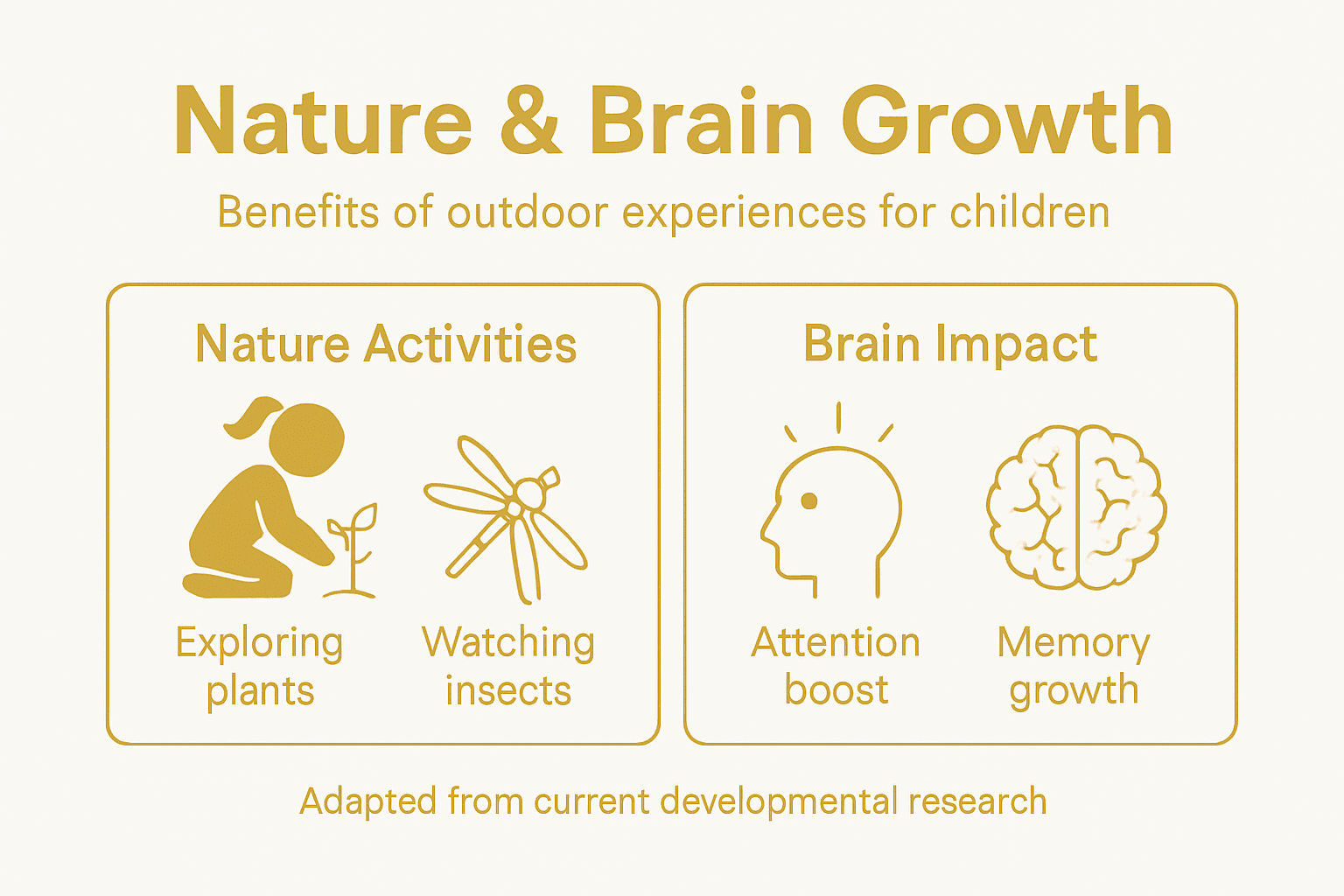
Engagement with nature during early childhood develops creative and critical thinking whilst fostering problem-solving skills and enhancing executive functions. Natural environments provide rich sensory experiences that stimulate neurodevelopment in ways structured activities cannot match.
Specific cognitive benefits include:
- Attention regulation – nature settings improve focus and reduce mental fatigue
- Executive function – planning, decision-making, and impulse control strengthen through outdoor exploration
- Creative thinking – unstructured natural spaces encourage imaginative play and novel problem-solving
- Emotional resilience – outdoor challenges build confidence and stress-coping abilities
- Social skills – nature play naturally encourages collaboration and communication
Consider what happens when your child searches for insects with binoculars. They’re practising sustained attention, visual discrimination, planning (where to look next), and patience. Their prefrontal cortex is working hard—and they think they’re just playing.
Connection with nature and outdoor play improves attention and executive function skills whilst reducing stress that otherwise impairs learning. Natural settings uniquely encourage curiosity and exploration, creating foundations for school readiness and academic success.
The mechanism is straightforward. Natural environments demand active engagement rather than passive consumption. Your child must observe, hypothesise, explore, and adapt—all cognitive skills that transfer directly to academic and social contexts.
Outdoor nature experiences create secure attachments and reduce cortisol levels, allowing cognitive pathways to develop optimally rather than being suppressed by stress.
Urban green spaces count too. Even a small park, balcony garden, or regular woodland walk provides measurable cognitive benefits. The quality matters more than the scale—consistent, regular nature connection builds stronger cognitive gains than occasional visits.
Sensory play in nature provides rich neurological stimulation that enhances multiple developmental domains simultaneously. Your child’s growing brain thrives on multi-sensory input that structured indoor environments struggle to provide.
Conseil pro: Prioritise unstructured nature time where your child directs exploration rather than following adult-led activities; this child-directed engagement builds stronger executive function and creative thinking than guided nature walks.
Risks of neglect and supportive strategies
Developmental neglect—insufficient stimulation, attention, or engagement—poses serious risks during early childhood. Unlike dramatic injuries, neglect damages the brain quietly, affecting pathways that support learning, emotional regulation, and social connection for years to come.
Neglect impairs neural development in measurable ways. Children who lack adequate cognitive stimulation, sensory engagement, or responsive caregiving experience delayed milestones and weaker executive function development. The consequences aren’t always obvious at first, but they compound over time.
Early detection models in paediatric primary care emphasise timely interventions through interprofessional collaboration and enhanced screening. Catching developmental delays early—before they become entrenched—changes outcomes dramatically.
Warning signs of developmental neglect include:
- Minimal verbal interaction or language exposure
- Few opportunities for play or physical activity
- Limited sensory exploration (touching, observing, listening)
- Lack of responsive adult engagement
- Insufficient outdoor or nature exposure
- Screen-dominant routines with minimal interaction
Neglect in socioeconomically disadvantaged contexts increases risk of poorer neurodevelopment outcomes, but targeted interventions change trajectories significantly. Early neurodevelopmental assessments identify at-risk children before gaps widen.
Supportive strategies that work:
- Parent education – helping caregivers understand developmental milestones and engagement importance
- Cognitive stimulation – structured but playful activities that challenge thinking
- Quality preschool programmes – professional environments designed to support neuroplasticity
- Nature exposure – regular outdoor time providing multi-sensory enrichment
- Occupational therapy – targeted interventions for specific developmental delays
Early intervention during critical developmental windows can partially or fully compensate for earlier neglect, though prevention remains far more effective than remediation.
You don’t need expensive programmes. Consistent engagement—talking with your child, exploring nature together, offering varied sensory experiences—prevents developmental neglect effectively. Nature engagement specifically provides rich stimulation across multiple neurological domains simultaneously.
If you’re concerned about your child’s development, early evaluation through your GP or health visitor offers peace of mind and access to support if needed. Most childhood developmental concerns respond well to targeted intervention.
Conseil pro: Document your child’s developmental milestones (first words, new skills, behavioural changes) and share observations with health professionals; this creates a fuller picture than single assessments and helps identify subtle delays earlier.
Boost Your Child’s Neurological Development with Nature-Inspired Tools
The article highlights how early childhood neurological development thrives on active sensory stimulation, cognitive challenge, and emotional regulation through nature engagement. Many parents face the challenge of providing stimulating outdoor experiences that foster executive functions, attention regulation, and creative thinking. By understanding that child-directed exploration in natural settings shapes critical neural pathways, it becomes clear that simple, engaging tools can empower your child’s brain growth during these vital years.
At The Zoofamily, we offer more than just the best kids’ cameras, walkie-talkies, and binoculars—we create interactive experiences that ignite curiosity, encourage problem-solving, and deepen connections with the natural world. Every product is designed to stimulate multiple neurological systems simultaneously, supporting your child’s sensory development and executive function in a playful, real-world context. With every camera sold, we plant a tree, nurturing not only young minds but the planet’s future.
Explore our collection and empower your child’s neurological journey with engaging tools that turn outdoor time into stimulating, brain-building adventures. Invest today to support their cognitive flexibility, emotional resilience, and lifelong love of nature.
Discover The Zoofamily and transform daily exploration into a critical developmental opportunity now.

Frequently Asked Questions
What is neurological development in early childhood?
Neurological development in early childhood refers to the process through which a child’s brain builds connections and matures, affecting their motor skills, cognitive abilities, sensory functions, and emotional regulation.
How does nature engagement benefit my child’s neurological development?
Engaging with nature stimulates multiple neurological systems simultaneously, providing sensory experiences that enhance cognitive skills, improve focus, and foster emotional resilience.
What are the stages of brain maturation during early childhood?
The major developmental stages include infancy (0-12 months), toddlerhood (1-3 years), early preschool (3-5 years), and late preschool (5-6 years), each marked by specific key developments like language expansion and executive function strengthening.
How can I create rich neurological experiences for my child if living in an urban environment?
You can create stimulating experiences by encouraging nature observation through potted plants, bird-watching from windows, or regular visits to parks, which provide valuable sensory and cognitive benefits.
Recommended
- Understanding Brain Development in Middle Childhood – The Zoofamily
- Donner envie nature enfant – Stimuler la curiosité durable – The Zoofamily
- Sensory Play in Nature: Benefits for Young Minds – The Zoofamily
- Sensory Play in Nature: Benefits for Young Minds – The Zoofamily
- Complete Guide to Benefits of Natural Lighting – Mats4U USA
- De werkbij: klein beestje, grote impact! Lekkerhoning.nl