

TL;DR:
- Engaging children in nature photography nurtures their curiosity, patience, and observation skills.
- Creative activities like scavenger hunts and long-term projects enhance ecological understanding and appreciation.
- Focusing on reflection and connection, rather than perfect images, fosters meaningful outdoor experiences.
Getting children away from screens and genuinely absorbed in the natural world is one of the most common challenges parents face today. A camera, surprisingly, can be the bridge. Rather than competing with digital entertainment, a camera puts technology in service of curiosity, giving children a reason to crouch down beside a beetle, stare up at a cloud formation, or wait quietly for a bird to land. This article explores the most effective, creative, and age-appropriate ways to use photography as a gateway to nature exploration, with practical activities you can start this weekend.
Table of Contents
- Setting criteria: What makes a great nature photography activity for kids?
- Nature scavenger hunts: Turning everyday walks into discovery missions
- Spot and shoot: Micro-projects for sharpening observation
- Documenting nature’s changes: Seasonal and long-term photography projects
- Showcasing creativity: Portfolios, exhibitions, and competitions
- Our fresh take: True creativity starts with observation and reflection
- Discover more nature adventures with The Zoofamily
- Frequently asked questions
Key Takeaways
| Point | Details |
|---|---|
| Build observation skills | Camera activities transform walks into opportunities for children to learn and notice details in their surroundings. |
| Adapt tasks by age | Tailoring photography prompts to children’s developmental stages enhances learning and engagement. |
| Encourage creativity | Micro-projects and scavenger hunts inspire artistic thinking and patience in children. |
| Connect through sharing | Portfolios, exhibitions, and competitions turn photography into a community-building experience for young explorers. |
| Reflect for deeper learning | Reviewing and journaling photos together fosters lasting nature appreciation and family connection. |
Setting criteria: What makes a great nature photography activity for kids?
Not every outdoor activity with a camera is equally valuable. The best ones share a handful of qualities that make them genuinely enriching rather than just novel. Before trying any of the ideas in this article, it helps to run them through a simple checklist.
A good nature photography activity for children should:
- Be age-appropriate. A three-year-old and a ten-year-old are not going to get the same thing from the same task. The best activities scale up or down with relatively little effort from parents.
- Spark curiosity rather than just tick boxes. The goal is for children to notice things they would otherwise walk straight past. A photography introduction for kids works best when it feels like discovery, not homework.
- Prioritise safety without killing adventure. This means choosing accessible paths, supervising near water or roads, and making sure camera equipment is child-friendly and easy to hold.
- Encourage patience and sustained attention. Nature does not perform on demand. Activities that require a child to wait, watch, and try again are building essential skills beyond photography.
- Work across seasons and weather. The outdoors changes constantly. The best activities take advantage of that rather than being cancelled by a bit of drizzle.
Photo scavenger hunts in nature teach observation, categorisation, and patience for young children, and they meet nearly every criterion on this list. Alongside hunts, the other activities in this article have been chosen for exactly the same reasons.
Pro Tip: When introducing any new activity, let your child choose the first subject they photograph. Ownership from the very start makes a remarkable difference to engagement and enthusiasm.
You can find a broader set of photography tips for children on our blog to support your planning before you head outdoors.
Nature scavenger hunts: Turning everyday walks into discovery missions
The photo-based scavenger hunt is one of the most effective tools in any nature-loving parent’s toolkit. It transforms a routine park visit into a genuine mission, giving children a clear sense of purpose and a satisfying end result: a set of images they found and captured themselves.
The most important design principle is to match the hunt to your child’s age and developmental stage. For younger children aged three to six, use broad, sensory prompts:
- Find something red in the hedgerow
- Photograph something rough you can touch
- Spot something that moves in the wind
- Find evidence of an animal (a feather, a burrow, a nibbled leaf)
For older children aged seven and above, the prompts can become considerably more specific and scientifically interesting:
- Photograph a raptor or bird of prey in flight
- Find three different types of lichen on the same tree
- Capture a spider’s web with water droplets
- Document signs of seasonal change in a single square metre of ground
Photo scavenger hunts teach observation, categorisation, and patience, which are skills children genuinely use across every area of learning. The act of looking for something specific trains the eye to notice what it would otherwise filter out.
A wonderful real-world example of this at scale is the Ridgeway50 project, in which hundreds of primary school children produced uncropped exhibition photographs. The project reported significant boosts to engagement and wellbeing among participating children, demonstrating that photography in nature is far more than a fun afternoon activity.
Pro Tip: After each hunt, encourage your child to record a short description beside each image in a small notebook. Over time, this becomes a naturalist’s journal that chronicles their growing knowledge and observation skills. It also provides a wonderful record to revisit across the years.
You can find detailed scavenger hunt tips and a wide range of nature scavenger hunt ideas on our blog to help you plan hunts for any location and season.
Spot and shoot: Micro-projects for sharpening observation
Once children are comfortable with scavenger hunts, short focused challenges help them develop a more deliberate, artistic way of seeing. These micro-projects are ideal for keeping energy and attention high during longer walks, and they consistently produce surprising results.
One of the most effective is the every-twenty-steps challenge. It works as follows:
- Walk at a normal pace along any path or trail.
- Every twenty steps, stop completely and look around for one interesting subject.
- Photograph it before moving on. The subject can be anything: a shadow, a texture, an unexpected colour, an insect at work.
- Review the images together at the end of the walk and discuss what you both noticed.
- Try the same walk again on a different day or in different weather, and compare the two sets of images.
As outdoor photography educators note, encouraging children to stop every twenty steps and photograph something interesting builds close observation skills over time and teaches them to look at their surroundings the way an artist does.
“The camera becomes a tool for seeing, not just recording. Children who practise this stop-and-look discipline start noticing details that most adults walk straight past.” — Paths of Learning
This kind of structured attention to detail is particularly powerful in edge-case weather. Rain creates extraordinary compositions: droplets on spiders’ webs, reflections in puddles, the silvered undersides of leaves turned upward. Cloud cover softens harsh light and makes animal subjects easier to photograph. Even fog and frost open up entirely different visual worlds for children to explore.
Our bug photography guide is an excellent companion resource for micro-project walks, especially in warmer months when insect activity is high and the opportunities for close observation are remarkable. You will also find further ideas for inspiring creativity outdoors on our blog.
Documenting nature’s changes: Seasonal and long-term photography projects
From the fast-paced energy of micro-projects, we move to something slower and, in many ways, more rewarding. Long-term documentation projects teach children that nature is not static. It breathes, cycles, and transforms across seasons in ways that are genuinely astonishing once you start paying close attention.
The core idea is simple. Choose a single spot outdoors, ideally somewhere your family can visit regularly and safely, and photograph it once a month across a full year. It could be a particular tree in a local park, a hedgerow at the end of your road, a pond, or a corner of your garden.
Photographing the same spot monthly to track seasonal changes is one of the most effective ways to teach children about natural cycles, and the before-and-after comparisons are always striking.
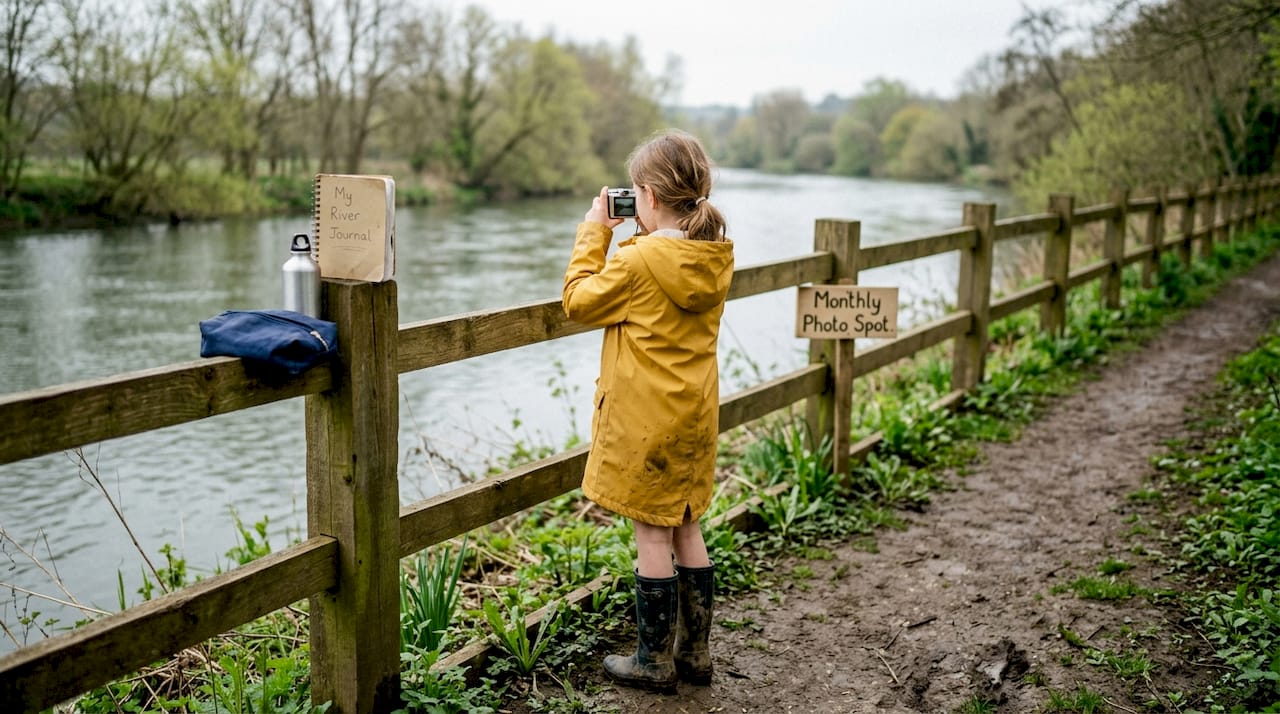
Here is an example of what a monthly documentation project might reveal across a single deciduous tree:
| Month | What to look for | Photography focus |
|---|---|---|
| January | Bare branches, frost, roosting birds | Silhouette and texture |
| March | First buds appearing, early insects | Close-up of buds |
| May | Full leaf, nesting activity | Canopy and movement |
| July | Dense foliage, insect abundance | Wildlife in leaves |
| September | Colour change beginning | Colour contrast |
| November | Leaf fall, fungi at the base | Ground level, decay |
The benefits of this kind of long-term project extend well beyond photography:
- Patience and perspective. Children learn that meaningful observation takes time.
- Scientific thinking. They begin to form predictions about what they will see next month.
- Emotional connection. A place you have photographed monthly for a year becomes genuinely meaningful.
- Ecological literacy. Children absorb an understanding of food webs, seasonal behaviour, and habitat without any formal teaching.
For a creative variation, some families attach a small pet collar camera to a family dog during woodland walks, capturing ground-level footage that gives children an entirely different perspective on the landscape. The results are often hilarious and surprisingly educational.
You will find a broader range of ideas for nature photography for kids on our blog, including how to build these seasonal projects into school holiday routines.
Showcasing creativity: Portfolios, exhibitions, and competitions
After documenting and creating, sharing the results can amplify children’s confidence significantly and connect them with a wider community of young nature lovers. Do not underestimate how motivating it is for a child to see their photograph on a wall or entered into a competition.
There are three primary ways to showcase a child’s nature photography:
| Format | Pros | Cons |
|---|---|---|
| Personal portfolio | Low pressure, highly personal, builds over time | Limited audience, less external motivation |
| Local exhibition | Community connection, visible pride, group experience | Requires organisation, limited reach |
| Competition entry | Wider recognition, structured feedback, exciting stakes | Potentially disappointment if unsuccessful |
Portfolios can be as simple as a physical folder of printed images with handwritten captions, or a digital album shared with grandparents. The key is that the child selects the images themselves and explains why each one mattered to them. This reflective process is where much of the real learning happens.
Local exhibitions are more achievable than many parents realise. Schools, libraries, community centres, and even local cafés are often open to hosting a display of children’s nature photography, particularly if it ties into an environmental theme. The Ridgeway50 project showed that even primary-aged children can produce exhibition-quality work when given the opportunity and encouragement.
For older and more confident young photographers, the NHM Young Wildlife Photographer of the Year competition is open to under-18s across Europe with multiple age categories. Entering, regardless of the outcome, teaches children to evaluate their own work critically and to take creative risks.
Our guide to inspiring creativity with nature covers how to build a simple portfolio process at home that works even for very young children. For a creative variation on recording wildlife, some families also experiment with a pet collar cam to capture footage from an animal’s viewpoint, which children find endlessly engaging.
Our fresh take: True creativity starts with observation and reflection
Here is an honest observation from years of working with children, cameras, and nature: the photographs themselves are rarely the most important thing.
Most parents come to nature photography activities hoping their child will capture something spectacular. A kingfisher, perhaps, or a perfectly lit mushroom. And sometimes that happens. But the real value is happening in the ten minutes before the photograph, when the child is crouched in the mud, completely still, watching.
What we consistently find is that the habit of observation is what transforms a child’s relationship with the natural world. Once you have spent twenty minutes watching a beetle navigate a crack in a log, that beetle is no longer irrelevant background. It is interesting. And interesting things deserve care.
This is why reflection matters as much as the photography itself. Sitting together and reviewing photos as a family while journalling meanings and creating portfolios deepens learning in ways that simply taking pictures cannot. When a child explains why they chose to photograph a particular shadow or a half-eaten leaf, they are practising articulation, critical thinking, and empathy simultaneously.
We would go further and say that the families who build the strongest nature connection are not the ones with the best camera equipment. They are the ones who talk about what they see. The camera is a conversation starter. The real work is the teaching of observation skills that happens around it.
Forget perfect photographs. Focus on attentive children. The images will look after themselves.
Discover more nature adventures with The Zoofamily
At The Zoofamily, helping children fall in love with nature is at the heart of everything we create. Our cameras, binoculars, and walkie-talkies are all designed with young explorers in mind, and for every camera sold, we plant one tree.

Whether you are just starting out or looking for your next adventure, our nature exploration resources cover everything from beginner guides to advanced outdoor challenges. If you are ready to plan your first outdoor photography session, our photography scavenger hunt tips are a brilliant place to begin. Practical, fun, and designed for real families in real parks and woodlands across Europe, they make it easy to get started today.
Frequently asked questions
How can I make nature photography safe for young children?
Supervise all photo walks, choose well-maintained and accessible paths, and guide camera handling so children stay focused on safe, reachable subjects. Avoid environments with fast-moving water, unstable terrain, or heavy foot traffic.
What camera types are best for kids just starting out?
Simple point-and-shoot cameras or robust smartphone cameras offer easy handling and immediate results, which makes them ideal for beginners. Purpose-built children’s cameras are also excellent for younger children as they are designed to withstand the inevitable drops.
How do I adapt scavenger hunts for different ages?
Use broad sensory prompts such as finding colours or textures for younger children, and give older ones more specific observational tasks like photographing birds or insect signs. Photo scavenger hunts tailored by age teach observation, categorisation, and patience in a way that feels natural and fun rather than structured.
Can children enter nature photography competitions?
Yes, and it is well worth encouraging. The NHM Young Wildlife Photographer of the Year is open to under-18s across Europe with multiple age categories, making it accessible to a wide range of young photographers.
How do weather conditions affect nature photography projects?
Weather variation consistently adds new creative possibilities rather than limiting them. Rain produces striking natural compositions such as droplets on webs and reflective puddles, while overcast skies provide soft, even light that is actually easier to photograph in than bright sunshine. Teaching children to adapt to conditions builds both artistic flexibility and resilience outdoors.
Recommended
- Benefits of Kids’ Cameras – Fostering Creativity and Nature Connection – The Zoofamily
- Initier à la photographie écologique pour enfants facilement – The Zoofamily
- How Cameras Inspire Learning in Young Minds – The Zoofamily
- Baimė fotografuotis: Kaip prisijaukinti kamerą ir atrasti savo tikrąjį švytėjimą - Vestuvių fotografas Mantas Janavičius