

Creative play sounds like just another way for children to pass the time, but studies show its impact goes much deeper. Nearly every child who participates in regular imaginative play demonstrates enhanced adaptability and stronger communication skills. Most adults remember playing pretend or turning cardboard boxes into castles, yet few realise this playful exploration is actually a building block for emotional health, social growth, and lifelong learning.
Table of Contents
- What Is Creative Play And Its Significance?
- Why Creative Play Matters In Child Development?
- How Creative Play Enhances Learning And Problem-Solving Skills
- Exploring The Impact Of Creative Play On Emotional Well-Being
- The Role Of Parents In Facilitating Creative Play
Quick Summary
| Takeaway | Explanation |
|---|---|
| Creative play fosters emotional regulation. | Engaging in imaginative activities helps children learn to manage their emotions effectively and develop resilience. |
| Imaginative play enhances problem-solving skills. | Through creative scenarios, children learn to approach challenges from various angles and devise innovative solutions. |
| Parental involvement boosts creativity. | Active parental support in play encourages exploration, which significantly enhances a child’s imaginative capabilities. |
| Play promotes cognitive flexibility. | Creative play stimulates brain development, allowing children to think abstractly and adapt to new situations. |
| Children learn empathy through role-playing. | Imagination-based scenarios provide opportunities for children to practice emotional intelligence and understand others’ perspectives. |
What is Creative Play and Its Significance?
Creative play represents a dynamic and spontaneous form of child-directed activity where imagination, exploration, and personal expression converge. Unlike structured learning environments, creative play allows children to navigate their inner worlds freely, transforming ordinary objects into extraordinary experiences.
The Essence of Imaginative Expression
At its core, creative play involves children using their imagination to interpret and interact with their surroundings. Understanding the landscape of imaginative play reveals how children engage in activities that transcend literal reality. Whether constructing elaborate stories with simple toys, designing imaginary worlds, or role-playing different scenarios, children demonstrate remarkable cognitive flexibility.
According to research from PBS, creative play enables children to express themselves openly, fostering emotional health and mental growth. This process helps children develop critical skills such as:
- Emotional regulation
- Problem-solving capabilities
- Social interaction strategies
- Cognitive flexibility
Developmental Significance of Creative Exploration
Creative play is not merely entertainment but a fundamental mechanism for learning and development. Children naturally use play as a method to understand complex social dynamics, experiment with different roles, and process emotional experiences. Through imaginative scenarios, they learn negotiation, empathy, and personal boundaries.
Research indicates that children who engage regularly in creative play demonstrate enhanced adaptability, stronger communication skills, and more nuanced emotional intelligence. By providing an environment that encourages unrestricted imagination, parents and educators can support holistic child development, helping young minds build confidence and resilience through playful exploration.
Why Creative Play Matters in Child Development?
Creative play serves as a critical foundation for comprehensive child development, acting as a powerful mechanism through which children learn, adapt, and understand their complex world. Far beyond simple entertainment, this dynamic process enables children to construct knowledge, develop crucial life skills, and nurture their cognitive, emotional, and social capabilities.
Neurological and Cognitive Benefits
The brain undergoes remarkable transformations during creative play. Our guide on childhood brain development highlights how imaginative activities stimulate neural connections and enhance cognitive flexibility. During play, children engage multiple brain regions simultaneously, strengthening neural pathways responsible for:
- Abstract thinking
- Memory formation
- Executive functioning
- Spatial reasoning
According to research from the Child Care and Development Fund, play encourages brain development by promoting exploration, curiosity, and critical thinking skills. Children who regularly participate in creative play demonstrate enhanced problem-solving abilities and greater mental adaptability.

Emotional and Social Development
Creative play provides a safe, controlled environment where children can explore complex emotional landscapes and develop critical social skills. Through role-playing and imaginative scenarios, children learn empathy, emotional regulation, and interpersonal negotiation. They experiment with different perspectives, understand social dynamics, and build emotional intelligence without real-world consequences.
By transforming ordinary objects and situations into extraordinary narratives, children develop resilience, learn to manage uncertainty, and build confidence in their ability to navigate challenging social interactions. This process of imaginative exploration becomes a fundamental mechanism for emotional growth and psychological well-being.
The table below summarises the key neurological, emotional, and social benefits of creative play to provide a quick reference for understanding its multi-dimensional impact on child development.
| Area of Development | Benefit | How Creative Play Supports This Area |
|---|---|---|
| Neurological / Cognitive | Enhanced abstract thinking, memory, executive function | Stimulates multiple brain regions and neural pathways |
| Emotional | Improved regulation and resilience | Allows safe exploration and expression of feelings |
| Social | Stronger communication, empathy, negotiation | Encourages role-play and understanding other perspectives |
| Problem-Solving | Cognitive flexibility and innovative thinking | Provides risk-free scenarios for experimental learning |
| Psychological Well-Being | Stress reduction and self-confidence | Builds coping strategies and psychological distance |
How Creative Play Enhances Learning and Problem-Solving Skills
Creative play transforms learning from a structured, linear process into a dynamic, multisensory exploration that empowers children to develop sophisticated cognitive abilities. By engaging imagination and curiosity, children naturally cultivate complex problem-solving skills that extend far beyond traditional educational approaches.
Cognitive Flexibility and Strategic Thinking
Discover engaging learning activities that demonstrate how creative play acts as a powerful cognitive training ground. During imaginative scenarios, children continuously adapt their strategies, switch perspectives, and experiment with multiple solutions. This process builds cognitive flexibility, enabling them to:
- Approach challenges from different angles
- Generate innovative solutions
- Understand complex cause-effect relationships
- Develop resilience in facing uncertainties
According to research from the International Journal of Environmental Research and Public Health, creative play significantly enhances children’s executive functions, particularly their ability to strategically navigate complex cognitive tasks.
Experimental Learning through Imagination
Creative play provides a risk-free environment where children can explore hypothetical scenarios without fear of failure. By transforming ordinary objects into extraordinary tools, children learn to view challenges as opportunities for exploration rather than obstacles. This approach to learning encourages experimental thinking, where trial and error become valuable educational experiences.
Children engaged in creative play develop critical metacognitive skills unconsciously. They learn to analyse their own thought processes, understand different perspectives, and develop intrinsic motivation for learning. Through imaginative play, abstract concepts become tangible, complex problems become approachable, and learning transforms into an exciting, self-directed journey of discovery.
Exploring the Impact of Creative Play on Emotional Well-Being
Creative play serves as a profound mechanism for emotional development, offering children a unique pathway to understand, process, and express their complex inner experiences. Beyond mere entertainment, it represents a critical psychological tool that enables children to navigate their emotional landscapes with greater resilience and self-awareness.
Emotional Processing and Self-Expression
Discover strategies for supporting your child’s emotional growth through creative play. During imaginative scenarios, children can safely explore and articulate feelings that might be challenging to communicate directly. This process allows them to:
- Externalize internal emotional experiences
- Practice emotional regulation
- Develop empathy and emotional intelligence
- Build psychological safety and self-confidence
According to research published in PubMed, cooperative-creative game programs significantly improve children’s social behaviors, emotional stability, and self-concept, demonstrating the profound impact of playful interactions on emotional well-being.
Stress Reduction and Psychological Resilience
Creative play functions as a natural stress-management mechanism, providing children with a controlled environment to process complex emotions and challenging experiences. By transforming real-world scenarios into imaginative narratives, children develop psychological distance that helps them understand and manage emotional challenges more effectively.
Children who engage regularly in creative play learn to view emotional difficulties as navigable experiences rather than insurmountable obstacles. This approach cultivates emotional flexibility, enabling them to develop robust coping strategies and a more balanced psychological perspective that will serve them throughout their lives.
The Role of Parents in Facilitating Creative Play
Parents are not passive observers but active architects of their children’s creative play experiences. By understanding and strategically supporting imaginative exploration, parents can transform ordinary moments into extraordinary opportunities for learning, emotional growth, and cognitive development.
Creating an Enabling Environment
Learn about engaging activities for children that demonstrate how parents can nurture creativity. An enabling environment for creative play involves more than providing toys and space. Parents must cultivate an atmosphere that:
- Encourages curiosity and exploration
- Tolerates mess and unconventional play
- Allows children to lead their imaginative processes
- Provides diverse, open-ended play materials
According to research from the Directory of Open Access Journals, parental involvement in traditional play significantly enhances children’s creativity, particularly for younger children aged 5 to 6 years.
Supportive Interaction and Guided Discovery
Effective parental support in creative play is not about directing children’s activities but facilitating their natural exploratory instincts. Responsive parenting involves observing, listening, and occasionally participating without controlling the play narrative. By asking open-ended questions, parents can help children extend their imaginative scenarios, develop narrative skills, and deepen their cognitive engagement.
Parents who view play as a serious learning mechanism create opportunities for children to develop critical life skills. Through gentle guidance and unconditional support, they help children transform play from a simple recreational activity into a powerful tool for holistic personal development.
The following table outlines the distinct roles parents can take to facilitate creative play and the specific actions associated with each approach, helping readers visualise practical support strategies.
| Parental Role | Practical Actions |
|---|---|
| Environment Creator | Provide open-ended materials, tolerate mess, foster curiosity |
| Supportive Participant | Observe, listen, ask open-ended questions, avoid directing narrative |
| Guide for Discovery | Encourage exploration, offer reassurance, scaffold without controlling |
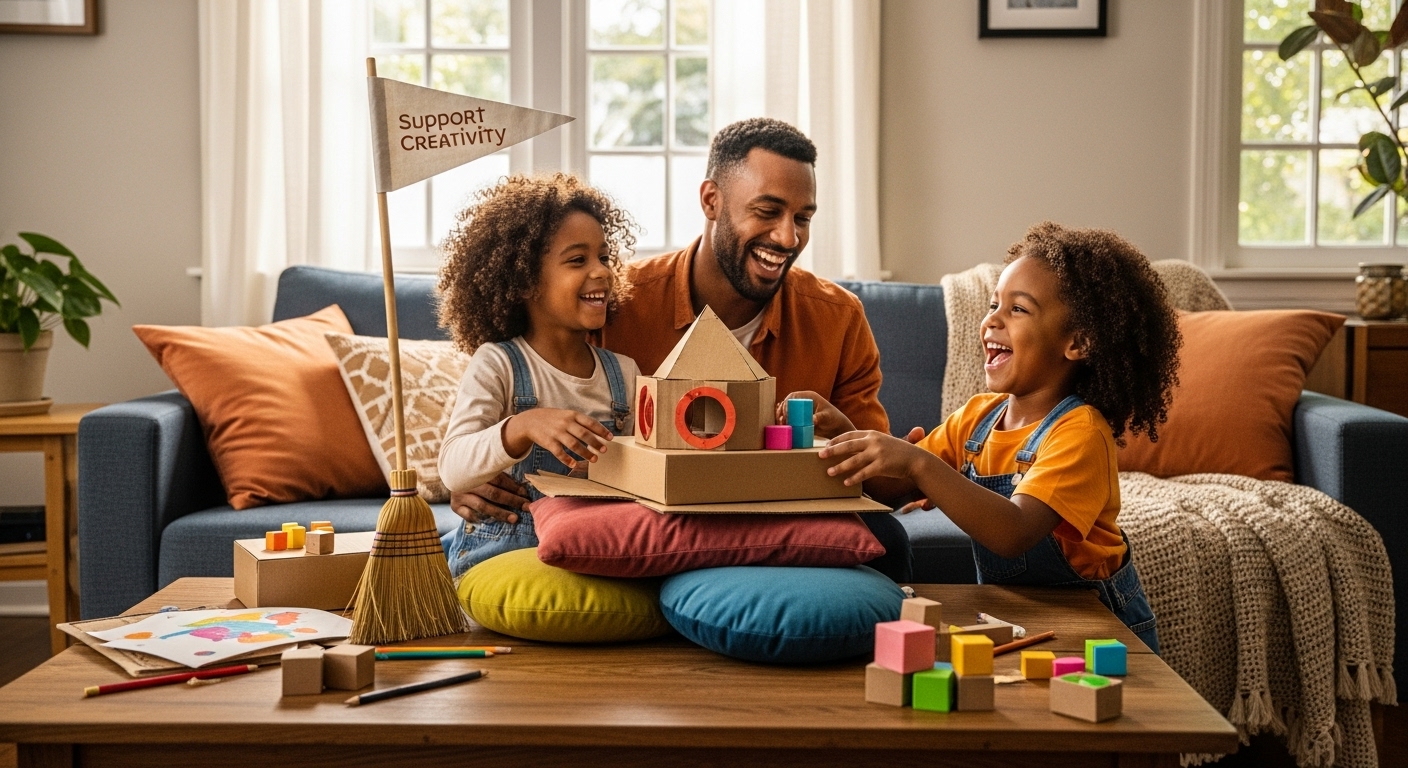
Spark Creative Play and Grow Young Minds with The Zoofamily
Understanding that creative play helps children develop confidence, problem-solving skills, and emotional resilience, many parents worry about finding ways to provide the right environment and tools for imaginative exploration. The article highlighted how vital it is to support emotional and cognitive growth through open-ended, playful experiences. Yet, with so many digital distractions, finding real, tactile products that nurture these skills can be a challenge.
Imagine bringing your child’s curiosity to life every day. With The Zoofamily, you can transform creative play into a powerful journey of discovery. The unique kids’ cameras, walkie-talkies, and binoculars are designed to encourage imaginative thinking and closer connections with nature. Each product is inspired by the animal world, turning every adventure into a vivid learning experience. Plus, for every camera sold, a tree is planted, so your purchase directly supports the next generation’s connection to the planet.
If you want to empower your child’s imaginative learning and emotional well-being right now, visit The Zoofamily and explore our playful, nature-inspired collection. Give your children the tools to explore their world and make creativity part of everyday life.
Frequently Asked Questions
What is creative play?
Creative play is a type of spontaneous, child-directed activity that allows children to use their imagination, explore their environment, and express themselves freely.
How does creative play benefit children’s emotional development?
Creative play helps children process complex emotions, develop empathy, and enhance emotional regulation by allowing them to explore feelings in a safe and controlled environment.
What skills can children develop through creative play?
Children can develop critical skills such as emotional regulation, problem-solving abilities, social interaction strategies, and cognitive flexibility through creative play.
How can parents facilitate creative play at home?
Parents can create an enabling environment for creative play by encouraging curiosity, tolerating mess, providing diverse and open-ended materials, and allowing children to lead their imaginative processes.