

Sparking curiosity is the process of intentionally creating moments and conditions that stimulate your child’s natural desire to learn and explore. Psychologists define it as the desire to know, inquire, and close a knowledge gap. Research from the University of California confirms that curiosity can be increased through daily challenges over as little as 21 days. That means curiosity is not a fixed trait your child either has or lacks. It is a skill you can actively cultivate, and the strategies you use today will shape how your child approaches learning for life.
How to spark curiosity: the psychology behind it
Before you can reliably ignite curiosity in your child, it helps to understand what triggers it in the brain. The most widely cited framework is the Information Gap Theory, developed by behavioural economist George Loewenstein. According to this model, curiosity requires four conditions: specificity, relevance, perceived accessibility, and emotional tension. In plain terms, your child needs to feel that a question is interesting to them personally, that the answer is within reach, and that not knowing creates a mild, motivating discomfort.
The emotional environment matters just as much as the question itself. Curiosity drops under stress because the brain shifts from exploration to threat detection. A child who feels anxious, judged, or rushed cannot access curiosity in the same way. Slowing down, using calm language, and regulating your own emotional state as a parent creates the nervous system conditions curiosity needs to appear.
Tolerating uncertainty is the third pillar. Many children (and adults) feel uncomfortable sitting with an unanswered question. Exploration thrives when people accept the anxiety of unfinished thinking without forcing a quick, tidy answer. Teaching your child to say “I wonder why…” rather than rushing to Google is one of the most powerful curiosity habits you can build.
| Condition | What it means for parents |
|---|---|
| Specificity | Ask narrow, concrete questions rather than broad ones |
| Relevance | Connect questions to your child’s existing interests |
| Accessibility | Make the answer feel findable, not overwhelming |
| Emotional tension | Allow mild “not knowing” without rushing to resolve it |
Pro Tip: Model curiosity yourself. Children mirror inquisitive behaviours seen in adults, so asking genuine questions out loud, especially ones you do not know the answer to, is one of the most effective things you can do.
How can parents use curiosity microdosing every day?
“Microdosing” curiosity means introducing small, intentional moments of inquiry into your daily routine rather than waiting for big, planned learning experiences. The concept comes from recent behavioural research showing that micro-interventions like banning instant fact-checking rebuild openness and encourage mental exploration. For parents, this is genuinely good news. You do not need to redesign your week.
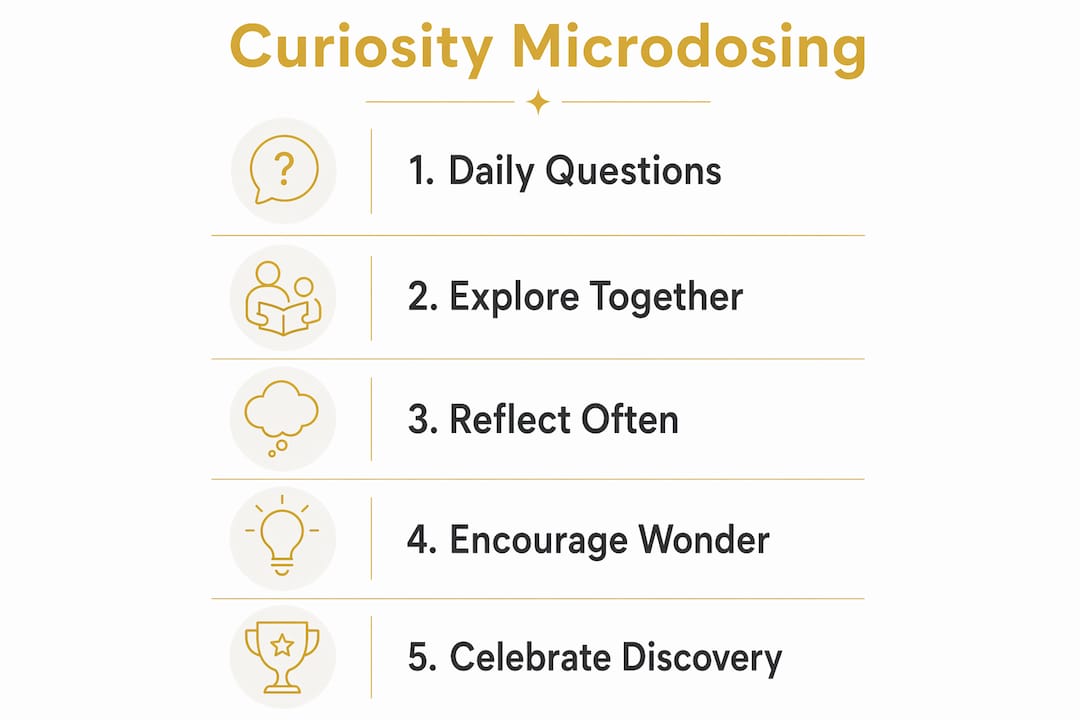
Here are five microdosing techniques you can start today:
- Ban the instant answer at dinner. When your child asks a question, resist the urge to look it up immediately. Write it down and agree to explore it together after 24 hours. This builds tolerance for not knowing and makes the eventual discovery more satisfying.
- Ask one open question per car journey. “What do you think would happen if there were no shadows?” or “Why do you think birds sing in the morning?” These questions have no correct answer, which removes the pressure of being wrong.
- Introduce a “wonder wall.” Stick a piece of paper on the fridge and invite your child to write or draw any question that crosses their mind during the week. Reviewing it together on Sunday turns curiosity into a shared family ritual.
- Swap statements for questions. Instead of telling your child a fact, ask what they already think. “What do you reckon makes rainbows appear?” activates their thinking before any information arrives.
- Celebrate wrong guesses. When your child’s hypothesis turns out to be incorrect, respond with genuine enthusiasm. “Oh, that’s interesting. So what does that tell us?” reframes being wrong as a discovery rather than a failure.
Small, sustainable curiosity habits outperform grand gestures in building long-term curious mindsets. A single museum trip is memorable, but a daily question at the dinner table reshapes how your child relates to not knowing.
Pro Tip: Teach your child to ask “What else might be true?” when they land on an answer. This single question shifts thinking from certainty to discovery and is one of the most transferable intellectual habits you can give them.
What activities effectively ignite and sustain curiosity in children?
Structured activities give curiosity a concrete place to land. The most effective ones share a common feature: they reward observation and questioning, not just correct answers. Thezoofamily’s research into hands-on learning activities confirms that outdoor nature discovery games and creative play inspire observation, questioning, and exploratory engagement in children of all ages.
Here are activities that work across different ages and settings:
- Nature scavenger hunts with a twist. Rather than listing items to find, give your child a question to answer using only what they observe outdoors. “What evidence can you find that something ate here recently?” turns a walk into an investigation.
- Simple science experiments tied to their interests. A child obsessed with dinosaurs will engage far more deeply with a vinegar-and-bicarbonate eruption if you frame it as “volcanic activity from the Cretaceous period.” Relevance is the engine of curiosity.
- Sketch journalling in nature. Drawing what they see forces children to look more carefully. Developing observation skills is directly linked to stronger curiosity and deeper engagement with the world around them.
- “What if” building challenges. Give your child a handful of household materials and a hypothetical problem. “What if you had to build a shelter for a beetle?” combines creative play with problem-solving.
- Photography projects. Giving a child a camera and asking them to document “things that look like they have a secret” sharpens their attention and generates natural questions about what they have captured.
| Activity type | Best for | Curiosity mechanism |
|---|---|---|
| Nature investigation | Ages 5 and up | Observation and open questioning |
| Science experiments | Ages 6 and up | Hypothesis and discovery |
| Sketch journalling | Ages 7 and up | Detailed attention and reflection |
| Building challenges | Ages 4 and up | Problem-solving and creative thinking |
| Photography projects | Ages 6 and up | Perspective-taking and noticing |
The balance between structured and unstructured time matters here. Structured activities teach children how to be curious. Unstructured free time gives them the space to practise it independently.
How to overcome common challenges in keeping curiosity alive
The most common obstacle parents face is not a lack of good ideas. It is the daily friction of distraction, frustration, and the pull of screens. When a child hits a wall during an activity and says “this is boring,” the instinct is often to rescue them with an answer or switch to something easier. That instinct, however well-meaning, short-circuits the very discomfort that curiosity needs to grow.
Exploration is inherently uncomfortable, and parents who help children tolerate frustration and unproductive “rabbit holes” are doing some of the most important work in raising curious thinkers. The goal is not to eliminate difficulty but to stay present while your child works through it.
Practical strategies for the hard moments:
- Reframe boredom as a starting point. When your child says they are bored, respond with “Great. What question does that give you?” rather than filling the gap immediately.
- Avoid attaching outcomes to curiosity. If your child spends an hour investigating why spiders build webs and produces nothing “useful,” that is a success. Curiosity does not need to justify itself with a product.
- Limit but do not ban screens. Screens are not the enemy of curiosity. Passive, algorithm-driven consumption is. Documentaries, creative apps, and nature photography on a tablet can all encourage questions in children when used with intention.
- Check your own emotional state first. A stressed parent cannot model calm exploration. Before a curiosity activity, take a breath and arrive genuinely interested, not performatively enthusiastic.
“The goal is not to raise a child who knows all the answers. It is to raise a child who cannot stop asking questions.”
Managing your own expectations is the quieter challenge here. Curiosity-led learning looks messy, non-linear, and sometimes unproductive from the outside. Trusting the process, even when it does not look like learning, is what sustains it.
Key takeaways
Curiosity is a learnable skill, and the most effective way to build it in children is through consistent, small daily habits rather than occasional grand experiences.
| Point | Details |
|---|---|
| Curiosity needs the right conditions | Reduce stress and create emotional safety before expecting curiosity to appear. |
| Microdosing beats grand gestures | Daily habits like banning instant answers build more lasting curiosity than one-off events. |
| Activities should reward observation | Choose tasks that ask children to notice and question, not just complete. |
| Frustration is part of the process | Help children sit with discomfort rather than rescuing them from unanswered questions. |
| Parents are the most powerful model | Asking genuine questions out loud is the single most contagious curiosity behaviour. |
Why curiosity is more fragile than most parents realise
I have spent a long time watching how curiosity behaves in children, and the thing that surprises most parents is how quickly it disappears under the wrong conditions. It is not robust. It does not push through stress or judgement. It retreats. The children I have seen thrive as curious thinkers are almost never the ones whose parents had the most elaborate activities planned. They are the ones whose parents were genuinely, visibly uncertain about things themselves.
The microdosing approach changed how I think about this entirely. I used to believe that curiosity required special circumstances: the right book, the right museum, the right teacher. What the research from 2025 and 2026 makes clear is that the daily texture of a child’s environment matters far more than any single experience. A parent who says “I have no idea, let’s find out together” at the dinner table is doing more for their child’s intellectual development than a weekend science workshop.
The hardest part, honestly, is resisting the urge to perform curiosity rather than practise it. Children see through enthusiasm that is not real. What they respond to is genuine puzzlement, genuine interest, and a parent who is comfortable not knowing. That is the model worth setting.
— ALAIN
Explore curiosity-building tools from Thezoofamily
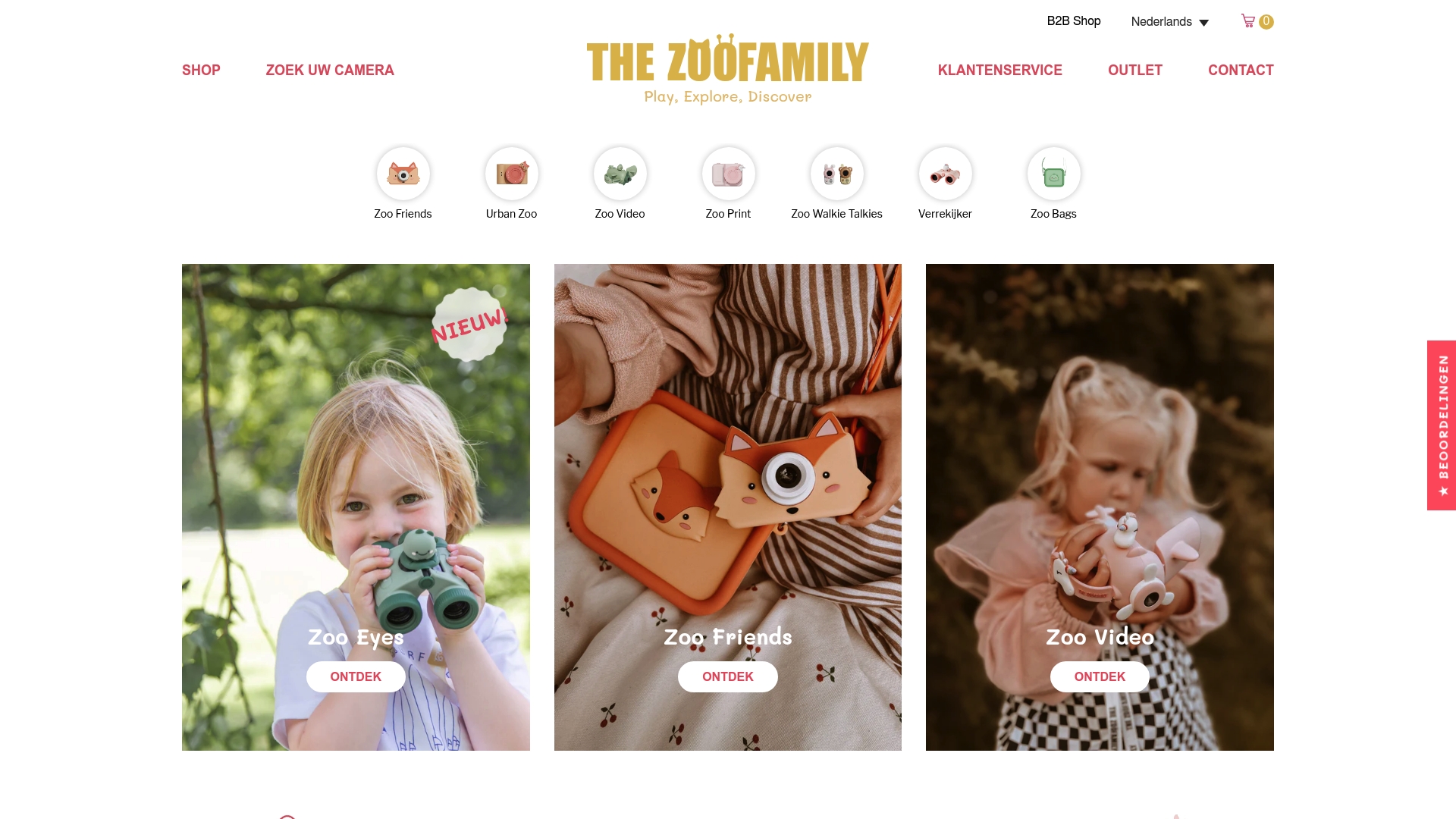
Thezoofamily builds products designed to put curiosity directly into children’s hands. From kids’ cameras that turn a walk in the park into a nature documentary to binoculars that make the garden feel like a wildlife reserve, every product is designed to encourage observation, questioning, and connection with the natural world. For every camera sold, Thezoofamily plants one tree, so your child’s curiosity actively contributes to the planet they are learning to love. Browse the full range and discover tools for curious kids that make exploration a daily habit, not a special occasion.
FAQ
What does it mean to spark curiosity in a child?
Sparking curiosity means intentionally creating conditions that trigger your child’s desire to ask questions and explore. This involves presenting knowledge gaps that feel relevant, accessible, and mildly unresolved.
How long does it take to build curiosity as a habit?
Research from the University of California shows that daily curiosity challenges produce measurable improvements in trait-level curiosity after just 21 days. Consistency matters more than intensity.
Why does my child lose interest so quickly during activities?
Rapid disengagement often signals that the activity lacks personal relevance or that the child feels judged for not knowing. Connecting tasks to your child’s existing interests and removing the pressure of correct answers significantly improves sustained engagement.
Can screens help stimulate curiosity in children?
Passive, algorithm-driven screen time tends to reduce curiosity, but intentional use of documentaries, creative apps, and photography tools can actively encourage questioning and observation when paired with discussion.
What is the single most effective thing a parent can do?
Modelling curiosity authentically is the most powerful strategy available to parents. Children mirror inquisitive behaviours they see in adults, making your own genuine questions more influential than any structured activity.