

Many parents believe creativity requires structured indoor art sessions, complete with easels, paints and carefully curated supplies. Yet research reveals that nature connection nurtures creativity far more powerfully through sensory and emotional pathways. For eco-conscious European families seeking engaging outdoor activities, nature-based play offers young children a richer canvas for imagination, problem-solving and meaningful connection with our planet. This guide explores practical approaches to unlock creative connection outdoors, from Forest School principles to simple activities you can start today.
Table of Contents
- What Is Creative Connection For Children?
- Forest School And Outdoor Learning As Key Approaches
- Engaging Nature Activities That Foster Creativity
- Considerations And Best Practices For Safe, Eco-Friendly Connection
- Discover Creative Nature Connection At The Zoofamily
- FAQ
Key takeaways
| Point | Details |
|---|---|
| Nature unlocks creativity | Connection with nature supports creativity through sensory, emotional and hands-on experiences that indoor activities cannot replicate. |
| Forest School leads the way | This child-led, eco-friendly approach uses native woodland and no-trace principles to foster lifelong pro-environment attitudes. |
| Start small, grow gradually | Practical outdoor activities and mindful moments can begin with weekly nature walks and expand into deeper exploration. |
| Safety meets freedom | Guided risk-taking in small groups builds confidence whilst respecting nature and recognising hazards. |
What is creative connection for children?
Creative connection represents emotional, sensory and meaningful engagement with natural environments that goes far beyond traditional art or structured play. It prioritises imaginative development through direct contact with living systems, weather patterns, seasonal changes and the textures, sounds and smells of the outdoors. Whilst conventional creativity focuses on producing artefacts like drawings or sculptures, creative connection emphasises the process of discovery, wonder and relationship-building with the natural world.
The University of Derby framework identifies five pathways through which nature connection in schools nurtures creativity: senses, emotion, beauty, meaning and compassion. Each pathway engages different aspects of a child’s development. Sensory engagement might involve feeling bark textures or listening to birdsong. Emotional connection emerges when children care for living things or feel awe at natural phenomena. Beauty appreciation develops through observing patterns in leaves or colours in sunsets. Meaning-making occurs as children construct narratives around their outdoor experiences. Compassion grows through understanding interdependence between species and ecosystems.
This approach differs fundamentally from fact-based environmental education. Rather than memorising plant names or animal classifications, children engage in creative play and open-ended exploration. They might build miniature homes for imaginary creatures using fallen twigs, create nature mandalas from petals and stones, or invent stories inspired by woodland sounds. These activities develop cognitive flexibility, spatial reasoning and emotional intelligence whilst fostering intrinsic motivation to protect natural spaces.
Key characteristics of creative connection include:
- Child-led exploration rather than adult-directed instruction
- Multi-sensory engagement with natural materials and phenomena
- Emotional investment in outdoor spaces and living things
- Imaginative play that incorporates natural elements
- Hands-on experimentation with cause and effect in nature
For parents seeking to nurture this connection, hands-on nature learning provides an accessible starting point that requires minimal equipment or formal training.
Forest School and outdoor learning as key approaches
Forest School represents the gold standard for nature-based creative connection, originating in Scandinavian outdoor kindergartens and now flourishing across Europe. This approach uses native woodland and no-trace principles to foster lifelong pro-environment attitudes in children through regular, repeated exposure to natural settings. Unlike occasional nature walks or outdoor lessons, Forest School commits to sustained engagement, typically requiring sessions of 1.5 to 2 hours or more in all weather conditions.
Core Forest School principles create optimal conditions for creative connection. Sessions occur in native woodland or natural areas rather than manicured parks, exposing children to authentic ecosystems with fallen logs, muddy patches, varying terrain and seasonal transformations. Sustainable, no-trace ethics ensure children learn to enjoy nature without damaging it, using only fallen materials for construction and art. Child-led play and multi-sensory exploration dominate the experience, with adults facilitating rather than directing activities.
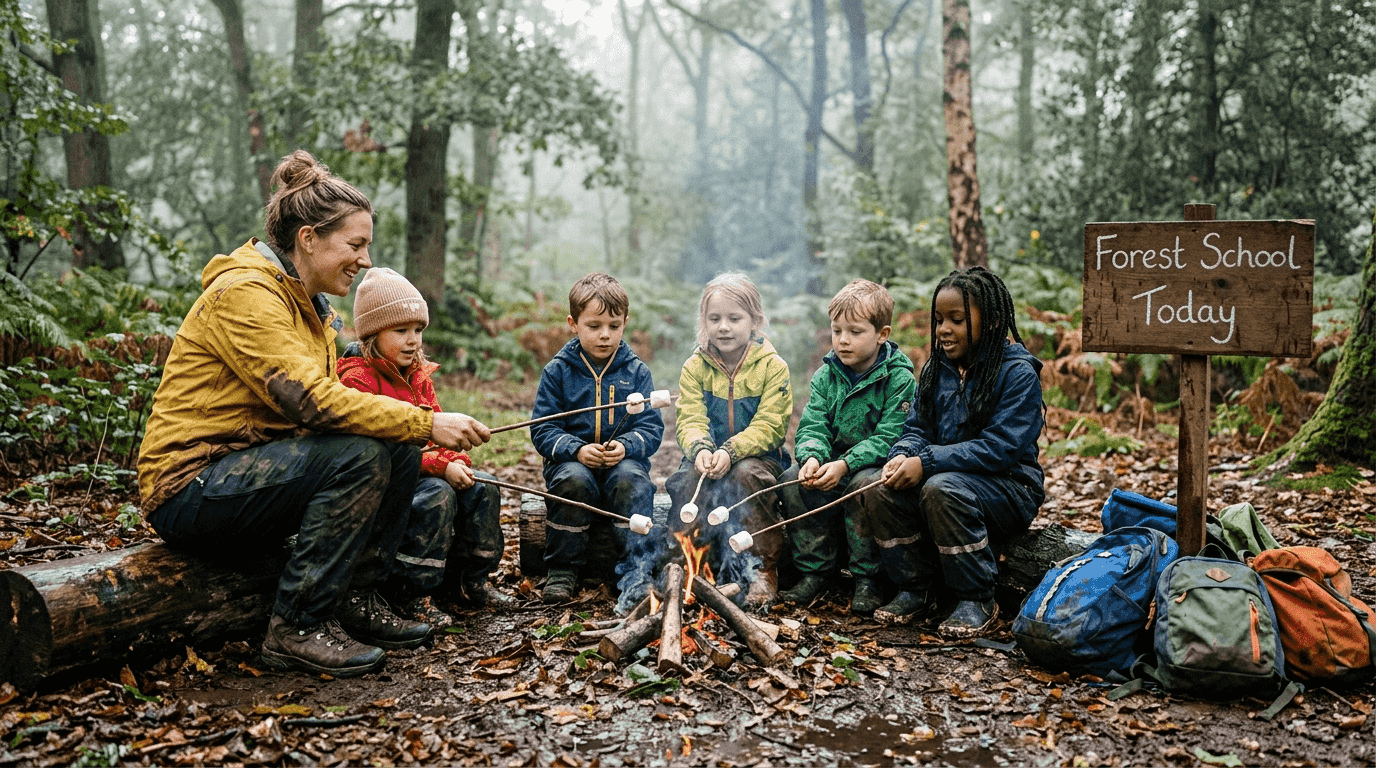
The all-weather inclusivity of Forest School challenges conventional assumptions about outdoor play. Rain, wind, snow and sunshine each offer unique sensory experiences and creative opportunities. Children learn to dress appropriately, observe how weather affects plants and animals, and discover that discomfort often transforms into exhilaration. Small group sizes, typically 8 to 12 children with multiple adults, enable deep relationships and personalised attention that larger classroom settings cannot provide.
Comparing Forest School to traditional approaches reveals stark differences:
| Aspect | Forest School | Traditional classroom |
|---|---|---|
| Duration | 1.5 to 2+ hours per session | 30 to 45 minute art periods |
| Environment | Native woodland, all weather | Indoor, climate controlled |
| Materials | Fallen natural items, living plants | Manufactured art supplies |
| Leadership | Child-led with adult facilitation | Teacher-directed instruction |
| Group size | 8 to 12 children maximum | 20 to 30+ students typical |
| Frequency | Weekly or more, year-round | Occasional outdoor trips |
Pro Tip: Before enrolling in formal Forest School programmes, spend several weeks visiting local woodland areas with your child to observe seasonal changes, collect natural treasures and gauge their interest in sustained outdoor exploration.
For families seeking to incorporate these principles at home, outdoor creative play ideas offer practical starting points that align with Forest School philosophy whilst fitting into busy schedules.
Engaging nature activities that foster creativity
Practical nature activities transform abstract concepts of creative connection into tangible experiences children can enjoy immediately. These activities use natural or fallen materials exclusively, modelling eco-consciousness whilst stimulating imagination, problem-solving and sensory engagement. The key lies in providing open-ended opportunities rather than prescribed outcomes, allowing each child’s creativity to flourish in unique directions.
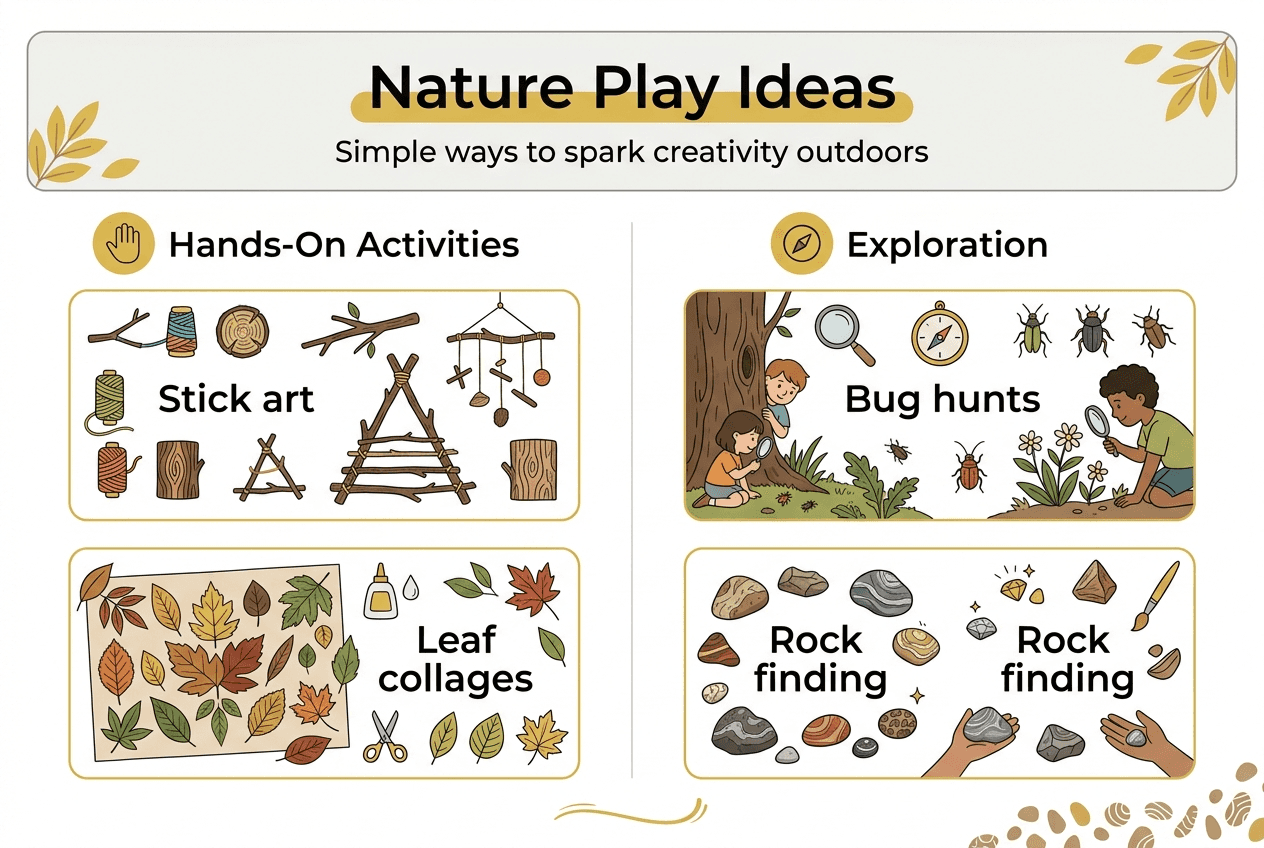
Popular child-led nature activities include mud kitchens, mini beast hunts, den building and nature art using only natural materials. Each activity offers multiple developmental benefits. Mud kitchens develop fine motor skills, mathematical concepts like volume and measurement, and imaginative role-play. Mini beast hunts cultivate observation skills, compassion for living creatures and scientific inquiry. Den building teaches spatial reasoning, collaborative problem-solving and engineering principles. Nature art encourages pattern recognition, colour theory and aesthetic appreciation.
To set up a simple mud kitchen outdoors:
- Designate a patch of bare earth or create one by removing grass in a small area
- Gather old pots, pans, wooden spoons and bowls from charity shops or your kitchen
- Provide buckets of water and containers for collecting natural ingredients like leaves, petals, seeds and small stones
- Add tree stumps or logs as work surfaces and seating
- Let children experiment with mixing, pouring, decorating and serving their mud creations
- Rotate natural ingredients seasonally to maintain interest and reflect changing availability
Creating seed bombs combines creativity with environmental stewardship:
- Mix five parts dry clay powder with three parts compost and one part wildflower seeds native to your region
- Add water gradually whilst kneading until the mixture holds together like playdough
- Roll into walnut-sized balls and let children decorate the outsides with pressed flowers or leaf prints
- Dry completely for 24 to 48 hours in a sunny spot
- Toss into bare patches of garden or community spaces where wildflowers can naturalise
- Observe together as seeds germinate and grow over coming weeks
Additional activities to explore include:
- Nature weaving using sticks as looms and grasses, flowers or wool as weft
- Bark rubbing with paper and crayons to capture tree textures and patterns
- Leaf printing with natural pigments made from crushed berries or petals
- Stone balancing to develop patience, focus and spatial awareness
- Nature scavenger hunts with sensory clues like “find something rough” or “locate three shades of green”
- Stick people and fairy houses constructed entirely from fallen woodland materials
- Cloud watching with storytelling about shapes and movements observed
- Sound mapping by sitting quietly and marking every sound heard on a simple diagram
These activities support creative recycled art projects by teaching children to see potential in natural and discarded materials. For more structured guidance, creative nature-inspired projects offer step-by-step approaches suitable for various age groups and skill levels.
Considerations and best practices for safe, eco-friendly connection
Thoughtful implementation of nature-based creative connection requires balancing freedom with safety, spontaneity with structure, and enthusiasm with ecological responsibility. Small group sizes prove essential for meaningful connection. Safety measures include no eating plants, guided risk-taking and small groups for deeper connections. Research shows that groups of 8 to 12 children enable adults to provide individualised attention, notice emotional needs and facilitate peer relationships that larger groups overwhelm.
All-weather outdoor time represents a cornerstone of authentic nature connection. Finnish families demonstrate this principle powerfully, with 93% engaging in regular outdoor nature activities regardless of season, contributing to stronger immune systems and resilience. Rather than cancelling outdoor play during rain or cold, provide appropriate clothing and embrace the unique sensory experiences each weather type offers. Children discover that puddles invite splashing, frost creates magical patterns, and wind makes leaves dance in ways sunshine cannot replicate.
Eco-friendly practices must guide every activity to model environmental stewardship authentically. Use only fallen materials for construction and art projects, never breaking branches from living trees or picking flowers indiscriminately. Teach children to observe insects and small creatures without capturing or harming them. Practice leave-no-trace principles by removing any non-natural items brought into wild spaces. These habits instil respect for ecosystems whilst demonstrating that creativity need not consume or damage.
Guided risk-taking builds confidence and resilience when implemented thoughtfully. Allow children to:
- Climb trees to heights they can descend independently
- Use real tools like vegetable peelers for whittling under close supervision
- Navigate uneven terrain and natural obstacles at their own pace
- Experience minor discomforts like cold hands or muddy clothes
- Make mistakes and solve problems without immediate adult intervention
Pro Tip: Create a simple risk-benefit assessment for each activity by asking whether the developmental benefits outweigh potential hazards and whether you can mitigate risks through supervision, boundaries or equipment.
Establish clear safety boundaries that children understand and can remember. Designate visible boundaries for free exploration using natural landmarks like specific trees or paths. Teach recognition of hazardous plants common in your region, such as giant hogweed or certain berries. Practice the “stop, look, listen” approach when encountering unfamiliar plants, animals or situations. Ensure at least one adult present holds current first aid certification and carries a basic outdoor first aid kit.
For additional guidance on balancing freedom with safety, outdoor creative play tips offer practical frameworks tested by families across Europe.
Discover creative nature connection at The Zoofamily
Your journey into nature-based creative connection can deepen with resources designed specifically for eco-conscious families. At The Zoofamily, we’ve created tools that stimulate creative connections between children and our planet, from cameras that capture nature’s wonders to guides that inspire outdoor exploration. Our animal-themed designs trigger children’s natural curiosity about wildlife whilst supporting environmental restoration through our one-camera-one-tree planting commitment.
Explore our collection of creative recycled art projects that complement outdoor play with indoor creativity using sustainable materials. Discover creative nature-inspired projects offering step-by-step activities that bring woodland magic into your home. Each resource supports your family’s commitment to raising children who cherish and protect our natural world.
FAQ
What is creative connection for children?
Creative connection engages children’s senses, emotions and imagination through nature-based play and exploration rather than structured indoor activities. It builds a meaningful bond with the natural environment by prioritising process over product, encouraging children to discover, wonder and create using living systems and natural materials. This approach supports cognitive flexibility, emotional intelligence and intrinsic environmental stewardship.
How can I start nature-based creative activities with my child at home?
Start with small weekly nature walks to local parks or woodland areas, collecting interesting natural objects like interesting stones, fallen leaves or seed pods. Create a home mud kitchen using old pots and natural found objects in a corner of your garden or balcony. Use recycled art projects alongside natural materials to connect creativity with sustainability. Begin with 30 to 45 minute sessions and gradually extend as your child’s engagement deepens.
Are Forest Schools suitable for all children?
Forest Schools embrace child-led play and adapt to diverse needs, supporting emotional and creative growth across abilities and temperaments. They operate in small inclusive groups with personalised attention from trained practitioners who modify activities for individual children. The multi-sensory, movement-based approach often benefits children who struggle in traditional classroom settings, whilst the natural pace accommodates varying developmental stages.
What safety precautions should be taken for outdoor nature play?
Avoid eating plants unless absolutely certain of identification, supervise risk-taking activities like climbing or tool use, maintain small group sizes for adequate oversight, and adapt clothing and duration for all weather conditions. Educate children to respect nature by observing rather than capturing creatures, recognising hazards like steep drops or water depth, and understanding boundaries for independent exploration. Review outdoor play safety guidance for comprehensive frameworks tailored to different age groups and environments.