

Pretend play is defined as symbolic, imaginative activity in which children create scenarios, adopt roles, and act out situations that differ from immediate reality. Research from Prof. Paul Ramchandani at the University of Cambridge and Dr. Kathy Hirsh-Pasek at Temple University confirms that this type of play builds executive function, empathy, language, and emotional resilience in children aged two to seven. The benefits of pretend play extend far beyond entertainment. They represent a primary mechanism through which young children develop the cognitive and social architecture they will rely on for the rest of their lives.
What are the cognitive benefits of pretend play?
Pretend play directly strengthens executive function, the cluster of mental skills that includes working memory, flexible thinking, and self-control. Executive function skills built through imaginative play predict academic success more reliably than early literacy drills alone. A child who spends thirty minutes pretending to run a market stall is practising sequencing, negotiation, and rule-following simultaneously. That combination is difficult to replicate through passive screen time or structured worksheets.
The neurological basis for this is well established. Pretend play activates the prefrontal cortex, the region of the brain responsible for planning, problem-solving, and self-regulation. Thirty minutes of deep imaginative play exercises this region in a way that is comparable to active learning sessions and unattainable through passive media exposure. The salience network, which helps children decide what deserves attention, is also engaged when a child must maintain a fictional scenario while responding to real-world interruptions.
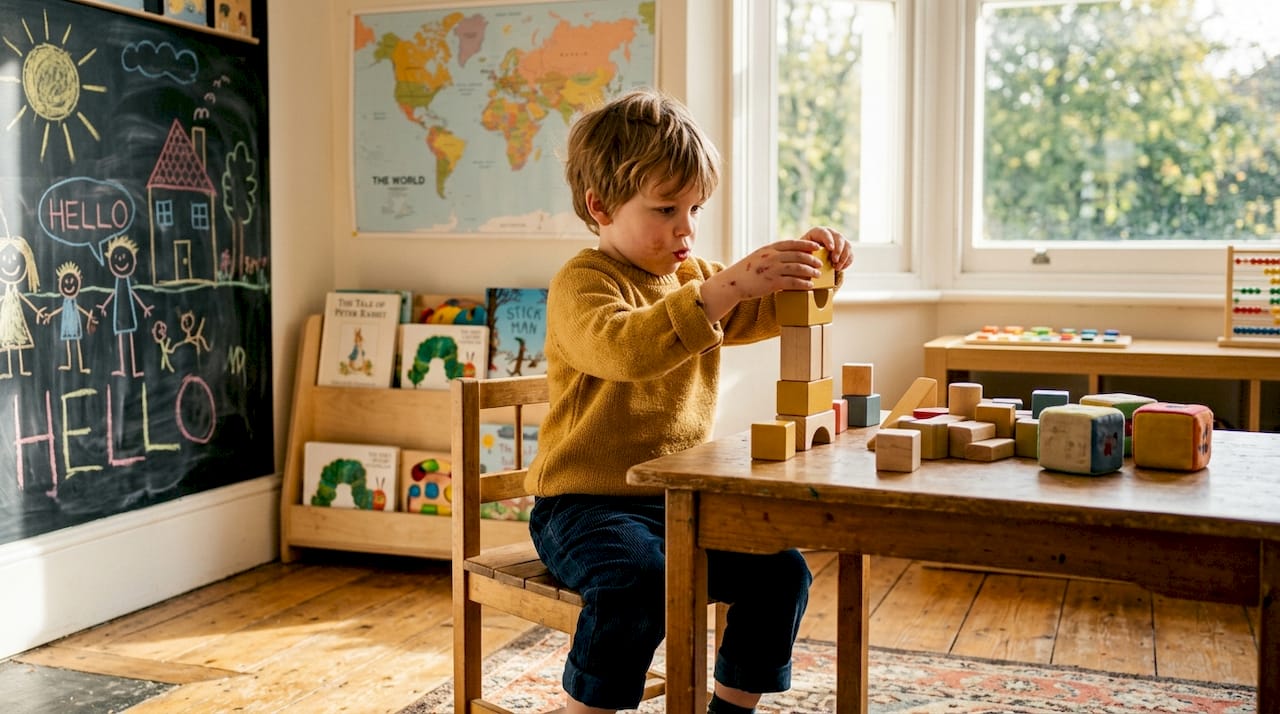
Creativity and divergent thinking grow through the same process. When a child decides that a cardboard box is a spaceship, a kitchen, and then a submarine within the same afternoon, they are practising cognitive flexibility. Children learn best through active, playful learning, and pretend play exemplifies this by demanding that children generate novel solutions rather than recall memorised answers.
Key cognitive skills developed through imaginative play
- Working memory: Children hold multiple story threads in mind at once, strengthening recall and attention.
- Mental flexibility: Shifting between roles (doctor, patient, parent) trains the brain to adapt to new information quickly.
- Self-control: Staying “in character” requires children to suppress impulses, a skill directly linked to school readiness.
- Problem-solving: Scenarios that go wrong mid-play, such as the “patient” refusing treatment, demand on-the-spot creative solutions.
- Divergent thinking: Open-ended scenarios have no single correct answer, which trains children to generate multiple possibilities.
Pro Tip: Offer your child a single open-ended prop, such as a length of fabric or an empty cardboard box, rather than a themed toy set. The absence of a prescribed narrative forces the brain to work harder and produces richer cognitive gains.
How does pretend play help emotional development?
Pretend play functions as a safe laboratory where children can rehearse emotional experiences without real-world consequences. A child who acts out a scary visit to the doctor controls the narrative, which reduces the fear associated with the real event. This mechanism explains why pretend play sessions three times a week produce significantly less observed distress in preschoolers compared with block play or story time alone. The 2018 randomised trial that produced this finding used 97 preschoolers across 30-minute dramatic play sessions, making it one of the most controlled studies in this area.
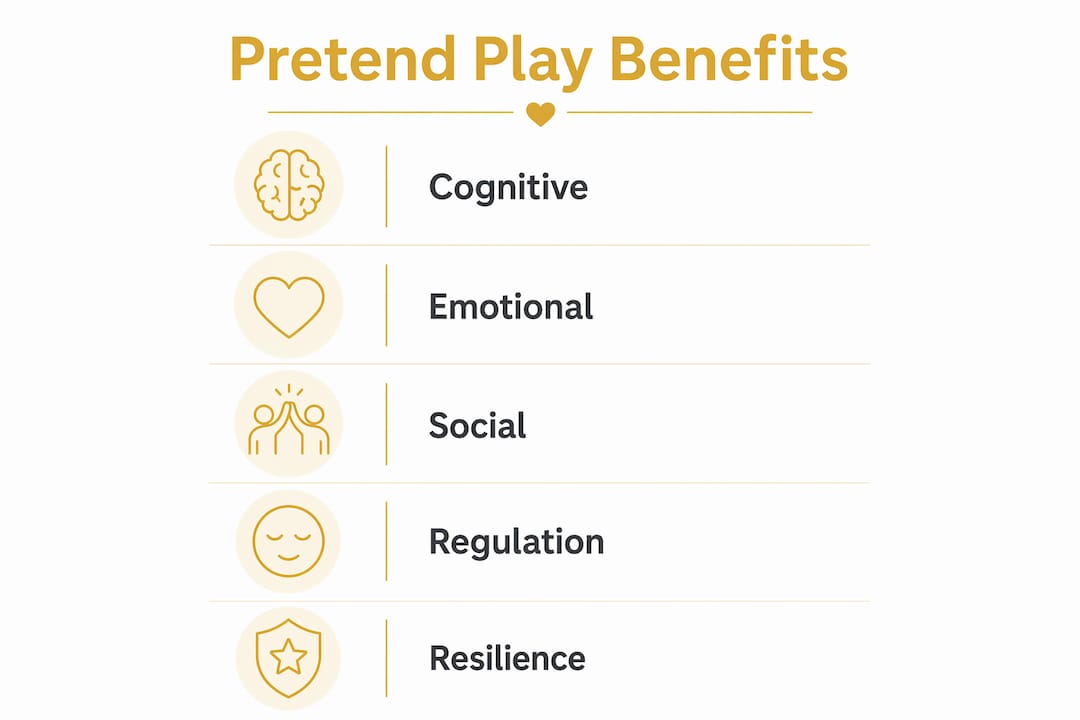
The long-term picture is equally compelling. A longitudinal study tracking 1,426 children from a 2004 cohort found that higher pretend play ability at ages two to three is significantly linked to fewer mental health problems at ages four to seven, measured through the Strengths and Difficulties Questionnaire. This is not a minor correlation. It suggests that the quality of a child’s imaginative play in the toddler years has measurable consequences for their psychological wellbeing years later.
The preventive dimension matters enormously given the scale of the problem. Approximately 1 in 7 children globally have a diagnosable mental health condition. That figure reframes pretend play not as a luxury but as a genuine public health tool. Parents who protect their child’s unstructured play time are, in effect, investing in emotional resilience that reduces the likelihood of anxiety and behavioural difficulties later.
“Play is not a break from learning. It is the primary vehicle through which young children learn to manage their inner world.” — Dr. Kathy Hirsh-Pasek, Temple University
Emotional regulation through play also builds resilience. When a child’s imaginary scenario collapses because a playmate changes the rules, they experience frustration and must find a way through it. That micro-experience of tolerating discomfort and recovering is precisely the kind of practice that builds emotional durability over time.
Pretend play and social skills: what the research shows
Social competence in young children develops most rapidly through role-taking and perspective shifts during pretend play. When a child plays the role of a teacher, they must model how a teacher thinks, speaks, and responds. This is the foundation of theory of mind, the ability to understand that other people have thoughts, feelings, and intentions that differ from one’s own. Theory of mind is the cognitive engine behind empathy, and pretend play is one of its primary training grounds.
The social gains compound when children play together. A 2024 meta-analysis found a consistent link between pretend play frequency and social competence scores across multiple studies and age groups. The skills being practised are not abstract. They are the practical mechanics of getting along with other people.
Here are the four core social skills that group pretend play develops most directly:
- Negotiation. Children must agree on the scenario, the roles, and the rules before play can begin. This is genuine collaborative decision-making.
- Turn-taking. Shared story-building requires each child to wait, listen, and build on what the other has contributed.
- Conflict resolution. Disagreements during play are inevitable. Resolving them without adult intervention teaches children to manage interpersonal friction independently.
- Perspective-taking. Playing a character whose circumstances differ from your own, such as a character who is frightened or unwell, builds the habit of imagining another person’s experience.
Conflicts during play deserve particular attention because adults often rush to resolve them. A child who argues with a playmate over whether the dragon is friendly or dangerous is practising exactly the kind of respectful disagreement that underpins healthy adult relationships. The benefits of imaginative play in early years are most visible in precisely these unscripted social moments.
How parents can support productive pretend play
The most effective thing a parent can do is protect time and space for unstructured play, then step back. Open-ended, non-prescriptive materials consistently outperform themed toy sets because they require children to supply the narrative themselves. A set of wooden blocks, a collection of fabric scraps, or a box of kitchen utensils gives a child far more cognitive work to do than a pre-packaged role-play kit with a fixed storyline.
Parental involvement is valuable, but the balance matters. A University of Cambridge PEDAL Centre analysis of 39 studies found that guided play with child agency produces better outcomes for literacy, numeracy, and social skills than direct instruction. The key phrase is “child agency.” Parents who join the play but follow the child’s lead, rather than directing the story, produce the best results. If your child says the banana is a telephone, your job is to answer the call.
Avoid correcting the logic of a child’s pretend scenario. Repetitive or “incorrect” pretend play is part of normal brain development and autonomy growth. A child who insists that dogs can fly in their game is not confused about biology. They are exercising the cognitive flexibility that will later allow them to think creatively under pressure.
- Set aside at least 30 minutes of uninterrupted, screen-free play time each day.
- Offer props rather than instructions. Ask “What could this be?” rather than “Let’s play doctors.”
- Use open-ended prompts such as “What happens next?” to extend a scenario without taking it over.
- Resist the urge to resolve conflicts between playing children immediately. Give them two minutes to work it out first.
- Rotate materials regularly to keep scenarios fresh and prevent play from becoming repetitive.
Pro Tip: Storytelling is a natural extension of pretend play. Sharing storytelling techniques for children with your child can deepen their narrative skills and give their imaginative scenarios more structure without removing their creative freedom.
Key takeaways
Pretend play is the single most effective low-cost activity parents can provide to build cognitive, emotional, and social skills in children aged two to seven.
| Point | Details |
|---|---|
| Cognitive gains are neurological | Pretend play activates the prefrontal cortex, building self-regulation and problem-solving capacity. |
| Emotional resilience starts early | Higher pretend play ability at ages two to three links to fewer mental health problems by age seven. |
| Social skills require practice | Group pretend play builds negotiation, turn-taking, and perspective-taking through real interaction. |
| Open-ended materials work best | Non-prescriptive props produce richer cognitive and creative outcomes than themed toy sets. |
| Parental restraint is a strategy | Following a child’s lead during play, rather than directing it, produces measurably better developmental outcomes. |
Why I think we underestimate what children are doing when they play
Parents often tell me they feel guilty letting their child “just play” when they could be doing something educational. That framing is the problem. Play is not the opposite of learning. It is the most efficient form of learning available to a young child, and pretend play sits at the top of that hierarchy.
What I find genuinely surprising, even after years of thinking about child development, is how precisely the research maps onto what you can observe in any living room. A four-year-old who spends an hour playing veterinarian with her stuffed animals is practising empathy, sequencing, vocabulary, and emotional regulation at the same time. No structured activity delivers that combination in a single session.
The misconception I encounter most often is that free play is passive. It is the opposite. A child deep in an imaginary scenario is working harder cognitively than a child completing a worksheet. The worksheet has a correct answer. The imaginary scenario has infinite variables, all of which the child must manage simultaneously.
My honest view is that the pressure to fill childhood with structured enrichment activities, classes, and screen-based learning programmes is one of the most significant threats to child development in the current era. Creative play for children does not need to be organised, purchased, or supervised to be effective. It needs time, space, and a parent who trusts the process.
The research is clear. The instinct to protect play is correct. Trust it.
— ALAIN
Tools from Thezoofamily to spark imaginative play
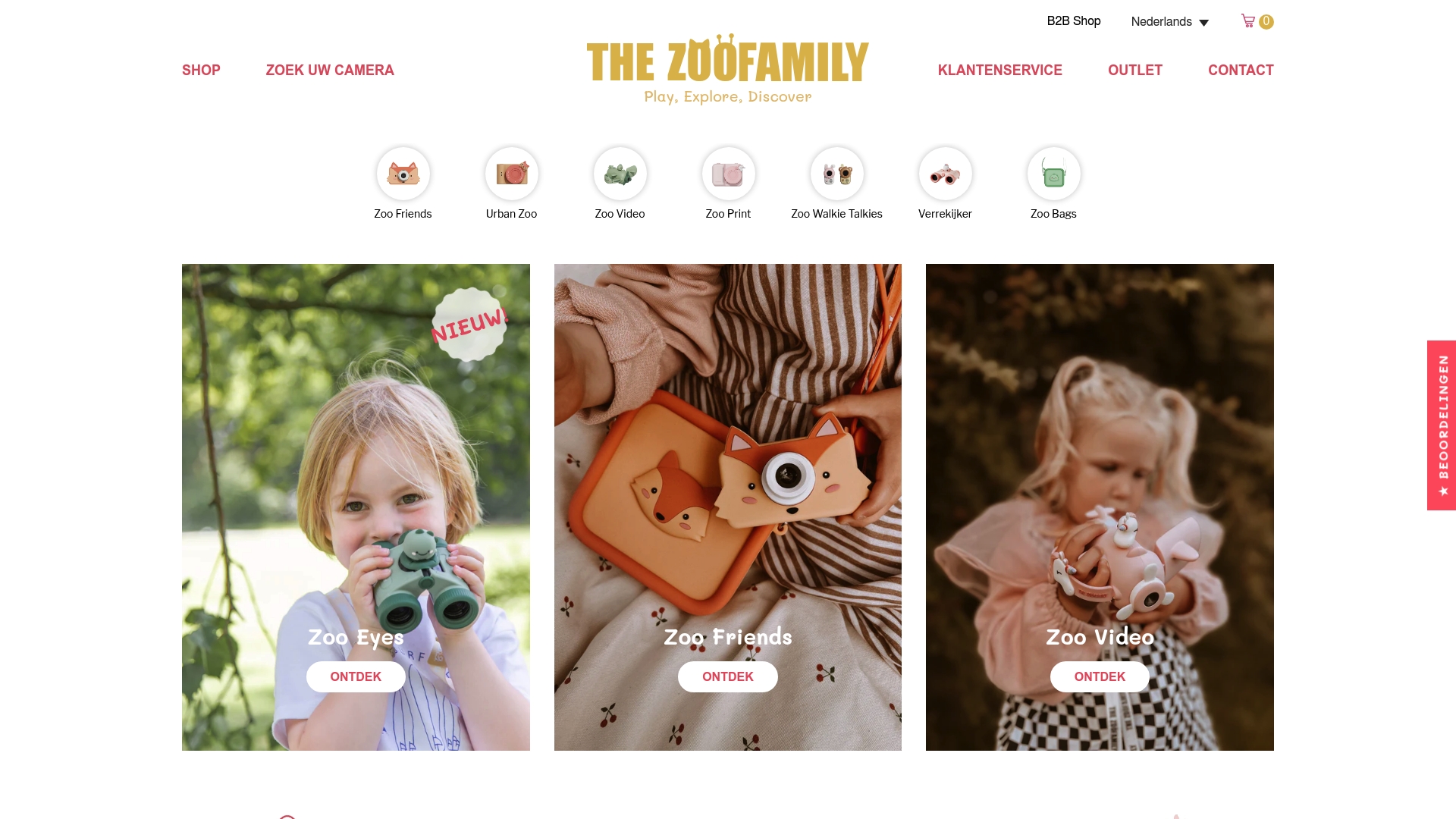
At Thezoofamily, we design products that give children a reason to step outside, look closely at the world, and build stories around what they find. Our kids’ cameras, walkie-talkies, and binoculars are built around animal references that connect children to nature and give their pretend play a richer, more vivid backdrop. A child with a pair of binoculars becomes an explorer. A child with a walkie-talkie becomes a field researcher. These are not just toys. They are props that extend imaginative scenarios into the real world, where the cognitive and social benefits of pretend play are amplified by genuine discovery. For every camera sold, we plant one tree. Explore the full range at Thezoofamily and find the prop that starts your child’s next adventure.
FAQ
What are the main benefits of pretend play for young children?
Pretend play builds executive function, emotional regulation, empathy, and social skills simultaneously. Research links higher pretend play ability in toddlers to fewer mental health problems and better school readiness by age seven.
At what age should children start pretend play?
Symbolic play typically begins around 18 months and becomes more complex between ages two and six. This window represents the most critical period for the cognitive and social benefits of imaginative play to take hold.
How long should a child spend in pretend play each day?
Thirty minutes of uninterrupted imaginative play per day is sufficient to produce measurable benefits to prefrontal cortex development and emotional regulation, based on the 2018 preschool trial using dramatic play sessions.
Does pretend play help children with anxiety?
Pretend play gives children a controlled environment in which to rehearse frightening scenarios, which reduces the distress associated with real events. The 2018 randomised trial found significantly less observed distress in children who engaged in dramatic play compared with those doing block play or story time.
What materials are best for encouraging pretend play?
Open-ended, non-prescriptive materials such as fabric, cardboard boxes, wooden blocks, and simple props consistently outperform themed toy sets. They require children to generate their own narratives, which produces greater cognitive and creative gains.