

Screen time guilt is real. Most parents have felt it, usually while handing a tablet to a tired child at the end of a long day. But the conversation is shifting. Nature focused screen time, the idea of using digital media deliberately to strengthen rather than sever a child’s connection with the natural world, offers parents a genuinely different way to think about devices. And with the American Academy of Pediatrics updating its guidance this year, the old “one hour limit” rule has officially been retired in favour of something far more useful.
Table of Contents
- Key takeaways
- Understanding the 2026 screen time guidance
- Why nature matters so much for children’s brains
- Using screens to build a connection with nature
- Practical tips for managing screens and getting outside
- My take on screens, nature, and parenting without the guilt
- Thezoofamily tools for screen-smart, nature-loving families
- FAQ
Key takeaways
| Point | Details |
|---|---|
| Ditch the minute counting | The AAP’s 2026 framework judges screen use by quality and what it displaces, not total time. |
| Nature has measurable benefits | Even 20 to 30 minutes of daily outdoor time improves children’s focus and emotional regulation. |
| Screens can support nature connection | Apps that encourage plant and animal identification build ecological curiosity when paired with real outdoor time. |
| Expect resistance when switching off | Children typically need about 20 minutes to move past boredom and engage with outdoor play. |
| Family media plans outperform rules | Device-free zones, co-viewing, and intentional scheduling produce better outcomes than strict time limits alone. |
Understanding the 2026 screen time guidance
The AAP retired strict time limits in 2026 and replaced them with a 5-C framework. It is one of the most practical shifts in children’s health guidance in years, and it changes what parents actually need to pay attention to.
The five Cs are as follows:
- Child. Media use should match your child’s developmental stage and temperament. A five-year-old and a twelve-year-old are not watching the same things for the same reasons.
- Content. Educational, interactive, and creative media produces better outcomes than passive entertainment. The type of programme matters enormously.
- Calm. Screens used for emotional regulation can be appropriate in some contexts. The concern arises when they become the only tool a child has for managing big feelings.
- Crowding out. This is perhaps the most significant factor. Screen time worsens outcomes primarily when it displaces sleep, physical activity, outdoor time, or face-to-face socialising. A child watching a 20-minute nature documentary after a full day of outdoor play is in a very different position than one watching three hours of passive video after sitting indoors all day.
- Communication. Co-viewing and discussing media with your child consistently produces better developmental and psychological outcomes across all age groups. Sitting beside your child and talking about what you are both watching is one of the highest-impact things you can do.
Pro Tip: Start your child’s screen timer only when active, intentional viewing begins. Background television running while your child plays counts differently from deliberate screen engagement, and timing screen use accurately prevents parents from over-restricting genuinely useful media.
The shift in thinking matters because guilt-driven time limits rarely work. They create conflict and resentment without addressing why the screen is being used in the first place. The 5-C framework puts the focus where it belongs: on what your child is watching, with whom, and what it is replacing.
Why nature matters so much for children’s brains
The research on green time is striking, and it goes well beyond the general advice to “get outside more.” There is now substantial evidence linking nature exposure to cognitive performance, emotional regulation, and even academic results.
| Benefit | Evidence |
|---|---|
| Academic performance | Tree cover near schools positively linked to essay and subject scores across 3 million students |
| Attention and focus | 20 to 30 minutes outdoors quiets the prefrontal cortex and supports cognitive restoration |
| ADHD symptom reduction | Frequent outdoor activity in early childhood significantly associated with lower ADHD severity |
| Emotional regulation | Nature’s restorative effect allows children’s brains to reset, improving self-regulation capacity |
What stands out in the data is not the dramatic, weekend-in-the-woods kind of nature exposure. It is the consistent, brief, daily contact that makes the difference. A morning walk. Time in a garden. A view of trees from a classroom window. These small doses accumulate.
“Nature offers effortless attention capture, allowing children’s brains to reset in ways that structured activities simply cannot replicate.” — Hope Springs Behavioural Health
The finding about tree cover is particularly worth sitting with. Researchers examining data from over three million Brazilian students found that tree cover within 300 metres of a school was positively linked with academic scores. Not general vegetation. Not parks. Tree cover specifically. This suggests that the quality and density of the natural environment matters, not just whether some greenery exists nearby.
For parents, this points to something practical. You do not need to live near a forest. A single tree in a garden, a community park, a nature strip with shrubs and birds, these count. The goal is regular, attentive time outside rather than grand excursions.
Using screens to build a connection with nature
Here is the reframe that makes nature focused screen time genuinely useful: screens do not have to be the enemy of nature connection. Used thoughtfully, they can be the thing that sparks it.
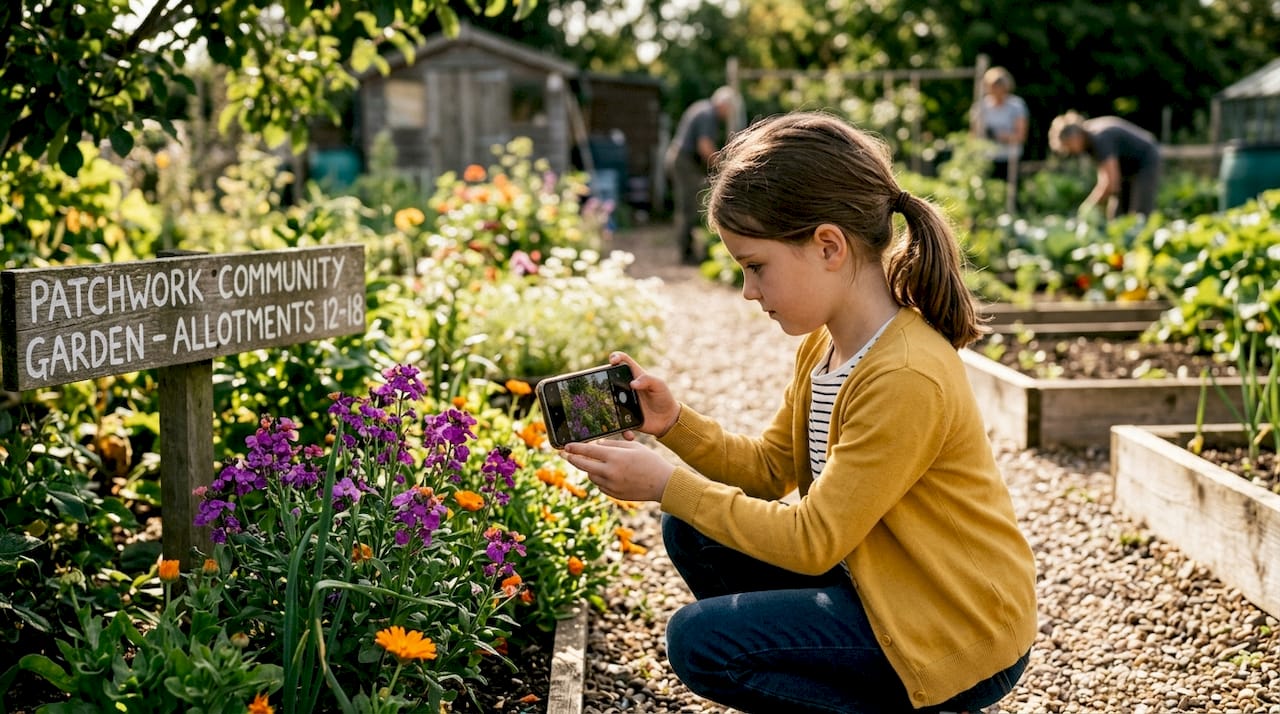
Apps that encourage ecological literacy are a good example. Tools like Seek, developed by iNaturalist, allow children to point a phone camera at a plant or insect and receive an identification in real time. The screen use triggers outdoor activity rather than replacing it. A child who spends ten minutes identifying beetles in the garden is engaged in nature screen activity that directly produces outdoor exploration.
Here is how to make this work in practice:
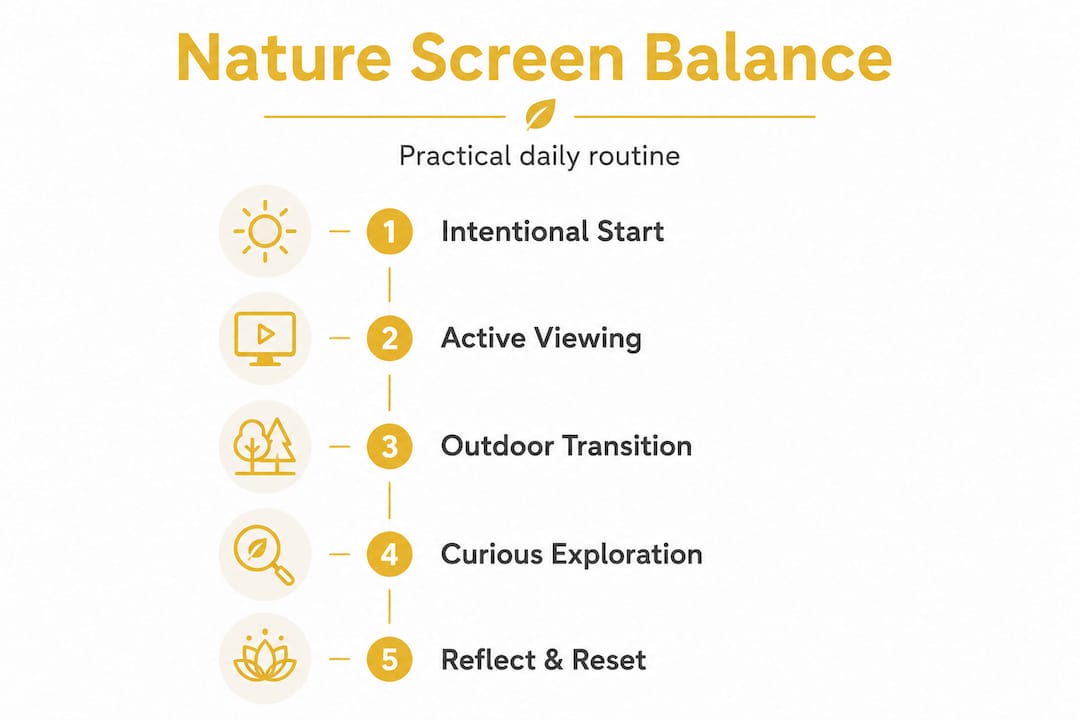
- Use screens to prepare, not replace. Watch a short documentary about garden birds before going outside to look for them. The screen creates curiosity. The outdoor time fulfils it.
- Choose active over passive content. Nature-based digital content that asks children to observe, count, sketch, or identify produces far more benefit than content they simply watch. Screens as a bridge to ecological exploration is a concept well supported by educators and child development researchers.
- Co-view with intention. Sit with your child and connect what you are watching to what you can find outside. “We just saw a red kite on that programme. Shall we see if we can spot one on our walk tomorrow?”
- Set a clear transition. Twenty minutes of a nature-related app followed by outdoor time trains children to associate the two. Over time, the screen becomes a launch pad rather than a destination.
- Avoid autoplay. Autoplay is designed to keep attention captured indefinitely. Turning it off is one of the simplest and most effective boundaries for healthy media use.
Pro Tip: Let your child lead the nature identification process. When children use an app like Seek to discover something themselves, the learning sticks far better than when you point it out for them. Curiosity owned by the child is far more durable than curiosity delivered by an adult.
The key distinction in all of this is between nature-inspired screen experiences that point outward and passive entertainment that keeps children looking inward at a screen. Both involve a device. The outcomes are very different.
Practical tips for managing screens and getting outside
Making this work day-to-day requires structure, not perfection. Here is a realistic approach that addresses the actual friction points parents face.
Setting up your family media plan
A family media plan is not a list of rules. It is an agreement about when, where, and how screens fit into your family’s life. The American Academy of Pediatrics offers a builder tool online, but the core decisions are straightforward:
- Identify device-free zones. Meals and bedrooms are the two that produce the clearest benefits for sleep and family connection.
- Set consistent off times. A device-free hour before bed is one of the most well-supported recommendations in child sleep research.
- Name the outdoor time. Block it like any other commitment. “After school, we go outside before any screens” is easier to maintain than a vague intention to get outside more.
- Build in co-viewing time. Choose one piece of nature-based digital content per week to watch together and discuss.
- Review and adjust. What works for a six-year-old will need revisiting at nine. Build in a monthly check-in rather than treating the plan as permanent.
Managing the transition from screens to outdoors
This is where most parents give up, and it is worth knowing that the struggle is normal. When children move from screen engagement to outdoor play, they typically hit a boredom threshold of about 20 minutes. During this window, they will protest, complain, and declare themselves bored. This is not defiance. It is the brain recalibrating from high-stimulation input to the quieter, more exploratory stimuli of the natural world.
Persistence through those 20 minutes is genuinely worth it. What follows is usually extended, self-directed outdoor engagement. A few things help:
- Have a starter activity ready. A specific task, such as collecting five different leaves, looking for signs of a specific bird, or building a small structure from sticks, reduces the open-endedness that makes the transition feel overwhelming.
- Nature-based crafts in multi-step phases are particularly effective. When children collect natural objects and use them to create something, the activity lengthens engagement and stimulates planning and creativity.
- Go outside with them. Your presence during the transition makes a significant difference, especially for younger children.
For nature play ideas that hold children’s attention across different ages, there is a wide range of activities that build on each other over time rather than feeling like one-off events.
My take on screens, nature, and parenting without the guilt
I have spent years watching parents tie themselves in knots over screen time, and what strikes me most is how often the anxiety is built around the wrong question. The question “how many minutes?” is almost useless. The question “what is this replacing?” is where things get genuinely interesting.
From where I stand, the families who navigate this well are not the ones with the strictest limits. They are the ones who have thought clearly about what they want their children’s days to actually look like, and then designed their media use around that vision. Screens slot in. They do not take over.
What I have also seen, both in research and in real family life, is that integrating nature focused screen time rather than eliminating devices tends to produce far better results than cold-turkey approaches. Children who learn that a screen can be a tool for exploring the world outside become better at self-regulating than those who have simply been told screens are bad.
The boredom threshold thing is real, and it is worth celebrating rather than dreading. Those 20 minutes of resistance are not failure. They are the transition. Once you understand that, it stops feeling like a battle and starts feeling like a process. That shift in perspective changes everything.
— ALAIN
Thezoofamily tools for screen-smart, nature-loving families
Thezoofamily exists precisely at the intersection of technology and nature, not to compete with screens, but to give children something more interesting to do with their curiosity.
If you are building a family media plan and looking for the outdoor side of that equation, Thezoofamily’s blog covers both angles in depth. You will find creative outdoor activities that work across age groups, guides on limiting screen time in ways that actually stick, and healthy screen time habits built around real-world engagement rather than punishment and restriction. Every camera Thezoofamily sells plants one tree, because the goal was never to make better devices. It was to make children who love the world they live in.
FAQ
What is nature focused screen time?
Nature focused screen time refers to the deliberate use of digital media, including apps, documentaries, and interactive tools, to build children’s curiosity about and connection to the natural world, always paired with real outdoor exploration.
How much outdoor time do children need each day?
Research shows that even 20 to 30 minutes of daily nature exposure improves children’s concentration and emotional regulation. Consistent short sessions are more beneficial than occasional long ones.
What did the AAP change about screen time guidance in 2026?
The AAP replaced strict hour limits with the 5-C framework, shifting focus from total screen minutes to the quality of content, context of use, and whether screen time displaces sleep, activity, or socialising.
Why does my child resist going outside after screens?
This is the boredom threshold, a normal phase of approximately 20 minutes during which children’s brains recalibrate from high-stimulation screens to outdoor play. Patience and a simple starter activity help bridge this gap.
Which apps support outdoor screen time for children?
Apps like Seek by iNaturalist encourage children to identify plants and animals using their device camera, turning outdoor screen time into active nature exploration rather than passive consumption.