

Turning learning into play can feel impossible once children start associating education with boring routines. Yet studies show that children learn most effectively when activities align with their own interests and spark curiosity. What if the secret to happy, motivated learners lies in less structure and more playful discovery than you ever imagined?
Table of Contents
- Step 1: Identify Your Child’s Interests
- Step 2: Gather Fun Learning Resources
- Step 3: Create Interactive Learning Activities
- Step 4: Incorporate Playful Learning Techniques
- Step 5: Evaluate Engagement And Adjust Activities
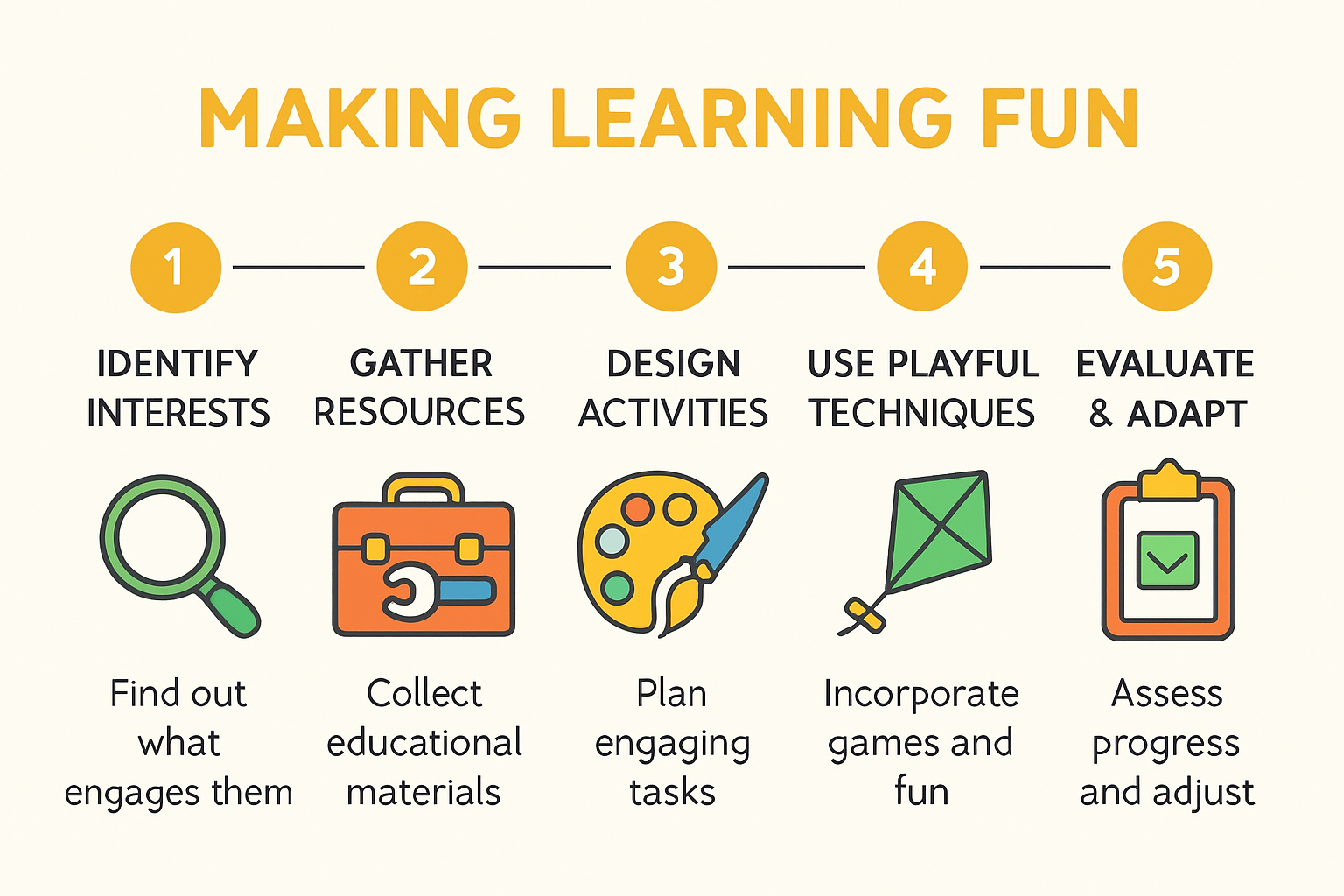
Quick Summary
| Key Point | Explanation |
|---|---|
| 1. Observe Your Child’s Interests | Pay attention to what captivates your child, such as their play choices and conversations, to tailor learning experiences. |
| 2. Curate Engaging Learning Resources | Collect both digital and physical materials that align with your child’s interests to spark curiosity and enjoyment. |
| 3. Design Interactive Learning Activities | Create gamified, hands-on experiences that encourage exploration and engagement rather than traditional learning methods. |
| 4. Integrate Playful Learning Techniques | Use imaginative and sensory activities to make education feel like enjoyable exploration rather than a chore. |
| 5. Continuously Evaluate and Adapt | Regularly observe children’s engagement and be flexible to adapt activities for sustained interest and excitement. |
|
Step 1: Identify Your Child’s Interests
Making learning fun begins with understanding what truly captivates your child’s imagination and curiosity. Each child has unique interests that can transform educational experiences from mundane tasks into exciting adventures. The key is keen observation and genuine engagement.
Start by becoming a careful observer of your child’s natural play patterns and spontaneous interactions. Watch what makes their eyes light up - whether it’s building intricate structures with blocks, drawing elaborate landscapes, exploring how things work, or telling imaginative stories. These moments reveal profound insights into their learning preferences.
Spend deliberate time watching your child without directing their play. Notice the toys they gravitate towards, the games they repeatedly choose, and the subjects that spark extended conversations. According to NAEYC research, children learn most effectively when educational activities align with their intrinsic motivations.
Engagement isn’t just about identifying surface-level preferences. Dive deeper by asking open-ended questions that encourage detailed responses. Instead of asking “Did you enjoy building that tower?”, try “Tell me about what you were thinking while creating this structure.” Such conversations unveil underlying interests and thought processes.
Consider maintaining a simple observation journal where you document your child’s emerging interests. Record specific moments that demonstrate enthusiasm, persistent curiosity, or concentrated engagement. This documentation becomes a valuable resource for designing personalized learning experiences.
Remember that interests can be fluid and evolving. What fascinates your child today might change next month, so remain flexible and continuously attentive. Your goal is creating an adaptive learning environment that responds to their developing passions and intellectual curiosities.
Successful identification of interests means you can now confidently design learning activities that feel more like play than traditional education. By connecting educational content to what naturally motivates your child, you transform learning from a potentially tedious obligation into an exciting, self-driven exploration.
Step 2: Gather Fun Learning Resources
Transforming learning into an engaging adventure requires strategic resource collection that matches your child’s unique interests. This step moves beyond passive gathering and focuses on curating educational materials that spark genuine excitement and curiosity.
Begin by exploring diverse learning platforms that offer interactive and multimedia experiences. Digital resources can be particularly compelling, providing immersive experiences that traditional textbooks cannot match. Look for educational websites, interactive apps, and online platforms that present information through games, animations, and storytelling techniques.
According to Smithsonian Institution research, interactive resources that blend entertainment with education can significantly enhance children’s learning engagement. Museums, science centers, and educational institutions often provide free online resources that transform complex subjects into enjoyable experiences.
Consider creating a versatile learning toolkit that includes both digital and physical resources. This might encompass educational board games, science experiment kits, art supplies, puzzles, and themed activity books that align with your child’s interests. Physical manipulation and hands-on exploration can be incredibly powerful learning tools.
Libraries remain underutilized treasures for learning resources. Modern libraries offer far more than books - they provide workshops, interactive displays, educational programs, and multimedia resources. Many libraries now have digital platforms allowing free access to educational videos, language learning tools, and skill-building courses.
Do not overlook community resources like local workshops, educational clubs, and extracurricular programs. Check out our guide on creating exciting learning adventures that can transform ordinary experiences into extraordinary learning opportunities.
Verify your resource collection’s effectiveness by observing your child’s engagement. Successful resources will generate spontaneous questions, demonstrate increased curiosity, and inspire independent exploration. Remember, the goal is not to overwhelm but to provide a thoughtful, stimulating selection that nurtures your child’s natural learning inclinations.
Flexibility is key. Be prepared to rotate resources, retire materials that no longer spark interest, and continuously adapt your learning toolkit to match your child’s evolving curiosities. Learning resources are not static collections but dynamic, responsive tools that grow alongside your child’s intellectual journey.
To help you select and rotate engaging materials for your child, here is a table summarising different types of learning resources, along with examples and their key benefits.
| Resource Type | Example Materials | Key Benefit |
|---|---|---|
| Digital | Educational apps, interactive websites | Immersive, multimedia experiences |
| Physical | Science kits, art supplies, board games | Hands-on, tactile learning |
| Library | Books, workshops, multimedia resources | Access to diverse, free materials |
| Community | Local clubs, extracurricular programmes | Social and collaborative opportunities |
| Home-made | DIY kits, scavenger hunts | Personalised and adaptive activities |
Step 3: Create Interactive Learning Activities
Interactive learning activities transform education from passive absorption to dynamic exploration. The art of creating engaging educational experiences requires creativity, flexibility, and a deep understanding of your child’s unique learning style.
Gamification is a powerful strategy for making learning compelling. Convert traditional learning objectives into playful challenges that feel more like entertainment than education. For instance, mathematical concepts can become treasure hunt games where solving equations reveals hidden clues, or language learning can transform into role-playing adventures where communication becomes the primary objective.
According to George Mason University’s research, children learn most effectively when activities encourage curiosity and hands-on exploration. Design activities that prompt questions, invite experimentation, and celebrate the process of discovery rather than focusing solely on final outcomes.
Consider developing multi-sensory learning experiences that engage different cognitive pathways. A science lesson about plant growth might involve not just reading or watching videos, but actually planting seeds, measuring their progress, maintaining a growth journal, and observing biological transformations firsthand. Physical interaction deepens understanding and makes learning memorable.
Technology can be an exceptional ally in creating interactive experiences. Educational apps, augmented reality platforms, and interactive online simulations can turn abstract concepts into immersive learning journeys. Explore creative learning techniques that blend digital and physical engagement.
Encourage collaborative learning by designing activities that involve family participation or peer interaction. Board games that teach strategic thinking, collaborative art projects that explore cultural concepts, or family science experiments can transform learning into a shared, enjoyable experience.
To verify the effectiveness of your interactive activities, observe your child’s engagement levels. Successful activities will generate spontaneous questions, inspire continued exploration beyond the initial activity, and create an environment where learning feels like a natural, enjoyable process. Look for signs of sustained curiosity, voluntary participation, and genuine excitement about the learning experience.
Remember that not every activity will be a perfect hit, and that’s okay. The key is maintaining flexibility, being willing to adapt, and continuously experimenting with different approaches that resonate with your child’s evolving interests and learning preferences.
Step 4: Incorporate Playful Learning Techniques
Playful learning techniques transform educational experiences from mundane tasks into exciting adventures of discovery. This approach moves beyond traditional instruction, creating an environment where learning feels like a natural, enjoyable exploration.
Imagination becomes the primary vehicle for educational engagement. Role-playing scenarios offer remarkable opportunities for interactive learning. Transform historical lessons into dramatic reenactments, scientific concepts into magical investigative missions, or mathematical challenges into treasure hunt expeditions that require problem-solving skills.
According to Edutopia’s research, incorporating deliberate play into learning environments significantly enhances children’s cognitive and social development. The key is designing experiences that feel spontaneous yet have intentional educational objectives.
Consider creating learning zones that encourage open-ended exploration. A geography lesson might involve constructing miniature landscapes using household materials, allowing children to understand topographical concepts through tactile manipulation. Language learning can become an immersive storytelling adventure where children create characters, dialogue, and narrative arcs that naturally improve communication skills.
Sensory experiences are powerful learning tools. Integrate activities that engage multiple senses - texture exploration, sound experiments, movement-based learning - which help children process information more deeply. A chemistry lesson might involve creating slime, a mathematics session could include building geometric shapes with clay, or a biology class could explore plant growth through hands-on gardening.
Discover more about the magic of imaginative play and how it can transform learning experiences. By reframing educational content as an exciting journey, you create an environment where curiosity naturally flourishes.
Technology can be an exceptional ally in playful learning. Educational apps, augmented reality experiences, and interactive simulations can turn abstract concepts into immersive adventures. However, balance digital experiences with physical interactions to ensure comprehensive learning.
Verify the effectiveness of your playful techniques by observing key indicators: sustained attention, voluntary participation, spontaneous questions, and visible excitement. Successful playful learning techniques will make children eager to continue exploring, turning education from a mandatory task into a delightful personal mission of discovery.
Step 5: Evaluate Engagement and Adjust Activities
Evaluating and refining learning activities is a dynamic process that transforms educational experiences from static approaches to responsive, personalized journeys. Continuous observation and adaptation are crucial in maintaining your child’s learning momentum and excitement.
Begin by developing a nuanced observation framework that goes beyond simple performance metrics. Pay attention to subtle indicators of engagement - spontaneous questions, unsolicited exploration, duration of focused attention, and emotional responses during learning activities. These qualitative signals often reveal more about learning effectiveness than traditional quantitative assessments.
Create an informal tracking system to document your observations. This might involve a simple journal where you note your child’s reactions, emerging interests, moments of visible excitement, and potential areas of disengagement. The goal is understanding learning patterns, not creating rigid performance expectations.
Consider maintaining a visual progress map that allows your child to participate in self-reflection. Colorful charts, sticker systems, or digital tracking tools can transform evaluation into an interactive, collaborative process that empowers children to understand their own learning journey.
Be prepared to pivot quickly when activities lose their spark. Rigidity can transform learning from an exciting adventure into a tedious obligation. If a particular approach stops generating curiosity, it’s time to reimagine the learning experience. Flexibility is your most powerful educational tool.
Technology can be an exceptional ally in this evaluation process. Many educational apps and platforms offer built-in analytics that provide insights into learning progress and engagement levels. Learn more about creative assessment techniques that make tracking fun and interactive.
Remember that engagement is not a linear trajectory. Children’s interests fluctuate, and what captivates them today might feel mundane tomorrow. Your role is to remain attentive, responsive, and willing to experiment.
Key verification signs of successful engagement include:- Voluntary continuation of learning activities beyond scheduled times- Spontaneous questions related to the subject- Emotional enthusiasm during learning experiences- Creative extensions of learned concepts through play or personal projects
Here is a checklist table to help you verify your child's engagement and know when to adapt your approach. Use this summary during and after learning activities to evaluate effectiveness.
| Verification Step | What to Look For |
|---|---|
| Voluntary continuation of activity | Child chooses to keep learning beyond required time |
| Spontaneous questions | Child asks interesting or related questions |
| Emotional enthusiasm | Child shows excitement and positive emotions |
| Focused attention | Child maintains attention for extended periods |
| Creative extension of concepts | Child recreates or plays with concepts independently |
| Willingness to try new variations | Child is open to adjusting activities |
| Family/peer engagement | Activity inspires others to join in |
Ultimately, making learning fun is an art of continuous discovery. By maintaining a playful, observant approach, you transform education from a prescribed process into an exciting, personalized adventure of growth and exploration.
Unlock a World of Playful Learning with The Zoofamily
Many parents face the challenge of keeping children genuinely engaged and excited about learning. This article shows that when you tap into curiosity, interactive activities, and play-based techniques, children learn more effectively and build a lifelong passion for discovery. Yet even the most creative efforts can fall flat without the right resources to spark imagination and nurture an authentic connection with nature.
With The Zoofamily, you can bridge this gap. Our uniquely designed kids’ cameras, walkie-talkies, and binoculars are more than just toys. Each product is inspired by the animal world and helps children turn curiosity into concrete exploration, both at home and outdoors. We want your family to create memories that inspire a love of learning and nature, while also making a difference for the planet. For every camera you buy, we plant a tree, bringing education and sustainability together.
Discover the tools that transform ordinary activities into captivating learning adventures. Visit The Zoofamily today and find the perfect resource to make everyday play more meaningful. Give your child the gift of joyful, hands-on exploration—there has never been a better time to turn learning into lasting adventure.
Frequently Asked Questions
How can I identify my child’s interests to make learning more engaging?
Start by observing your child’s play patterns and interactions. Notice what captures their attention, the toys they favour, and the subjects they discuss. Ask open-ended questions to uncover deeper interests and keep a journal to document these observations.
What types of resources can I gather to support fun learning activities?
Collect a mix of digital and physical resources aligned with your child’s interests, such as educational apps, interactive websites, science kits, art supplies, and board games. Libraries and local community programs also offer valuable resources.
How can I create interactive learning activities for my children?
Use gamification techniques to turn educational concepts into playful challenges. Include multi-sensory activities that stimulate different learning modalities and involve family participation to enhance engagement and enjoyment.
How should I evaluate my child’s engagement in learning activities?
Observe your child’s reactions, including spontaneous questions and focus duration. Keep a tracking system or visual progress map to document their learning journey. Be flexible and ready to adjust activities if engagement wanes.
Recommended
-
[ Understanding the Benefits of Imaginative Play
– The Zoofamily](https://thezoofamily.com/en/blogs/news/benefits-of-imaginative-play)
-
[ Comment protéger la planète au quotidien avec ses enfants
– The Zoofamily](https://thezoofamily.com/en/blogs/news/comment-proteger-la-planete-au-quotidien-avec-ses-enfants)
-
[ Childhood Brain Development: A Guide for Modern European Mums
– The Zoofamily](https://thezoofamily.com/en/blogs/news/childhood-brain-development-guide-european-mums)
-
[ Bricolages avec coquillages : Créez des cadeaux uniques pour enfants
– The Zoofamily](https://thezoofamily.com/en/blogs/news/bricolages-avec-coquillages)