

Play is the primary mechanism through which children aged 0–6 learn, build brain architecture, and develop the skills they will rely on for the rest of their lives. Far from being a break from learning, play-based learning is the learning. A scoping review of 51 peer-reviewed studies found that play-based approaches significantly improve cognitive, academic, and socio-emotional development in 4 to 6 year olds. Understanding why play is so important in early childhood education means understanding how young brains actually grow. This article explains the science, clears up common myths, and gives you practical ways to support your child at home.
How does play promote cognitive and brain development in young children?
Play physically builds the brain. Neural connections and synapses form at a remarkable rate during early childhood, and play is the primary driver of that process. These connections form the infrastructure for language, memory, attention, and academic skills. Every time your child stacks blocks, acts out a story, or chases a friend, their brain is wiring itself for future learning.
Executive function is one of the most important skill sets a child develops before age six. It covers self-regulation, problem-solving, working memory, and the ability to shift attention. These skills predict school readiness more reliably than early reading or maths drills. Play, particularly imaginative and social play, builds all of them simultaneously.
Children are also natural scientists. Children intuitively create challenges in play that mimic the scientific method, testing hypotheses and inventing solutions without any adult instruction. A child who keeps adjusting a ramp to make a toy car go faster is practising early STEM thinking. That curiosity-driven approach is far harder to teach through a worksheet.

Pro Tip: Offer your child open-ended materials such as cardboard boxes, water, sand, or building bricks. These prompt more complex thinking than single-purpose toys because the child must invent the rules.
| Type of play | Brain systems engaged | Key skills developed |
|---|---|---|
| Physical play (running, climbing) | Motor cortex, cerebellum | Coordination, spatial awareness, risk assessment |
| Imaginative play (role play, storytelling) | Prefrontal cortex, language centres | Creativity, narrative thinking, emotional regulation |
| Social play (games with peers) | Mirror neuron system, limbic system | Empathy, cooperation, conflict resolution |
| Exploratory play (building, experimenting) | Problem-solving networks, sensory cortex | Cause and effect, persistence, early STEM concepts |
What role does play have in social and emotional development?
Play is where children practise being human. It gives them a safe space to experience strong emotions, test social rules, and recover from small failures. Play supports emotional regulation by helping children make the world feel manageable and secure, building resilience against stress in the process. A child who plays through a difficult scenario, such as a toy character losing a friend, is rehearsing coping strategies in low-stakes conditions.
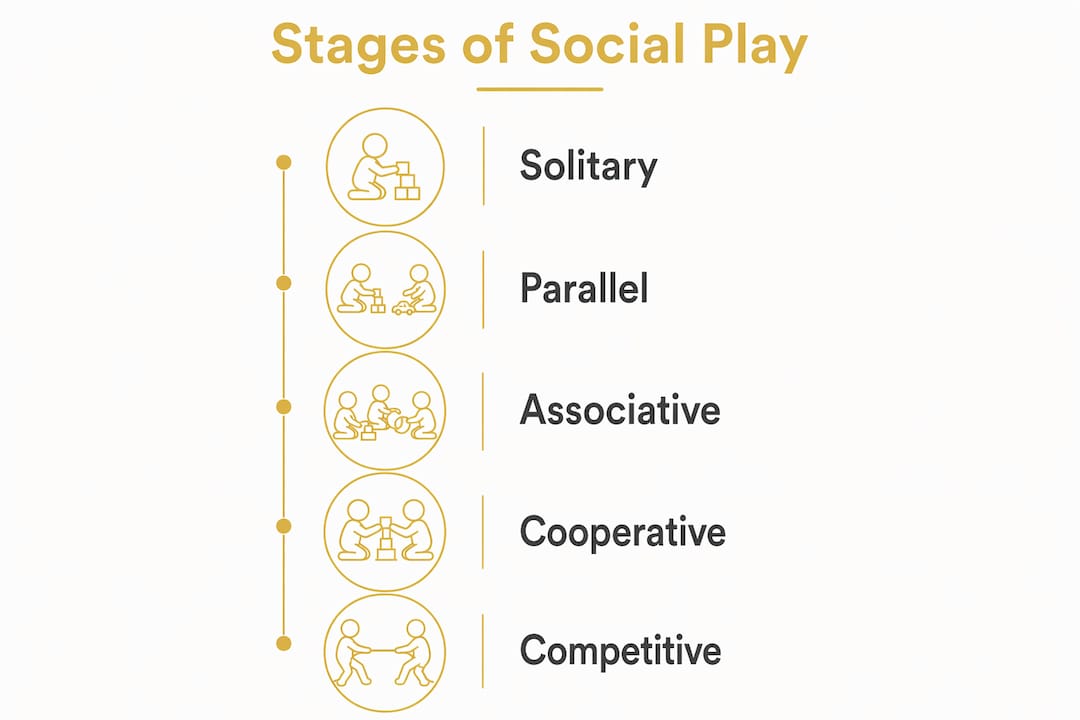
Social development through play follows a clear progression. Children move through six stages from birth to age five, starting with solitary play and gradually advancing to cooperative play that requires negotiation, empathy, and shared goals. Each stage builds on the last. A two year old playing alongside another child without interacting is not being antisocial. They are at exactly the right developmental stage.
The parent-child relationship is also shaped through play. Serve-and-return interactions between parents and children, where a child initiates and a parent responds, strengthen language skills, self-regulation, and the parent-child bond in ways that passive screen time cannot replicate. Even ten minutes of focused, responsive play each day makes a measurable difference.
Key social and emotional skills that play develops:
- Empathy. Role play and cooperative games require children to consider other perspectives and respond to others’ feelings.
- Language. Conversation during play builds vocabulary and narrative skills faster than most structured activities.
- Resilience. Losing a game, resolving a dispute, or rebuilding a fallen tower teaches children to persist through frustration.
- Self-regulation. Following rules in a game, waiting for a turn, and managing excitement all practise impulse control.
- Confidence. Child-led play gives children agency, which builds a sense of competence and self-worth.
Free play vs guided play vs structured play: which is best?
The honest answer is that all three types matter, and they work best in combination. Each serves a different developmental purpose, and understanding the difference helps you make better choices at home and when evaluating nursery or pre-school settings.
Free play is entirely child-directed. There is no adult agenda, no goal, and no right answer. The child chooses what to do, how to do it, and when to stop. This type of play is where creativity, independence, and intrinsic motivation grow. It is also where children take the kinds of intellectual risks that lead to genuine discovery. Adult-led structured learning can limit growth when it replaces self-directed play entirely, which is why free play time is not a luxury in early years settings. It is a necessity.
Guided play sits in the middle ground. An adult sets up an environment or poses a question, but the child leads the exploration. Guided play can be as or more effective than conventional instruction for teaching literacy, numeracy, and thinking skills, particularly for learning shapes and spatial concepts. A parent who hides letters in a sand tray is using guided play. The child is playing freely, but the learning goal is intentional.
Structured play has clear rules and adult-defined outcomes, such as a board game or a group activity with a specific task. It builds turn-taking, rule-following, and goal-directed behaviour. The key is that it retains joy and engagement rather than feeling like a test.
| Play type | Adult involvement | Best for | Watch out for |
|---|---|---|---|
| Free play | None | Creativity, independence, intrinsic motivation | Too little time allocated in busy schedules |
| Guided play | Low to moderate | Literacy, numeracy, specific concept learning | Becoming too directive and removing child agency |
| Structured play | High | Rules, cooperation, goal-directed behaviour | Replacing free and guided play entirely |
Pro Tip: Aim for a daily mix of all three. A rough guide: roughly half the day in free play, a portion in guided play with you or a key adult, and a smaller portion in structured activities. The balance matters more than the exact split.
What practical ways can parents encourage play at home?
Parents do not need expensive equipment or elaborate plans. The most powerful thing you can do is protect time and space for play, then step back.
-
Create a yes space indoors. Designate one area where your child can make a mess, build freely, and explore without constant redirection. A corner with building bricks, art materials, and a few open-ended props is enough. Rotate materials every few weeks to keep curiosity alive.
-
Prioritise outdoor play every day. Outdoor environments offer sensory richness that indoor spaces rarely match. Mud, sticks, puddles, and uneven ground all challenge the body and brain in ways that carpet and plastic cannot. Even a small garden or local park provides the variety children need. For parents looking for ideas on outdoor play activities, physical play outdoors builds confidence and spatial awareness alongside pure enjoyment.
-
Limit screen time during play hours. Screens are not inherently harmful, but passive viewing replaces the active, responsive play that builds skills. The serve-and-return interactions that strengthen language and emotional regulation simply do not happen when a child watches a screen alone.
-
Play alongside your child without taking over. Sit on the floor, follow their lead, and resist the urge to correct or redirect. Ask open questions such as “What do you think will happen if…?” rather than providing answers. Parental scaffolding that allows child control yields the best developmental outcomes. Your role is to enrich the play, not direct it.
-
Encourage imaginative and role play. Dressing up, playing shops, or acting out stories builds narrative thinking, vocabulary, and empathy. You do not need a costume box. A cardboard box and a few household objects are enough to spark hours of creative play. The benefits of imaginative play for cognitive and emotional growth are well documented across developmental research.
-
Introduce nature-based play. Collecting leaves, watching insects, or caring for a plant connects children to the natural world and builds observation skills. These experiences also lay the groundwork for environmental awareness and curiosity about science.
Key takeaways
Play-based learning is the single most effective approach to early childhood education because it builds brain architecture, social skills, and emotional resilience simultaneously.
| Point | Details |
|---|---|
| Play builds the brain | Synapse formation during play creates the neural infrastructure for language, memory, and learning. |
| All play types matter | Free, guided, and structured play each serve distinct purposes and work best in combination. |
| Parents are key players | Serve-and-return interactions and supportive scaffolding during play drive the strongest developmental gains. |
| Emotional skills grow through play | Children practise regulation, empathy, and resilience through play long before formal schooling begins. |
| Free play is not optional | Replacing self-directed play with adult-led instruction limits creativity, independence, and intrinsic motivation. |
Play is serious business: my honest view as a parent advocate
I have spent years watching parents feel guilty for letting their children “just play” while other families drill phonics or practise writing at age three. That guilt is misplaced, and the research is unambiguous on this point.
Play-based learning is not contrary to academic rigour. It delivers deep, joyful, meaningful learning that meets high standards. The child building a tower and testing why it falls is doing physics. The child negotiating roles in a game is doing social science. The child making up a story is doing literacy. None of it looks like a classroom lesson, and that is precisely why it works so well for young children.
The misconception I encounter most often is that play and learning are opposites. They are not. For children under six, they are the same thing. The brain at this age is not designed for passive instruction. It is designed for active, curious, self-directed exploration. When we replace that with worksheets and drills, we are working against the child’s biology, not with it.
My advice to parents is simple. Trust the play. Protect the time for it. Get on the floor and join in when you can. The skills your child builds through play, including the ability to focus, cooperate, regulate emotions, and think creatively, are the very skills that will carry them through school and beyond. No flashcard set comes close.
— ALAIN
How Thezoofamily supports creative play at home
Children learn best when play connects them to the world around them. Thezoofamily was built on exactly that idea.
Thezoofamily designs kids’ cameras, walkie-talkies, and binoculars with animal-inspired details that spark curiosity about nature and encourage children to explore their environment actively. Every product is built to support the kind of open-ended, outdoor, and imaginative play that research shows matters most in the early years. For every camera sold, Thezoofamily plants one tree, connecting children’s play directly to the health of the planet they are growing up in. Visit Thezoofamily to find play-focused tools and ideas that bring the outdoors into your child’s everyday adventures. You can also read more about creative play benefits and how to build a richer play environment at home.
FAQ
Why is play so important in early childhood?
Play builds the neural connections that underpin language, memory, and social skills. A review of 51 studies confirmed that play-based approaches significantly improve cognitive and socio-emotional development in children aged 4 to 6.
How do kids learn through play?
Children learn through play by testing ideas, solving problems, and practising social interactions in low-stakes conditions. These experiences build executive function skills such as self-regulation, persistence, and creative thinking.
Why is free play important in early childhood?
Free play allows children to direct their own learning, which builds independence, creativity, and intrinsic motivation. Research shows that replacing self-directed play with adult-led instruction can limit these qualities in young children.
What is the difference between guided play and free play?
Free play is entirely child-directed with no adult agenda, while guided play involves an adult setting up an environment or question that the child then explores freely. Guided play has been shown to be as or more effective than direct instruction for teaching specific skills such as literacy and numeracy.
At what age do children start cooperative play?
Children typically begin cooperative play, which involves shared goals, negotiation, and empathy, around age four to five. Before that, they move through earlier stages including solitary, onlooker, and parallel play, each of which builds the social skills needed for cooperation.