

TL;DR:
- Dirt play exposes children to microbes that strengthen their immune systems and reduce allergies.
- Unstructured outdoor dirt play boosts creativity, emotional resilience, and social skills.
- Safe dirt play involves choosing clean areas, supervision, and thorough handwashing after activities.
Most parents spend a good deal of energy keeping their children clean, yet the science quietly points in the opposite direction. Dirt play supports immune development by exposing children to the beneficial microbes their bodies need to build lasting resilience. Far from being a hazard, a muddy afternoon in the garden may be one of the most productive things your child does all week. In this guide, we look at the evidence behind dirt play, explore its surprising benefits for immunity, creativity, and social development, and offer practical advice for parents who want to make the most of outdoor time.
Table of Contents
- How dirt play builds stronger immunity
- Boosting creativity, imagination, and resilience outdoors
- Building environmental awareness and social skills
- Safety, hygiene, and evidence-based best practices
- Why the dirt debate misses what children really need
- Discover nature-rooted family experiences
- Frequently asked questions
Key Takeaways
| Point | Details |
|---|---|
| Immune system boost | Dirt play exposes children to microbes that strengthen immune defence and reduce allergy risks. |
| Creativity and resilience | Messy, open-ended outdoor play fosters creative thinking and emotional well-being. |
| Nature connectedness | Hands-on dirt experiences help children develop environmental empathy and social skills. |
| Balanced hygiene | Simple precautions like handwashing ensure dirt play remains safe and beneficial. |
How dirt play builds stronger immunity
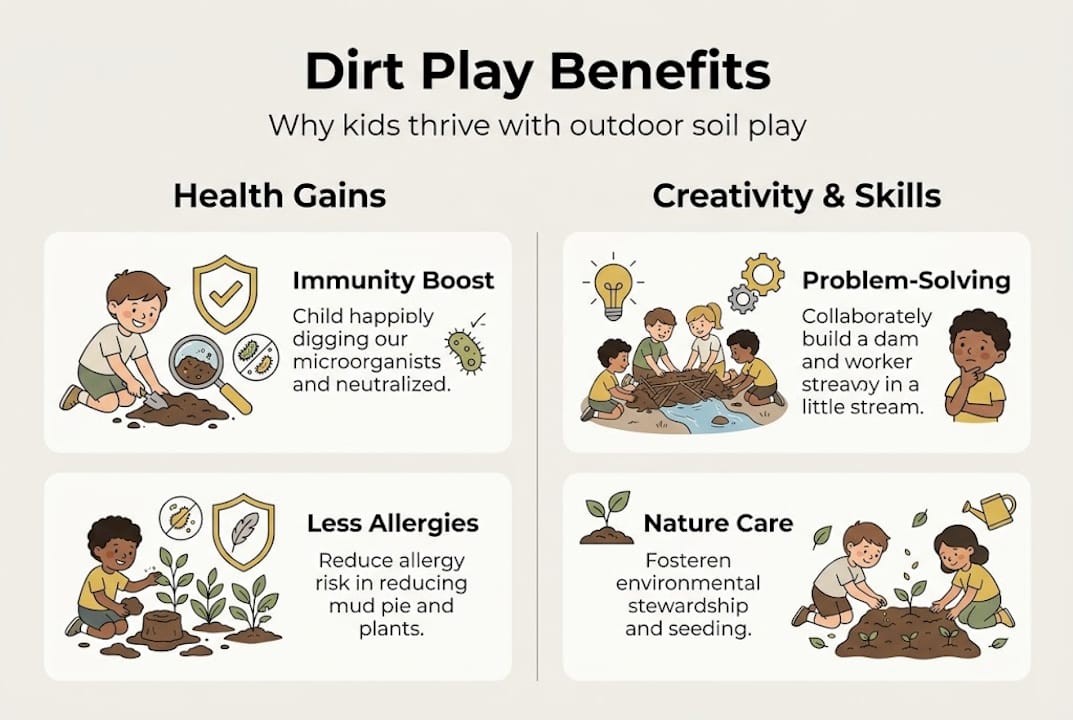
When your child plunges their hands into the soil, they are not just making a mess. They are introducing their immune system to a rich community of microbes that help train it to respond appropriately to threats. Beneficial microbes in dirt reduce the risk of allergies, asthma, and autoimmune conditions by giving the immune system meaningful work to do during the critical early years.
The evidence from research is striking. Studies comparing children raised on farms with those growing up in urban environments consistently show that farm children have lower asthma and allergy rates due to regular soil exposure. This is sometimes called the “farm effect,” and it has shaped how researchers now think about childhood health in general.
A particularly compelling study found that daycare children in biodiverse yards showed measurable increases in microbiota diversity and improved immune regulation after just one month of regular outdoor play. That is a meaningful change in a very short period. It suggests that even small, consistent doses of nature contact can shift a child’s health trajectory.
Across Europe, this understanding is already shaping early years education. Forest schools in Scandinavia, nature kindergartens in Germany, and outdoor nurseries in the UK all prioritise unstructured time in natural settings. These are not fringe experiments. They are mainstream approaches backed by decades of observation and, increasingly, by clinical research.
| Setting | Soil contact | Allergy and asthma risk |
|---|---|---|
| Urban flat with no garden | Very low | Higher |
| Suburban garden play | Moderate | Moderate |
| Rural or farm environment | High | Lower |
| Forest school or nature kindergarten | High | Lower |
The table above illustrates a clear pattern. More contact with natural soil tends to correlate with better immune outcomes. This does not mean city children are destined for poor health, but it does mean that parents can make deliberate choices to increase their child’s exposure to beneficial microbes through regular outdoor play.
For a broader look at how outdoor time shapes development, our child development outdoors guide covers the full picture from physical growth to cognitive skills.
Pro Tip: You do not need a large garden or a forest nearby. A planter box filled with garden soil, a patch of grass in a local park, or a community garden visit can all provide meaningful microbial exposure for your child.
Boosting creativity, imagination, and resilience outdoors
Dirt play is not just good for the body. It is one of the most powerful tools available for building a creative, emotionally resilient child. When children play with mud, sticks, stones, and leaves, they are engaging in open-ended, unstructured activity that no screen or structured toy can replicate.
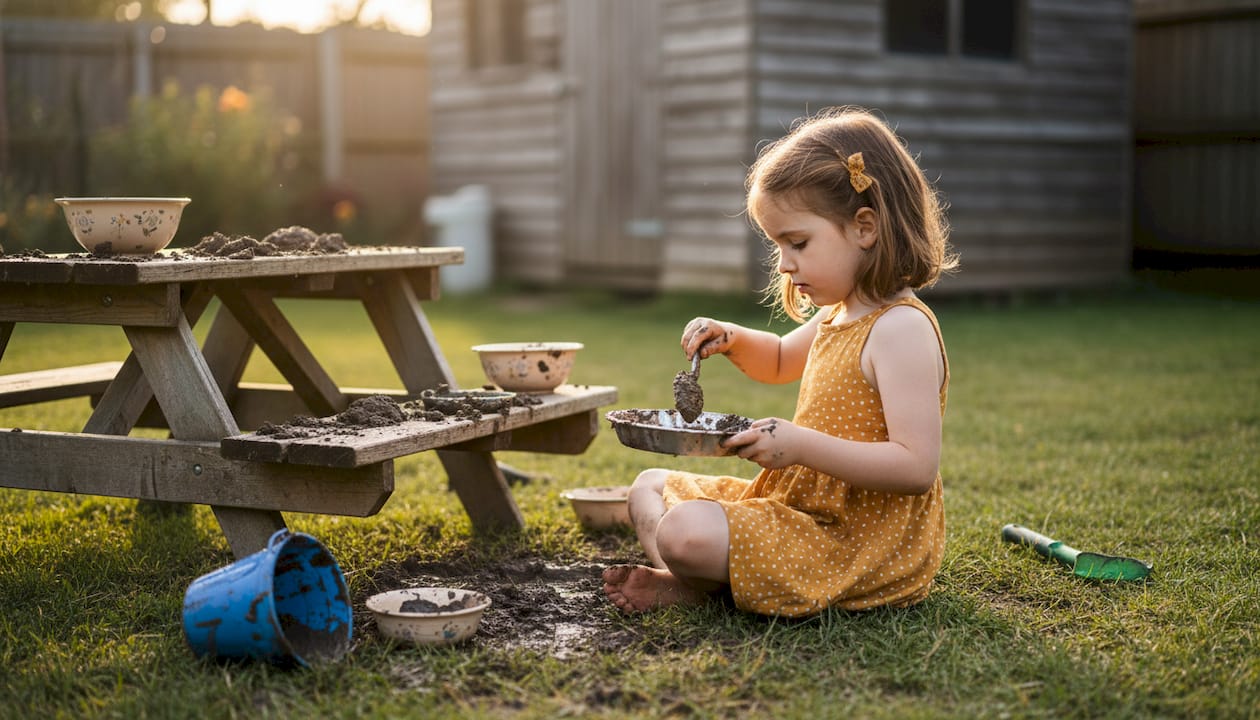
Dirt play promotes open-ended creativity and problem-solving in ways that sanitised playgrounds simply cannot match. A mud kitchen encourages children to invent recipes, negotiate roles, and experiment with textures. A pile of stones becomes a castle, a market, or a science experiment. There are no instructions and no wrong answers, which is precisely what makes it so valuable.
There is also a fascinating biochemical dimension to this. Soil bacteria like Mycobacterium vaccae trigger the release of serotonin in the brain, improving mood and building emotional resilience. Children who play regularly in natural soil are, in a very literal sense, getting a mood boost from the ground beneath their feet.
Here is a quick comparison of structured versus unstructured outdoor play:
| Type of play | Creative freedom | Problem-solving | Emotional regulation |
|---|---|---|---|
| Structured playground | Low | Low | Moderate |
| Organised sport | Moderate | Moderate | Moderate |
| Unstructured dirt play | High | High | High |
Practical ideas to get started at home or in a local park include:
- Mud kitchen: Set up a small area with old pots, spoons, and water. Let children mix, pour, and create freely.
- Forest scavenger hunt: Ask children to find five different textures in nature, encouraging close observation.
- Digging patch: Designate a corner of the garden for digging. Add a few small creatures like worms and watch curiosity take over.
- Nature sculpture: Collect sticks, stones, and leaves to build animals or patterns on the ground.
For more ideas on connecting creativity with outdoor time, explore our guide to creative outdoor bonding or our nature-based play guide for families.
Pro Tip: Resist the urge to direct the play. The moment you suggest what the mud should become, you reduce the creative challenge. Step back, observe, and let your child lead.
Building environmental awareness and social skills
Children who play regularly in natural, unstructured settings develop something that is difficult to teach in a classroom: a genuine connection to the living world around them. When a child feels the soil between their fingers, watches a worm navigate through mud, or discovers a beetle under a stone, they are building ecological empathy from the ground up.
Dirt play builds nature connectedness and ecological empathy, helping children understand that they are part of a larger living system rather than separate from it. This early connection is the foundation of environmental awareness that lasts into adulthood.
Group dirt play adds another layer of benefit. When two or three children work together to build a mud dam, dig a river, or create a nature sculpture, they are practising cooperation, negotiation, and communication in a context that genuinely matters to them. Group mud play improves social skills including sharing, cooperation, and negotiation, according to a growing body of empirical research.
The social benefits of dirt play include:
- Improved ability to share materials and space
- Richer verbal communication as children describe their ideas
- Greater empathy through shared sensory experiences
- Stronger conflict resolution skills when disagreements arise over resources
- Increased confidence from leading or contributing to group projects
“Outdoor play in natural environments gives children the opportunity to develop not just physical skills, but the social and emotional foundations they need to thrive.” UNICEF Europe and Central Asia
For families interested in making their outdoor space more welcoming to local wildlife, our guide to wildlife friendly gardens offers practical steps that children can help with directly.
Safety, hygiene, and evidence-based best practices
For many parents, the hesitation around dirt play is not philosophical. It is practical. What about germs? What about contaminated soil? What if my child puts mud in their mouth? These are fair questions, and they deserve honest answers.
The reassuring reality is that the majority of soil microbes are harmless, and thorough handwashing after play is sufficient to manage the small risk that does exist. Soil contamination is a genuine edge case in urban settings, but it is manageable with a little planning.
Research also confirms that unstructured, open-ended dirty play in natural settings produces the greatest developmental benefits compared with more controlled or sanitised versions of outdoor activity. In other words, the messier and more natural, the better.
Here is a simple step-by-step approach for setting up safe dirt play:
- Choose your location carefully. Avoid areas near busy roads, old industrial sites, or places where dogs or other animals frequently toilet. Parks with maintained green spaces are generally safe.
- Check for obvious hazards. Before play begins, scan the area for broken glass, sharp objects, or animal waste.
- Dress for the occasion. Old clothes and wellies make cleanup easier and remove the anxiety around getting dirty.
- Be present, not prescriptive. Stay nearby to supervise without directing. Your role is safety, not control.
- Establish a handwashing routine. Wash hands thoroughly with soap and water after play, before eating, and before touching eyes or mouth.
- Avoid pesticide-treated areas. In gardens, choose organic or untreated soil where possible.
For a fun, practical introduction to outdoor mess-making, our fun mud pie guide walks families through a simple activity that children love.
Statistic to remember: Children who play regularly in biodiverse outdoor environments show measurable improvements in immune regulation within as little as four weeks.
Why the dirt debate misses what children really need
Here is an uncomfortable truth: the modern obsession with cleanliness is not neutral. It has costs. When we reflexively reach for the antibacterial wipe or steer children away from muddy patches, we are making a health decision, just not always the right one. “Dirt-deficiency” risks increasingly outweigh the minimal pathogen threats that soil actually presents.
Nordic countries have understood this for generations. In Finland, Norway, and Sweden, children spend hours outdoors in all weather, including in mud and snow, as a matter of educational policy. The results in terms of wellbeing, resilience, and academic outcomes speak for themselves.
For parents in urban Europe, the challenge is real. Gardens are smaller, parks are busier, and the cultural pressure to keep children clean is strong. But the shift does not require a forest or a farm. It requires a willingness to reframe what a good afternoon looks like. A muddy child is not a neglected child. More often, they are a thriving one. We believe that connecting children to nature, even in small, everyday ways, is one of the most meaningful things a family can do. Explore more on our nature play perspective for practical inspiration.
Discover nature-rooted family experiences
At The Zoofamily, we believe that children thrive when they are genuinely connected to the natural world. Every product we make, from our animal-themed cameras to our binoculars and walkie-talkies, is designed to draw children closer to nature and spark the kind of curiosity that lasts a lifetime. For every camera sold, we plant a tree.

If this guide has inspired you to take outdoor play more seriously, our collection of parent-child nature activities is a brilliant next step. You will find ideas that work in gardens, parks, and wild spaces across Europe, all designed to make nature feel like the most exciting place your child can be.
Frequently asked questions
Is it safe for my child to play in dirt?
For most children, dirt play is safe and beneficial. The majority of soil microbes are harmless, and regular handwashing with soap and water is all that is needed to manage any residual risk.
What age is best to start dirt play?
Toddlers and preschoolers benefit most from early and regular soil contact, but older children gain from it too. Daycare children in biodiverse yards showed improved immunity after just one month, suggesting it is never too early to start.
How do I encourage my child if they dislike getting dirty?
Start with low-pressure, fun activities like mud kitchens or group games, and join in yourself. Open-ended dirt play builds creativity and confidence, and children often warm to it quickly when a trusted adult models enjoyment.
Does dirt play really help prevent asthma and allergies?
The evidence is strong. Children on farms with regular soil exposure consistently show lower rates of asthma and allergies compared with urban peers, a pattern researchers call the farm effect.
What precautions should I take for city dirt play?
Choose areas free from pesticides, animal waste, and industrial contamination. Supervise children during play and establish a handwashing routine immediately after every session.