

Outdoor group story making is a collaborative storytelling practice where children build shared narratives together in natural settings, developing creativity, communication, and teamwork in a single activity. Unlike classroom writing exercises, it requires no paper, no screens, and no preparation beyond finding a patch of grass. Collaborative storytelling builds communication skills, trust, and a shared sense of identity among children. Sessions typically run for 15–45 minutes and work well with groups of 5–10 children, making it one of the most flexible group activities you can organise outdoors.
What tools do you need for outdoor group story making?
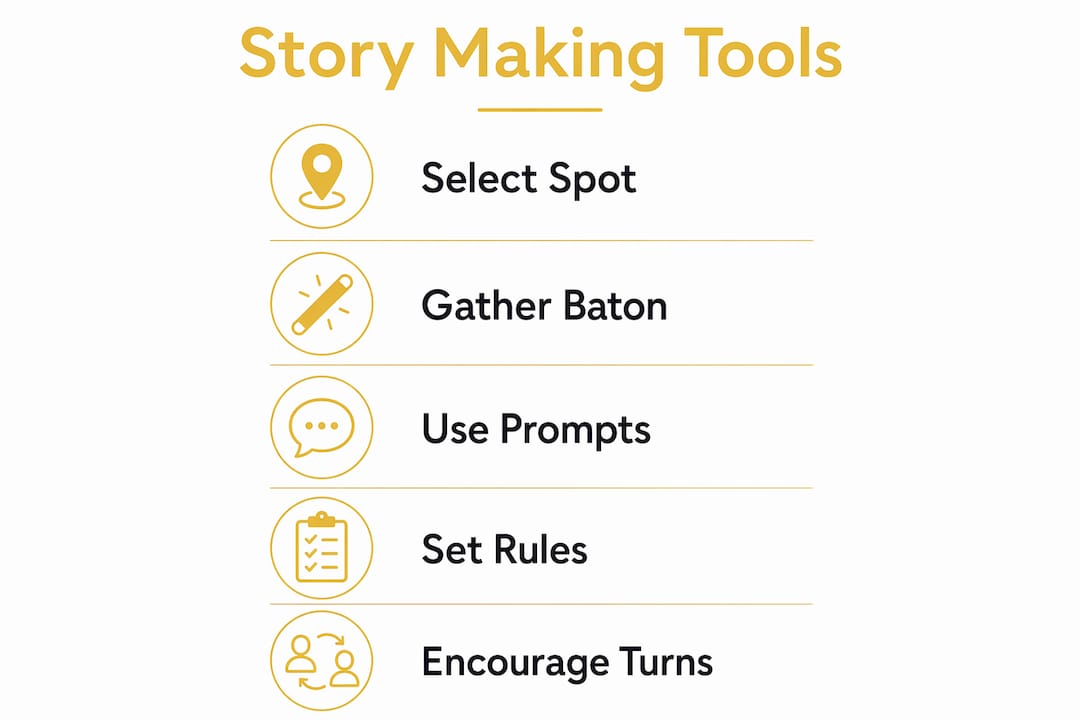
The beauty of outdoor group story making is that the kit list is almost nothing. The single most important item is a story baton: a physical object passed between children to signal whose turn it is to speak. Simple natural objects such as wooden spoons, pinecones, or smooth stones make excellent speaking sticks. That physical handover creates a clear, respectful ritual that children understand immediately.
Beyond the baton, a few optional extras can deepen the experience:
- Picture cards or story prompt cards: Draw or print simple images (a dragon, a rainstorm, a lost key) and place them face down in the centre of the circle. Children draw a card when it is their turn for an extra creative nudge.
- A drawing pad and pencils: Older children can sketch scenes or characters between turns, which helps quieter participants feel involved without the pressure of speaking immediately.
- Natural objects as props: Feathers, leaves, bark, and pebbles can become characters, treasure, or magical artefacts within the story.
- Comfortable seating: Cushions, folded blankets, or flat logs arranged in a circle work well. The circle shape is not decorative. It signals equality and keeps every child in eye contact with the group.
| Item | Purpose | Cost |
|---|---|---|
| Pinecone or stick | Story baton for turn-taking | Free |
| Picture prompt cards | Spark ideas for reluctant contributors | Low |
| Drawing pad | Visual engagement between turns | Low |
| Natural objects (leaves, stones) | Props and narrative inspiration | Free |
| Cushions or flat logs | Comfortable circle seating | Free or low |
Pro Tip: Choose a spot with natural sound cover, such as near light tree cover or a hedgerow, rather than an open field. Wind noise and distant traffic are the two biggest concentration killers in outdoor storytelling sessions.
How to run outdoor storytelling games step by step
Running a successful session is straightforward once you have a clear structure. The classic format is Pass-the-Story, and it is the best starting point for any age group.
- Gather the group in a circle. Sit at the same level as the children. This signals that you are a participant, not just a supervisor.
- Introduce the story baton. Explain that only the person holding the baton may speak. Everyone else listens.
- Set the opening line. You start with a single sentence: “One morning, a small fox discovered a door at the bottom of the garden.” Keep it open-ended so children have room to take it anywhere.
- Pass the baton clockwise. Each child adds one sentence to continue the story. No vetoing what the previous person said.
- Close the story. After one or two full rounds of the circle, the last child delivers a closing sentence. Applaud the group for the story they built together.
Sessions lasting 15–45 minutes with groups of 5–10 children hit the sweet spot for engagement without fatigue. That range gives you flexibility: a quick 15-minute warm-up before a picnic, or a longer 40-minute session as the main activity.
Once children are comfortable with Pass-the-Story, introduce variations to keep things fresh:
- Story Chain: Each child repeats the last three words of the previous sentence before adding their own. It sharpens listening and creates natural narrative flow.
- Exquisite Corpse: Each child writes or whispers their contribution without hearing the full story so far, only the final sentence. The result is a wonderfully strange, disjointed tale that children find hilarious.
- Story Card Draw: Place picture prompt cards face down. Each child draws one before speaking and must include whatever is on the card in their sentence.
Pro Tip: If a child freezes when the baton reaches them, offer a gentle “pass” option. They can say “pass” and receive the baton again at the end of the round. Most children choose to contribute the second time around once the pressure is removed.
How to manage group dynamics and encourage participation
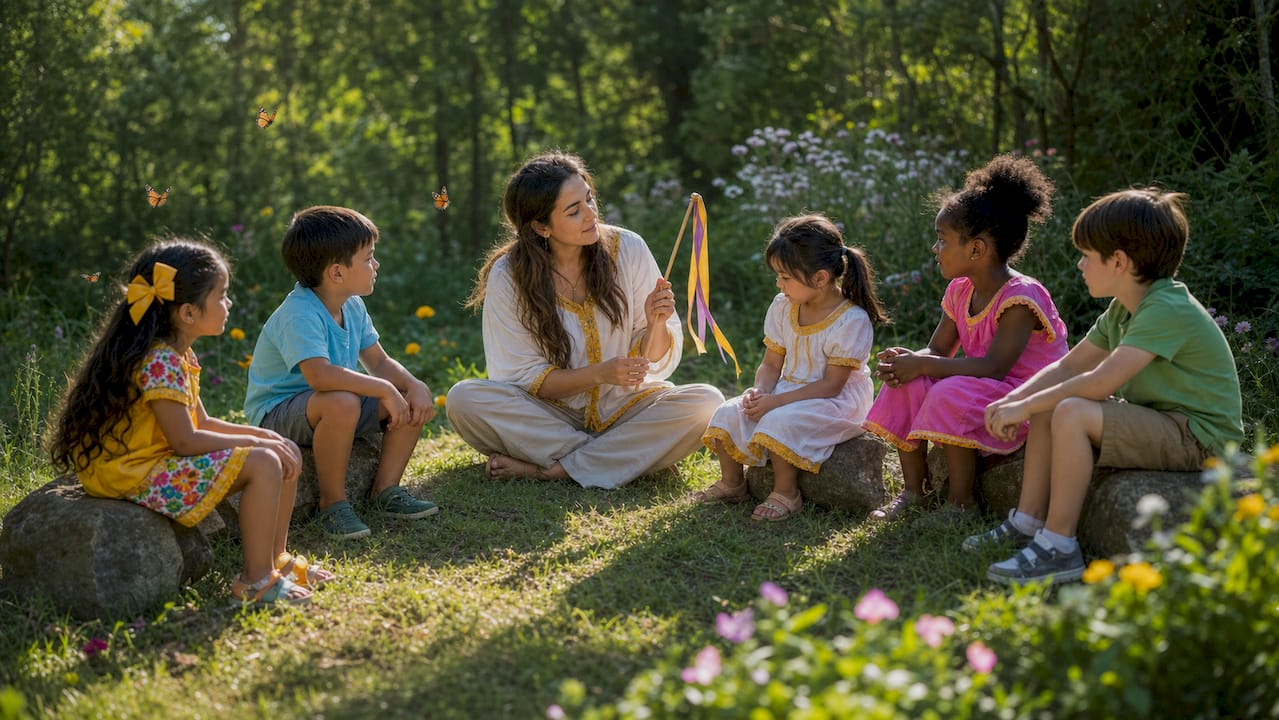
The facilitator’s role in group storytelling activities is not to direct the story. It is to protect the space. Psychological safety is the foundation of a successful session: every child must feel that their contribution will be accepted, not corrected or laughed at unkindly.
A few principles make this work in practice:
- Ban plot vetoing. No child may say “that’s wrong” or “that can’t happen.” If a child insists the fox is now a spaceship pilot, the group accepts it and builds from there.
- Use the baton strictly. The physical object is your most powerful tool for managing dominant personalities. If a child speaks without holding it, calmly hold out your hand and wait. No lecture needed.
- Invite, never demand. For quieter children, try: “What do you think happens next?” rather than “It’s your turn.” The framing matters enormously.
- Celebrate the bizarre. Nonsensical or illogical stories encourage creative risk-taking and are more valuable than tidy, logical narratives. When the group laughs at an absurd plot twist, that is the activity working exactly as intended.
“The goal is not a good story. The goal is a shared story.”
This distinction is worth repeating to children at the start of every session. It removes the fear of getting it wrong and replaces it with the pleasure of getting it weird.
Pro Tip: If one child consistently dominates, introduce a rule that each person may only speak for the length of one breath per turn. It is a playful constraint that levels the field without singling anyone out.
How does the outdoor setting shape your story?
The environment you choose for creative outdoor storytelling is not just a backdrop. It actively shapes what children imagine. Open spaces lead to adventurous tales while intimate natural spots, such as a hollow between tree roots or a sheltered garden corner, encourage quieter, more personal stories. Choosing your setting deliberately is one of the most underused tools available to you.
Encourage children to use all five senses as raw material for their narratives. Sensory observation with 8 or more descriptive words per sense category measurably enhances children’s narrative writing skills. Before the session begins, spend two minutes asking: “What can you hear? What can you smell? What does the ground feel like under your hands?” Those details will appear in the story.
Different settings produce reliably different story types:
| Setting | Story Tone | Best For |
|---|---|---|
| Open field or park | Adventurous, epic, wide-ranging | Energetic groups, older children |
| Woodland edge or tree hollow | Mysterious, magical, intimate | Quieter groups, younger children |
| Garden or back yard | Familiar, domestic, character-led | First sessions, mixed ages |
| Beside a stream or pond | Sensory-rich, nature-focused | Sensory observation exercises |
You can also use pets or wildlife as story inspiration, either as characters in the narrative or as the physical story baton itself. A dog who carries the baton between children creates instant delight and deepens engagement considerably.
Pro Tip: Arrive at your chosen spot five minutes before the children and listen. Bird calls, rustling leaves, and distant sounds become free narrative prompts. Point them out at the start: “I heard something moving in those bushes. What do you think it was?”
What are the common challenges and how do you solve them?
Even well-planned sessions hit friction. Knowing the common problems in advance means you can redirect rather than react.
- One child dominates every turn. Introduce a strict one-sentence rule and use the baton as the enforcer. Physical objects are neutral arbiters that children accept more readily than adult instruction.
- The story derails completely. This is usually fine. Let it run for one more round, then introduce a prompt card to gently steer. Avoid correcting the narrative direction directly.
- Children get distracted by the environment. Use the distraction. If a bird lands nearby, ask: “What if that bird is a messenger? What message does it bring?” Turn the interruption into a plot device.
- Younger children struggle with full sentences. Accept single words or sounds. A child who contributes “BOOM!” is participating fully. Build the sentence around their contribution as a group.
- Age gaps create imbalance. Pair younger children with older ones as storytelling partners for their turn. The older child can whisper a suggestion, and the younger child decides whether to use it.
Facilitators who focus on inclusiveness rather than story correction consistently produce more engaged groups. The measure of a successful session is not the quality of the story. It is whether every child spoke at least once.
Pro Tip: For groups with a wide age range, use fantasy writing prompts printed on small cards as equalising tools. A prompt like “a door appears in the middle of the forest” gives every age group an equal starting point.
Key takeaways
Outdoor group story making works best when the facilitator protects the space, uses a physical baton to manage turns, and values collective creativity over narrative logic.
| Point | Details |
|---|---|
| Minimal kit required | A pinecone or stick as a story baton is all you need to run a full session. |
| Session length matters | Aim for 15–45 minutes with 5–10 children for the best engagement without fatigue. |
| Protect psychological safety | Ban plot vetoing and model respectful listening to keep every child contributing. |
| Environment shapes the story | Choose open spaces for adventure tales and enclosed spots for personal, imaginative narratives. |
| Bizarre stories are the goal | Nonsensical outcomes signal creative risk-taking, which is more valuable than a tidy plot. |
Why i think we get outdoor storytelling wrong
Most parents I speak to approach group storytelling as a literacy activity. They want coherent plots, proper sentences, and a satisfying ending. That framing kills the session before it starts.
The most memorable outdoor storytelling session I have ever witnessed ended with a story about a sentient sandwich who became Prime Minister of the moon. Not a single sentence made logical sense. Every child in that circle was leaning forward, laughing, and desperate for their turn. That is the outcome you are aiming for.
The mistake is treating the story as the product. The story is the process. What you are actually building is the habit of listening to someone else’s idea and saying yes to it. That skill, practised in a field with a pinecone in hand, transfers directly into how children collaborate, argue, and create for the rest of their lives.
My one firm recommendation: do not wait for the perfect setting or the perfect group size. Start with two children and a stick in your garden this afternoon. The outdoor play ideas for preschoolers on the Thezoofamily site are a useful companion for younger groups, but the core activity needs nothing more than you, a child, and a willingness to say “and then a dragon appeared.”
Patience is the only non-negotiable skill. Some children need three or four sessions before they stop looking to you for approval and start looking to the group. That shift, when it happens, is worth every awkward pause.
— ALAIN
Bring more outdoor creativity into your family’s life
Thezoofamily was built on one idea: children connect more deeply with each other and with nature when they have the right tools and the right activities. Storytelling is one piece of that picture.
On the Thezoofamily website, you will find a full range of creative outdoor activities designed to spark imagination, encourage group play, and deepen children’s relationship with the natural world. From storytelling games to nature-based creative challenges, the resources are built for real families in real gardens and parks. Visit Thezoofamily to explore the full collection and find your next outdoor adventure together.
FAQ
What is outdoor group story making?
Outdoor group story making is a collaborative activity where children take turns building a shared narrative in a natural setting, using a physical object to manage speaking turns. It builds creativity, listening skills, and social confidence simultaneously.
How long should an outdoor storytelling session last?
Sessions of 15–45 minutes work best for groups of 5–10 children. Shorter sessions suit younger children or first-time groups; longer sessions work well once children are familiar with the format.
What can i use as a story baton?
Any natural object works well as a story baton. Pinecones, smooth stones, sticks, and wooden spoons are all effective speaking sticks that signal whose turn it is without any additional rules needed.
How do i include shy children in group storytelling?
Offer a “pass” option so no child feels forced to speak immediately. Invite contributions with open questions rather than direct prompts, and seat quieter children next to supportive peers to reduce pressure.
Does the story need to make sense?
No. Bizarre and illogical stories are a sign that children are taking creative risks, which is the most valuable outcome of collaborative storytelling. Coherent plots are a bonus, not the goal.