

Most people think mindfulness means sitting cross-legged in a quiet room with eyes closed. That picture puts off more people than it helps. Nature inspired mindfulness breaks that mould entirely. It asks you to step outside, pay attention to what is already around you, and let the natural world do a surprising amount of the heavy lifting. Research shows that brief outdoor mindfulness sessions produce statistically significant psychological benefits within just one month. This guide will show you exactly how to start, what the science says, and how to build a practice that actually fits your life.
Table of Contents
- Key takeaways
- What nature inspired mindfulness actually is
- Beginner techniques worth trying
- Outdoor vs indoor mindfulness: key differences
- Integrating nature mindfulness into daily life
- My honest take on practising mindfulness outdoors
- Explore more with Thezoofamily
- FAQ
Key takeaways
| Point | Details |
|---|---|
| Science backs it firmly | Even brief, repeated outdoor sessions improve mindfulness, mood, and nature connectedness within weeks. |
| No formal posture needed | Short moments of mindful breathing outdoors are as valid as a structured meditation session. |
| The sit spot works | Returning to the same nature spot regularly deepens your practice and sharpens ecological awareness. |
| Sensory variety is the advantage | Outdoor environments stimulate senses in gentle ways that indoor settings simply cannot replicate. |
| Consistency beats duration | Five minutes outside daily builds more lasting change than one long session per week. |
What nature inspired mindfulness actually is
Mindfulness is the practice of paying deliberate, non-judgemental attention to the present moment. Nature inspired mindfulness does this in and through the natural world, using the sounds, textures, smells, and rhythms of outdoor environments as the object of attention rather than the breath alone.
The science behind why nature works so well starts with pattern recognition. Natural fractals (repeating shapes found in ferns, clouds, and tree branches) require significantly less cognitive effort to process than the chaotic visual noise of urban environments. Your brain finds genuine pleasure in these patterns, which triggers nervous system relaxation almost automatically.
There is also the matter of what happens inside your body outdoors. Fresh air and sunlight improve brain oxygenation and raise serotonin levels, which directly improves mood. Spending time away from screens and digital noise allows the brain to replenish its attentional reserves, which is why people often report feeling more creative and clear-headed after a walk in the park.
The psychological benefits are equally well-documented:
- Lower levels of cortisol (the primary stress hormone) after time in green spaces
- Improved mood and reduced symptoms of anxiety and mild depression
- Greater sense of connection, gratitude, and meaning
- Stronger environmental awareness and protective instincts toward nature
“Ecotherapy and forest bathing practices promote slowing down, sensing, and reciprocal relationships with nature, easing mental overload and fostering behaviours that protect the natural world.” The Globe and Mail
Mindfulness in nature is not simply a relaxation technique. Over time, it reshapes your relationship with the world around you.
Beginner techniques worth trying
Starting an outdoor mindfulness practice does not require equipment, training, or a dedicated block of time. The following are some of the most accessible methods, ordered from simplest to more structured.
- Mindful sound meditation. Sit or stand outside. Close your eyes and do nothing except listen. Notice sounds that are near, then sounds that are far away. Notice sounds that repeat and sounds that surprise you. Do this for three to five minutes. That is a complete practice.
- Sensory observation. Pick one natural object: a leaf, a cloud formation, the bark of a tree. Examine it as if you have never seen anything like it before. Notice its colour, texture, shape, and any movement. This simple act of close attention is a form of nature meditation that calms the nervous system by supporting gentle detachment from reactive thought loops.
- Breath awareness outdoors. This is standard breath-focused mindfulness, but the outdoor environment changes its quality entirely. Feel the temperature of the air entering your nostrils. Notice whether it smells of rain, soil, or grass. The sensory detail anchors attention more effectively than breath alone.
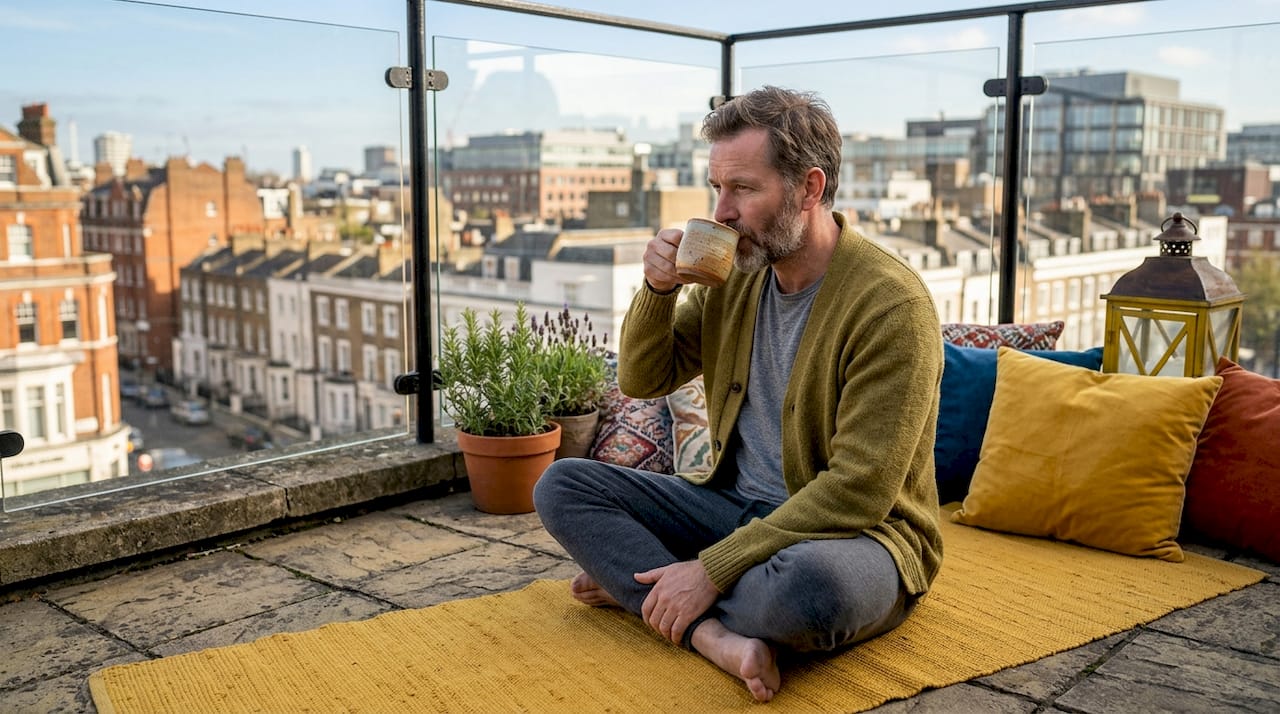
- The sit spot practice. Choose one location in a garden, park, or even a balcony. Return to it regularly, ideally several times a week. Returning to the same spot trains you to notice subtle ecological changes: a plant growing, birds shifting their routines, the quality of light changing with the season. This deepens both your mindfulness practice and your ecological literacy.
- Mindful movement. Walk slowly and pay attention to each footstep, the feeling of ground beneath you, and the rhythm of your body. This is particularly useful for people who find sitting still difficult.
Pro Tip: Removing the pressure to sit in a specific posture or meditate “correctly” makes the practice far more accessible. Even three to five minutes of mindful breathing outdoors counts. Starting small removes the biggest barrier most beginners face.
The wandering mind is not a failure of practice. It is the practice. Every time you notice your mind has drifted and bring it back to the tree, the birdsong, or the breeze, you are doing exactly what mindfulness training asks of you.
Outdoor vs indoor mindfulness: key differences
Understanding what outdoor mindfulness offers compared to indoor practice helps you make better choices rather than feeling you must choose one or the other.
| Feature | Indoor mindfulness | Outdoor mindfulness practice |
|---|---|---|
| Sensory environment | Controlled, minimal distraction | Rich, multi-sensory, naturally engaging |
| Flexibility | Easy to schedule, weather-independent | Requires planning, weather-dependent |
| Emotional depth | Calm and focused | Often evokes awe, wonder, and gratitude |
| Brain processing | Relies on deliberate effort | Supported by nature’s gentle stimuli |
| Barrier to entry | Requires quiet space and discipline | Accessible in short bursts outdoors |
| Seasonal variation | Consistent year-round | Changes with seasons, adding variety |
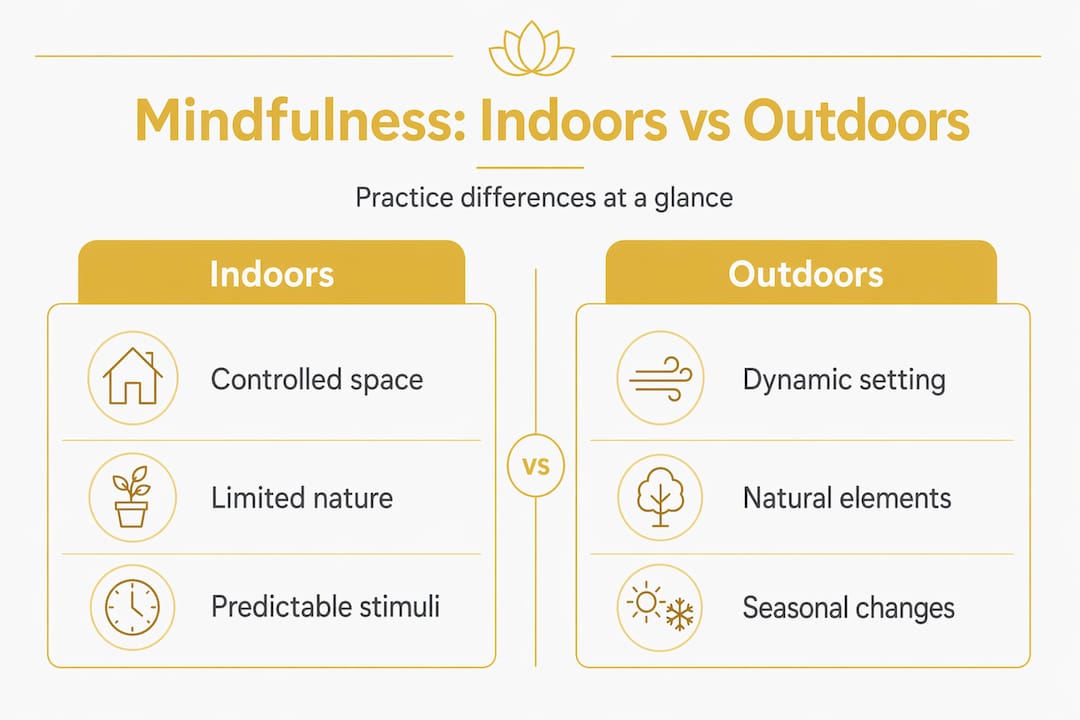
The most significant advantage of an outdoor mindfulness practice is not that it is easier. It is that the environment actively supports the mental shift you are trying to make. Indoor mindfulness asks your mind to calm itself. Nature does a portion of that work for you.
Seasonal changes are worth embracing rather than avoiding. Winter practice encourages attention to stillness and bare structure. Spring practice draws attention to emergence and growth. These seasonal textures keep the practice alive and prevent it from becoming routine in the way indoor sessions sometimes can.
One persistent misconception is that outdoor practice is less serious or rigorous than formal seated meditation. Ecotherapy research consistently links time in nature to lower anxiety, reduced depression, and improved overall wellbeing. The method is different. The outcomes are equally real.
Integrating nature mindfulness into daily life
The gap between knowing about mindfulness and actually practising it consistently is enormous. The following approach closes that gap without requiring a complete lifestyle overhaul.
Choose your location deliberately. You do not need a forest. A garden corner, a public park bench, a quiet balcony, or even a window seat facing a tree can all serve as starting points. The quality of your attention matters far more than the grandeur of the setting.
Start with a non-negotiable five minutes. Attach your outdoor mindfulness moment to something you already do: your morning coffee, the school run, or your lunch break. Habits attach more easily when they follow existing anchors. Five minutes of mindful time outdoors is genuinely sufficient for beginners to experience benefit.
Use multi-sensory awareness. Rather than focusing on a single sense, let your attention move naturally between what you see, hear, smell, and feel. The variety keeps attention engaged without effort. Notice temperature against your skin, the sound of wind, the colour shifts in a cloud.
- Pick one nature spot and return to it at least three times per week
- Keep a short journal note after each session: one thing you noticed, one thing you felt
- Let seasonal changes shift your practice rather than resisting them
- If your attention drifts to your to-do list, use a sound (a bird call, wind in leaves) to bring it back
- Practise reciprocity: leave the space as you found it, or better
Pro Tip: Eco-friendly mindfulness activities extend beyond individual practice. Picking up litter during a mindful walk, or simply choosing not to disturb nesting birds, builds the kind of reciprocal relationship with nature that deepens your sense of connection over time and makes the practice genuinely sustainable.
Building consistency is more important than building duration. A study using eight outdoor sessions over one month showed statistically significant improvements in mindfulness, positive affect, and nature connectedness. Eight sessions. One month. That is achievable for almost anyone.
My honest take on practising mindfulness outdoors
When I first tried to meditate outdoors, I found it genuinely harder than I expected. Inside, I could control the variables. Outside, a dog barking or a phone ringing three gardens away felt like constant interruption. It took me a few weeks to realise that those interruptions were not obstacles. They were the practice.
What shifted things for me was adopting a sit spot. I picked a particular bench in a local park and returned to it every few days for a month. By week three, I noticed things I had never seen before: a robin that always sang from the same branch, the way the light changed through the trees at different times. My mind started to arrive at that bench already softer, already more open. The location had become a kind of anchor.
What I’ve learned is that the biggest mistake people make is waiting until they have enough time or the right conditions. Nature-based stress relief does not require ideal conditions. It requires showing up. Even standing by an open window and noticing the quality of the light counts. The practice belongs to you. The nature is already there.
Reconnecting with the natural world through mindfulness has a way of changing how you see your own life. You start to notice cycles, rhythms, and impermanence in a way that makes your own problems feel more proportionate. That is not a small thing.
— ALAIN
Explore more with Thezoofamily

If this article has sparked an interest in deepening your relationship with the natural world, Thezoofamily has been building a community around exactly that. With tools designed to bring children and families closer to nature, from kids’ binoculars to cameras that plant a tree with every purchase, the brand’s blog is full of practical ideas for outdoor connection. Explore parent-child bonding activities that weave creativity and nature together, or discover how animal play builds nature love in children from an early age. Whether you are building a mindfulness practice for yourself or looking to share the experience with your family, visit Thezoofamily to find your next step outdoors.
FAQ
What is nature inspired mindfulness?
Nature inspired mindfulness is the practice of bringing deliberate, non-judgemental attention to the present moment using natural environments as the focus. It uses sensory experiences like sounds, textures, and natural patterns to anchor attention and reduce mental stress.
How long do outdoor mindfulness sessions need to be?
Sessions as brief as three to five minutes can be effective, particularly for beginners. Research shows that brief outdoor sessions repeated consistently over several weeks produce measurable psychological benefits.
Can I practise nature mindfulness without a garden or green space?
Yes. A balcony, an open window, a park bench, or even a single potted plant outdoors can serve as the foundation for practice. The quality of your attention matters more than the scale of the natural setting.
What is a sit spot and why does it work?
A sit spot is a fixed outdoor location you return to repeatedly for mindfulness practice. Returning regularly trains your brain to enter a mindful state more easily and deepens your awareness of subtle natural changes over time.
Is outdoor mindfulness better than indoor meditation?
Neither is universally better. Outdoor mindfulness practice provides richer sensory engagement and is supported by nature’s calming patterns, while indoor meditation offers more control and consistency. Many people find the two approaches complement each other well.