

Most people assume that documenting nature changes requires years of scientific training or professional equipment. That assumption stops a lot of genuinely curious people from starting. The reality is that some of the most valuable environmental records in existence were made by amateurs with notebooks, basic cameras, and a habit of showing up to the same spot more than once. Whether you are tracking wildlife behaviour across seasons or watching a hedgerow change year by year, your observations matter. This guide covers the methods, tools, and photographic techniques that make documenting nature changes both accessible and genuinely rewarding.
Table of Contents
- Key takeaways
- What counts as documenting nature changes
- Methods and tools for recording what you find
- Photography techniques that strengthen your records
- Organising your observations for long-term comparison
- Real-world examples of citizen observations making a difference
- My honest take on documenting nature changes
- Start your own nature documentation practice
- FAQ
Key takeaways
| Point | Details |
|---|---|
| Start with repeat visits | Returning to the same location across seasons builds a picture of change that a single visit never can. |
| Metadata transforms casual photos | Adding location, date, and conditions to every image or journal entry turns personal records into usable data. |
| Combine analogue and digital | Pairing a written nature journal with an app like iNaturalist gives you richer, more comparable records over time. |
| Consistent camera angles matter | Repeating the same viewpoint and composition allows genuine comparison between photographs taken months or years apart. |
| Citizen science multiplies impact | Sharing your documented observations with platforms like Nature’s Notebook contributes to real climate and biodiversity research. |
What counts as documenting nature changes
Before you can record changes, you need to know what to look for. Nature changes operate across very different timescales, and most of them are visible to anyone paying attention.
Phenological changes are the ones you notice first. These are the seasonal events: buds breaking in March, the first cuckoo call, swallows arriving, leaves turning. Phenology is essentially the calendar of nature, and it is shifting. Flowers blooming earlier, migrations arriving out of sync, and insects appearing before their food sources are all signals of the impact of climate change on flora and fauna alike.
Then there are gradual structural changes. A woodland thickening, a pond silting up, a scrub edge advancing across a meadow. These happen slowly enough that you only notice them if you have records from years past. That is precisely why your observations now are so valuable to your future self, and to science.
Acute events are the third category. A storm that flattens a section of woodland, a flash flood that reshapes a riverbank, a severe drought that kills off a stand of reeds. These are dramatic, but their long-term effects on changes in ecosystems only become clear when compared against baseline records taken before the event.
- Seasonal/phenological: First flowering, leaf fall, bird arrivals, insect emergence, amphibian breeding
- Gradual structural: Vegetation encroachment, water level shifts, soil erosion, tree canopy changes
- Acute/event-driven: Storm damage, flooding, fire, drought kill-off, habitat clearance
The single most useful habit you can build is recording basic metadata every time. Location (as precise as a grid reference or GPS pin), date and time, weather conditions, and your name. Precise location and timestamp are what separate a casual observation from a scientifically usable one.
Pro Tip: When choosing a spot for repeat visits, pick something with a fixed physical reference. A gate post, a particular tree, a fence corner. This makes it far easier to return to the exact same position season after season.
Methods and tools for recording what you find
The good news is that you do not need to choose between old-fashioned journaling and modern digital tools. They complement each other in ways that most beginners overlook.
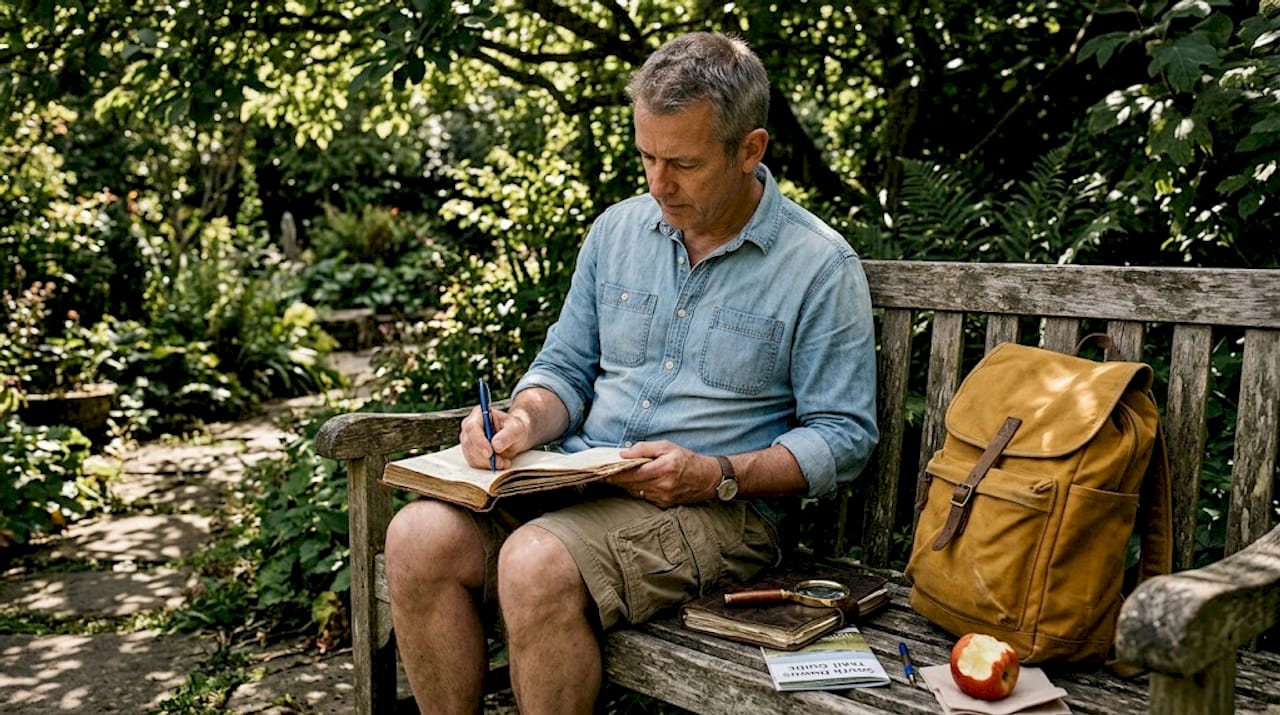
Keeping a nature journal is the foundation. A nature journal does not need to be elaborate. The Natural History Museum recommends recording four things at minimum: what you observed, where you were, when it happened, and who was present. Add sketches or photos, note the behaviour you witnessed, and you already have a record that will be legible and useful years from now. Journaling prompts for phenology and behaviour prevent memory lapses and build genuine observational discipline over time.
The real power comes from structuring your notes around measurable phenology events rather than loose descriptions. Rather than writing “the oak looked like it was budding,” write “first bud break observed on lower south-facing branches.” Those specifics are what allow comparison across years and between sites.
Digital tools open up a second layer of documentation.
- iNaturalist is the most widely used platform for amateur naturalists. With location services enabled, it tracks changing growing patterns and species behaviour across time and geography. Every observation you upload contributes to a global dataset used by researchers.
- Nature’s Notebook specialises in phenology. It supports repeat observation sites where you return to the same individual plants or animals to record their seasonal milestones, building a long-term personal dataset that feeds into climate research.
- Merlin Bird ID and similar apps help with species identification on the spot, reducing errors in your records.
- Google Maps or OS Maps allow you to pin your observation sites precisely, which makes relocating them months later straightforward.
Standardised monitoring methods prevent observations from becoming incomparable over time. The Great Bay National Estuarine Research Reserve developed protocols that combine vegetation surveys and upland forest assessments precisely because inconsistent recording makes data unreliable. You do not need their level of rigour, but the principle applies. Decide on your method and stick to it.
Pro Tip: Set a recurring calendar reminder at the start of each season to revisit your key sites. Consistency matters far more than the quality of any individual visit.
Photography techniques that strengthen your records
Photography is where many nature enthusiasts feel most confident. But there is a difference between a beautiful nature photograph and one that actually documents change. The two are not mutually exclusive, but they require slightly different thinking.
Camera geometry continuity is the most underrated concept in amateur nature documentation. Repeating your viewpoint and angle allows you to make genuine comparisons between photographs taken months or years apart. If your composition shifts from visit to visit, you cannot tell whether the vegetation has changed or you are simply standing in a different spot. Find a fixed physical marker and photograph from the same point every time.
| Approach | Good for documentation | Good for art |
|---|---|---|
| Fixed viewpoint, consistent framing | Yes | Sometimes |
| Wide establishing shot + close-up detail | Yes | Yes |
| Spontaneous composition | Rarely | Often |
| Date stamp and location metadata included | Yes | Rarely considered |
| Behaviour notes alongside the image | Yes | Rarely considered |
For wildlife, the Northern Moose Alliance recommends photographing the whole animal from one side with a visible date stamp. This approach reveals coat condition, body weight, and health changes across seasons in a way that artistic compositions simply cannot.
For plants, always shoot the whole organism first, then move in for close-ups of flowers, fruit, seed heads, or leaves. These are the features that indicate phenological stage, and they are what researchers actually need.
A few additional principles to keep in mind:
- Use a wide reference shot that includes landmarks, then a detailed shot of the subject
- Photograph in consistent lighting conditions where possible (same time of day, similar weather)
- Adopt ethical photography practices to avoid disturbing nesting birds, fragile habitats, or easily trampled plants
- Record behavioural context alongside the image. A photograph of a fox is more useful if you note whether it was foraging, resting, or fleeing
For sharper images of moving wildlife, professional action photography tips can help you work with faster shutter speeds and better burst modes without frightening your subject.
Organising your observations for long-term comparison
Gathering records is only half the work. The other half is keeping them in a form you can actually use later.
A simple folder structure on your computer can take you surprisingly far. Organise by location first, then by year and month within each location. Label every image file with date and species before importing. This sounds tedious the first time and becomes automatic after a month.
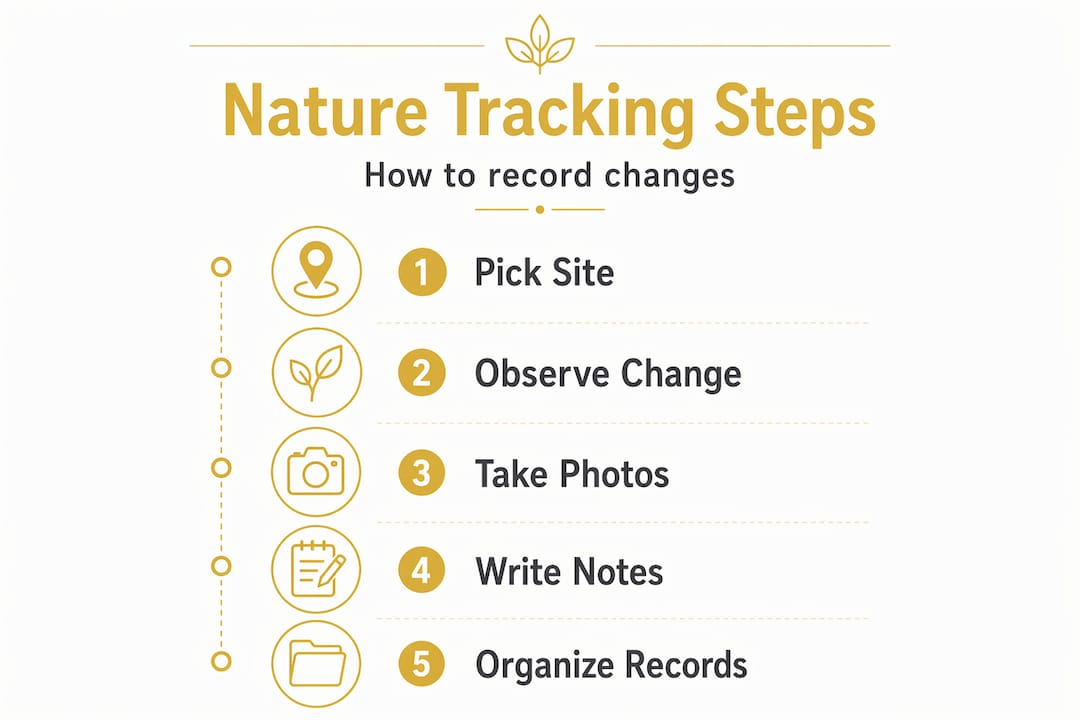
Focusing your active monitoring season between May and October reduces the seasonal variability in your data and makes year-to-year comparisons much cleaner. Great Bay NERR collects hundreds of data points within this window for exactly that reason. You do not need to stop observing outside those months, but treating it as your core comparison period adds rigour.
Pro Tip: At the end of each season, spend thirty minutes reviewing your records from the same period in previous years. Patterns you would never notice visit-by-visit become obvious when you look across three or four years at once.
For those keen on organising nature photos with both creative and conservation value in mind, building a consistent tagging system means your archive works for art projects and science contributions simultaneously.
Regular review sessions also reveal anomalies: a species appearing two weeks earlier than usual, a plant failing to flower at its normal time, a bird absent from a site it has used for years. These are the signals that matter most for reporting biodiversity shifts and for understanding how your local ecosystem is responding to broader change.
Real-world examples of citizen observations making a difference
Amateur documentation has contributed to real science far more than most people realise.
The Appalachian Mountain Club’s iNaturalist project is one of the clearest examples. Thousands of trail users contribute photos with geo-tags and timestamps, building a dataset that researchers use to track phenological shifts across entire mountain ranges. Individual observations that might seem trivial in isolation become statistically meaningful when aggregated.
“Every photograph with a date and location is a data point. Enough data points become a trend. Trends are what science runs on.”
Coastal habitat monitoring tells a similar story. US tidal wetlands experienced a net loss of 1,640 km² between 1985 and 2023, driven by sea level rise and extreme weather events. Much of that loss was detected and quantified by combining satellite data with ground-level observations contributed by people visiting those sites regularly. Documenting habitat loss at the local level, even informally, feeds into the larger picture.
The Northern Moose Alliance’s citizen science programme shows how consistent photographic protocols translate directly into wildlife health data. Contributors follow a standardised photo format showing the full animal in profile with a date stamp, and the resulting archive lets researchers track coat condition and body score across populations over multiple years.
Nature journals, meanwhile, have a longer history than any of these digital platforms. Victorian naturalists whose notebooks survive have given modern researchers baseline data on species distributions and flowering times that would be impossible to reconstruct any other way.
My honest take on documenting nature changes
I will say plainly: the biggest mistake I made when I started was treating each visit as a standalone event. I would go out, take photographs I was proud of, and move on. It took a couple of years before I understood that the value was in the comparison, not the image itself.
Once I started returning to the same sites and keeping records in a consistent format, everything changed. I spotted a marsh that was visibly contracting year by year. I noticed a particular hedgerow oak leafing out ten days earlier in 2023 than in 2019. Those observations came not from special equipment but from showing up repeatedly and writing things down.
The tension between artistic photography and documentation photography is real. Sometimes the most scientifically useful shot is also the least interesting one visually. My current approach is to take both: one standardised reference image and one composition I actually enjoy. That way the record is complete and the experience remains satisfying.
Contributing to citizen science has also surprised me. What I expected to be a solitary habit turned out to connect me to a community of people paying close attention to the same things. That connection is worth something beyond the data.
— ALAIN
Start your own nature documentation practice
If this guide has made documenting nature feel more accessible, Thezoofamily has more to help you along the way. The blog covers everything from beginner ecological photography to building observation habits that last across seasons. Whether you are just starting out or looking to sharpen a practice you already have, the resources at Thezoofamily are built for people who want to engage with nature meaningfully, not just observe it from a distance. Every camera sold also plants a tree, so your purchase directly supports the natural world you are working to understand and protect.
FAQ
What is the easiest way to start documenting nature changes?
Choose one local site, visit it at the same time each month, and record what you see with a photo and a few written notes. Consistency over a single season already generates usable comparative data.
Which apps are best for monitoring environmental changes as an amateur?
iNaturalist and Nature’s Notebook are the two most widely used platforms. iNaturalist is better for species diversity records, while Nature’s Notebook specialises in tracking phenology events at specific sites over time.
How does photography help with tracking wildlife behaviour?
Consistent photographs from the same angle and with date stamps allow you to compare animal condition, behaviour, and population presence across seasons. The Northern Moose Alliance uses this approach to track moose health across entire regions.
Do I need professional equipment to document changes in ecosystems?
No. A smartphone with GPS enabled and a simple notebook are sufficient for producing scientifically useful records. What matters most is consistency in method, location, and timing, not the quality of the equipment.
Can amateur records really contribute to reporting biodiversity shifts?
Yes. Platforms like iNaturalist aggregate millions of amateur observations into datasets used in peer-reviewed research. Observations with precise location and timestamp data are directly usable by scientists studying phenology, habitat loss, and species distribution changes.