

TL;DR:
- Active use of technology enhances children’s imagination and environmental awareness more than passive watching.
- Digital storytelling and eco-art projects improve creativity and foster eco-values in children.
- Parents should evaluate children’s tech tools using the 5Es Framework and encourage hands-on, creative activities.
Children who use technology actively, creating stop-motion films or coding nature stories, consistently show stronger imagination and environmental awareness than those who simply watch videos. Many parents across Europe worry that any screen time is harmful, but constructive tech use actually boosts learning outcomes, whilst passive use shows neutral or negative effects. The difference lies not in the device, but in what a child does with it. This guide will help you separate myths from evidence, so you can choose tools that genuinely support your child’s growth as a creative, eco-minded thinker.
Table of Contents
- What is kids tech? Understanding the basics
- How technology is fostering creativity and environmental awareness
- The best tools: Apps, platforms and physical tech for home and school
- Making tech work: Practical strategies for parents
- Why children should be creators, not just consumers
- Get inspired and start your child’s creative tech journey
- Frequently asked questions
Key Takeaways
| Point | Details |
|---|---|
| Active tech supports growth | Children gain most from engaging with technology for creation, not just consumption. |
| Blend apps and hands-on | Real-world and digital experiences together inspire creativity and environmental care. |
| Choose tools with purpose | Select apps and devices that are proven to boost eco-awareness and creative skills. |
| Parental guidance is vital | Parents play a crucial role in guiding tech’s positive impact at home. |
What is kids tech? Understanding the basics
Kids tech refers to technology explicitly designed for learning and creative engagement by children. It is not simply a tablet loaded with cartoons. It includes coding kits, interactive robots, digital art platforms, and eco-themed apps built around active participation. The key distinction is between active and passive use, and it matters enormously.
Passive use means a child watches, listens, or scrolls without creating anything. Active use means a child builds, codes, photographs, or tells a story. Research confirms that active tech engagement lifts learning outcomes, whilst passive consumption does not. This single insight should reshape how every parent thinks about screen time.
Common examples of genuinely active kids tech include:
- STEM apps that ask children to solve real problems, such as building a bridge or growing a virtual garden
- Interactive robots like Cubetto, which teach logic without a screen at all
- Digital art platforms that let children animate drawings or compose music
- Eco-themed storytelling tools that connect nature with narrative
A widespread misconception is that all screen time is harmful. The evidence does not support this. What matters is the quality and structure of the experience.
“The most valuable tech experiences are those where children are the authors, not the audience. When a child codes a character or edits a film, they are exercising the same cognitive muscles as a writer or engineer.”
Blending digital and physical experiences is equally important. A child who photographs a beetle in the garden and then researches it on an app is doing something richer than either activity alone. The physical world feeds the digital project, and the digital tool deepens the physical encounter. This blend is the foundation of truly educational kids tech.
How technology is fostering creativity and environmental awareness
With a clearer understanding of what kids tech is, let’s explore how it’s driving creativity and eco-values across Europe.
One of the most compelling examples comes from Split, Croatia, where teachers ran digital storytelling and eco-art courses that wove technology, creativity, and environmental themes together in a single programme. Students created stop-motion videos using recycled materials, produced digital nature journals, and built collaborative stories about local ecosystems. The results were striking.
| Outcome measured | Before the programme | After the programme |
|---|---|---|
| Imaginative writing scores | Below average | Significantly improved |
| Positive attitudes to technology | Mixed | Strongly positive |
| Environmental awareness | Low engagement | Active interest |
These are not abstract gains. Children who spent time making films about plastic pollution became vocal advocates at home. Students who animated stories about endangered birds started noticing wildlife on their walk to school. The technology did not replace nature; it made nature more visible and more urgent.
Why do environmental themes work so well in children’s digital projects? Because they give the work meaning. A child coding a game about deforestation has a reason to research the topic, a reason to care about accuracy, and a reason to share the result. Purpose drives creativity far more effectively than open-ended prompts.
Practical activities that blend tech with eco-awareness include:
- Stop-motion animation using leaves, stones, and recycled card
- Digital photography walks focused on nature and creativity projects
- Narrated slideshows about a local habitat
- Eco-photography for kids using a simple camera to document seasonal change
When children see their own work displayed, shared, or celebrated, their motivation to keep creating grows. That momentum is one of the most valuable things a parent or teacher can nurture.
The best tools: Apps, platforms and physical tech for home and school
Seeing the impact in schools, families may ask what tools work best at home. Here’s how to choose and use them.
Not every app marketed to children deserves a place on your device. A useful way to evaluate any tool is the 5Es Framework, which checks for efficacy (does it work?), effectiveness (does it fit your child?), ethics (is it safe?), equity (is it accessible?), and environment (does it support real-world learning?). Run any candidate tool through these five questions before downloading.
Here is a comparison of some well-regarded options:
| Tool | Type | Best for | Eco or STEM focus |
|---|---|---|---|
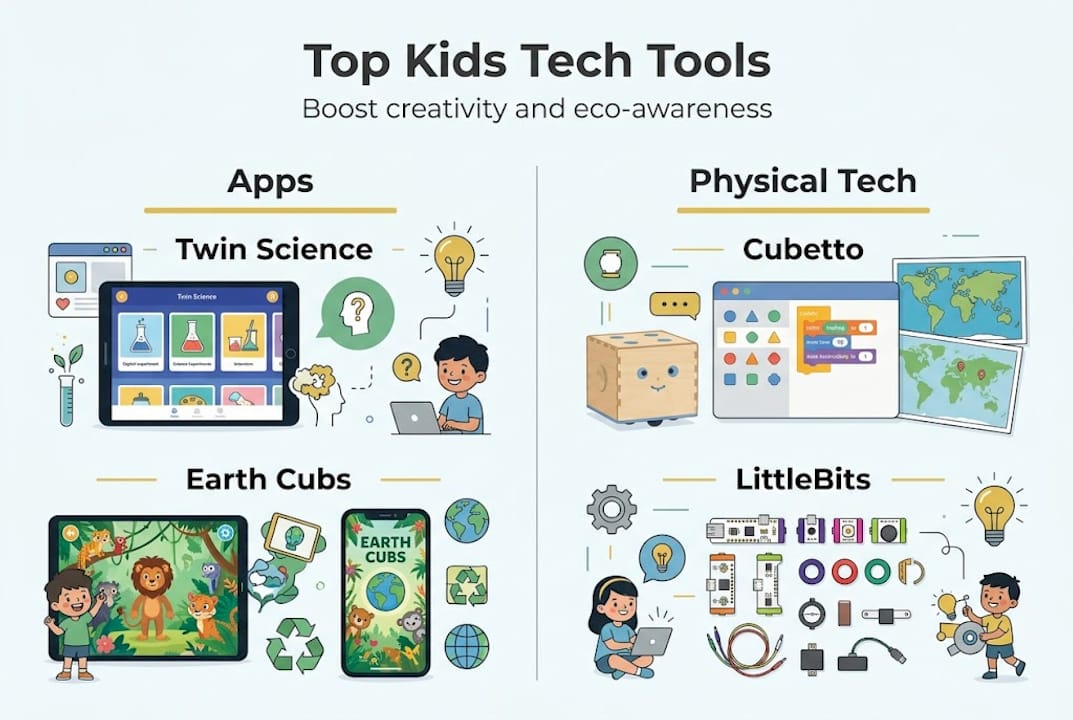
| Twin Science | App | Ages 5 to 12 | STEM, SDG climate projects |
| Earth Cubs | App | Ages 4 to 8 | Nature, environmental awareness |
| OctoStudio | App | Ages 6 to 12 | Creative coding, storytelling |
| Cubetto | Physical robot | Ages 3 to 6 | Screen-free coding logic |
| Poly-Universe | Physical kit | Ages 5 to 10 | Maths, spatial creativity |
Twin Science and Earth Cubs are particularly strong choices. Twin Science includes AI-generated progress reports and links projects to the UN Sustainable Development Goals, including climate action. Earth Cubs holds a 4.3 out of 5 rating and focuses specifically on nature-based learning for younger children.
Pro Tip: Before handing over a device, spend ten minutes exploring the app yourself. Check whether the child is asked to create something or simply to watch and tap. Creation is the signal that the tool is worth your time.
A numbered approach to evaluating apps at home:
- Open the app and complete the first activity yourself
- Ask: did I make something, or did I consume something?
- Check reviews from other parents, not just the overall star rating
- Look for a parental dashboard or usage controls
- Pair the app with a hands-on extension, such as creative recycled art activities, to ground the digital learning in the physical world
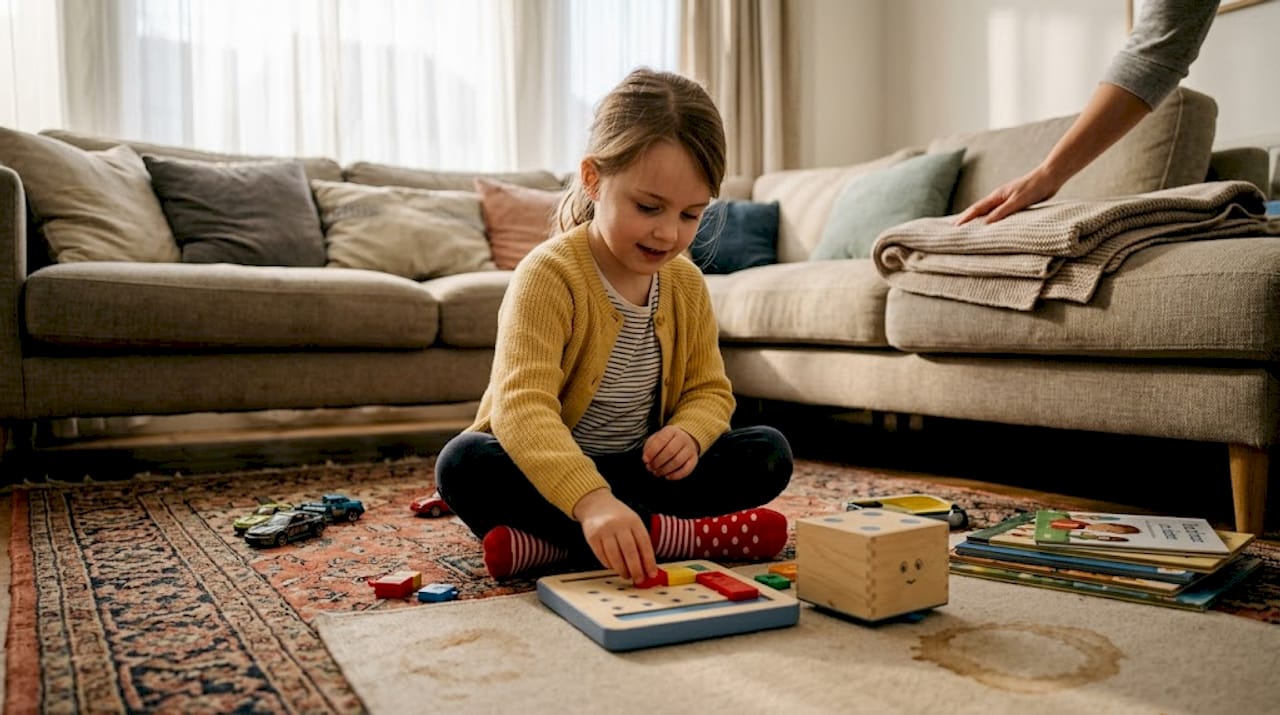
Physical tools like Cubetto are worth considering for younger children who are not yet ready for screens. The robot responds to coloured blocks arranged by the child, teaching sequencing and logic through touch and play. No screen required, no passive consumption possible.
Making tech work: Practical strategies for parents
Armed with recommendations, it’s crucial for parents to implement these tools wisely and proactively.
Parental involvement is the single most important factor in whether educational tech actually extends learning or simply fills time. Children whose parents engage with their digital projects, ask questions, and connect the work to real life show measurably better outcomes than those left to explore alone.
Here are practical strategies to make tech genuinely work in your home:
- Set a creative goal before starting. Instead of “you can use the tablet for thirty minutes,” try “let’s make a short film about the tree in the garden.”
- Sit alongside your child for the first session with any new app. Your curiosity signals that the activity is worth taking seriously.
- Use the 5Es Framework to review tools every few months. Children’s needs change, and a tool that worked at age five may not challenge a seven-year-old.
- Extend every digital project into the physical world. A nature photography session should end with a printed photo pinned to the wall, not just saved on a device.
- Celebrate the output, not the screen time. Frame the conversation around what was made, not how long the device was used.
Pro Tip: Plan one Earth Day activity each month, not just in April. Regular, small eco-projects build habits far more effectively than one big annual event.
For families who want to go further, combining digital tools with eco-friendly art ideas creates a powerful loop. A child photographs autumn leaves, edits the images on a simple app, then uses the physical leaves to make a collage. Each step reinforces the others, and the environmental theme runs through all of them.
Screen time concerns are real, but the goal is not to minimise time on devices. The goal is to maximise the quality of what happens during that time.
Why children should be creators, not just consumers
Here is something worth saying plainly: the most common mistake parents make is assuming that creativity only happens offline. Drawing, building with blocks, playing in mud — yes, these are irreplaceable. But the idea that digital tools are inherently passive is simply wrong, and clinging to it means missing a genuine opportunity.
The most powerful tech experiences we have seen are those that amplify real-world exploration rather than replace it. A child who uses collage art with recycled materials and then animates their creation digitally is doing something neither activity could achieve alone. The making, the coding, the building, and the caring for the environment are not separate pursuits. They are one continuous act of growing up.
Research from National Geographic Education confirms that guardians prefer children to be producers rather than consumers, and that digital tools work best when they complement nature experiences and hands-on making. We share that view completely. At The Zoofamily, we believe the child who photographs a dragonfly, edits the image, and shares it with a friend has done something genuinely meaningful. Technology was the bridge, not the destination.
True growth comes from blending making, coding, building, and caring for the planet. Give children tools that let them do all four.
Get inspired and start your child’s creative tech journey
With this perspective in mind, there’s no better time to empower your child with meaningful tech experiences.
The Zoofamily is built around exactly this idea: that children grow best when technology, nature, and creativity work together. We create cameras, binoculars, and walkie-talkies designed to spark curiosity about the natural world, and for every camera sold, we plant one tree.
Beyond our products, our blog is full of project inspiration, from recycled art ideas to guided nature walks and eco-themed storytelling activities. Whether your child is four or twelve, you will find ideas that blend hands-on making with genuine environmental purpose. Adventure starts with the right guidance, and we are here to help you find it.
Frequently asked questions
How much screen time is safe for young children using educational tech?
Moderate, supervised screen time focused on active creation is safe and beneficial. The key is balancing digital activity with offline exploration, as constructive tech use supports learning whilst passive use does not.
Can technology really boost creativity and environmental awareness?
Yes. Eco-art and digital storytelling courses in Croatia showed measurable improvements in children’s imagination, writing, and attitudes towards the environment.
What if my child prefers hands-on activities to apps?
Many tools blend both worlds beautifully. Robotics kits like Cubetto require no screen at all, and active tech engagement works best when paired with physical making, such as eco-art using recycled materials.
How do I choose safe, effective apps for my child?
Apply the 5Es Framework to any app: check efficacy, effectiveness, ethics, equity, and environmental value. Also look for parental controls, strong user reviews, and a clear creative output for the child.
Recommended
- 8 Creative Recycled Art Projects for Kids’ Fun – The Zoofamily
- News – The Zoofamily
- Toy Camera Digital: Inspiring Eco-Friendly Creativity – The Zoofamily
- Touchscreen Digital Camera: Inspiring Eco-Friendly Creativity – The Zoofamily
- HEVEA Swim Fins | Eco-Friendly Kids’ Swim Fins in Natural Rubber – Hevea Australia