

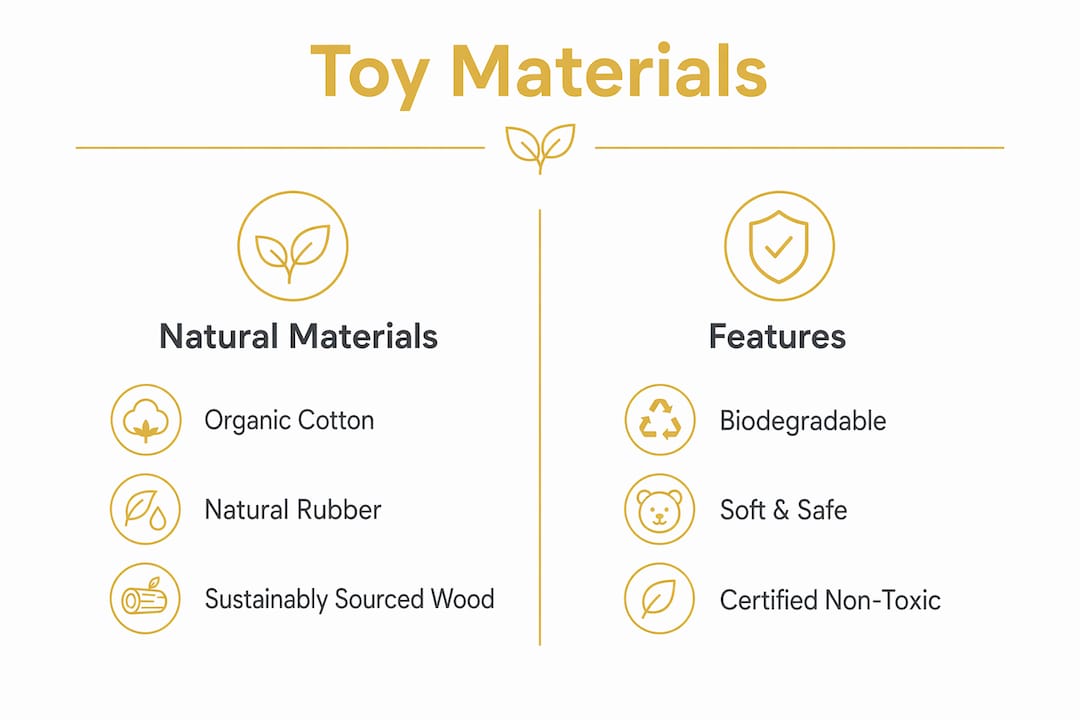
Eco friendly newborn toys are products made from natural, non-toxic, sustainable materials that protect both your baby and the environment from day one. They avoid plastics and harmful chemicals, relying instead on organic cotton, natural rubber, and sustainably harvested wood. Brands like Oli&Carol, HEVEA, Viverano, and Babipur lead this category with products that meet current safety standards, including the updated EN 71-1:2026 regulation. For new parents, choosing the right green baby playthings means understanding what materials actually matter, which certifications to trust, and how to tell genuine sustainability from marketing noise.
What materials are used in eco friendly newborn toys?
Natural rubber is the most widely used material in eco friendly newborn toys. Brands like Oli&Carol and HEVEA source it from rubber trees, making it soft, flexible, and fully biodegradable. The Oli&Carol Evolutive Rattle is made from 100% natural rubber with recycled cherry seed filling and FSC-approved packaging, recommended from birth. That combination of biodegradable material and certified packaging makes it one of the most complete eco choices on the market.
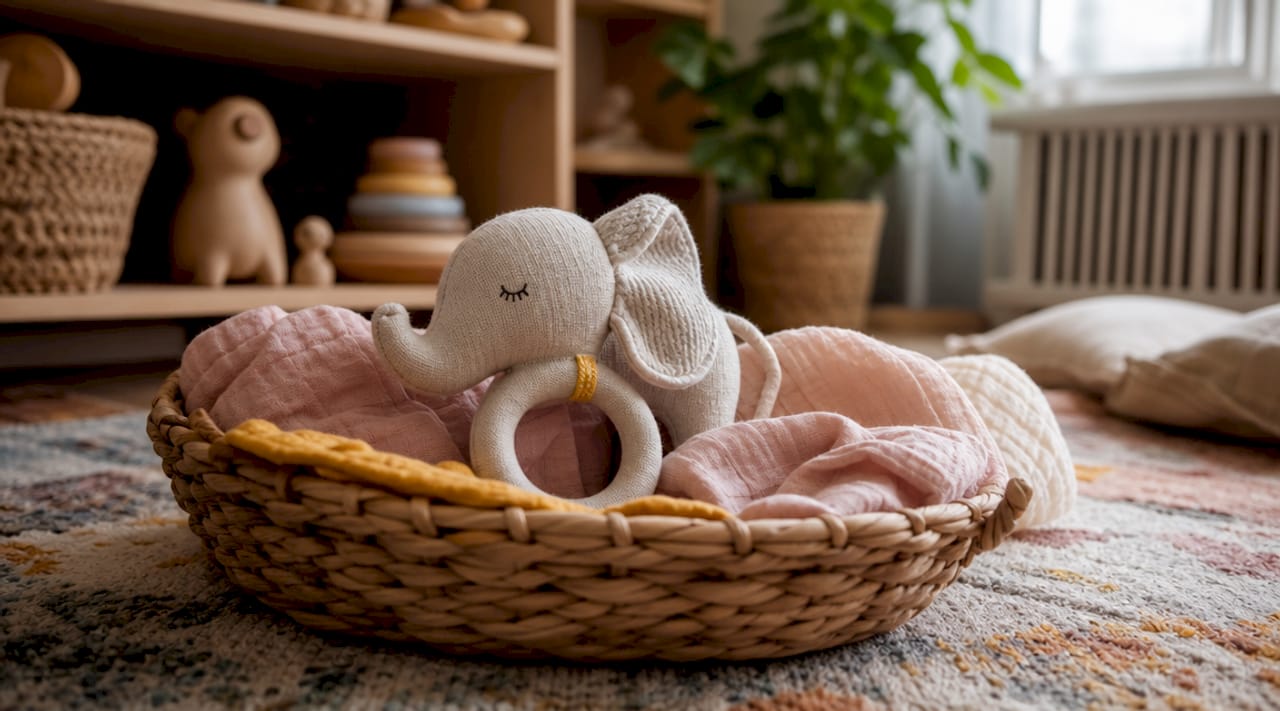
Organic cotton is the second major material in sustainable baby toys. Viverano’s elephant rattle is handcrafted from organic cotton, GOTS certified, and ethically manufactured, which means the farming, processing, and labour conditions all meet strict environmental and social standards. GOTS certification is the gold standard for organic textiles. It covers the entire supply chain, not just the raw fibre.
Sustainably sourced wood rounds out the trio of core materials. Babipur’s Nanchen Flower Fairy Ring Grasper uses organic cotton, wool, and maple wood, all Bioland certified and plastic-free. Sustainably harvested wood is durable, naturally textured, and free from the off-gassing that synthetic materials can produce.
| Material | Pros | Cons | Sustainability factor |
|---|---|---|---|
| Natural rubber | Soft, flexible, biodegradable | Can cause latex sensitivity in rare cases | High: renewable, compostable |
| Organic cotton | Breathable, gentle, washable | Less durable than wood or rubber | High: GOTS certified farming |
| Sustainably sourced wood | Durable, natural texture | Harder surface for very young newborns | High: FSC or Bioland certified |
Pro Tip: Check for FSC certification on packaging as well as the toy itself. FSC-certified packaging is a measurable sign that a brand’s sustainability commitment extends beyond the product.
How do eco friendly newborn toys meet safety standards?
Safety and sustainability are not the same thing, and the best non-toxic newborn items deliver both. The EN 71-1:2026 standard, published in January 2026, updates the EU’s requirements for mechanical and physical toy hazards, including revisions for ride-on and food-imitating toys. This matters for eco toy buyers because natural rubber teethers and wooden graspers must meet these updated physical safety criteria, not just claim to be plastic-free.
EU toy safety assessment covers chemical, physical, and mechanical hazards under a combined regulatory framework that includes REACH chemical exposure limits. That scope is broader than many parents realise. A toy can be made from organic cotton and still fail compliance if its construction poses a physical hazard to a newborn.
Hygienic design is where eco toys genuinely outperform conventional plastic alternatives. The HEVEA Fish Teether is made from 100% natural rubber in a seamless, one-piece design with no holes or crevices where bacteria and mould can accumulate. It uses FDA-approved natural colour pigments and meets EN 71, REACH, and US/UK safety standards. A one-piece design also means the toy lasts longer before hygiene concerns prompt replacement, which is itself a sustainability benefit.
Here is a practical checklist for parents buying safe, eco-friendly toys for newborns:
- Confirm EN 71-1:2026 compliance or equivalent national standard on the product listing.
- Look for REACH certification to verify chemical safety, including absence of BPA and heavy metals.
- Choose one-piece designs without seams, holes, or crevices that trap moisture.
- Verify material certifications: GOTS for textiles, FSC for wood and packaging, Bioland for organic farming.
- Check that pigments and dyes are food-safe or FDA-approved, especially for teethers.
- Avoid toys with small detachable parts, regardless of how natural the materials are.
Pro Tip: Marketing phrases like “no plastic or silicone” tell you what a toy avoids, not whether it passes updated EN 71 requirements. Always check for an explicit compliance statement from the manufacturer.
Why choose eco friendly toys over conventional options?
The environmental case for biodegradable baby products is straightforward. Conventional plastic toys are petroleum-based, non-biodegradable, and often manufactured with chemical additives that persist in landfill for centuries. Natural rubber, organic cotton, and certified wood decompose without leaving toxic residue. Oli&Carol explicitly minimises carbon footprint across production and packaging, making the full product lifecycle measurably cleaner than a standard plastic rattle.
The health case is equally direct. Newborns mouth everything they touch, which means chemical exposure from toys is not theoretical. Non-toxic newborn items made without BPA, phthalates, or synthetic dyes reduce the risk of chemical ingestion during the months when babies are most orally exploratory. Natural textures also provide richer sensory stimulation than smooth plastic, supporting tactile development in the first weeks of life.
The benefits break down across three areas:
- For your baby: Natural textures stimulate touch and grip development; absence of synthetic chemicals reduces allergy and toxin risk; softer materials are gentler on sensitive gums.
- For the planet: Biodegradable materials reduce landfill waste; sustainable sourcing protects forests and farming ecosystems; FSC and GOTS certified supply chains support ethical labour practices.
- For you as a parent: Certified eco toys carry verified safety credentials; longer-lasting natural materials reduce the frequency of replacement; transparent sourcing builds genuine trust in the product.
One underappreciated point: a toy that lasts longer because it is well-made from durable natural materials is more sustainable than a cheap eco-branded toy that needs replacing after two months. Durability is part of the environmental equation.
How to choose the best eco friendly toys for newborns
The most reliable starting point is verified safety compliance. A toy can carry every organic certification available and still pose a physical risk if it has not been tested to current standards. Cross-reference the brand’s compliance claims with the specific standard cited, particularly EN 71-1:2026 for EU-sold products.
Consider your newborn’s developmental stage honestly. In the first three months, babies cannot grasp intentionally, so the toy’s primary function is visual and tactile stimulation during tummy time or when held by a carer. Lightweight rattles and soft graspers suit this stage better than wooden rings, which become more appropriate from around three months when grip develops. Matching the toy to the developmental window also means you buy fewer items overall, which is itself a sustainable choice.
Ease of cleaning is non-negotiable for newborn toys. One-piece designs without hidden crevices, like the HEVEA Fish Teether, are far easier to sanitise than multi-part toys with fabric inserts. For eco friendly bath toys and teethers especially, seamless construction prevents the mould build-up that makes parents discard toys prematurely.
- Prioritise toys with explicit safety compliance statements, not just material claims.
- Choose one-piece or minimal-seam designs for hygiene and longevity.
- Look for GOTS, FSC, and Bioland certifications as independent verification of sustainability claims.
- Select age-appropriate weights and textures: soft and lightweight for 0 to 3 months, firmer and graspable from 3 months.
- Consider packaging: FSC-certified boxes and plastic-free wrapping signal a brand’s full commitment to sustainability.
Pro Tip: Source locally where possible. A GOTS-certified toy manufactured and shipped from within Europe carries a lower transport footprint than an equivalent product shipped from overseas, even if both carry identical material certifications. For more on selecting eco toys, the principles apply across all age groups.
Comparing popular brands in the eco newborn toy market
The four brands most consistently cited by parents and retailers in this category are Oli&Carol, Viverano, Babipur, and HEVEA. Each takes a distinct approach to materials and design.
Oli&Carol’s Evolutive Rattle stands out for its complete lifecycle approach. The toy is 100% natural rubber with a recycled cherry seed filling, biodegradable, plastic-free, and packaged in FSC-certified boxes. It is designed for newborns from 0 months and doubles as both a rattle and a teether as the baby develops. The recycled filling is a detail most competitors have not matched.
Viverano’s organic cotton rattle is the softest option in this group. The knitted organic cotton shell is GOTS certified, the manufacturing facility meets ethical labour standards, and the toy is designed specifically for the sensory needs of very young infants. It is the right choice for parents whose primary concern is chemical exposure rather than teething.
Babipur’s Nanchen Flower Fairy Ring Grasper combines organic cotton velour, organic wool stuffing, and sustainably sourced maple wood in a single 17cm toy designed from birth. The Bioland certification covers both the textiles and the farming practices behind them. The wooden ring element makes it more stimulating as grip develops.
HEVEA’s Fish Teether is the most hygiene-focused product in this comparison. Its seamless, one-piece natural rubber construction with FDA-approved pigments makes it the easiest to clean and the least likely to harbour bacteria.
| Brand and product | Material | Certification | Recommended age | Key feature |
|---|---|---|---|---|
| Oli&Carol Evolutive Rattle | Natural rubber, recycled cherry seed | FSC packaging | 0+ months | Biodegradable, rattle and teether |
| Viverano Elephant Rattle | Organic cotton | GOTS | 0+ months | Softest option, ethical manufacture |
| Babipur Nanchen Grasper | Organic cotton, wool, maple wood | Bioland | From birth | Multi-material sensory design |
| HEVEA Fish Teether | Natural rubber | EN 71, REACH, FDA pigments | 0+ months | Hygienic one-piece design |
Key takeaways
Eco friendly newborn toys deliver genuine safety and sustainability only when they combine certified natural materials with verified compliance to current standards like EN 71-1:2026.
| Point | Details |
|---|---|
| Material certification matters | Look for GOTS, FSC, and Bioland labels as independent proof of sustainability claims. |
| Safety compliance is separate | EN 71-1:2026 and REACH cover physical and chemical hazards beyond material choice alone. |
| Hygienic design extends toy life | One-piece, seamless designs prevent mould and reduce the need for early replacement. |
| Match toy to developmental stage | Lightweight soft toys suit 0 to 3 months; graspable designs become relevant from 3 months. |
| Packaging counts too | FSC-certified packaging is a measurable indicator of a brand’s full sustainability commitment. |
Why I think parents are asking the wrong first question
Most parents start by asking “is this toy eco friendly?” when the more useful question is “is this toy safe and eco friendly, and can I prove both?” I have seen beautifully packaged natural rubber toys that carried no EN 71 compliance statement whatsoever. The organic branding was impeccable. The safety documentation was absent.
The brands that get this right, HEVEA, Oli&Carol, Viverano, and Babipur among them, treat safety certification and sustainability certification as equally non-negotiable. Neither replaces the other. A toy made from certified organic cotton that has not been tested for mechanical hazards is not a safe toy for a newborn. A toy that passes EN 71 but is made from virgin plastic is not a sustainable toy. Both boxes need ticking.
My other observation is about texture. Parents sometimes gravitate towards the softest, most minimal toy because it feels safest. But newborns benefit enormously from varied tactile input. The combination of wood, wool, and cotton in the Babipur Nanchen Grasper, or the firm-yet-yielding quality of natural rubber in the HEVEA teether, provides sensory contrast that a single-material toy cannot. Developmental appropriateness is part of what makes a toy genuinely good, not just genuinely green.
Do not let marketing language do your due diligence for you. Read the compliance statements. Check the certifications. Then enjoy the fact that the best options in this category are also genuinely beautiful objects.
— ALAIN
Explore Thezoofamily’s range of sustainable newborn toys
At Thezoofamily, sustainability is not a selling point. It is the reason the brand exists. Every product is designed to connect children with the natural world, and for every camera sold, Thezoofamily plants one tree.
The range includes carefully selected non-toxic newborn items made from natural materials, with eco-friendly packaging and verified safety credentials. Whether you are looking for a first teether, a sensory grasper, or a soft rattle that will last through the early months, the collection is built around the same principles covered in this article: real materials, real certifications, and real care for the planet your child will grow up in. Explore the full range and find toys that earn their eco credentials.
FAQ
What makes a newborn toy eco friendly?
Eco friendly newborn toys are made from natural, non-toxic materials such as organic cotton, natural rubber, or sustainably sourced wood, and avoid plastics, BPA, and synthetic chemicals. Certifications like GOTS, FSC, and Bioland provide independent verification of these claims.
Are eco friendly newborn toys safe for mouthing?
Yes, provided they meet current safety standards. The HEVEA Fish Teether, for example, is compostable and BPA-free and uses FDA-approved natural pigments, meeting EN 71, REACH, and US/UK safety standards. Always check for explicit compliance statements before purchase.
What certifications should I look for on sustainable baby toys?
Look for GOTS for organic textiles, FSC for wood and packaging, Bioland for organic farming, and EN 71-1:2026 compliance for mechanical and physical safety. REACH certification confirms the toy meets EU chemical safety limits.
How do I clean eco friendly newborn toys safely?
Choose one-piece designs without holes or crevices, as seamless construction prevents bacteria and mould build-up. Natural rubber toys can be rinsed with warm water and mild soap; organic cotton toys are generally machine washable on a gentle cycle.
At what age can newborns use eco friendly toys?
Many eco friendly toys, including the Oli&Carol Evolutive Rattle and the HEVEA Fish Teether, are designed from 0 months. In the first three months, lightweight soft toys for visual and tactile stimulation are most appropriate, with graspable designs becoming suitable from around three months.