

Earth Day is an annual global observance held on April 22 to raise awareness of environmental protection and encourage action on issues from deforestation to climate policy. This earth day article covers where it began, why it still matters, and how you and your children can mark it, from simple household swaps to full family outings.
TL;DR:
- Most impactful actions prioritize reducing energy use, shifting to plant-based diets, and choosing active transport over recycling or consumer habits.
- Focus your efforts on measurable goals like decreasing household energy consumption, planting native species, or engaging with policymakers for maximum effect.
- Simple outdoor activities for children, such as scavenger hunts or building bug hotels, foster curiosity and build lasting environmental awareness.
- Earth Day’s global variations allow regions to tailor activities around local environmental issues, making the observance relevant worldwide despite a shared date.
- The day serves as a platform for environmental education and policy announcements, with breakthroughs like the Paris Agreement opening for signature on Earth Day.
Table of Contents
- What is Earth Day? Origins of a global movement
- Why Earth Day matters today: the numbers behind the awareness
- How to celebrate Earth Day: actions that actually add up
- High-impact actions versus easy wins: how to prioritise your effort
- Celebrating Earth Day with children: ideas that stick
- How Earth Day looks different around the world
- Environmental education and policy advocacy: what Earth Day actually changes
- A personal take on why one day still matters
- Where these facts came from
- Sources
- FAQ
What is Earth Day? Origins of a global movement
Earth Day started as a response to a decade of visible environmental damage. Oil spills, smog and industrial pollution had pushed the issue into public view by the late 1960s, but there was no coordinated national response in the United States. Senator Gaylord Nelson wanted to change that, and with organiser Denis Hayes, he built a national teach-in that became the first Earth Day on 22 April 1970, according to Earthday. Millions of Americans took part, across schools, streets and parks, making it one of the largest single-day demonstrations in the country’s history.
The scale of that first event pushed environmental policy into the mainstream. The Environmental Protection Agency traces its own roots to the momentum Earth Day helped generate, and the years that followed saw a wave of legislation addressing air and water quality in the United States.
A few milestones mark how the day grew from a national protest into a worldwide fixture:
- 1970: First Earth Day, US-only, with large nationwide participation
- 1990: Earth Day goes global, mobilising countries worldwide
- 2000: Focus shifts to clean energy and global warming
- 2016: The Paris Agreement was opened for signature on Earth Day
- 2026: The theme “Our Power, Our Planet” links environmental action to civic power, per EarthDay.org
Why Earth Day matters today: the numbers behind the awareness
The stakes have not shrunk since 1970. They have grown, and the figures behind them are stark.
The scale of the problem: the planet loses about 10 million hectares of forest every year, and roughly one million animal and plant species are currently threatened with extinction, according to the United Nations.
Numbers like that can feel abstract until you connect them to what Earth Day actually does: it turns a distant statistic into a shared, visible moment. Millions of people acting, posting, planting and campaigning on the same day creates political pressure that a scattered, year-round effort rarely manages. That pressure has a track record. It fed directly into the creation of the EPA and a run of environmental legislation in the early 1970s, and the 2026 theme, “Our Power, Our Planet”, explicitly frames environmental protection alongside social equity and civic participation.
What this means for you is simple: individual choices genuinely compound at scale. Consider what mass participation actually delivers:
- Amplified public pressure that has historically shaped legislation
- Global visibility for local and indigenous conservation efforts
- A single, memorable date that makes environmental awareness articles and school lessons far easier to plan around
A single day will not reverse a million-species extinction crisis. But it is the mechanism by which awareness turns into policy, funding and habit change, and that mechanism has worked before.
How to celebrate Earth Day: actions that actually add up
You do not need to overhaul your life on 22 April. You need a plan that fits your household, and Earth Day gives you the excuse to start one.
1. Cut everyday waste before you recycle it. Reducing consumption, buying less, and repairing what you already own generally delivers more benefit than recycling alone, based on guidance from the University of West Florida. Try a plant-rich dinner, air-dry your laundry, or fix a broken appliance instead of replacing it.
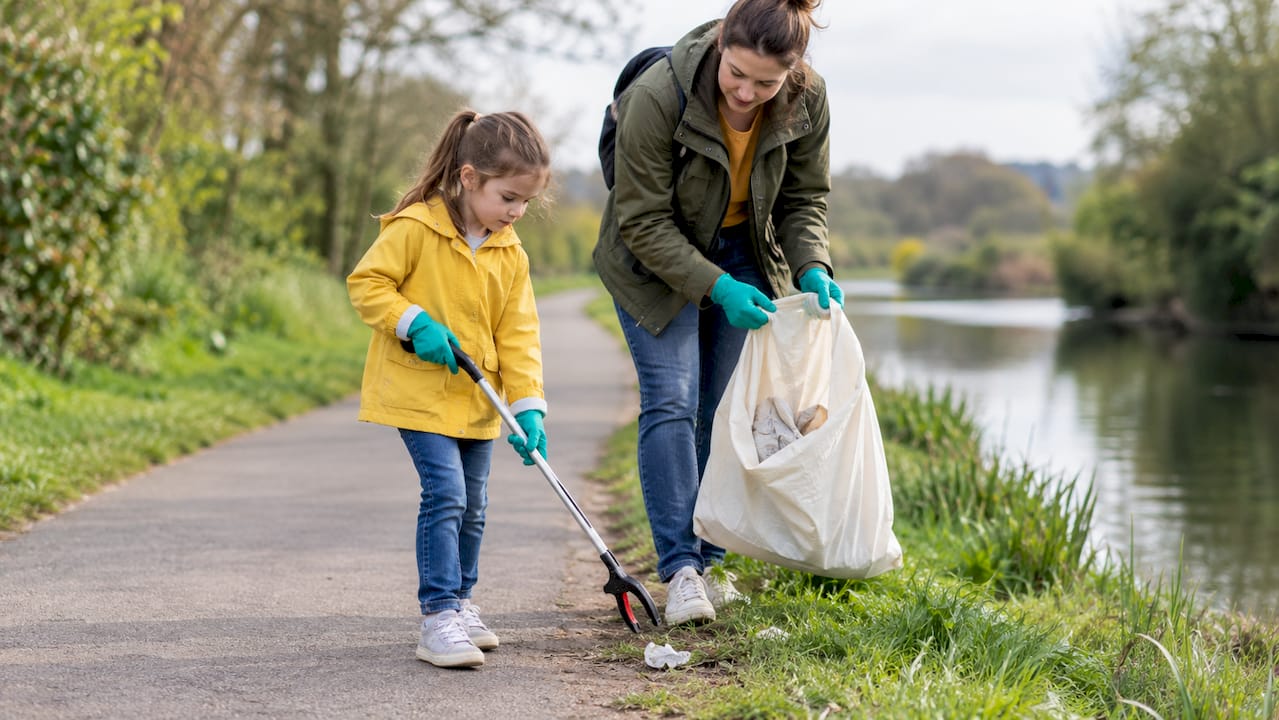
2. Join or organise a local litter pick. Council-backed clean-up days are common around Earth Day, and they take an hour, not a weekend.
3. Plant something that stays in the ground. A tree, a native shrub, or a pollinator-friendly border all count, and most give back for decades.
4. Volunteer with a conservation group. Wetland restoration, river surveys and habitat monitoring projects often need extra hands specifically around Earth Day.
5. Contact a policymaker. A short letter or email to a local representative about a specific environmental issue takes ten minutes and adds a constituent voice to the record.
6. Share one credible resource. Passing on a single article or dataset to someone who has not seen it does more than a vague social post.
7. Take the kids outside. Run an eco-themed scavenger hunt, hand them a camera for a nature photography challenge, or build a simple bug hotel from garden offcuts. If you want a gentle push on the household cleaning side of things, sustainable cleaning swaps are an easy place to start, and a wildlife-friendly garden project gives children a reason to keep watching what happens outside long after the day itself.
Pro Tip: Pick one action from this list and repeat it weekly for a month. A single habit practised consistently beats ten good intentions tried once.
High-impact actions versus easy wins: how to prioritise your effort
Not every eco-friendly practice carries equal weight, and pretending otherwise leads to burnout, not progress. The clearest framework is straightforward: reduce first, reuse second, recycle last, following the hierarchy outlined by researchers at the University of West Florida. Recycling feels productive, but cutting consumption in the first place avoids the environmental cost of manufacturing entirely.
If you want to focus your limited time and energy, aim it here first:
- Energy use at home: switching off standby devices, insulating draughty rooms, and shifting to efficient appliances
- Transport choices: walking, cycling or combining car journeys where public transport is not practical
- Diet: shifting toward more plant-based meals, which tends to reduce a household’s footprint faster than most product swaps
Easier wins, meanwhile, build the habit that sustains the bigger changes: carrying a reusable bottle, batch-cooking to cut food waste, or setting a monthly “no new purchases” challenge. Set one measurable goal, such as one plant-based dinner a week for a month, rather than a vague resolution to “live greener.” Specific and trackable beats broad and abandoned.
Celebrating Earth Day with children: ideas that stick
Children remember what they do outdoors more than what they are told indoors. A short list of activities that consistently work across age groups:
- A nature photography challenge: five things that are green, five things that fly, five textures they can touch
- A backyard scavenger hunt using a printable checklist, adaptable for toddlers through to older kids
- Building a simple bug hotel from stacked twigs, bark and hollow stems
- Growing a pot of native flowers on a windowsill or balcony and tracking what visits it
A pair of binoculars or a simple kids’ camera turns a walk into an observation exercise, and that shift from “looking” to “noticing” is where genuine curiosity about nature tends to start. At Thezoofamily, that idea sits behind every product line, and for each camera sold, Thezoofamily plants one tree, connecting a birthday gift directly to habitat restoration.
Pro Tip: Let your child lead the scavenger hunt. Adults spot the obvious things; children spot the strange ones, and that is usually the more interesting list. For more structured ideas, see this guide to celebrating Earth Day with kids or these nature scavenger hunt templates.
How Earth Day looks different around the world
Earth Day is not a single, uniform event. It bends to whatever environmental pressure is most visible in each country. In the United States, the fixed date of 22 April holds, but according to National Geographic Education, some regions and countries anchor their observance to the spring equinox instead, treating it as a moment tied to natural cycles rather than a calendar date drawn from a specific national event.
In countries facing acute deforestation, Earth Day activities often centre on tree-planting drives and forest protection campaigns. Coastal nations with rising sea levels or heavy plastic pollution tend to focus events on beach clean-ups and ocean advocacy. Cities with severe air quality problems run car-free days and public transport pushes. India, for instance, has used Earth Day to spotlight air pollution and renewable energy targets, while Pacific island nations frame it around sea-level rise and coral reef loss, issues that barely register in landlocked, temperate countries.
This local flexibility is arguably why Earth Day has lasted more than five decades without going stale. A single global theme, like 2026’s “Our Power, Our Planet,” gives every country a shared banner, but local organisers fill it with whatever crisis is most pressing on their doorstep. A school in flood-prone Bangladesh and one in drought-affected California can both mark the same day with entirely different lesson plans, and both are doing Earth Day correctly.
Environmental education and policy advocacy: what Earth Day actually changes
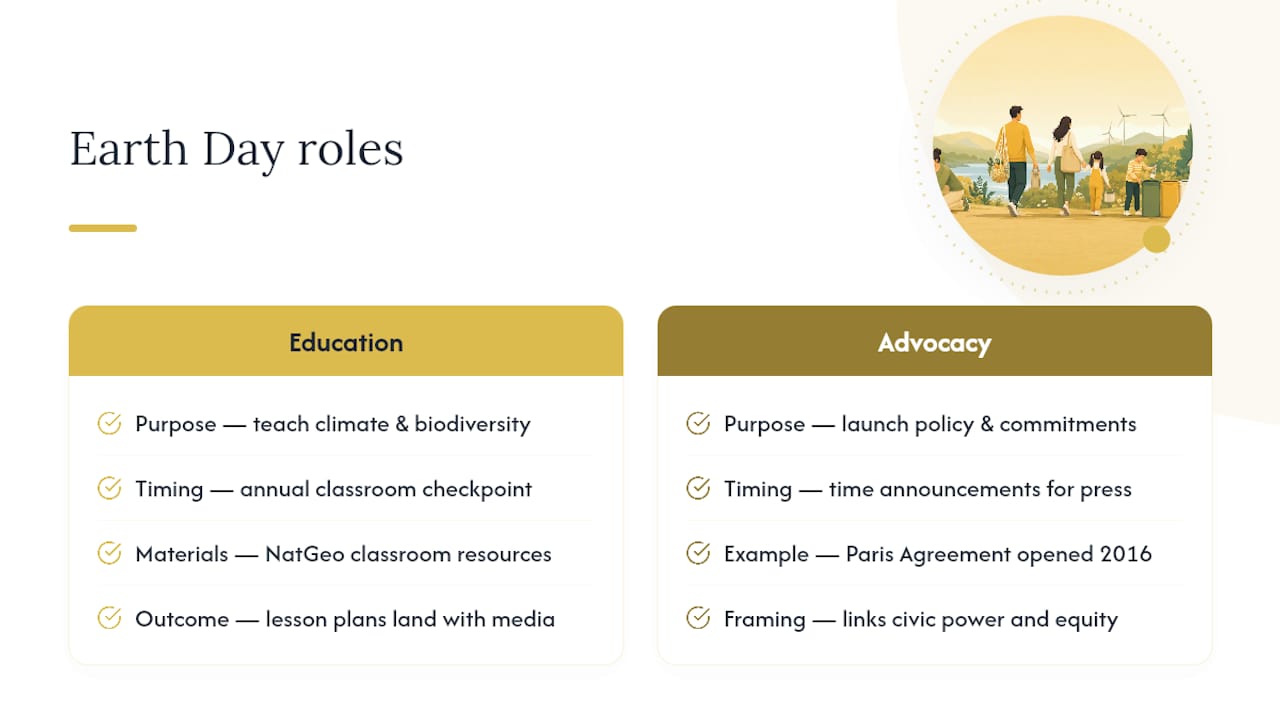
Earth Day functions as an annual checkpoint for environmental education, not just a one-off event. Schools use it to introduce climate science, biodiversity loss and conservation to students who might not otherwise encounter the topic in a structured way, and National Geographic Education publishes classroom-ready material specifically timed to the date each year. That annual rhythm matters more than it sounds: teachers can build a lesson plan they know will land on a day with built-in relevance and media coverage, rather than trying to create interest from nothing.
On the advocacy side, Earth Day has repeatedly served as a launch date for policy. The Paris Agreement opened for signature on Earth Day in 2016, a deliberate choice that tied a landmark climate treaty to a date already loaded with public meaning. National governments and city councils frequently time environmental announcements, funding commitments or new regulations to coincide with the day, betting on the extra press attention it guarantees.
The 2026 theme, “Our Power, Our Planet,” pushes this further by explicitly linking environmental protection with civic participation and social equity, rather than treating them as separate causes. That framing matters for advocacy groups because it widens who feels invited to the conversation. Environmental policy has historically been framed as a scientific or regulatory issue; folding in civic power reframes it as something ordinary voters and communities can directly shape, not just something governments do to them.
A personal take on why one day still matters
I think the sceptics have a point when they say one day changes nothing on its own. Where they are wrong is assuming that is the goal. Earth Day was never meant to fix the planet in 24 hours. It was meant to create a recurring, unmissable prompt, and prompts work.
If you take one thing from this piece, let it be this: pick a single habit and keep it past 22 April. A weekly plant-based dinner, a repair instead of a replacement, ten minutes teaching your child to notice birdsong. Small and repeated beats grand and abandoned, every time. If you want a starting point built around your kids, our family activity guides are a reasonable place to look.
— ALAIN
Where these facts came from
This article draws on primary sources, including the United Nations’ Earth Day page, EarthDay.org’s history archive, the US EPA’s Earth Day overview, and National Geographic Education’s Earth Day resources. Each is a direct source for the statistics and historical claims made above.
Sources
FAQ
What is the theme for Earth Day 2026?
The 2026 theme is “Our Power, Our Planet,” which links environmental protection to civic participation and social equity, according to EarthDay.org. It builds on a recent trend of framing environmental action alongside broader community power rather than treating them as separate issues.
What are five things you can do for Earth Day?
Reduce waste before recycling, join a local litter pick, plant something native, contact a policymaker about a specific issue, and take children outside for a nature scavenger hunt or photography challenge. Prioritising reduction over recycling tends to deliver the biggest impact for the least effort, per the University of West Florida.
What are five facts about Earth Day?
Earth Day began on 22 April 1970, organised by Senator Gaylord Nelson and coordinated by Denis Hayes, according to EarthDay.org. It helped spur the creation of the US EPA, went global in 1990 with worldwide mobilisation, hosted the opening signature of the Paris Agreement in 2016, and is marked on 22 April in most countries, though some align observances to the spring equinox instead, per National Geographic Education.
Can you summarise Earth Day in a few lines?
Earth Day is a global observance held every 22 April to raise awareness of environmental issues and encourage protective action. It began in 1970 in the United States and has since grown into a worldwide event marked by clean-ups, tree planting, education and policy campaigns, with the planet currently losing around 10 million hectares of forest annually and roughly one million species threatened with extinction.
Is Earth Day always on 22 April?
In most countries, yes, Earth Day falls on 22 April every year. Some regions instead observe it around the spring equinox, treating the day as tied to a natural seasonal marker rather than the fixed calendar date used in the United States, according to National Geographic Education.