

TL;DR:
- Creative eco journaling enhances children’s observation skills and environmental awareness.
- It is an accessible, low-cost activity suitable for all ages and weather conditions.
- The process fosters family connections, creativity, and long-term pro-environmental attitudes.
Getting children genuinely excited about the natural world is harder than it sounds. Many parents feel the pull between screen time battles and meaningful outdoor experiences, searching for activities that are creative, low-cost, and actually stick. Creative eco journaling fosters children’s connection to nature and environmental awareness in ways that feel playful rather than educational. It blends drawing, writing, and simple science observation into something any family can do, whether you have a sprawling garden or a single windowsill. This guide walks you through everything you need to know to start, sustain, and genuinely love the habit.
Table of Contents
- What is creative eco journaling and why does it matter?
- What you need: materials, setup, and getting the family on board
- How to start: step-by-step guide for creative eco journaling
- Tips, troubleshooting, and making eco journaling a family habit
- Why creative eco journaling is more powerful than you think
- Connect your family to nature with The Zoofamily
- Frequently asked questions
Key Takeaways
| Point | Details |
|---|---|
| Easy start for all ages | Even young children can join in eco journaling with simple adaptations like stickers or scrapbooking. |
| Blends creativity and science | Mixing drawing, storytelling, and observation boosts learning and fosters a deeper connection to nature. |
| Boosts eco awareness | Consistent journaling builds pro-environmental attitudes and can enrich family bonds. |
| Flexible for every family | Eco journaling works in any location, in any weather, fitting into busy schedules and diverse settings. |
What is creative eco journaling and why does it matter?
Creative eco journaling is the practice of recording nature observations through a mix of creative and scientific approaches. Think pressed leaves alongside hand-drawn beetles, poetry about the first frost, or a scrapbook page dedicated to the sounds heard during a woodland walk. It is not a school project. It is a living record of your family’s relationship with the natural world.
The approach works for children as young as three, scaling beautifully as they grow. A toddler might stick a feather to a page and scribble around it. A ten-year-old might sketch a robin and note its behaviour across several weeks. Both are equally valid, and both build something lasting.
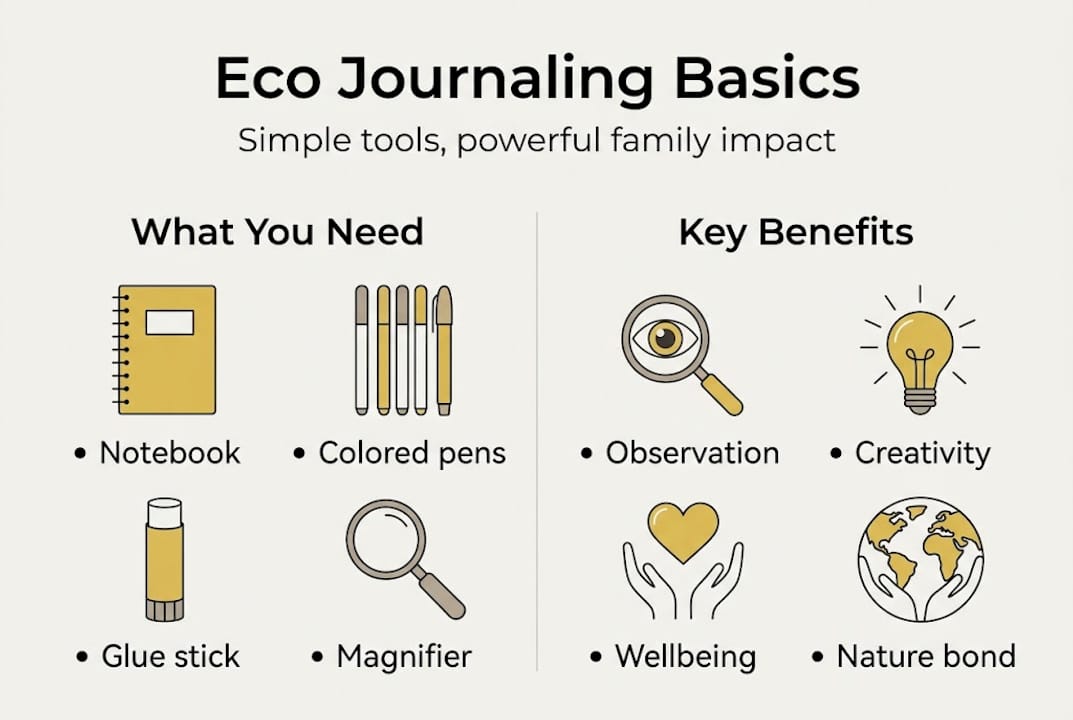
The evidence is compelling. Nature journaling boosts observation skills, wellbeing, and pro-environmental attitudes in children, according to research from Penn State University. These are not small gains. Families who journal together report stronger emotional connections to local ecosystems, and children show measurable improvements in developing observation skills that carry into science learning at school.
Here is a quick comparison to help frame what eco journaling offers versus other popular nature activities:
| Activity | Cost | Creative element | Science learning | Habit-forming |
|---|---|---|---|---|
| Eco journaling | Very low | High | High | Very high |
| Nature walks alone | Free | Low | Medium | Medium |
| Gardening | Medium | Medium | High | High |
| Wildlife apps | Low | Low | Medium | Low |
The nature journaling essentials are refreshingly simple, which is part of the appeal for busy families. You do not need specialist knowledge or expensive kits. You need curiosity, a few basic materials, and a willingness to slow down together.
Key benefits at a glance:
- Builds science observation and critical thinking
- Nurtures pro-environmental values from an early age
- Encourages creativity through drawing, poetry, and storytelling
- Strengthens family bonds through shared discovery
- Adaptable for all ages, seasons, and budgets
Now that you know the impact, let’s look at what you’ll need to start.
What you need: materials, setup, and getting the family on board
The beauty of creative eco journaling is that you almost certainly have most of what you need already. The bare minimum is a notebook, a pencil, and some coloured pencils. That is genuinely all it takes to begin.
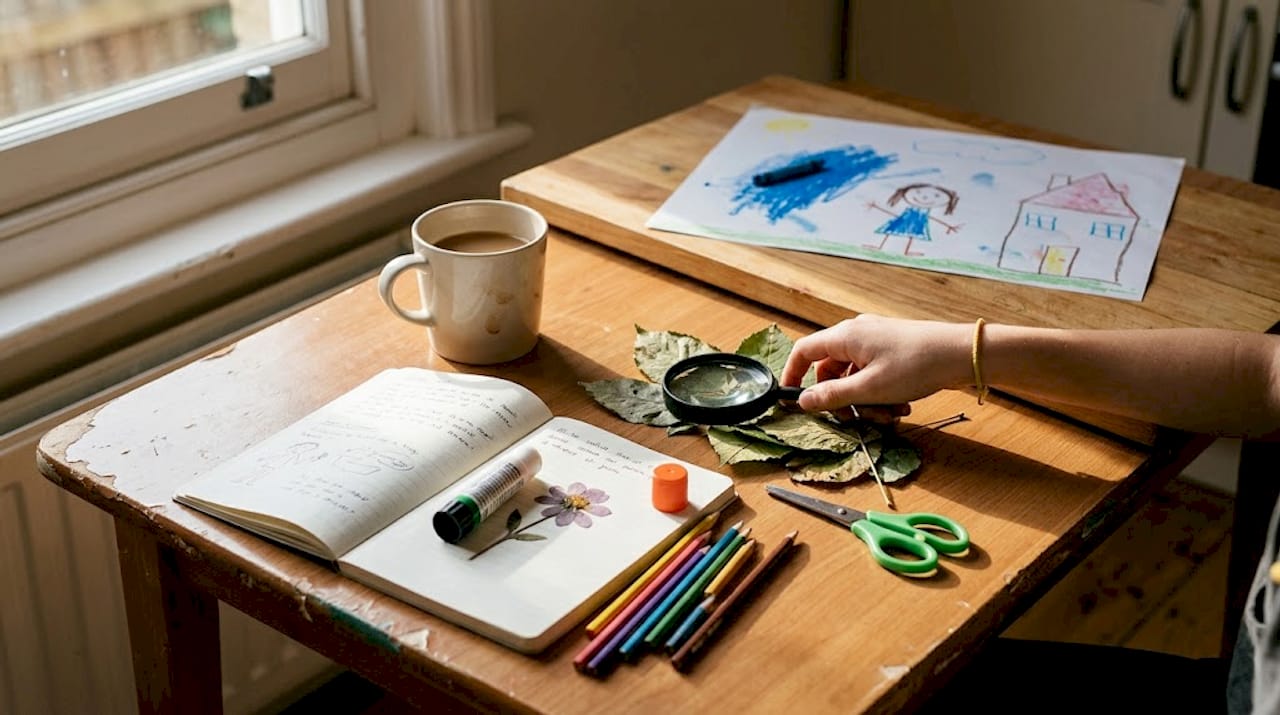
For families who want to go a little further, a few optional extras make the experience richer. A magnifying glass transforms a patch of grass into a miniature world. A local field guide helps children name what they find. A simple kids’ camera lets them photograph what they cannot yet draw. A weather app adds a layer of scientific record-keeping that older children tend to love.
| Material | Essential or optional | Best for age |
|---|---|---|
| Notebook or loose paper | Essential | All ages |
| Pencils and coloured pencils | Essential | All ages |
| Eraser | Essential | All ages |
| Glue and stickers | Optional | Preschoolers |
| Magnifying glass | Optional | 4 and above |
| Field guide | Optional | 6 and above |
| Kids’ camera | Optional | 5 and above |
For preschoolers, larger pages and scrapbooking materials work brilliantly. Starting with one-minute daily entries, using all senses, and adapting for young children with stickers and collage makes the habit feel achievable rather than overwhelming. A leaf rubbing, a torn piece of bark, a pressed daisy. These small acts of collection become treasured records.
Sensory tools add real depth. Sound maps, where children draw a circle and mark where different sounds come from, are a favourite for all ages. Leaf rubbings require nothing more than a pencil and paper placed over a leaf. Both encourage children to slow down and truly notice.
Keep all your supplies in a small outdoor bag so journaling is always ready to go. Spontaneity matters. The best entries often happen unexpectedly, during a school run or a rainy afternoon in the garden. You might also find Earth Day journaling ideas and wildlife garden activities useful for themed sessions that keep things fresh.
Pro Tip: Let your children help choose their own journal and pencil colours. That small act of ownership dramatically increases how much they invest in the habit.
With your materials gathered and excitement building, let’s move into the step-by-step process.
How to start: step-by-step guide for creative eco journaling
Starting is the hardest part, so here is a clear sequence that works for families with children of all ages.
- Set a regular time. Choose a consistent slot, perhaps Sunday mornings, after school on Fridays, or just before dinner. Regularity builds habit faster than intensity. Even fifteen minutes weekly is enough to begin.
- Begin each entry with context. Record the date, time, weather, and location at the top of each page. This simple ritual grounds children in scientific thinking and makes the journal a genuine record over time.
- Use a creative prompt. Prompts remove the blank-page paralysis. Try: Draw something you could hear but not see, or Write three words that describe today’s sky. Using all senses, recording science notes, and employing prompts for creativity keeps entries varied and engaging.
- Engage all the senses. Encourage children to note not just what they see but what they smell, hear, and feel. A pine forest smells entirely different in rain than in sunshine. These details make journals vivid and memorable.
- Reflect together. After each session, share one interesting thing each person noticed. This brief conversation cements the experience and builds family connection around nature.
Age adaptations matter enormously. Preschoolers thrive with glue, stickers, and pressed flowers. Older children can begin tracking wildlife patterns across seasons, noting which birds appear in which months, or how a particular tree changes week by week. European programmes involving woodland and beach walks with creative prompts for ecology awareness show that structured outdoor learning works at every age.
Research suggests that journaling can boost pro-environmental attitudes by up to 40%, a statistic worth pausing on. That is not just a love of nature. That is the foundation of a generation that will care for it. Pair journaling sessions with observation skills activities for children for even stronger results. You can also explore the biodiversity journal project from Lund University, where children and biologists document local species together, a wonderful model for family-led citizen science.
Pro Tip: Take a photo of each completed journal page. If the physical book gets lost or damaged, the digital record remains, and children love scrolling back through their own nature archive.
While getting started is simple, a few common hurdles can pop up. Here is how to keep things on track.
Tips, troubleshooting, and making eco journaling a family habit
The most common reason families stop journaling is overambition at the start. They commit to daily entries, elaborate drawings, and full scientific notes, then feel defeated when life gets in the way. The solution is radical simplicity.
Keep entries short. One to five minutes is enough for young children or busy weeks. A single sentence and a quick sketch count. Short entries, flexibility in bad weather, and shared journals increase how long families stick with the habit.
Rainy days are not rest days. Indoor window observations are entirely valid. Watch raindrops race down the glass. Note which birds visit the garden in wet weather. Observe how the light changes. Urban families can explore nature journaling benefits through parks, balconies, and even houseplants.
Practical tips for building the habit:
- Keep journals visible, not stored away in a drawer
- Link journaling to an existing routine, such as after breakfast or before bed reading
- Celebrate milestones, like a completed journal or a first wildlife sighting
- Try ecological photography for kids as a companion activity for children who prefer images to words
- Rotate who chooses the prompt each week to share creative ownership
Shared family journals, where everyone contributes to the same book, create a powerful sense of collective memory. Looking back at entries from a year ago, noticing how a child’s handwriting changed or how their observations became more detailed, is one of the quiet joys of the practice.
“No academic detriment, only enrichment and maths gains.” Research consistently shows that time spent in nature-based creative activities does not take away from academic performance. It adds to it.
Pro Tip: Support the habit by linking journaling with daily routines like mealtime or bedtime conversation. A simple question, such as What was the most interesting thing you noticed outside today?, keeps nature awareness alive even on days when there is no time to write.
With new habits in place, your family can expect some wonderful results and connections.
Why creative eco journaling is more powerful than you think
Most articles about nature journaling focus on the obvious benefits: fresh air, creativity, science skills. Those are all real. But we think the deeper value is often missed.
Creative eco journaling is one of the few family activities that works on three levels simultaneously. It builds individual skills in children. It creates shared family stories. And it quietly turns children into advocates for the natural world, not because they were told to care, but because they have spent hours genuinely noticing it.
There is a real tension between purely creative approaches, poetry, stories, imaginative play, and structured scientific observation, biodiversity logs, species tracking. Both have value, and eco journaling supports intergenerational nature connectedness while combining creativity with stewardship in a way that neither approach alone achieves.
We believe the process matters far more than the product. A messy journal full of smudged drawings and pressed leaves that fell apart is infinitely more valuable than a pristine notebook that was never used because the pressure to do it perfectly was too great. Families who embrace imperfection tend to journal longer and build stronger connections to the natural world. Explore garden wildlife journaling and the broader National Trust programmes for more inspiration on structured family nature engagement.
Rebalancing family priorities towards nature does not require a dramatic lifestyle change. It requires fifteen minutes, a pencil, and a willingness to look.
Connect your family to nature with The Zoofamily
If this guide has sparked something in your family, we would love to help you keep that momentum going. At The Zoofamily, everything we create is designed to deepen children’s connection to the natural world, from our wildlife-inspired kids’ cameras to the resources we share for families just like yours.
Our blog is full of practical ideas for families ready to explore further. Discover how exploring wildlife gardens can become a journaling adventure in itself, or find Earth Day inspiration for themed sessions that children remember for years. Join a growing community of eco-conscious parents across Europe at The Zoofamily, where every camera sold plants a tree and every idea shared brings families closer to nature.
Frequently asked questions
What is the best age for children to start creative eco journaling?
Children as young as three can begin with adapted activities such as scrapbooking and sticker collage, making eco journaling genuinely accessible for the whole family.
Can eco journaling be done in urban areas or during bad weather?
Absolutely. Creative eco journaling works anywhere, including cities and indoors, by observing from a window or exploring plants and wildlife in local parks.
How does creative eco journaling help children’s development?
It improves observation skills, science thinking, creativity, and wellbeing, while nurturing pro-environmental attitudes that last well into adulthood.
How can I keep my family motivated to journal regularly?
Keep entries short, mix creative and scientific activities, and tie journaling to daily routines for the best consistency over time.
Should we focus more on creative writing or scientific observation?
Both have distinct benefits. Mixing creative and scientific approaches enhances children’s environmental awareness and keeps engagement high across different personality types.
Recommended
- 7 Creative Ideas for Celebrating Earth Day with Kids – The Zoofamily
- Initier à la photographie écologique pour enfants facilement – The Zoofamily
- Créer des souvenirs nature : Renforcer le lien familial – The Zoofamily
- The Power of Writing Your Thoughts Down — The Caia Journal