

Neuroscience in early years is the scientific study of how the brain develops and functions from birth to around age 7, and it is the most evidence-rich guide parents and educators have for shaping lifelong learning. The field draws on tools like fNIRS neuroimaging, executive function research, and guidelines from organisations including the American Academy of Pediatrics (AAP) and Cleveland Clinic to explain why the first years of life are biologically unlike any other. Early brain development is not simply a warm-up for school. It is the foundation on which cognition, behaviour, and emotional wellbeing are built.
What does neuroscience in early years actually reveal?
The core finding of early childhood neuroscience is this: a child’s brain forms around 1,000 trillion synapses by age 3. That figure is not just impressive. It tells you that the brain is doing its most intensive wiring during the years when children are learning to walk, talk, and play. Every interaction, every repeated word, every cuddle is contributing to that wiring process.
Synaptic connections are the communication links between brain cells. The more a connection is used, the stronger it becomes. The ones that go unused are gradually removed in a process called synaptic pruning. This is not a loss. It is the brain becoming more efficient, sharpening the circuits that matter most for the child’s environment and experiences.

Understanding this process changes how you think about early learning. The goal is not to expose children to as many new things as possible. The goal is to provide the right experiences, repeated consistently, so the brain can build and reinforce the pathways it needs.
How does synapse formation and pruning shape learning?
Synaptic connections peak between ages 2 and 5, then decline through pruning as the brain refines its architecture. Researcher Sam Wass notes that young brains excel at pattern learning during this window but can be overwhelmed by complex or rapidly changing inputs. This is why calm, structured environments tend to produce better learning outcomes than chaotic, novelty-heavy ones.
The pruning mechanism follows a clear principle. Unused connections are removed from infancy through the teenage years in a “use it or lose it” pattern, while frequently activated pathways grow stronger. The Cleveland Clinic confirms that repeated, supportive experiences are what drive this strengthening. A child who hears the same story read aloud ten times is not being under-stimulated. Their brain is consolidating a pathway.
Key facts about synapse formation and pruning:
- Synaptic density peaks around age 3, earlier than most parents expect
- Pruning begins in infancy and continues well into adolescence
- Frequently used neural pathways become faster and more reliable over time
- Overstimulation during peak connectivity can hinder rather than help learning
- Emotional safety during learning experiences supports more effective pruning
Pro Tip: Repetition is not boring for a young brain. Revisiting the same books, songs, and games multiple times gives the brain the repeated activation it needs to build strong, lasting pathways.
How do executive functions develop in the first three years?
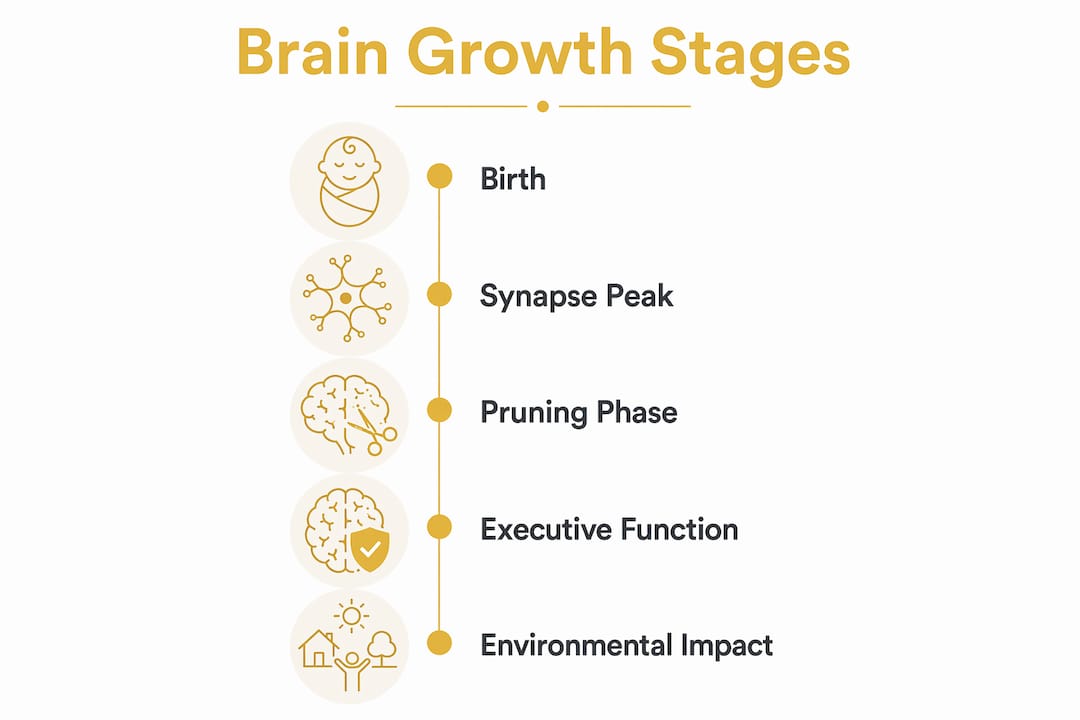
Executive functions are the mental skills that allow children to control their attention, manage impulses, hold information in mind, and shift between tasks. They are the cognitive tools behind self-regulation, and they begin developing within the first 36 months of life. A 2026 Frontiers mini-review confirms that neuroimaging shows clear shifts in frontal and parietal cortex activation linked to inhibitory control and cognitive flexibility during toddlerhood.
The brain regions most involved include the dorsolateral prefrontal cortex (DLPFC) and the orbitofrontal cortex. These areas mature gradually, which is why a three-year-old cannot reliably resist grabbing a biscuit even when asked to wait. The behaviour is not defiance. It is neurobiology.
One of the most practically useful findings from this research is that outward behaviour can appear stable even when the underlying brain circuitry is still reorganising significantly. A child who seems to have mastered turn-taking may still be building the neural architecture that makes that skill reliable under stress. This means educators and parents should not assume a skill is fully consolidated just because it appears in easy conditions.
fNIRS neuroimaging, a portable and non-invasive brain imaging technique, has made it possible to study brain function in infants and toddlers in natural settings rather than clinical labs. This has dramatically improved the quality of evidence available for early childhood neuroscience, giving researchers a clearer picture of how the frontal and parietal networks mature in real time.
Pro Tip: Activities that combine attention, emotional regulation, and turn-taking simultaneously, such as simple board games or group storytelling, are especially effective because they engage multiple developing brain networks at once.
What environmental factors shape brain growth in early childhood?
The brain does not develop in isolation. Physical growth, caregiver responsiveness, sleep quality, and digital exposure all influence the trajectory of early brain development in measurable ways.
A longitudinal study published in eLife found that early physical growth before 5 months predicts optimal brain connectivity and later cognitive flexibility in preschoolers. The research, conducted with Gambian infants, demonstrates that nutritional adequacy in the earliest months has direct consequences for how well brain networks connect and function years later.
Caregiver interaction is equally powerful. Emotional responsiveness from a parent or carer, particularly in the window between 2 and 6 months, shapes the neural circuits that govern stress regulation and social cognition. A calm, attuned adult is not just comforting. They are actively participating in brain architecture.
Sleep is another non-negotiable factor. Disrupted sleep interferes with synaptic pruning and memory consolidation, undercutting the cognitive gains made during waking hours. Consistent sleep routines are not a lifestyle preference. They are a biological requirement for healthy brain development.
On screen time, the AAP’s 2026 guidance moves away from strict time limits and towards quality and context. Heavy solo screen use in children aged 0 to 5 is linked to delays in language, cognition, and social skills. But co-viewing with an engaged adult, or using media as a springboard for conversation, changes the outcome significantly. The screen is not the problem. Passive, unmediated use is.
Recommended environmental supports for healthy brain development:
- Consistent daily routines that reduce uncertainty and cognitive load
- Warm, responsive caregiving that models emotional regulation
- Regular outdoor play and physical activity to support motor and cognitive networks
- Shared reading and conversation to build language circuits
- Adequate, predictable sleep schedules
- Supervised, interactive media use rather than solo screen time
Pro Tip: Nature-based play, such as exploring with kids’ binoculars or cameras outdoors, engages multiple sensory systems simultaneously and supports the kind of rich, repeated experience that strengthens neural pathways.
How can parents and educators apply neuroscience to daily practice?
Translating the impact of neuroscience on learning into everyday practice does not require specialist training. It requires understanding a few core principles and applying them consistently.
The most important principle is this: repeated, supportive learning experiences build stronger brain pathways than novelty-heavy, one-off activities. A child who practises counting objects every morning builds a more reliable numerical circuit than one who encounters counting in a single elaborate activity once a month.
Novelty-heavy vs repetition-based approaches
| Approach | What it looks like | Brain outcome |
|---|---|---|
| Novelty-heavy | New activity each session, varied stimuli, high excitement | Broad but shallow activation; risk of overload |
| Repetition-based | Same songs, routines, and games revisited regularly | Stronger pruning and pathway consolidation |
| Scaffolded repetition | Familiar structure with gradually increasing challenge | Optimal: builds on existing circuits while extending them |
The table above shows that scaffolded repetition, familiar structure with gradually increasing challenge, produces the best outcomes. This mirrors how evidence-based early learning programmes are designed: many low-threat practice opportunities rather than occasional high-stimulation events.
Five practical steps for applying neuroscience principles at home or in the classroom:
- Build predictable daily routines so children’s brains can allocate attention to learning rather than managing uncertainty.
- Slow down your speech and emotional responses when a child is upset. Young brains tune to adult rhythms, and a calmer adult helps regulate a child’s stress response.
- Offer the same activity multiple times before moving on. Mastery, not variety, is the goal in early years cognitive development.
- Create low-threat environments where mistakes are expected and welcomed. The brain learns most efficiently when the threat response is not activated.
- Combine cognitive demands in play. Games that require waiting, remembering rules, and responding to others build executive function networks more effectively than single-skill drills.
For further reading on how these principles connect to childhood brain development, Thezoofamily’s guide for parents offers a practical companion to the research covered here.
Key takeaways
The single most important insight from early childhood neuroscience is that repetition, emotional safety, and consistent caregiving build stronger brains than stimulation alone.
| Point | Details |
|---|---|
| Synapses peak at age 3 | The brain forms around 1,000 trillion synapses by age 3, making early experiences uniquely powerful. |
| Pruning rewards repetition | Frequently used pathways strengthen; unused ones are removed. Repeated, calm experiences matter most. |
| Executive functions start early | Inhibitory control and working memory begin developing within the first 36 months, shaped by frontal cortex maturation. |
| Environment shapes the brain | Sleep, nutrition, caregiver responsiveness, and screen context all directly influence brain connectivity. |
| Scaffolded repetition wins | Familiar routines with gradual challenge produce better learning outcomes than novelty-heavy approaches. |
Why I think we’ve been overcomplicating early years learning
Parents and educators are bombarded with products, programmes, and advice promising to give children a cognitive edge. Most of it misreads the neuroscience. The research does not say “expose children to more.” It says “expose children to the right things, repeatedly, in a safe and responsive environment.”
The most counterintuitive finding I keep returning to is this: a child who seems to have mastered a skill behaviourally may still be building the neural architecture that makes that skill reliable under pressure. That means our job is not to move on the moment a child succeeds once. It is to keep providing the conditions for that circuit to consolidate.
Sleep and stress regulation are the two most underrated factors in early brain development. No enrichment activity compensates for a child who is chronically under-slept or living in an unpredictable emotional environment. These are not soft considerations. They are the biological platform on which everything else depends.
The most useful shift any parent or educator can make is to stop asking “am I doing enough?” and start asking “am I being consistent enough?” The brain responds to patterns, not performances.
— ALAIN
Support your child’s brain development with Thezoofamily

At Thezoofamily, we believe the best learning happens when children are curious, active, and connected to the world around them. Our range of kids’ cameras, walkie-talkies, and binoculars is designed to put rich, sensory, and repeated experiences into children’s hands outdoors, exactly the kind of engagement that neuroscience supports. Every camera sold plants a tree, because we want the natural world to remain a place worth exploring for generations to come. Visit Thezoofamily to explore our resources, guides, and tools for parents and educators who want to give children the best possible start.
FAQ
What is neuroscience in early years?
Neuroscience in early years is the study of how the brain develops and functions from birth to around age 7. It examines processes like synapse formation, pruning, and executive function maturation to inform effective caregiving and education.
How many synapses does a child’s brain have at age 3?
A child’s brain forms around 1,000 trillion synapses by age 3, representing the peak of synaptic density. After this point, pruning refines the brain’s architecture based on which connections are used most.
When do executive functions begin to develop?
Executive functions, including inhibitory control and working memory, begin emerging within the first 36 months. The frontal and parietal cortex regions responsible for these skills continue maturing well beyond early childhood.
Is screen time harmful to young children’s brain development?
Heavy solo screen use in children aged 0 to 5 is linked to delays in language, cognition, and social development, according to AAP 2026 guidance. Co-viewing with an engaged adult and using media interactively significantly reduces these risks.
Does repetition really help young children learn better than new activities?
Yes. Repeated supportive experiences strengthen neural pathways more effectively than one-off novel activities. The brain’s pruning process rewards consistency, making familiar routines with gradual challenge the most effective approach for early years learning.