

Hands-on learning in early childhood is defined as any experience where children actively manipulate materials, test ideas, and construct understanding through direct physical engagement rather than passive instruction. A review of 51 peer-reviewed studies spanning multiple continents confirms that play-based and hands-on approaches consistently improve cognitive, academic, and socio-emotional development in children aged 4–6. The evidence is no longer ambiguous. Active, physical learning is not a supplement to early education. It is the foundation. Parents and educators who understand the importance of hands-on learning in early childhood give children a measurable advantage in thinking, creativity, and resilience that passive methods simply cannot replicate.
What are the key benefits of hands-on learning for young children?
Hands-on learning builds critical thinking by forcing children to solve real problems with real consequences. When a child stacks blocks and the tower falls, they do not need a teacher to explain gravity. They test, adjust, and try again. That cycle of trial and reflection is exactly how deep understanding forms.
Developmental psychologist Dr Kathy Hirsh-Pasek argues that active playful learning develops essential future skills including critical thinking, creative innovation, and collaborative communication in ways that rote learning cannot. These are not soft skills. They are the competencies that employers, universities, and communities will demand from the next generation.
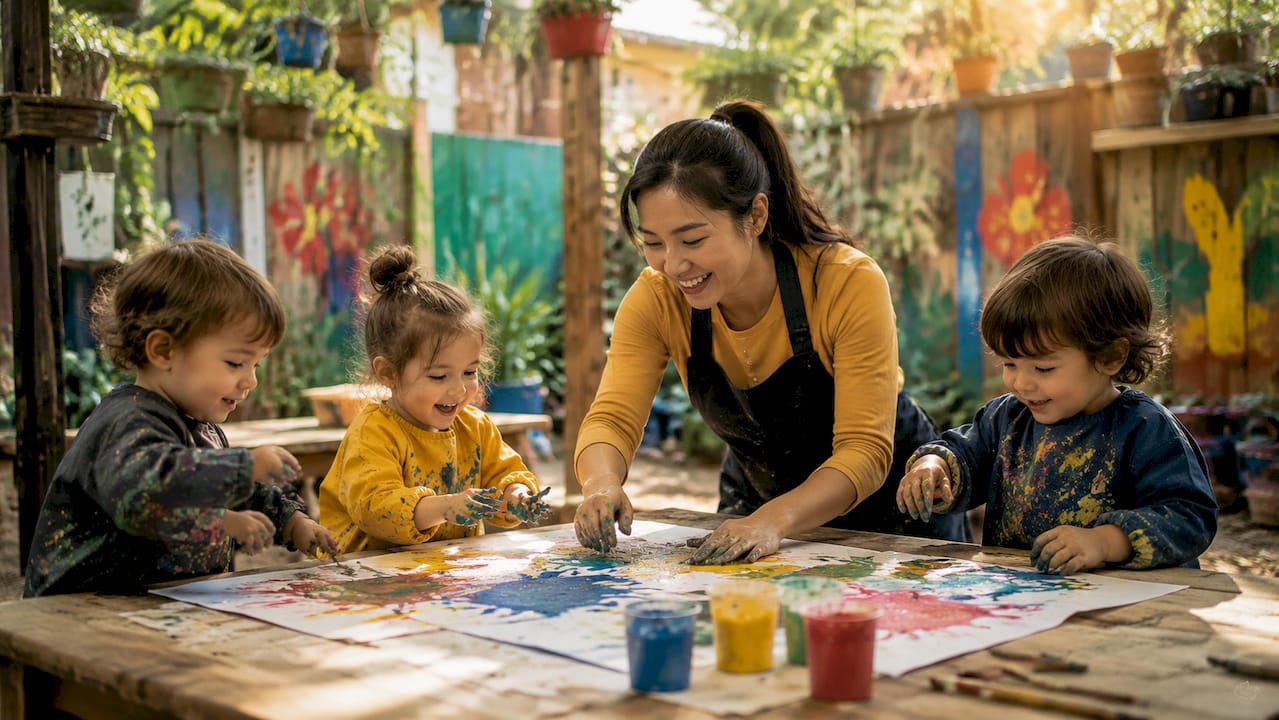
Creativity also grows faster through physical, open-ended play than through worksheets or screen-based activities. Children who build, paint, sort, and construct are constantly making decisions. Each decision strengthens neural pathways linked to planning and evaluation.
Professor Paul Ramchandani’s research shows that learning is deepest when children find the experience joyful. Joy extends engagement and improves retention. That finding matters enormously for parents and educators who worry that play is somehow less serious than structured lessons.
- Critical thinking: Children who sort, build, and experiment practise hypothesis testing without knowing it.
- Literacy and numeracy: Hands-on activities involving counting objects, reading labels, or writing labels on drawings embed early literacy and maths skills in context.
- STEM foundations: Pouring water, measuring sand, and observing insects all build the observational habits that underpin science.
- Social skills: Collaborative play teaches negotiation, turn-taking, and empathy far more effectively than role-play scripts.
“Play is the work of childhood.” This phrase, widely attributed to Jean Piaget, captures what decades of research now confirm: children are not wasting time when they play. They are doing the most important cognitive work of their lives.
Pro Tip: When a child finishes a hands-on activity, ask one open question such as “What surprised you?” rather than “Did you enjoy it?” That single question shifts the child from doing to understanding.
How does guided play compare with free play in hands-on learning?
Guided play and free play are not opposites. They sit on a spectrum, and the most effective early years settings use both deliberately. Free play gives children full autonomy over materials, time, and direction. Guided play introduces a learning goal while preserving the child’s sense of choice and joy.
An analysis of 39 studies by the PEDAL Centre at the University of Cambridge found that guided play is as effective as conventional teaching for literacy and numeracy, and superior for specific mathematical concepts in children aged 3–8. That result challenges the assumption that structured lessons are the gold standard for early skill acquisition.
The adult’s role in guided play is subtle but critical. A parent or educator sets up an environment or poses a question, then steps back and observes. They intervene only to extend thinking, not to correct or direct. This approach preserves the autonomy that makes play motivating while steering children toward specific learning outcomes.
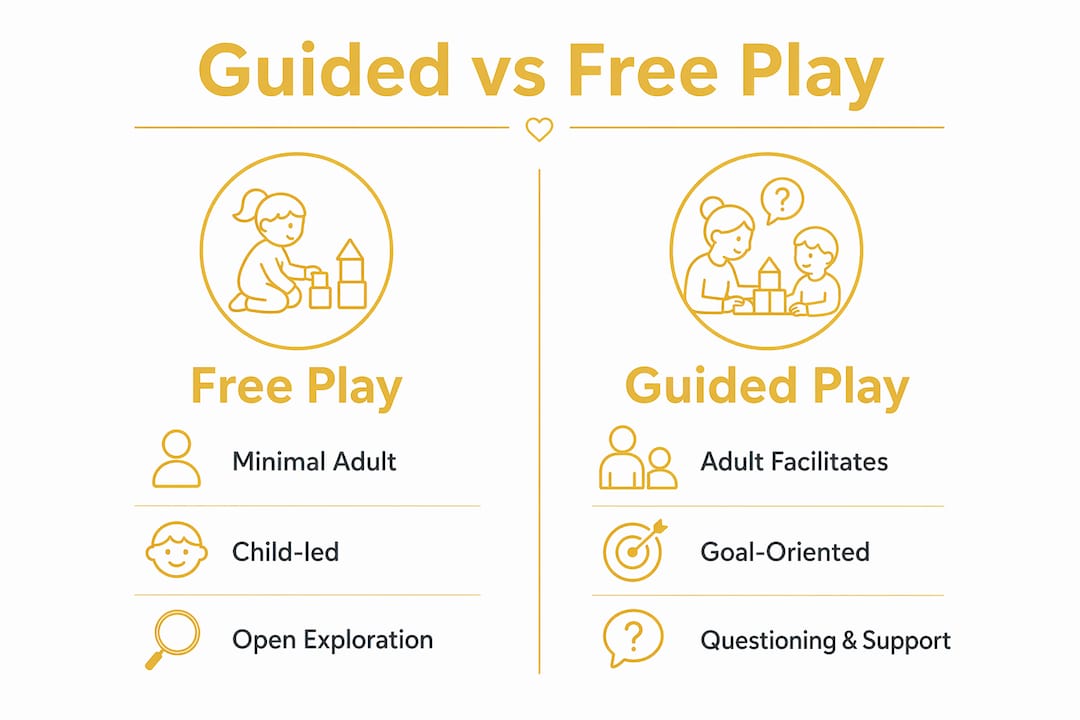
Pro Tip: Try “wondering aloud” during guided play. Say “I wonder what would happen if we added more water” rather than telling the child what to do. This keeps the child in control while nudging their thinking forward.
| Feature | Free play | Guided play |
|---|---|---|
| Adult involvement | Minimal or absent | Present but facilitative |
| Child autonomy | Full | High, within a loose framework |
| Learning goal | Emergent | Intentional but child-led |
| Best for | Creativity, social skills | Literacy, numeracy, STEM concepts |
| Risk of disengagement | Low | Low when done well |
Shifting from traditional instruction to guided play requires a mental change in educators. Many trained in didactic methods find it uncomfortable to step back. The evidence, however, is clear: children acquire concepts more deeply when they feel ownership over the process.
Why do open-ended objects beat prescriptive toys for early learning?
Children engage significantly longer in STEM-related behaviours when playing with open-ended, non-prescriptive objects compared to structured toys. The research is specific: cardboard boxes, fabric scraps, tubes, and simple containers outperform branded STEM kits with fixed instructions. The reason is straightforward. Versatile objects demand more from the child’s brain.
When a toy has one correct use, the child masters it quickly and moves on. When a cardboard box can be a house, a boat, a tunnel, or a rocket, the child must plan, test, and evaluate continuously. Those three behaviours, planning, testing, and evaluation, are the cognitive building blocks of scientific thinking.
Parents and educators should favour open-ended materials because everyday objects encourage complex planning and STEM-related behaviours far more effectively than toys marketed specifically for STEM learning. The marketing label does not predict the learning outcome. The object’s versatility does.
Here are four categories of open-ended materials that work particularly well for children aged 3–7:
- Natural materials: Sticks, stones, leaves, and pinecones invite sorting, counting, building, and storytelling. They connect children to the natural world at the same time.
- Household containers: Pots, bowls, tubes, and bottles support pouring, measuring, and construction without any instructions.
- Fabric and textiles: Scarves, old sheets, and ribbons become costumes, maps, rivers, and walls. They stretch imaginative play further than most purpose-built toys.
- Cardboard and paper: Boxes and tubes are the most versatile materials available in any home. Children use them to build, draw, cut, and construct across every developmental domain.
| Material type | STEM behaviour supported | Estimated engagement level |
|---|---|---|
| Cardboard boxes | Planning, construction, spatial reasoning | Very high |
| Natural objects | Sorting, classification, observation | High |
| Fabric and textiles | Imaginative play, problem-solving | High |
| Branded STEM kits | Following instructions, fine motor skills | Moderate |
| Single-function toys | Specific skill practice | Lower over time |
The adult’s response during this kind of play deepens the learning further. Asking a child to explain what they built, or why they chose a particular material, transforms hands-on activities into genuine cognitive growth. Reflection is what shifts a child from simply doing to truly understanding.
How can parents and educators implement hands-on learning effectively?
Effective implementation starts with observation, not planning. Edutopia’s guidance on exploration-based learning is clear: adults who slow down, watch what genuinely captures a child’s attention, and build from there create far richer learning experiences than those who arrive with a predetermined activity. A child obsessed with snails this week is ready to learn about habitats, lifecycles, and ecosystems. That interest is the curriculum.
Balancing structure and freedom is the practical challenge most parents and educators face. Too much structure kills curiosity. Too little structure leaves some children adrift. The solution is to prepare the environment richly and then follow the child’s lead within it.
- Prepare the space, not the script: Set out interesting materials and let children choose how to engage. Rotate materials weekly to maintain novelty.
- Follow the child’s interest: If a child is fascinated by birds, build activities around bird watching, feather sorting, and nest building rather than switching to a planned topic.
- Use nature as a classroom: Gardens, parks, and even windowsills offer daily opportunities for observation, comparison, and discovery. Hands-on nature connections are among the most powerful early learning experiences available.
- Avoid over-reliance on expensive toys: The research is consistent. A cardboard box and a curious adult beat a £50 kit every time.
- Ask open questions: “What do you think will happen?” and “How did you do that?” extend thinking without directing it.
Pro Tip: Keep a simple notebook to jot down what captures your child’s attention during free play. Those notes become your planning tool for the following week’s guided activities.
Thezoofamily’s approach to creative play for children reflects this philosophy directly. Products designed around animal references and nature connections give children a concrete, tactile entry point into the natural world, which is one of the richest contexts for experiential learning available to young children.
Key takeaways
Hands-on learning in early childhood builds deeper cognitive, social, and academic skills than passive instruction, and guided play with open-ended materials is the most effective delivery method available to parents and educators.
| Point | Details |
|---|---|
| Play-based learning works | A review of 51 studies confirms hands-on approaches improve cognitive and academic outcomes in children aged 4–6. |
| Guided play outperforms direct teaching | Cambridge PEDAL Centre research shows guided play matches or exceeds conventional teaching for literacy and maths. |
| Open-ended objects beat branded toys | Cardboard, fabric, and natural materials produce longer engagement and richer STEM behaviours than prescriptive kits. |
| Joy drives retention | Professor Paul Ramchandani’s research confirms that joyful experiences extend engagement and deepen learning. |
| Observation is the starting point | Adults who follow a child’s genuine interests create more effective learning experiences than those who impose predetermined activities. |
What I have learned from watching children actually play
The most striking thing I have observed over years of watching children learn is how rarely they need adults to teach them. They need adults to notice them. A child who spends forty minutes rearranging stones by size is not wasting time. That child is classifying, comparing, and building the mental structures that will later support mathematics. The adult who interrupts to suggest a “better” activity has just ended a lesson.
The common misconception I encounter most often is that hands-on learning means messy, unstructured chaos. It does not. The most effective sessions I have seen are calm, purposeful, and deeply focused. The child is working. The adult is watching, occasionally wondering aloud, and resisting the urge to take over.
What genuinely surprises parents is how little equipment this requires. The children I have seen most engaged were playing with water, sticks, and old containers. The children I have seen least engaged were sitting in front of expensive, single-function toys that left nothing to the imagination. That gap between expectation and reality is where most of the work for parents and educators lies.
Trust the child. Prepare the environment. Ask one good question. That is the entire method, and the research backs every part of it.
— ALAIN
Thezoofamily and hands-on learning for curious young minds
Thezoofamily builds products that put children in direct contact with the natural world, because that contact is where the richest early learning happens. A child using a Thezoofamily camera to photograph insects in the garden is observing, comparing, and documenting. A child using binoculars to watch birds is developing attention, patience, and scientific curiosity.
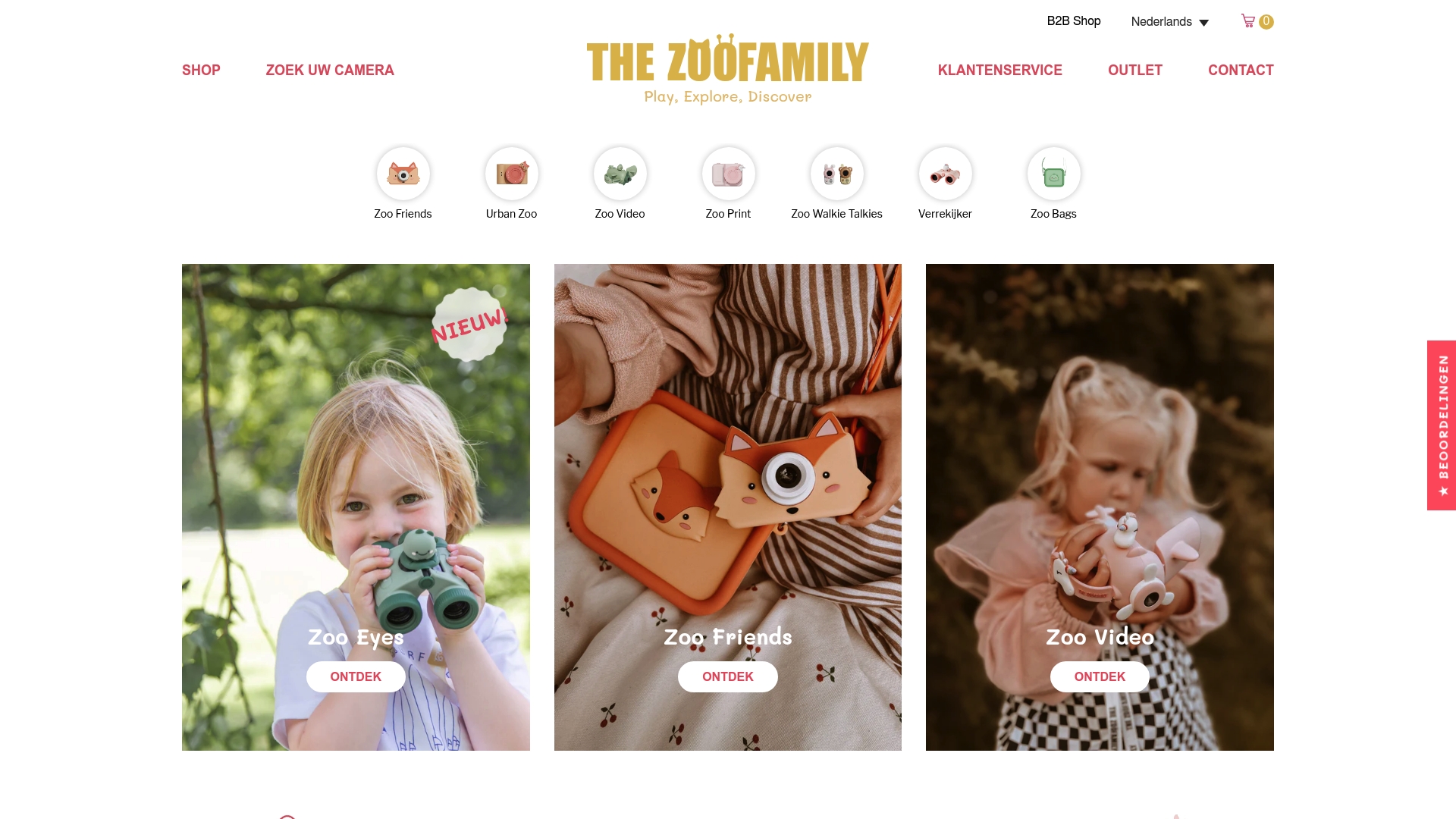
Thezoofamily’s blog offers a growing collection of engaging activities for kids that connect hands-on play to nature, animals, and the outdoors. Every product sold plants one tree, so the learning extends beyond the child’s immediate world into a genuine contribution to the planet they are learning about. Parents and educators looking for activity ideas grounded in experiential learning will find practical, nature-connected inspiration across the Thezoofamily site.
FAQ
What is hands-on learning in early childhood?
Hands-on learning is any experience where children actively manipulate materials and test ideas through direct physical engagement. It includes building, sorting, pouring, observing, and constructing rather than listening or watching passively.
How does hands-on learning help children develop?
A review of 51 studies confirms that play-based approaches improve cognitive, academic, and socio-emotional development in children aged 4–6. Children build critical thinking, creativity, and communication skills through active, physical experience.
Is guided play better than free play?
Guided play is as effective as conventional teaching for literacy and numeracy, and superior for specific mathematical concepts. Free play builds creativity and social skills. Both have a place in a balanced early years programme.
Do children need expensive toys for hands-on learning?
No. Research shows children engage longer and display richer STEM behaviours with open-ended everyday objects such as cardboard, fabric, and natural materials than with branded, single-function toys.
How can parents support hands-on learning at home?
Parents should observe what genuinely interests their child, prepare an environment with open-ended materials, and ask open questions rather than directing play. Following the child’s curiosity is more effective than imposing a predetermined activity plan.