

Motor development activities are purposeful physical and tactile exercises that build children’s gross and fine motor skills, which are the foundation for coordination, independence, and learning readiness. Motor skills divide into two categories: gross motor skills, which use large muscle groups like the legs, arms, and core, and fine motor skills, which target the small muscles of the hands and fingers. Both matter equally, and the good news is that the most effective activities cost almost nothing. Everyday play, household tasks, and outdoor exploration are all you need to give your child a strong physical foundation.
What are effective activities for motor development in young children?
Fine motor skill development is the process of training the small muscles of the hands and fingers to perform precise, controlled movements. Just 10 minutes of varied daily tactile practice builds hand strength and coordination in children aged 3–4. That is a remarkably low time investment for a skill that affects everything from holding a pencil to fastening a coat.
The most productive fine motor exercises mimic real tasks. Using tongs, opening containers, and cutting are highly effective because they require grip strength, hand-eye coordination, and sustained concentration. Clothespins, dried pasta, and small containers from your kitchen cupboard are all you need. Resistance-based activities like playdough, tweezing small objects, and tearing paper build the pincer grasp that children need for writing and self-care.
Here are the most effective fine motor activities and what each one targets:
- Playdough rolling and squeezing — builds overall hand strength and bilateral coordination
- Tong transfers (moving small objects from one bowl to another) — develops pincer grasp and hand-eye coordination
- Cutting with child scissors — trains hand control and bilateral coordination
- Threading beads or pasta — sharpens concentration and finger precision
- Peeling stickers or fruit — practises the pincer grip in a low-pressure context
- Vertical surface drawing (on a wall-mounted paper or easel) — improves shoulder engagement and pencil control more than drawing on a flat table
Pro Tip: Set up a small activity tray each morning with two or three items from the list above. Rotating the options keeps your child interested and covers different skill areas across the week.
For parents looking for a deeper breakdown of how these skills progress, the fine motor skills guide from Thezoofamily covers the key stages clearly.
How do gross motor activities support coordination and physical growth?
Gross motor skills involve the large muscle groups: legs, arms, core, and back. Running, climbing, jumping, and balance exercises build physical health, spatial awareness, and the neurological foundations for learning. Strong gross motor skills also prepare children for the seated concentration that school demands.

Active outdoor play on varied natural surfaces develops balance, stability, and locomotor skills that flat indoor floors simply cannot replicate. Grass, trails, and uneven ground challenge the core and improve proprioception, which is the body’s sense of where it is in space. A walk through a local park or woodland does more for a child’s physical development than most structured gym sessions.
Practical gross motor play ideas for home and outdoors include:
- Obstacle courses using cushions, garden furniture, and chalk lines on the pavement
- Hopscotch and jumping games for leg strength and spatial awareness
- Catching and throwing with soft balls of different sizes
- Balancing on a low wall or beam to build core stability
- Cycling or scooting for coordination and lower-body strength
- Climbing frames or trees for upper-body strength and spatial confidence
Parents can also explore outdoor child development ideas from Thezoofamily for age-appropriate suggestions that combine movement with nature connection. For families interested in active outdoor vehicles, outdoor play for kids offers useful context on how physical play supports large-muscle development.
How can parents integrate motor skill practice into daily routines?
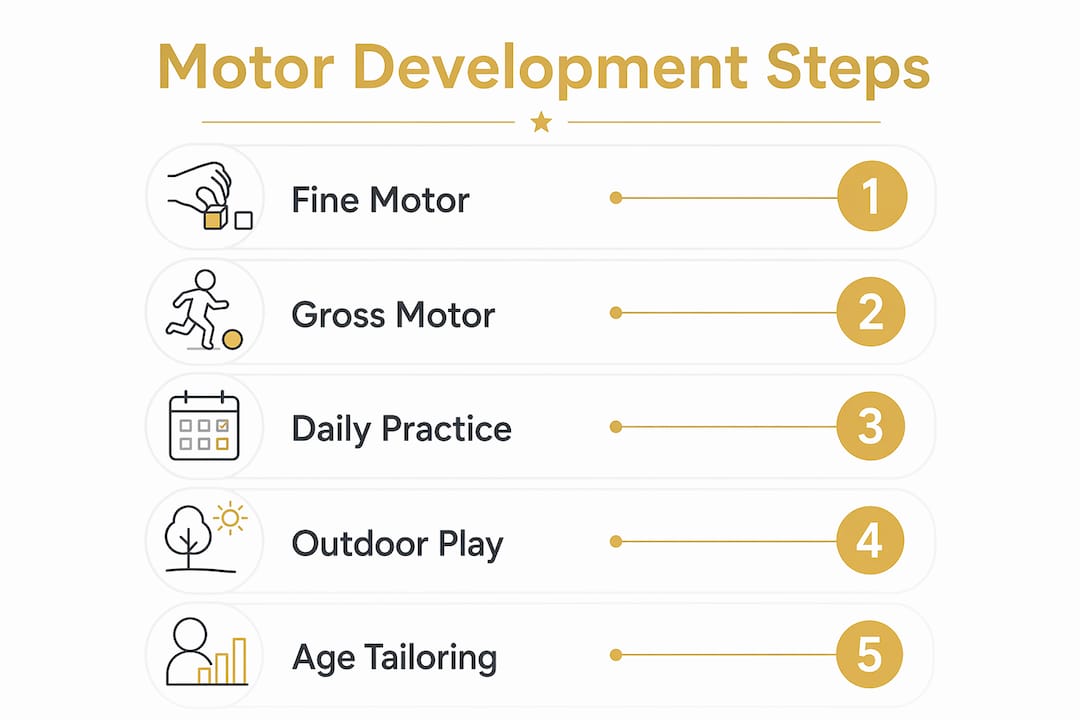
The most effective approach to motor skill development is not a dedicated session. It is woven into the ordinary rhythm of the day. Involving children in household chores builds meaningful motor strength and independence more effectively than specialised toys. Peeling fruit, folding socks, and stirring batter all require the same grip and coordination skills that formal activities target.
A simple daily structure works better than sporadic intensive sessions. Here is a practical framework:
- Morning: One fine motor activity tray (playdough, threading, or tong transfers) for 10 minutes before or after breakfast.
- Mid-morning: Outdoor gross motor play, even 20 minutes in the garden or on the way to the shops.
- Afternoon: Involve your child in a household task: washing vegetables, sorting laundry, or setting the table.
- Evening: A low-energy fine motor activity like colouring, sticker books, or simple puzzles before bed.
Reducing screen time in favour of tactile, hands-on activities for kids makes a measurable difference. Screen use involves swiping but does not develop the complex hand-muscle strength required for daily living skills. Replacing 20 minutes of screen time with playdough or tong play each day adds up to significant skill gains across a term.
Pro Tip: Prepare the environment rather than directing the activity. Set out the materials, step back, and let your child lead. Child-led practice builds confidence alongside physical skill.
What are common misconceptions about motor development activities?
The biggest misconception is that screen time counts as finger exercise. Swiping a tablet screen requires almost no muscular effort and provides no tactile resistance. Fine motor skills require physical resistance and tactile feedback to develop lasting hand strength. A touchscreen provides neither.
A second misconception is that fine motor skills develop independently of the rest of the body. Fine motor development depends on proximal stability. Core and shoulder strength directly influence how well a child controls their hands. A child who struggles to hold a pencil may simply need more gross motor activity to build the trunk stability that supports hand precision.
| Effective practice | Less effective practice |
|---|---|
| Playdough, tongs, cutting | Swiping on a touchscreen |
| Outdoor climbing and balancing | Sitting in a pushchair for long periods |
| Household chores with real tools | Specialised toy sets with limited resistance |
| Vertical surface drawing | Horizontal colouring only |
| Child-led tactile exploration | Adult-directed worksheets |
“Parents often overcomplicate motor activities. Natural play and chores yield better engagement and skill retention than expensive specialist equipment.”
The third myth is that you need specialist equipment or a formal programme. Simple household activities outperform specialised toys for building meaningful motor skills and self-reliance. A wooden spoon, a bowl of dried lentils, and a pair of tongs will do more than most commercial activity kits.
How to tailor motor activities to different ages and stages
Children aged 2–6 span a wide range of physical ability. Matching the activity to the developmental stage keeps children engaged and avoids frustration.
| Age | Gross motor focus | Fine motor focus |
|---|---|---|
| 2–3 years | Running, kicking, climbing low structures | Stacking blocks, tearing paper, large crayons |
| 3–4 years | Jumping, hopping, throwing and catching | Playdough, tong transfers, threading large beads |
| 4–5 years | Balancing, skipping, obstacle courses | Cutting with scissors, buttoning, drawing shapes |
| 5–6 years | Cycling, climbing, ball games | Writing letters, small bead threading, folding paper |
Playing catch, colouring, cooking, and cycling all count as motor skill development opportunities when parents join in. Your involvement signals that the activity matters, which increases a child’s motivation and persistence. Observe what your child finds easy and what causes frustration, then adjust the difficulty by one small step at a time.
For fine motor activities for 4 year olds specifically, the shift from large-grip tools to smaller ones is the key progression. Move from chunky crayons to standard pencils, from large beads to smaller ones, and from tearing paper to cutting straight lines. Each small step builds the hand control that writing and self-care require. The practical guide for parents from Thezoofamily covers these progressions in detail.
Key takeaways
The most effective activities for motor development are simple, daily, and drawn from ordinary life rather than specialist equipment or structured programmes.
| Point | Details |
|---|---|
| Fine motor needs daily practice | Just 10 minutes of tactile activity each day builds hand strength in children aged 3–4. |
| Gross motor underpins fine motor | Core and shoulder strength directly support hand control, so outdoor play matters for writing readiness. |
| Screen time does not count | Swiping lacks the physical resistance needed for lasting hand-muscle development. |
| Household chores are activities | Peeling, folding, and stirring build the same grip and coordination skills as formal activities. |
| Match activities to age | Adjust tool size, task complexity, and physical challenge as your child progresses through ages 2–6. |
Why I think parents are getting motor development backwards
Most parents I speak with focus heavily on fine motor activities, buying activity kits and workbooks, while letting gross motor development happen by accident. That is the wrong order. Core and shoulder stability come first. A child who cannot hold their trunk upright at a table will struggle to control a pencil, regardless of how many threading activities they complete.
The other thing I have noticed is that parents underestimate the power of boredom. When a child has nothing to do, they pick things up, pull them apart, stack them, and carry them. Every one of those actions is a motor skill activity. The moment you hand them a screen, that spontaneous physical exploration stops. The research backs this up: motor development builds independence and confidence, and success in everyday tasks motivates children to keep practising.
My honest advice is to stop buying things and start doing things. Cook with your child. Let them carry the shopping. Give them a pair of tongs and a bowl of grapes. Go outside and find uneven ground to walk on. The activities that build the strongest motor skills are the ones that look the least like activities.
— ALAIN
Thezoofamily resources for active, curious children
Thezoofamily creates tools that get children moving, observing, and connecting with the world around them. From kids’ cameras that encourage outdoor exploration to walkie-talkies that turn a garden into an adventure, every product is designed to replace passive screen time with active, hands-on play.

Physical play and nature connection go hand in hand at Thezoofamily. The brand’s blogs offer practical, parent-tested advice on child development, outdoor activities, and building independence through play. Visit Thezoofamily to find activity ideas, development guides, and products that make getting outside easy and genuinely exciting for children aged 3 and up.
FAQ
What are the best activities for motor development at home?
Playdough, tong transfers, cutting with child scissors, and obstacle courses are among the most effective home-based activities. They require no specialist equipment and target both fine and gross motor skills.
How much time should children spend on motor skill activities each day?
Ten minutes of varied tactile practice daily is sufficient for fine motor development in children aged 3–4. Gross motor play should ideally total at least 60 minutes across the day, spread through outdoor and active indoor play.
Does screen time help with fine motor skills?
Screen use does not develop fine motor skills. Swiping lacks the resistance and tactile feedback required for lasting hand-muscle strength, making it a poor substitute for hands-on tactile activities.
What fine motor activities suit 4 year olds specifically?
Four year olds benefit most from cutting straight lines with scissors, threading medium-sized beads, buttoning clothing, and drawing on vertical surfaces. These activities build the hand control and shoulder stability needed for school readiness.
When should parents be concerned about motor development delays?
If a child aged 4–5 struggles consistently with tasks like holding a crayon, climbing stairs, or dressing independently, speaking with a paediatric occupational therapist is a sensible next step. Early support makes a significant difference to long-term outcomes.